Archive
Buckshot
Welcome my son, welcome to the machine – Pink Floyd
Is your borg structured like the impending disaster depicted below? Since it’s so ubiquitous, publicly unquestioned, and taken for granted as a “best practice“, the odds are that it is. Note that the products are second class citizens at the bottom of the chart (if they’re even shown at all) and the people supposedly responsible for product integrity are blasted like buckshot across the DYSCO.
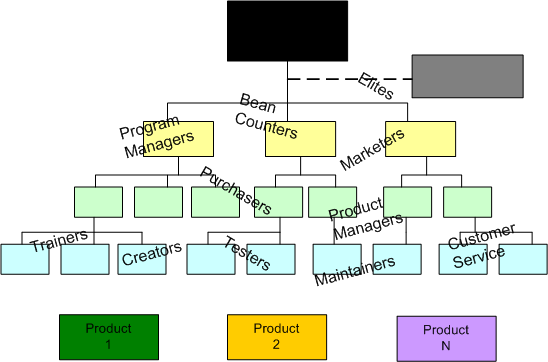
When a self-important SCOL, BOOGL, BUTT, CORKA, or BM is asked to sketch out a model of their beloved borg, you’ll likely get a cookie cutter picture just like it – yawn. In their brainwashed minds, what’s important is who reports to who and who (not what) funds their livelihood. Everybody, including the DICforce, is primarily concerned about who is above and below them in the pecking order. Despite what is espoused, everything else is secondary – especially the real stars in the borg – the product portfolio.
The figure below shows an alternative, flattened, product-centric arrangement highlighted with cross-learning links and dynamic job rotations. How many of these weird animals have you seen? Why not? Is it possible to transform the soulless, stationary borg above into the vibrating pancake below? What would it take? Who could do it? Should it be done?

Over The Wall
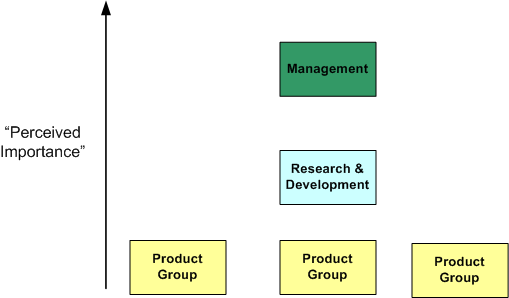
The figure below shows the perceived relative importance of groups in a typical corpricracy. The DICs, because they do the nasty stuff called work, are on the bottom. The R&D staff, because they are academically smarter than the DICsters, are next in line. Management, because….. they are managers, are of the utmost importance. Because of language differences and the entrenched graded scale of importance, there are huge communication gaps between the players in the “system“.
Now that the context has been established, let’s look at the dynamic interactions that take place (if they even do take place) between the R&D and product groups. On the left of the latest dorky Bulldozer00 figure below, we have the classic and ubiquitous “over the wall“, one way anti-pattern of excellence. New product and product enhancement gibberish gets tossed over the barrier and taken out to the trash. Meanwhile, like that liquid metal dude in Terminator II, the once vibrant product line freezes in place and competitors race ahead. Syonara dude.
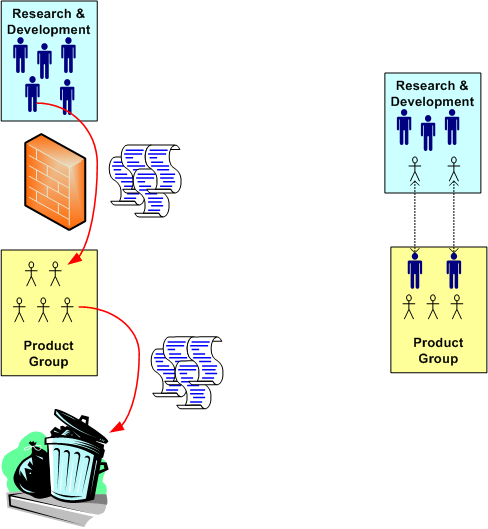
An alternative way of birthing new products and imbuing aging product lines with promising technology enhancements is to temporarily rotate and embed members of the two groups within each other’s sterile environment. Of course, this alternative way of doin’ b’ness is rarely observed in the wild because it would disrupt the pyramid of importance and force members of one guild to learn the language and customs of the other – which is verboten! Meanwhile, Rome burns.
Remotivated, At Least For Now
After watching former C++ and CORBA guru Steve Vinoski rave about Erlang in this InfoQ video, I’ve been re-motivated to try and learn a dynamically typed (yikes!), functional programming language. After starting to learn CLisp with the “Land Of Lisp” serving as my training reference, I’ve switched gears. I’ve downloaded the Erlang distribution, I’ve downloaded the Erlang Eclipse plugin “Erlide“, and I’m using “Erlang Programming” as my first training book.
The book’s first chapter describes an impressive list of built in features that have drawn me to Erlang like a moth to a flame:
- Erlang was developed to solve the “time-to-market” requirements of distributed, fault-tolerant, massively concurrent, soft real-time systems.
- Erlang concurrency is fast and scalable. Its processes are lightweight in that the Erlang virtual machine does not create an OS thread for every created process.
- Erlang processes communicate with each other through message passing.
- Erlang has distribution incorporated into the language’s syntax and semantics, allowing systems to be built with location transparency in mind. The default distribution mode is based on TCP/IP, allowing a node (or Erlang runtime system) on a heterogeneous network to connect to any other node running on any operating system.
- Global variables don’t exist.
As of now, I’m planning to occasionally blog about my Erlang learning experience as I inch forward into the weird and whacky world of functional programming. But; since I’m doing this on my own time, I’m a slooow learner, I love working in C++, we don’t use Erlang where I work, and my intrinsic motivation may vanish, I may abandon the effort. If I do decide to “bag it“, be sure to call me a quitter.

Thirty-Six Lucky Ones
With all this ranting that I do against hierarchical orgs, you’d think I would have been burned badly in the past by a succession of tyrant bosses. You’d be wrong. I’m fifty-two years old (D’oh!) and I’ve been working in hierarchies since I was 16. Throughout those 36 years, I can honestly say that I’ve never had a horrendous boss. I’ve worked for a handful of terrific ones that I deeply admire and respect. I’ve also worked for several good ones, and many average ones. In absolute terms, I’ve never felt underpaid, but in relative terms, I have (Waaah and Boo-Hoo!).

The “bad” experiences I’ve had within the hallowed halls of hierarchy were with 1 dimensional program managers, project managers, and product managers (damn-the-people-schedule-is-all-that-matters). Interestingly, the most friction I’ve been a co-creator of has been with manager wannabes. You know, those so-called technical peers who:
- talk a good, jargon-filled game to cover up their incompetence,
- continuously obstruct progress to fill their time and simultaneously cover up their own lack of contribution,
- don’t create any value directly – not even spreadsheets or Gannt charts in preparation for their upward advancement into the guild of management.
When those dudes do get promoted, and IMHO it has happened unconscionably often throughout my “career“, I steer clear of them. It’s BM city and my car ain’t gonna drive through it.
Even though I’ve been incredibly lucky with hierarchical bosses, I’ve known quite a few fellow DICsters over the years who’ve felt that they weren’t treated fairly by hierarchs – even by some of the exact same bosses that I’ve had.
How about you, what’s your boss story? Why won’t you tell me about it?
VHP Package
Several months ago, when I bought and read Zappos.com CEO Tony Hsieh‘s “Delivering Happiness: A Path To Profits, Passion, and Purpose” book, I signed up for the VHP (Very Happy Person) program. I also followed the “Happiness Bus” around as it cheerfully toured the USA, spreading a little bit of happiness at every stop.
Recently, I received in the mail, unsolicited and free of charge, a cool little thank you package filled with these five goodies:

Since the care package contains a copy of the DH book signed by Mr. Happiness himself, Tony Hsieh, I’d like to try and return the favor by spreading a little happiness of my own. Therefore, I’ll send my unsigned copy gratis to the first person who indicates, via the comments section in this post, that they’d like to own it. Hell, I’ll even spring for the postage cost 🙂
Reporting Delay
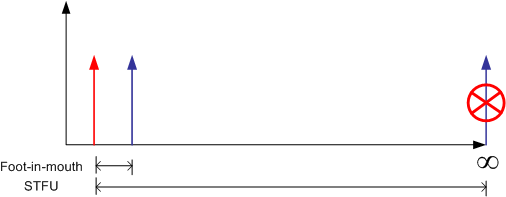
The figure below shows a generic Bulldozer00 model (which means it’s outright wrong) of what happens ‘tween the time one experiences an “important” event to the time at which one communicates to others about the event. What’s an important event? It’s something that has meaning – which implies that it is person-specific. One person’s important event is another’s trivial yawner.
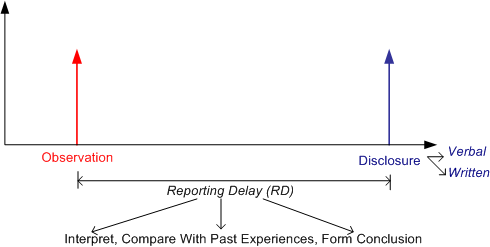
The length of the reporting delay (RD) is critical. If it’s too short, then one can suffer from foot-in-mouth syndrome like Bulldozer00. If it’s too long, with infinity being the limit, then the lack of disclosure can eat away at one’s psyche and cause stress and ill-health.
In dysfunctional corpricracies, the unspoken tool of “fear imposition” keeps the RD of many DICsters at infinity, or in layman’s words – STFU. What’s the nature of your RD?
Repeat Champion
Fortune magazine recently hatched its coveted list of the “Best 100 Companies to work for in 2011“. Two top ten winners, repeat champion SAS, and Zappos.com, have been on my faves list for a loooong time. Who’s on your list?

Don’t Listen…. Imitate
To most (but not all) corpo execs and fatty middle managers everywhere, take heed:
“Children are never good at listening to their elders, but they never fail to imitate them.” – James Baldwin

OMG, I’m so embarrassed! In yesterday’s post, I hinted that I sort-of wanted to do away with my Father Guido Sarducci “find-the-poop-in-the-picture” pattern of immaturity. Nevertheless, if this quote from the “Wilde” man doesn’t hold a grain of truth to it, then I’m hopelessly hosed:
Life is too short to be taken seriously – Oscar Wilde
Without Any Sting
Thanks to @stefanstern, I discovered the MIX. In this blarticle, Moving Past Austerity—Let’s Make 2011 the Year of Honesty, Humanity and Generosity, Polly LaBarre eloquently states what I wish I could, and without any offensive sting:
“zero-sum thinking, profit-obsession, power, conformance, control, hierarchy, and obedience don’t stand a chance against community, interdependence, freedom, flexibility, transparency, meritocracy, and self-determination.”
When you feel isolated and alone with your “abnormal” thoughts about a particular topic, it’s always comforting to discover others with similar opinions. Polly, in specific, and the MIX, in general, fit the bill for me. Now, if I could only learn how to keep immature, offensive language and childish poopie pictures out of my posts, I might soothe the occasional pangs of guilt that course through my being.
The line between constructive passion and destructive obsession is a tenuous one. Do you tread the line, or do you keep yourself warm and cozy and numb, hiding in the womb and not wanting to “get involved“?

Follow Me!
The Amazon Kindle has a kool “share” feature. You can highlight a passage in the book you’re reading, write an introductory note for it, and then e-send the note-link pair to twitter. Here’s what one of these shared note-link pairs looks like in a Twitter timeline:

The link displayed in the tweet points to an online stored version of the highlighted text that is visible to the public. Here’s an example book snippet that I recently tweeted:

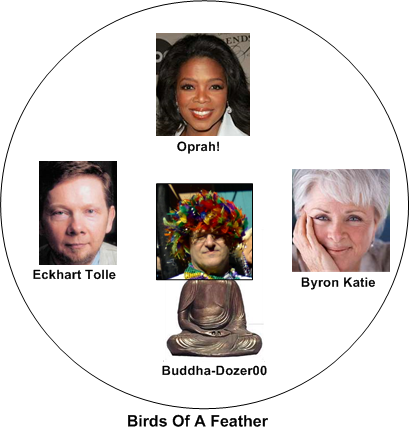
Sometimes, after sharing a passage from a spiritual book, I get one or two new Twitter followers the next day. Of course, they sign up to follow me cuz I’m wise and insightful, not because they have something they want to sell to me. Someday, I’ll move into the upper echelon of the spirituo-sphere with the big boys and girls:

Why am I here?
WTF?
Meh!
D'oh!

My BTC Address



 Bulldozer00's Blog