Archive
Take Me To Your Ruler

I Wuv What I Do
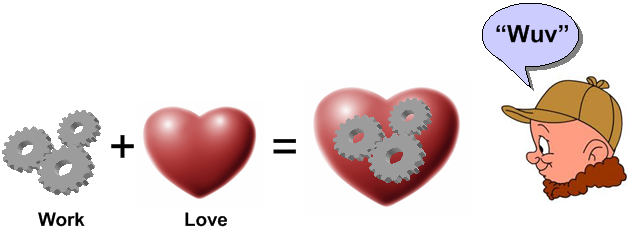
In the splendid “Evil Plans: Having Fun on the Road to World Domination“, Hugh MacLeod asks us to “unify work and love“. His reasoning is sound:
“After family and friends, what else is there?” – Hugh MacLeod
Because I’m lucky to love what I do, I feel like I’ve been blessed. How about you?
Are you feelin’ lucky today, punk? – Dirty Harry
CORKA, The Killer Whale
In case you were wondering, CORKA stands for CORpo Kiss-Ass. In DYSCOs (frequent disclaimer: not all companies are DYSCOs), the CORKA density is a function of the level one operates in within a corpricracy, no?

Jokingly Funny
Make Meaning
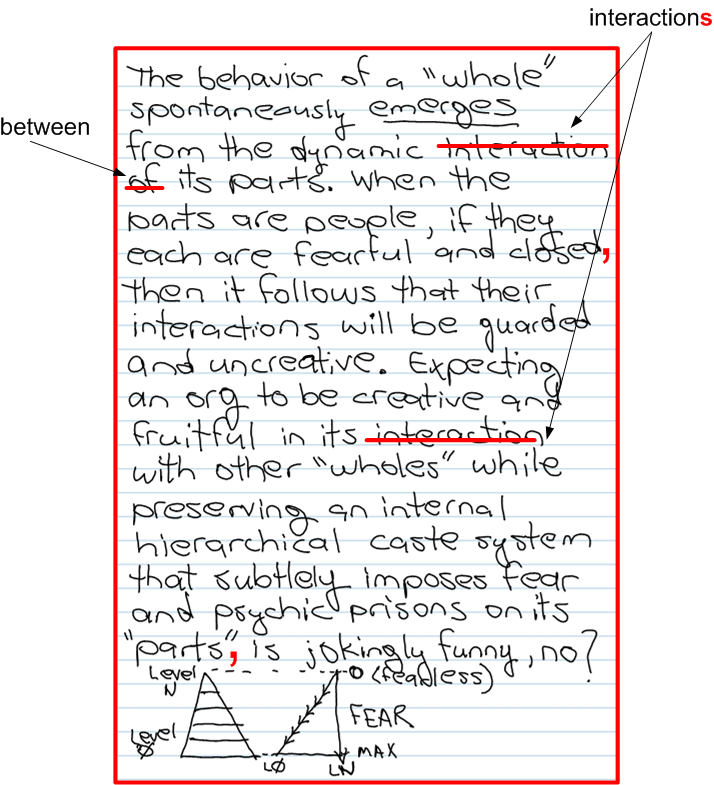
Can you make meaning out of this freakin’ sketch? I can’t. As I drew it, I struggled to come up with some profound (lol!) words to express my thoughts on the thick and impenetrable “personal filter” (a.k.a UCB) that prevents us from experiencing what’s truly real – which is nothing, er, “no thing“?

21st Century Assembler
I love working in the malleable medium of C++, but I wonder if it is becoming, or has already become, the “assembly language” of the 21st century – powerful and fast, but hard to learn and easy to make hard-to-diagnose mistakes. I recently stumbled upon this 5 year old interview with C++ creator Bjarne Stroustrup. The interviewer opened with:
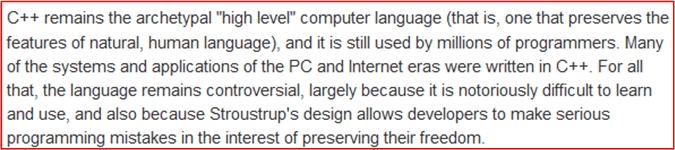
Mr. Stroustrup, the honest soul that he is, essentially validated the opening, but with a trailing caveat:
C++ has indeed become too “expert friendly” at a time where the degree of effective formal education of the average software developer has declined. – Bjarne Stroustrup
Since “experts” tend to be more narrow minded than the average Joe, they tend to look down upon newbies and non-experts in their area of expertise. And so it is with many a C++ programmer towards new age programmers who side step C++ for one of the newer, easier to learn, specialized programming languages. In the classic tit-for-tat response, new age programmers belittle C++ users as old timers that are out of touch with the 21st century and still clinging to the horse driven carriage in the era of the lamborghini.
So, who’s “right“? And if you do share your opinion with me, what language do you work with daily?

Defect Diaries
Once again, I’ve stolen a graphic from Watts Humphrey and James Over’s book, “Leadership, Teamwork, and Trust“:
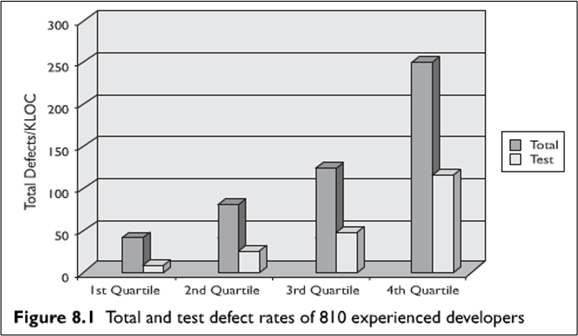
According to this performance chart, the best software developers (those in the first quartile of the distribution) “injected” on average less than 50 bugs (Watts calls them defects) per 1000 lines of code over the entire development effort and less than 10 per 1000 lines of code during testing. Assuming that the numbers objectively and fairly represent “reality“, the difference in quality between the top 25% and bottom 25% of this specific developer sample is approximately a factor of 250/50 = 5.
What I’d like to know, and Humphrey/Over don’t explicitly say in the book (unless I missed it), is how these numbers were measured/reported and how disruptive it was to the development process and team? I’d also like to know what the results were used for; what decisions were made by management based on the data. Let’s speculate…
I picture developers working away, designing/coding/compiling/testing against some requirements and architecture artifacts that they may or may not have had hand in producing. Upon encountering each compiler, linker and runtime error, each developer logs the nature of the error in his/her personal “demerit diary” and fixes it. During independent testing: the testers log and report each error they find; the development team localizes the bug to a module; and the specific developer who injected the defect fixes it and records it in his/her demerit diary.
What’s wrong with this picture? Could it be that developers wouldn’t be the slightest bit motivated to measure and record their “bug injection rates” in personal demerit diaries – and then top it off by periodically submitting their report cards lovingly to their trustworthy management “superiors“? Don’t laugh, because there’s quite a body of evidence that shows that Mr. Humphrey’s PSP/TSP process, which requires institutionalization of this “defection injection rate recording and reporting” practice, is in operation at several (many?) financially successful institutions. If you’re currently working in one of these PSP/TSP institutions, please share your experience with me. I’m curious to hear personal stories directly from PSP/TSP developers – not just from Mr. Humphrey and the CMU SEI.

Procedural, Object-Oriented, Functional
In this interesting blog post, Dr Dobbs – Whither F#?, Andrew Binstock explores why he thinks “functional” programming hasn’t displaced “object-oriented” programming in the same way that object-oriented programming started slowly displacing “procedural” programming in the nineties. In a nutshell, Andrew thinks that the Return On Investment (ROI) may not be worth the climb:
“F# intrigued a few programmers who kicked the tires and then went back to their regular work. This is rather like what Haskell did a year earlier, when it was the dernier cri on Reddit and other programming community boards before sinking back into its previous status as an unusual curio. The year before that, Erlang underwent much the same cycle.”
“functional programming is just too much of a divergence from regular programming. ”
“it’s the lack of demonstrable benefit for business solutions — which is where most of us live and work. Erlang, which is probably the closest to showing business benefits across a wide swath of business domains, is still a mostly server-side solution. And most server-side developers know and understand the problems they face.”
So, what do you think? What will eventually usurp the object-oriented way of thinking for programmers and designers in the future? The universe is constantly in flux and nothing stays the same, so the status quo loop modeled by option C below will be broken sometime, somewhere, and somehow. No?

Movin’ On Up
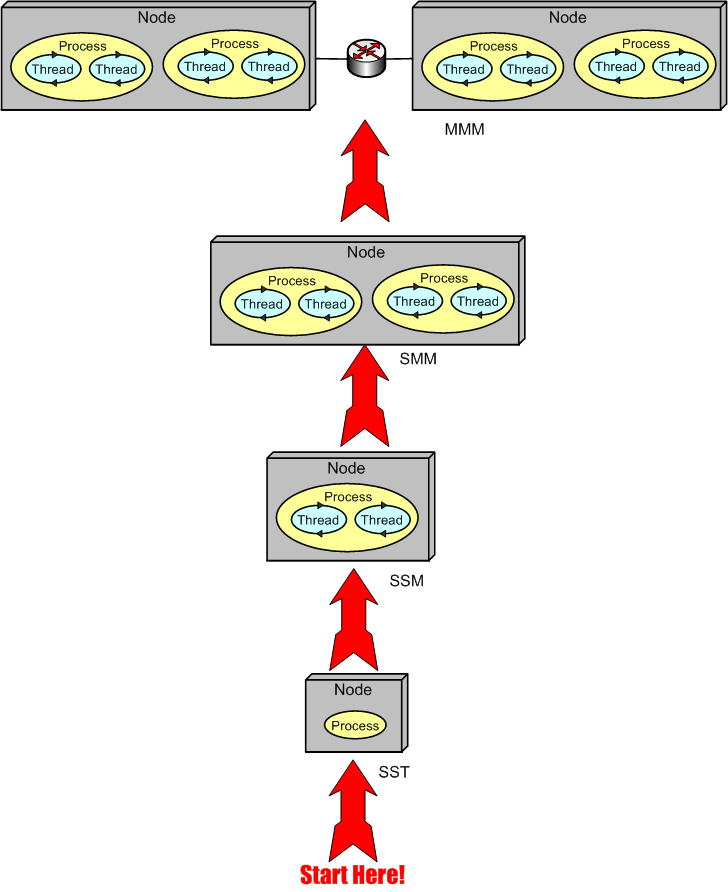
For some unknown reason, I recently found myself reflecting back on how I’ve progressed as a software engineer over the years. After being semi-patient and allowing the fragmented thoughts to congeal, I neatly summed up the quagmire as thus:
- Single Node – Single Process – Single Threaded (SST) programming
- Single Node – Single Process – Multi-Threaded (SSM) programming
- Single Node – Multi-Process – Multi-Threaded (SMM) programming
- Multi-Node – Multi-Process – Multi-Threaded (MMM) programming
It’s interesting to note that my progression “up the stack” of abstraction and complexity did not come about from the execution of some pre-planned, grand master strategy . I feel that I was “tugged” by some unknown force into pursuing the knowledge and skills that have gotten me to a semi-proficient state of expertise in the design and programming of MMM systems.
Being a graphical type of dude, here’s a pictorial representation of how I “moved on up“.
How about you? Do you have a master plan for movin’ on up? Wherever you are in relation to this concocted stack, are you content to stay there – in the womb so-to-speak? If you want to adopt something like it as a roadmap for professional development, are you currently immersed in the type of environment that would allow you to do so?
Taking Stock
Every once in awhile, it’s good to step back and take stock of your team’s accomplishments over a finite stretch of time. I did this recently, and here’s the marketing hype that I concocted:
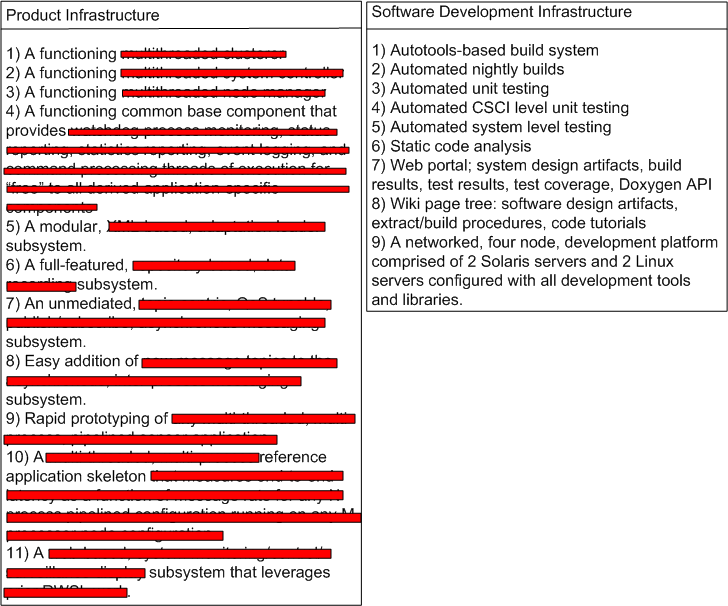
I like to think of myself as a pretty open dude, but I don’t think I’m (that) stupid. The product infrastructure features have been redacted just in case one of the three regular readers of this blasphemous blog happens to be an evil competitor who is intent on raping and pillaging my company.
The team that I’m very grateful to be working on did all this “stuff” in X months – starting virtually from scratch. Over the course of those X months, we had an average of M developers working full time on the project. At an average cost of C dollars per developer-month, it cost roughly X * M * C = $ to arrive at this waypoint. Of course, I (roughly) know what X, M, C, and $ are, but as further evidence that I’m not too much of a frigtard (<- kudos to Joel Spolsky for adding this term of endearment to my vocabulary!), I ain’t tellin’.
So, what about you? What has your team accomplished over a finite period of time? What did it cost? If you don’t know, then why not? Does anyone in your group/org know?

Why am I here?
WTF?
Meh!
D'oh!

My BTC Address



 Bulldozer00's Blog