Archive
Yin And Yang
In Bill Livingston’s current incarnation of the D4P, the author distinguishes between two mutually exclusive types of orgs. For convenience of understanding, Bill arbitrarily labels them as Yin (short for “Yinstitution“) and Yang (short for “Yang Gang“):
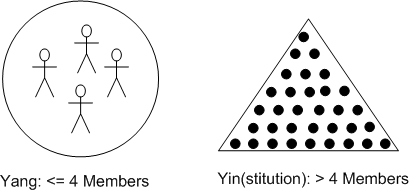
The critical number of “four” in Livingston’s thesis is called “the Starkermann bright line“. It’s based on decades of modeling and simulation of Starkermann’s control-theory-based approach to social unit behavior. According to the results, a group with greater than 4 members, when in a “mismatch” situation where Business As Usual (BAU) doesn’t apply to a novel problem that threatens the viability of the institution, is not so “bright” – despite what the patriarchs in the head shed espouse. Yinstitutions, in order to retain their identities, must, as dictated by natural laws (control theory, the 2nd law of thermodynamics, etc), be structured hierarchically and obey an ideology of “infallibility” over “intelligence” as their ideological MoA (Mechanism of Action).
According to Mr. Livingston, there is no such thing as a “mismatch” situation for a group of <= 4 capable members because they are unencumbered by a hierarchical class system. Yang Gangs don’t care about “impeccable identities” and thus, they expend no energy promoting or defending themselves as “infallible“. A Yang Gang’s structure is flat and its MoA is “intelligence rules, infallibility be damned“.
The accrual of intelligence, defined by Ross Ashby as simply “appropriate selection“, requires knowledge-building through modeling and rapid run-break-learn-fix simulation (RBLF). Yinstitutions don’t do RBLF because it requires humility, and the “L” part of the process is forbidden. After all, if one is infallible, there is no need to learn.
Healthy Debates
The article, “Overconfidence May Be a Result of Social Politeness”, opens up with:
Since society has taught us not to hurt other people’s feelings, we rarely hear the truth about ourselves, even when we really deserve it.
Phew, BD00 is glad this is the case. Otherwise BD00 would be inundated with “negative feedback” for being a baddy. Uh, he actually does get what “he deserves” occasionally, but what da hey.
Florida State University researcher Joyce Ehrlinger, upon whose research the article is based, empirically validated the following hypothesis to some degree:
If person A expressed views to a political subject that person B found contradictory to their own, the result would not be a healthy debate, but just silence from B – and an associated touch of overconfidence from A.
Now, imagine applying this conjecture to a boss-subordinate relationship in a hierarchical command and control bureaucracy. Bureaucratic system design natively discourages healthy debate up and down the chain of command and (almost) everybody complies with this design constraint. As a result, overconfidence increases as one moves up the chain. Healthy debates can, and do, occur among peers at any given level, but up-and-down-the-ladder debates on issues that matter are rare indeed. Hasn’t this been your experience?
1, 2, X, Y
Chris Argyris has his Model 1 and Model 2 theories of action:
- Model I: The objectives of this theory of action are to: (1) be in unilateral control; (2) win and do not lose; (3) suppress negative feelings; and (4) behave rationally.
- Model II: The objectives of this theory of action are to: (1) seek valid (testable) information; (2) create informed choice; and (3) monitor vigilantly to detect and correct error.
Douglas McGregor has his X and Y theories of motivation:
- Theory X: Employees are inherently lazy and will avoid work if they can and that they inherently dislike work.
- Theory Y: Employees may be ambitious and self-motivated and exercise self-control; they enjoy their mental and physical work duties.
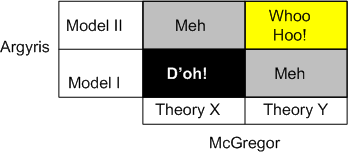
Let’s do an Argyris-McGregor mashup and see what types of enterprises emerge:
Building The Perfect Beast
The figure below illustrates a simplified model of a Starkermann dualism. My behavior can contribute to (amity), or detract from (enmity) your well being and vice versa.

Mr. Starkermann spent decades developing and running simulations of his models to gain an understanding of the behavior of groups. The table below (plucked from Bill Livingston’s D4P4D) shows the results of one of those simulation runs.
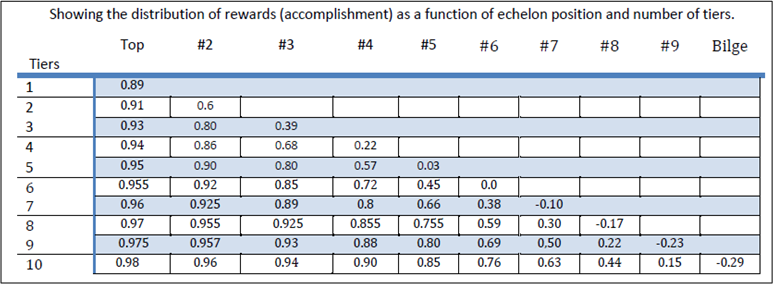
The table shows the deleterious effects of institutional hierarchy building. In a single tier organization, the group at the top, which includes everyone since no one is above or below anybody else, attains high levels of achievement (89%). In a 10 layer monstrosity, those at the top benefit greatly (98% achievement) at the expense of those dwelling at the bottom – who actually gain nothing and suffer the negative consequences of being a member of the borg.
What do you think? Does this model correspond to reality? How many tiers are in your org and where are you located?
Killers Or Motivators?
It’s ironic that many of the words and phrases in “100 words that kill your proposal” are used by management and public relations spin doctors to project a false illusion of infallibility:
- Uniquely qualified, very unique, ensure, guarantee
- Premier, world-class, world-renowned, well-seasoned managers
- Leading company, leading edge, leading provider, industry leader, pioneers, cutting edge
- Committed, quality focused, dedicated, trustworthy, customer-first
How can these subjective and tacky words sink a business proposal on the one hand, but (supposedly) inspire and motivate on the other hand?

Espoused Vs. In-Use
Although we say we value openness, honesty, integrity, respect, and caring, we act in ways that undercut these values. For example, rather than being open and honest, we say one thing in public and another in private—and pretend that this is the rational thing to do. We then deny we are doing this and cover up our denial. – Chris Argyris
Guys like Chris Argyris, Russell Ackoff, and W. E. Deming have been virtually ignored over the years by the guild of professional management because of their in your face style. The potentates in the head shed don’t want to hear that they and their hand picked superstars are the main forces holding their borgs in the dark ages while the 2nd law of thermodynamics relentlessly chips away at the cozy environment that envelopes their (not-so) firm.
Chris Argyris’s theory of behavior in an organizational setting is based on two conflicting mental models of action:
- Model I: The objectives of this theory of action are to: (1) be in unilateral control; (2) win and do not lose; (3) suppress negative feelings; and (4) behave rationally.
- Model II: The objectives of this theory of action are to: (1) seek valid (testable) information; (2) create informed choice; and (3) monitor vigilantly to detect and correct error.
The purpose of Model I is to protect and defend the fabricated “self” against fundamental, disruptive change. The patterns of behavior invoked by model I are used by people to protect themselves against threats to their self-esteem and confidence and to protect groups, intergroups, and organizations to which they belong against fundamental, disruptive change. D’oh!
From over 10,000 empirical cases collected over decades of study, Mr. Argyris has discovered that most people (at all levels in an org) espouse Model II guidance while their daily theory in-use is driven by Model I. The tool he uses to expose this espoused vs. in-use model discrepancy is the left-hand-column/right-hand-column method, which goes something like this:
- In a sentence or two identify a problem that you believe is crucial and that you would like to solve in more productive ways than you have hitherto been able to produce.
- Assume that you are free to interact with the individuals involved in the problem in ways that you believe are necessary if progress is to be made. What would you say or do with the individuals involved in ways that you believe would begin to lead to progress. In the right hand column write what you said (or would say if the session is in the future). Write the conversation in the form of a play.
- In the left-hand column write whatever feelings and thoughts you had while you were speaking that you did not express. You do not have to explain why you did not make the feelings and thoughts public.
What follows is an example case titled “Submerging The Primary Issue” from Chris’s book, “Organizational Traps:Leadership, Culture, Organizational Design“. A superior (S) wrote it in regard to his relationship with a subordinate (O) regarding O’s performance.
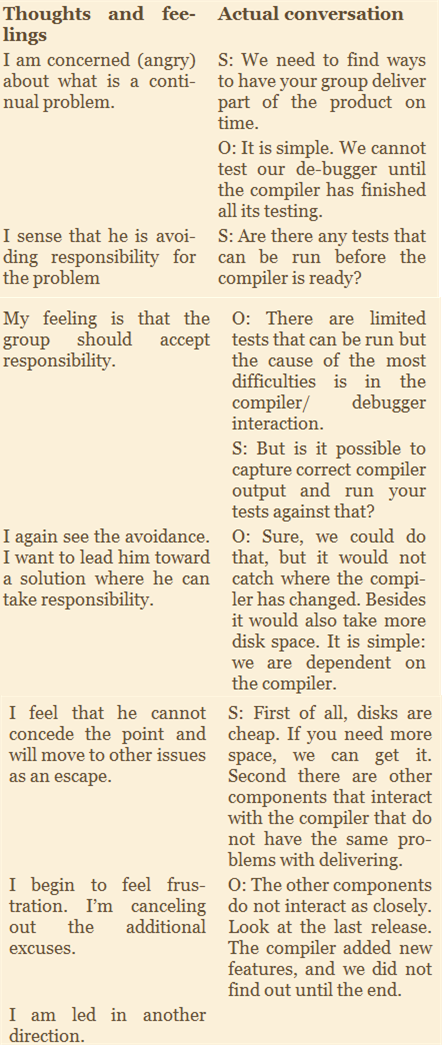
The primary issue in the superior’s mind, never directly spoken in the dialog, is his perception that the subordinate lacks a sense of responsibility. The issue that *did* end up being discussed was a technical one. (I’d love to see the same case as written by the subordinate. I’d also like to see the case re-written by the superior in a non-supervised environment.)
When Mr. Argyris pointed out the discrepancy between the left and right side themes to the case writer and 1000s of other study participants, they said they didn’t speak their true thoughts out of a concern for others. They did not want to embarrass or make others defensive. Their intention was to show respect and caring.
So, are the reasons given for speaking one way while thinking a different way legitimately altruistic, or are they simply camouflage for the desire to maintain unilateral control and “win“? The evidence Chris Argyris has amassed over the years indicates the latter. But hey, those are traits that lead to the upper echelons in corpoland, no?
Ego Battles


And yes, I don my armor daily. It’s war out thar!
Dispersion Of Ownership
Much as God was replaced by professional clergy who claim to “know” the will of God, the dispersion of ownership in a company (via the birth of the stock market) birthed the professional institution of management who claim to know the will of the owners.
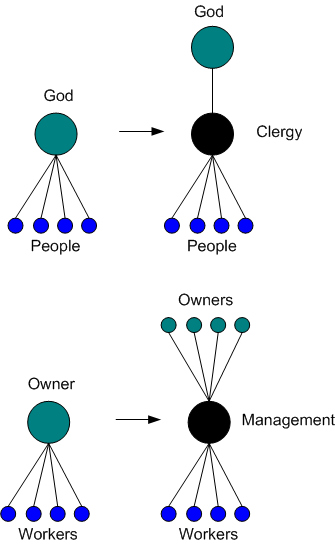
If the will of absentee owners is solely to extract maximal profit from the org, then management indeed knows the will of the owners. And since the workery can no longer communicate directly with the diluted and fragmented owner heap, their concerns and ideas are conveniently out of sight and out of mind; reinforcing the “maximal profit extraction” mindset.
Relying on the fairness of managers to balance profit with worker well-being is not much different than relying on the same behavior from a heap of unconnected, faceless owners because neither group is the original creator of the org.
Note: This post is the result of contemplation and reflection on the Russell Ackoff paper titled: “A SYSTEMIC VIEW OF TRANSFORMATIONAL LEADERSHIP“. It’s yet another unoriginal BD00 meta-post. As usual, I sketched up a picture and pasted some bogus words around it. You can probably come up with a better supporting story yourself. Give it a try.
Shall And Shall Not
For a controlled system to remain viable and stable, Ashby’s law of requisite variety requires that the system controller(s) exhibit a wider variety of behavior than the system controllee(s). This can be accomplished by either the controller increasing its variety of responses to controllee disturbances, or by decreasing the variety of controllee disturbances relative to its own variety of control responses, or both.
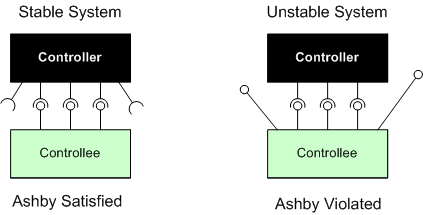
In order to comply with Ashby’s law (in conjunction with several other natural laws – 2nd law of thermo, control theory, Turing’s infallible/intelligence thesis, etc), Bill Livingston asserts that membership in any institution requires the internalization, either consciously or (more likely) unconsciously, of the following set of “shall” and “shall not” rules:
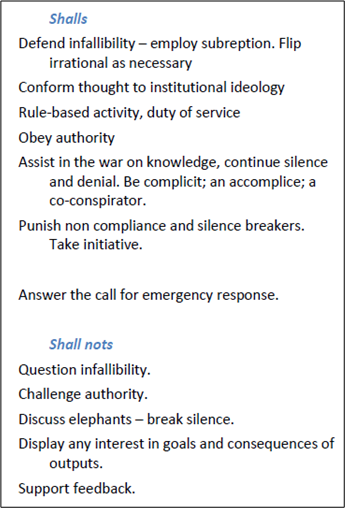
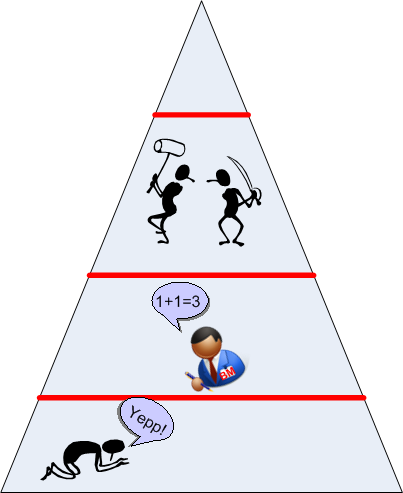
As you can see, suppressing variety in the controllee population is the preferred method of a controller aiming to satisfy Ashby’s law. The alternative, increasing its own variety of response relative to controllee variety of disturbance, requires learning and development. By definition, infallible controllers don’t need to learn and develop. They stopped learning when they achieved the status of “infallible” – either by force or by illusion.
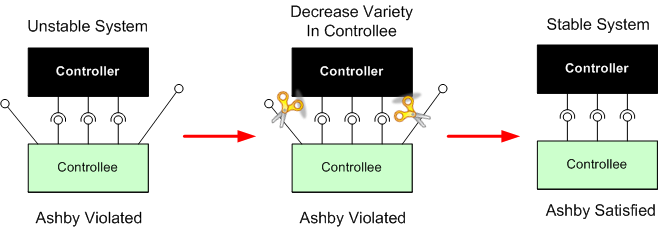
So, what do you think? Did Mr. Livingston hit the bullseye? Miss by a mile?
Your Operational Configuration
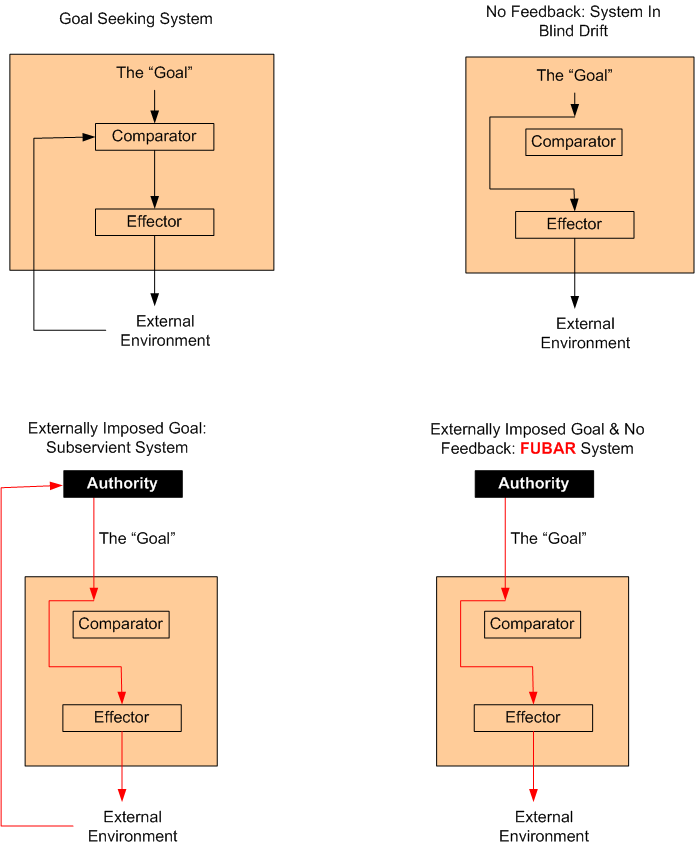
Which system configuration do you prefer? Which system configuration is most prevalent in nature? In the “civilized” world? What’s your operating configuration, and do you have just one?

Why am I here?
WTF?
Meh!
D'oh!

My BTC Address



 Bulldozer00's Blog