Archive
Busy Doing Nothing
The British created a civil service job in 1803 calling for a man to stand on the Cliffs of Dover. The man was supposed to ring a bell if he saw Napolean coming….. The job was abolished in 1945. – Robert Townsend.
The battle of Waterloo, in which Napolean’s army was routed, was fought in 1815. Thus, the series of dudes who stood guard for 130 years after the fall of the egotistical French emperor were busy doing nothing but pissing and pooping off the cliffs every few hours – and gettin’ paid for it.

In “Ackoff’s Best: His Classic Writings On Management“, uber systems thinker Russell Ackoff rails against bureaucracies:
A bureaucracy is an organization whose principle objective is to keep people busy doing nothing. They are preoccupied with what we call make-work…. The problem created by people who are busy doing nothing is that they frequently obstruct others who have real work to do. They impose unproductive requirements on others…. Bureaucracies obstruct development. They retard improvement of quality of life…. Bureaucrats want all parts of an organization to conform to one set of rules and regulations…. Conformity is treated as good in itself, an ultimate good. – Russell Ackoff
Mr. Ackoff not only rages against the machine, he advises on how to beat the system with a bevy of hilarious real-life examples in which individuals successfully “fought city hall” and won. He follows each ditty with a moral. Buy the book and read it for the delicious details of every battle.
Ty Detmer
Remember Philadelphia Eagles quarterback Ty Detmer? The DETMER metric, which was introduced in yesterday’s post and stands for Decision-To-Meeting-Ratio, is named after Ty. Hah, hah – just joking. There’s no connection between Detmer and DETMER. DETMER is a bogus metric acronym that I concocted and, for some weird reason, Ty’s name repeatedly comes to my defective mind every time I think of it. Time for a straight jacket and meds?
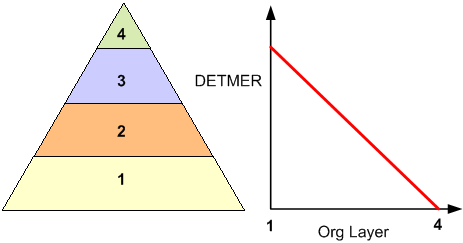
The figure below shows a madeup DETMER vs layer-of-importance curve for a typical corpricracy. The higher one moves up in the caste system, the more useless no-decision meetings one gets to attend. At these egofests, peer SCOLs psychologically duel with each other “under the covers” to prove “I’m great and you’re not“. It’s like a gaggle of peacocks struttin’ around in front of each other showing off how much prettier their plumes are. Of course, few if any important decisions are arrived at during these aristocratic social events. At the highest levels in the CCF, every hour of every day is booked with these “Dancing With The Czars” assemblies.
Meetings and Decisions
Orgs of people exist for a purpose. In order to continuously fulfill the org’s purpose in a changing external environment, its members need to make decisions regarding what to do and when to do it in order to counter unfavorable changes that are at odds with the org’s purpose. Since people need to know who will do what, when they’ll do it, and how they’ll coordinate with others to collectively counter external threats, decision-making meetings are held at all levels to decide such issues of importance.
The figure below introduces the Decision-To-Meeting-Ratio (DETMER) metric. It also shows the divergence of this metric for two competing orgs who initially had the same DETMER value at an arbitrary time, T=0. Assuming (and it’s a bad assumption) that all decisions made at each meeting are effective, as the DETMER goes to zero nothing changes for the good within the org walls. People do the same thing everyday, even as the environmental conditions outside the walls relentlessly change. Voila, a bureaucracy led by a cadre of Bozeltines emerges. Bummer.

Loop Of Disrespect
In most companies, “respect” is either an explicit or implicit core value. Is it respectful to repeatedly watch, and covertly condone, project teams working 50-60 hour, unpaid overtime weeks for years at a time to meet some schedule that they most likely had no hand in making? Since the overtime is not paid, it isn’t tracked and future schedule estimates derived from past performances don’t accurately reflect the effort needed to get the job done. Thus, the practice is a self-reinforcing loop of disrespect. But hey, since virtually all corpricracies operate that way, the practice must not be disrespectful, right?
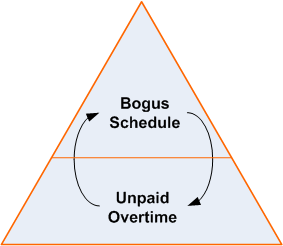
Demanding respect while not giving it, or pretending to give it, creates mediocracies. And since respect and loyalty are intimately coupled, demanding loyalty without giving respect doesn’t work too well either.
Watching Closely
Please tell me what type of manager broadcasts statements like this one:
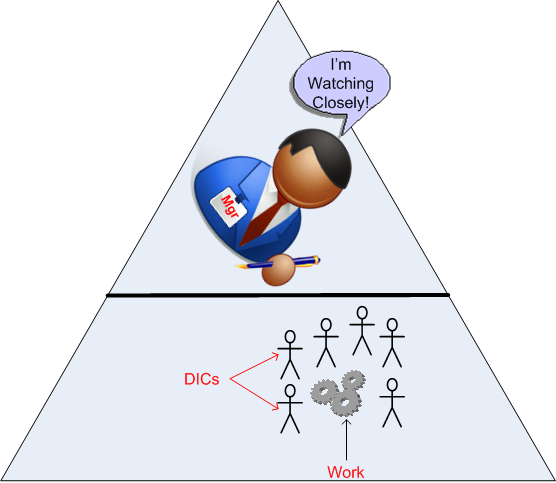
“Since there were no major accomplishments reported on this task last week, I’ll be watching this task closely.”
When I see or hear comic statements like this, I privately think to myself (but never publicly speak, of course):
- What are you gonna do to help if reported status is not up to your lofty but unarticulated expectations next week?
- Are you gonna issue more pointed and specific threats to the DICs assigned to the task?
- Are you gonna ratchet up the pressure even more so?
- Are you gonna roll up your sleeves, dive in and find out what is halting progress so you can directly or indirectly help?
What would you ask yourself?
DIC Revolt
From High-Frequency Programmers Revolt Over Pay – Forbes.com:
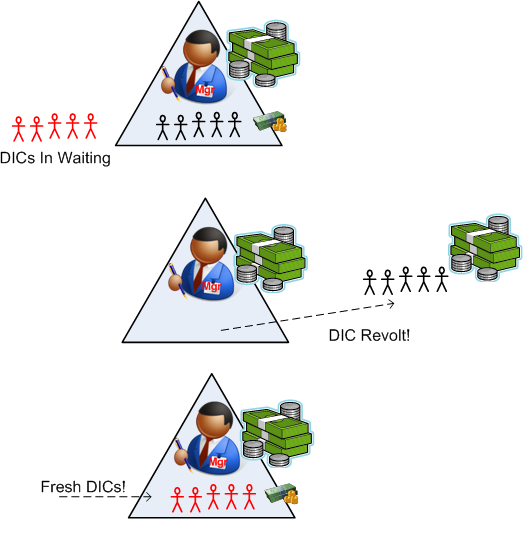
“Pity the programmers toiling away at Wall Street’s secretive high-frequency trading shops–places like Goldman Sachs, Citadel and Getco. They wrote algorithms that take advantage of fleeting trading opportunities and bring in up to $100,000 a day. In return, they received a fraction of the pay doled out to their bosses.”
Now some programmers feel used and are instigating a revolt. They are doing so by striking out on their own or forming profit-sharing arrangements.
Wow! A sampling of DICs has risen above the talking, whining, complaining, poor-me stage. They’ve actually taken action toward their perception of justice. Of course, the holes they’ve created at their former Wall Street greed-masters will be filled by other willing slave-DICs who will revive the whining, complaining, poor-me tradition left behind.
Strategic And Cautious
At nights and on weekends we cry out for human rights and freedom of speech, and then we go to work and become strategic and cautious about our every word for fear we will be seen as disloyal or uncommitted. – Peter Block
The above quote reminds me of many meetings that I’ve attended. In one of these watch-out-what-you-say-or you’ll-be-in-deep-shit group fear fests, the topic of a long time dedicated and highly productive employee leaving the company popped up. The frustrating and sad thing about the experience was that even though virtually everyone knew who the person was, no one spoke his name – including wimpy me. It was like an unwritten taboo, as hinted by Block’s quote above. At the time, I thought of getting up and yelling:
“Damn it! His name is XXXX. Why can’t anyone freakin’ speak it? Even though I think most of you know who we’re talking about, what harm would befall us if we spoke his name to the ones who don’t know? Why so much fear and secrecy?”
Of course, I only thought the thought and I didn’t say squat….. preferring to remain strategic and cautious.

Ego To Talent Ratio
In Scott Berkun‘s “Managing Breakthrough Projects” video, Scott concocts a metric called the Ego-To-Talent ratio (ETTR). Here’s my highly unscientific and speculative curve that plots ETTR versus position on the company org chart.
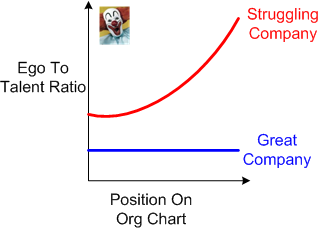
See that bozo on the chart? That’s me. Where are you?
Crisis?, What Crisis?
The other day, I heard a song on Pandora from one of my fave albums of the 70s (yes, they were called albums back then); Supertramp‘s “Crisis?, What Crisis“. The album title reminded me of orgs that emotionally panic “under the covers” when a crisis occurs, but outwardly behave as if there is no crisis. By “behaving like no crisis is occurring“, I mean that the SCOLs in charge apply whatever band aids they can in the short term to get through the crisis but don’t do anything of substance to stave off, or better handle, future crises.
When the crisis at hand passes, the heroes are congratulated and: the org structure stays the same, the people in the top roles stay the same, the operational business processes remain the same, and most ominously, the patriarchal CCH mindsets stay the same. It’s back to the same-old, same-old, business as usual.
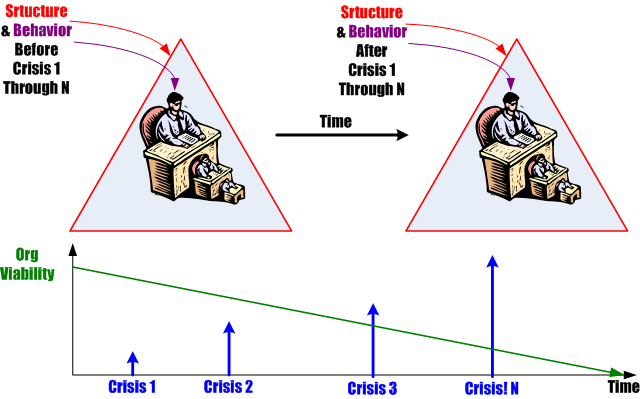
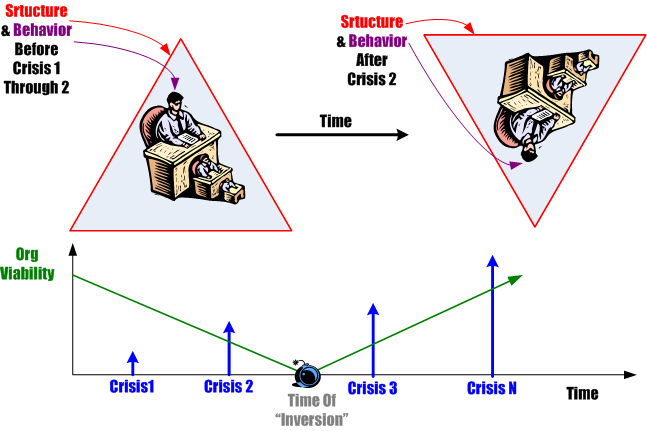
The figure below shows what maybe should happen when crises occur and learning takes place? Someone or some group willingly steps up to positively change the structures and behaviors so that the org can smoothly navigate through, and even thrive within, future crises. In the example below, it took 2 crises to stave off self destruction, right the course, and excel in the future. Alas, the problem with the previous sentence is the “someone or some group” phrase at the beginning.
Hurd Joins The Herd
I was considering writing a blog post about the downfall of Hewlett Packard’s CEO Mark Hurd, but I decided to back off. I figured that all the credentialed and highly respected tech columnists and bloggers have covered this horror story from all angles.
So, instead of my usual rag, rag, rag…… whine, whine, whine….. toll-u-so, toll-u-so, toll-u-sow verbage, I’ve written an empty husk of a blog post. The accompanying picture sux too….
 Nevertheless, I’ll be back on my high horse and raging against the machine soon.

Why am I here?
WTF?
Meh!
D'oh!

My BTC Address



 Bulldozer00's Blog