Archive
Saving Face
In CLORGs, the act of saving face by individuals and groups always takes precedence over the health of the organization has a whole. Actually, this behavior defines a CLORG, because without it, the assemblage of people wouldn’t be a freakin’ CLORG. It would be as Charlie Sheen sez: “winning“.
If an org is well led, its leaders will be skilled at detecting, exposing, and squashing face-saving behavior when the long term health of the org is put at risk. Sadly, those same people who should be diligently eradicating selfish, face-saving, behavior from their orgs are the greatest practitioners of it. D’oh!
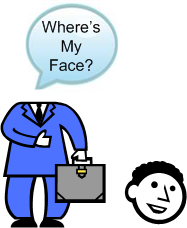
Shhhh! Be Quiet
If you’re having fun on a project, don’t let anyone outside of your team know that’s the case. You see, others will become jealous and they’ll start reacting like you’re a lazy ass slacker. The unconscious thinking behind the reaction is that if they’re not having fun, you shouldn’t be having fun either – verboten!
In true FOSTMA fashion, you’re required to be stressed out with your nose to the grindstone at all times. This is especially true for those who don’t understand the work but can never admit to it because they might be perceived as being “fallible” by other more important “infallibles“. D’oh!
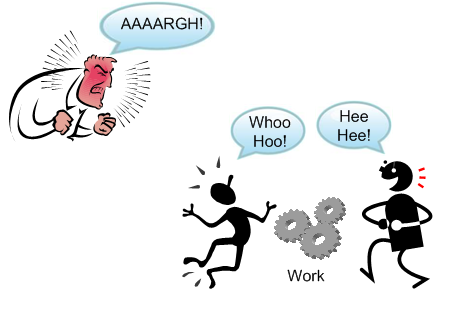
Cakeless
Assume that you have two product development teams toiling away. One finishes early and the other blows right past its schedule – finally finishing the work waaay downstream.
I love deadlines. I like the whooshing sound they make as they fly by – Douglas Adams
Do you think that managers at DYSCOs ignore the early finishers and reward the laggards with a cake party for the team’s “heroic effort down the stretch“? Either that happens, or all projects finish behind schedule and over budget….. and nobody gets any cake. Bummer.

Undetected Course Change
Every organized system of interdependent parts has a primary purpose – otherwise the conglomeration wouldn’t be a “system“. Assume that at T=0, a hypothetical system whose parts are an assemblage of people and machines is placed into operation. As the figure below shows, the system will start moving toward the achievement of its purpose.

Over time, assume that our fictitious system “loses its way” because of ineffective control actions. In hierarchically structured systems, the likelihood that the internal system controllers will detect the derailment and steer the system back on course is pitifully small. That’s because hierachical forms of human organization tend to instill a false sense of infallibility and hubris in those who control the system’s trajectory. Thus, via the phenomenon of cognitive dissonance and the inability to admit mistakes, the controllers will continue to shepherd the system away from its primary purpose toward a different, and most likely less noble purpose – all the while espousing that “we are on course to achieve our objectives“.
To Prevent Asking, Simply Don’t Ask
One of the dudes that I follow on Twitter is Don Harkey. His handle is “LeaderBook“, and he’s got a neat gig going on. When he tweets, it’s always a phrase or sentence from a book on leadership:

If you have a culture where your employees don’t even think about asking for, let alone actually asking for, a projector, a white board, a second computer monitor, a professional membership, a training class, or (heaven forbid) a tool that costs money, you get what you deserve.
So, how do you get a culture of “non-asking“? It’s so easy it comes naturally. There’s no work required – and that’s a good thing for work-averse managers. All ya gotta do is “lead by example” by never asking your employees what they need to do their jobs better. To really discourage the practice of employees from asking for things to help them do their jobs better (because employees can’t be trusted and they’ll take advantage of your goodwill, of course), you can ensure that the acquisition process is an unknowable labyrinth littered with approvals required by bureaucratic little Hitlers. See, I said it was easy.
Required Pretentiousness
“We grow up being afraid of our own ignorance and terrified that our ignorance may show. Over time, we’re conditioned to appear as “knowledgeable” as we can, while carefully concealing the limits of our understanding.”
Does the above quote, snipped from Peter Ralston’s “The Book Of Not Knowing“, ring as true for you as it does for me? I think it’s one of the top reasons why I spend a lot of time trying to keep abreast of developments in my field and advancing my programming and design skills.
You see, I often feel uncomfortable when someone starts talking about a topic that I’m ignorant of. I used to (and still do, but much less frequently) “pretend” that I understood what was being said so that I wouldn’t appear “stupid“. Now, I rarely hesitate to say sentences like “you lost me in the dust” or “I have no idea what you’re talking about” – regardless of the social consequences. I’ve realized that “not knowing” is the natural state of being – which means that we can’t avoid dwelling in it no matter how hard we try. Trying to fight spending one second in the state of not knowing is as ludicrous as a bird trying not to fly or a fish trying not to swim. Fighting one’s natural state of being always has a cost; psychological, physical, or both.
“Pretending to know” is a full time activity in hierarchically structured organizations that work with, and create, non-physical knowledge. Since knowledge is king, the higher one moves up in a hierarchy, the more pressure one feels to delude oneself into omniscience (e.g. when was the last time you asked a question that a superior didn’t whip out an answer to?). This unnatural behavior is exacerbated by the fact that all members in a hierarchy are either conscious or unconscious co-conspirators in the comedy.
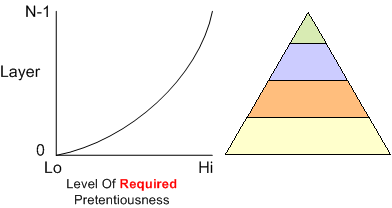
I’m a conscious and willing co-conspirator. How about you?
CORKA, The Killer Whale
In case you were wondering, CORKA stands for CORpo Kiss-Ass. In DYSCOs (frequent disclaimer: not all companies are DYSCOs), the CORKA density is a function of the level one operates in within a corpricracy, no?

Jokingly Funny
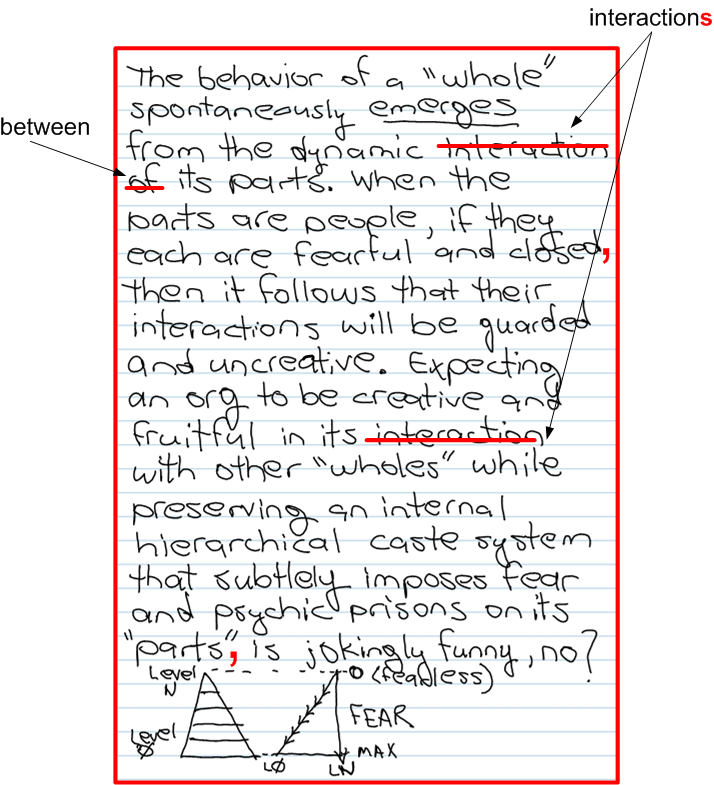
Mangled Model
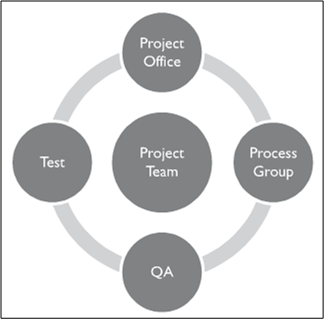
In their book, “Leadership, Teamwork, and Trust: Building a Competitive Software Capability“, Watts Humphrey and James Over model a typical software project system via the diagram below (note that they have separate Quality Assurance and Test groups and they put the “project office” on top).
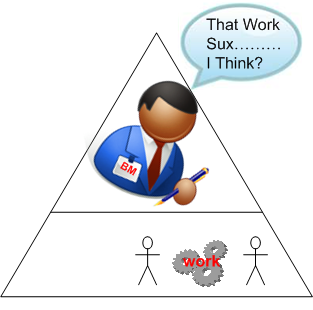
Bulldozer00 would have modeled the typical project system like this:

Of course, the immature and childish BD00 model would be “inappropriate” for inclusion into a serious book that assumes impeccable, business-like behavior and maturity emanating from each sub-group. Oh, and the book wouldn’t sell many copies to the deep pocketed audience that it targets. D’oh!
A Free Pass
In a culture of blame, and its Siamese twin, fear, any non-manager group member who consistently asks tough questions and points out shoddy, incomplete, ambiguous work becomes a group target for retribution. This defensive peer group behavior is a natural response to redirect attention away from the stank and to squelch criticism. The funny thing is, managers in CCHs are given a free pass to ask tough questions and criticize without fear of retribution. It helps that managers don’t produce any work products that can be scrutinized by DICsters – if they wanted to. Even if managers did pitch in by leading by example, most DICkies wouldn’t point out flaws because of……. fear of downstream retribution.
Ironically, because of the hierarchical mindset ingrained into all members of a DYSCO, and even though bad managers don’t have to worry about being tarred and feathered by the DICforce, most managers at the workface are incapable of asking the tough questions. Watts Humphrey summarizes this managerial shortcoming nicely:
However, as (Peter) Drucker pointed out, managers can’t manage knowledge work. This means that they cannot plan knowledge work, they cannot monitor and track such work, and they cannot determine and report on job status. – Watts Humphrey & James Over
Cultures of blame and fear of retribution go hand in hand with command and control hierarchies like peas and carrots, Jenny and Forrest. To expect otherwise is to be delusional.

Why am I here?
WTF?
Meh!
D'oh!

My BTC Address



 Bulldozer00's Blog