Archive
These Guys “Get It”
In the freely downloadable National Academies book, “Critical Code: Software Producibility for Defense“, the dudes who wrote the book “get it“. Check out this rather long snippet and place close attention on the bolded sentences. If you dare, pay closer attention to the snarky Bulldozer00 commentary highlighted in RED .
An additional challenge to the DoD is that the split between technical and management roles will result (has already resulted) in leaders who, on moving into management, face the prospect of losing technical excellence and currency over time. This means that their qualifications to lead in architectural decision making (and schedule making) may diminish unless they can couple project management with ongoing architectural leadership and technical engagement. The DoD does not (and legions of private enterprises don’t) have strong technical career paths that build on and advance software expertise with the exception of the service labs. Upward career progression trends leading closer to senior management-focused roles and further away from technical involvement tend to stress general management rather than technical management experience (well, duh! That’s the way status-centric command and control hierarchies are designed.). This is not necessarily the case in technology-intensive roles in industry (not necessarily, but still pervasively). Many (but nearly not enough) of the most senior leaders in the technology industry have technical backgrounds and continue to exercise technical roles and be engaged in technology strategy. Nonetheless, certain DoD software needs remain sufficiently complex and unique and are not covered by the commercial world, and therefore call for internal DoD software expertise. In the DoD, however, as software personnel take on more management responsibility, they have less opportunity and incentive to stay technically current (<- this “feature” is baked into command and control hierarchies where, of course, caste and who-reports-to-who is king – to hell with excellence and what sustains an enterprise’s health and profitability). At the same time, there is an increasing need for an acquisition workforce that has a strong understanding of the challenges in systems engineering and software-intensive systems development. It is particularly critical to have program managers who understand modern software development and systems (If that’s the case, then the DoD and most private enterprises are hosed. D’oh!).
Could it be that unelected, anointed “managers” in DoD and technology industry CLORGs and DYSCOs are still stuck in the 20th century FOSTMA mindset? You know, the UCB where they “feel” they are entitled to higher compensation and stature than the lower cast knowledge workers (architects, designers, programmers, testers, etc) just because they occupy a higher slot in an anachronistic, and no longer applicable, way of life – no matter what the cost to the whole org’s viability.
 In command and control hierarchies, almost everybody is a wanna-be:
“I wanna rise up to the next level so I’ll: make more money, have more freedom, be perceived as more important, and rule over the hapless dudes in my former level“. Nah, that’s not true. BD00 has been drinkin’ too many dirty, really really dirty, martinis.
Rare Sighting
A friend and colleague sent me this terrific link: “The Wall Says It’s Time To Go“. He asked me for my highly esteemed, expert opinion on the manager described in the “You’re On Your Own” story. I told him that the manager’s behavior was a great example of the rarely-seen-in-nature, PHOR species. Here are a coupla snippets from which I formulated my unassailable opinion:
While his staff worked away, he sat with his feet resting on his desk reading the newspaper. The only time he got up was when an employee came in to ask for help. Then the manager dropped his paper and embraced whatever problem the employee was grappling with.
…a manager’s job is to be a mentor, and although the manager spends most of the day with his feet up, his role is more important than any work being done in the office. His job is to enable his employees to take whatever steps are necessary to ensure their continuing value to the company.
OK, so there’s no context for this example – we don’t know what the nature of the work is, or what products/services the enterprise creates and delivers. Nevertheless, in any setting, I’d prefer to have managers sit around doing mostly nothing until they’re needed instead of jetting around to one useless half-hour meeting after another feigning business and importance. But that’s me, and maybe only me. What about you?

Wax On, Wax Off
Hands on, hands off. I was trying to contemplate the reasons why some managers operate with “hands off” and here are three that I scribbled down at the gym…
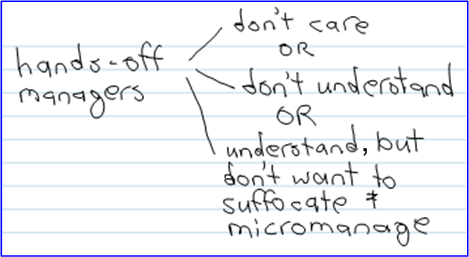
Got any others?
New Icon
The new icon‘s here! The new icon’s here! – Bulldozer00 (from the upcoming movie “The Jerk 2″)
Whoo Hoo! I’ve stumbled upon an icon that I’ll be using in future childish posts to represent female BMs, BOOGLs, BUTTs, and/or RAPPERs. It complements the venerable, male version nicely, dontcha think?

Fly On The Wall
Michael “Rands In Repose” Lopp has been one of my heroes for a long time. Here’s one reason why: rands tumbles – Friday Management Therapy. I would have loved to be a fly on the wall at that workshop, wouldn’t you?
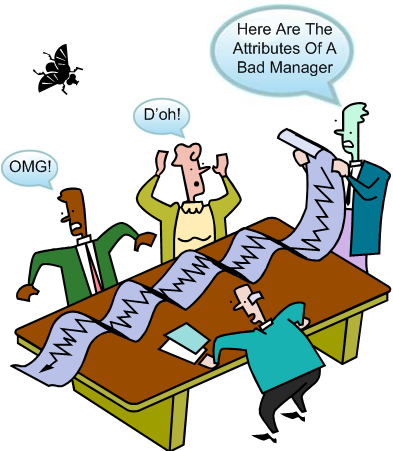
BTW, does anyone know what the”Buzz Kills” attribute means? If you don’t know what I’m talkin’ bout, then you didn’t click on the link and read the list. Shame on you 🙂
Inchies
So, what’s an Inchie? It’s an “INfallibility CHIp“. An Inchie is an invisible, but paradoxically real corpo currency that is the opposite of a demerit. An increasing Inchie stash is required to move up in a corpo caste system. The higher up you are in a CLORG, the more Inchies you have been awarded, and the more infallible you’ve become.
At level 0 down in the basement, you begin the game with 0 Inchies and you start making your moves – climbing the ladder Inchie by Inchie. Be careful and keep watch over your Inchie stash though, cuz your peers will try to steal your Inchies when you’re not looking.
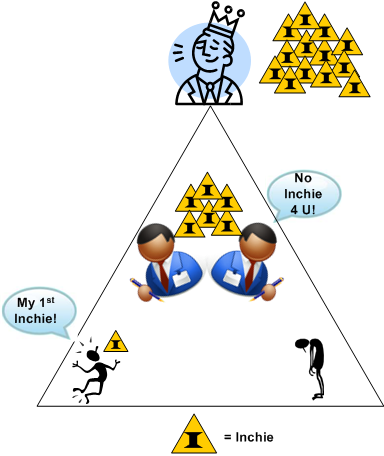 Alas, even though you now know that Inchies exist, don’t get your hopes up. You see, the criteria managers at level N (where N > 0) use for disbursing Inchies down to the less infallible people at level N-1 are random. Even among managers within a given level, the award criteria is arbitrarily different. Plus, to make the game more difficult, the dudes who awarded you your Inchies can take them back whenever they feel the need to “scratch your Inchie” – especially if you piss them off with career ending moves. D’oh!
Once you make it to the top of the pyramid with your big bag o’ Inchies, not only have you amassed the most Inchies in the DYSCO, but you’re given the keys to the Inchie minting machine. This gives you the opportunity to fabricate an unlimited number of Inchies to add to your display case and to sprinkle upon your sycophant crew as you please. You’ve become a 100% infallible god in the DYSCO microcosm. Whoo Hoo and Kuh-nInchie-wah!
Uneducated, Greedy, Fungible, Lazy, Untrustworthy
I enjoy reading Watts Humphrey‘s work, but it’s not because I’m a big fan of his TSP/PSP software development approach. It’s because his writings inspire me to think and inquire. Thus, his writings are full of great blog post seedlings.
In “Leadership, Teamwork, and Trust: Building a Competitive Software Capability“, Watts describes the unquestioned assumptions made by managers regarding workers back in the ole’ days when Frederick Taylor’s scientific management methods were king:
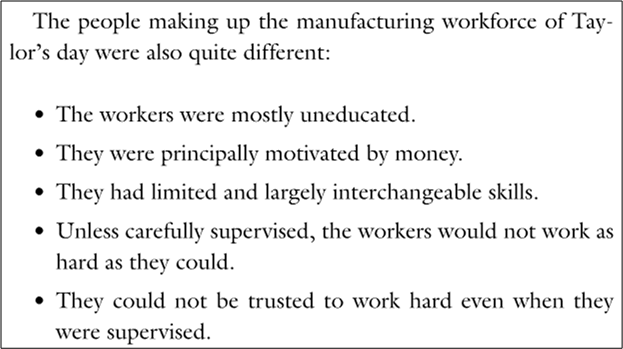
Uneducated, Greedy, Fungible, Lazy, and Untrustworthy – UGFLU. There must not be a vaccine for curing UGFLU because it seems like the affliction has heartily survived 100 years of medical advances. UGFLU is an adaptable and robust little bugger, no?

Which Path?
To all front line managers out there: “which path below did you take when you were promoted out of DIC-land?” To all DICs out there who want to, or are on a course to, move into the brave new world of management, uh, I mean formally anointed leadership: “which path below do you plan on taking?“.
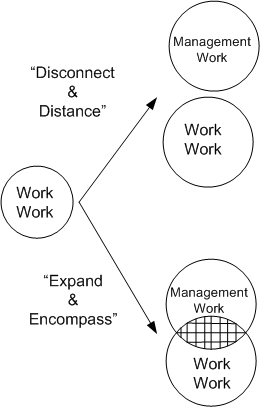
To all those who took or prefer the D&D path, please leave this page now. To the remaining E&E takers and preferrers, please peruse this follow-on diagram:

Will you allow the natural and effortless course of increasing entropy occur after you’ve made your choice, or will you temporarily “hold it together” with effortful due diligence throughout your career – no matter how high you go or how much pressure you feel from your peers?
Is it even reasonable to ask for any overlap between work-work and management-work as one ascends higher up in a hierarchically structured CLORG? For example, in a 10 layer hierarchy, is it insane to expect the dudes in the upper echelons to know something, anything, about the nature of the work that goes on down in the boiler room?
Norm And Dick
Since the main activity of some management chains seems to be preventing deviations from the norm, I propose that all managers change their names to “Norm“. It would complement “DICk” nicely, no?
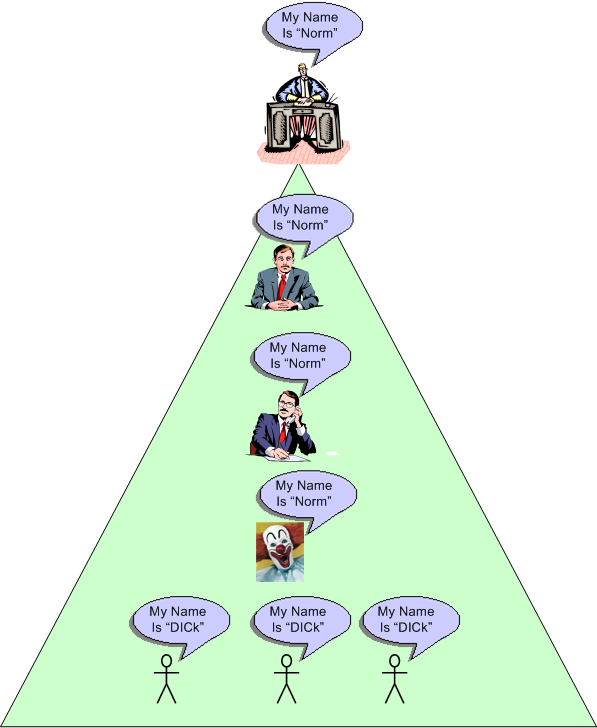
Without deviation from the “Norm“, there can be no progress – Frank Zappa
Thirty-Six Lucky Ones
With all this ranting that I do against hierarchical orgs, you’d think I would have been burned badly in the past by a succession of tyrant bosses. You’d be wrong. I’m fifty-two years old (D’oh!) and I’ve been working in hierarchies since I was 16. Throughout those 36 years, I can honestly say that I’ve never had a horrendous boss. I’ve worked for a handful of terrific ones that I deeply admire and respect. I’ve also worked for several good ones, and many average ones. In absolute terms, I’ve never felt underpaid, but in relative terms, I have (Waaah and Boo-Hoo!).

The “bad” experiences I’ve had within the hallowed halls of hierarchy were with 1 dimensional program managers, project managers, and product managers (damn-the-people-schedule-is-all-that-matters). Interestingly, the most friction I’ve been a co-creator of has been with manager wannabes. You know, those so-called technical peers who:
- talk a good, jargon-filled game to cover up their incompetence,
- continuously obstruct progress to fill their time and simultaneously cover up their own lack of contribution,
- don’t create any value directly – not even spreadsheets or Gannt charts in preparation for their upward advancement into the guild of management.
When those dudes do get promoted, and IMHO it has happened unconscionably often throughout my “career“, I steer clear of them. It’s BM city and my car ain’t gonna drive through it.
Even though I’ve been incredibly lucky with hierarchical bosses, I’ve known quite a few fellow DICsters over the years who’ve felt that they weren’t treated fairly by hierarchs – even by some of the exact same bosses that I’ve had.
How about you, what’s your boss story? Why won’t you tell me about it?

Why am I here?
WTF?
Meh!
D'oh!

My BTC Address



 Bulldozer00's Blog