Archive
Reeking Of Rank
In the 20th century (remember what it was like way back when?), “neutron” Jack Welch unabashedly, successfully, and transparently used a ranking system to catapult GE to the top of the financial world by ex-communicating the bottom 10% on a yearly(?) schedule.
When leadership teams make a corpo-wide policy change, they do so in a sincere attempt to improve some performance metric in the org without inflicting too much collateral damage. For example, take the above policy of “ranking” employees. Orgs that rank their employees may “assert” that rankings will increase engagement, morale, and let people “know where they stand” in relation to their peers.

That’s all fine and dandy as long as the ranking system applies equally to each and every level in the org – especially if it’s asserted to be a guaranteed slam dunk for increasing employee engagement . Hell, if it’s a no-brainer, then why exclude the supervisor, manager, director, and C-level layers? After all they’re “employees” too, no?
I wonder if #1 Jack Welch ranked his direct reports and gracefully escorted his bottom 10% out the door every year?

ReOrg City
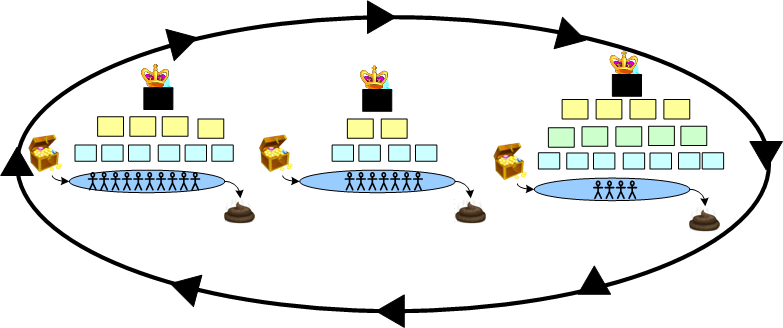
The structure of the “whole” and the behaviors at both the top and bottom remain the same. Only the width and/or height of the pyramid changes with each reorg. But alas, that’s just “the way it has to be“, no?

He’s In The MIX
Ricardo Semler, one of my innovation heroes, is now a MIXer: Ricardo Semler | Management Innovation eXchange. Until reading his first contribution to the MIX, I hadn’t seen hair nor hide of him for a couple of years. I had thought he’d retired or something like that.
As usual, in his “Retire-a-Little: Enabling More Fulfilled Working Lives“ management hack, Mr. Semler tells the story of yet another heretical and “outrageous” practice that he implemented at Semco Inc. Even if you don’t “buy into” his “retire a little” program, ya gotta love his 3 hour “Are You Nuts?” meetings, no? Try to picture the reception someone would get in your org for suggesting something like an “Are You Nuts?” initiative. Would anyone even attempt to suggest it?

Care-full
Check out this tweet from Stefan Stern:

21st century leaders “get” this recipe for building two way trust and respect. 20th century leaders demand that followers (willing or coerced) unconditionally care about what the leader wants. To them, establishing and nurturing a symmetrical, two-way caring relationship is not in the cards.
Quid pro quo Clarisse…. Quid pro quo – Hannibal Lecter
The D’oh Threshold
The figure below introduces the concept of the “D’oh Threshold“. Every institution has their own purely subjective “D’oh Threshold“. It is arbitrarily set by whoever is in charge.
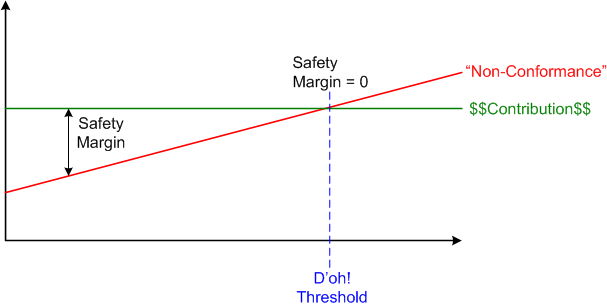
The more bureaucratic or dictatorial the org, the more the threshold shifts to the left (the less the positive safety margin and the more the negative safety margin). Since bureaucrats and dictators care more about conformance to their arbitrary and personally concocted rules than contribution to the “whole“, the “D’oh Threshold” wobbles all over the place. Its setting can vary month to month, day to day, minute to minute, group to group, individual to individual – depending on the emotional state and perceptions of those who run the circus.
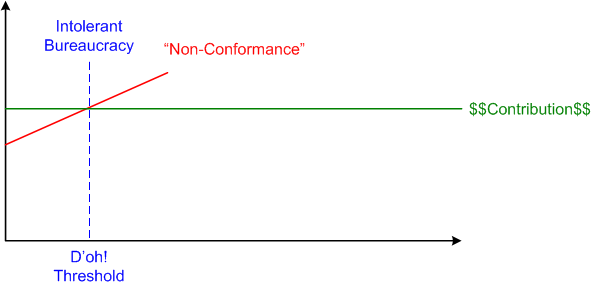
When humans are involved in organized group efforts, there is no escape from subjectivity. But in high performing orgs, the “D’oh Threshold” set point is relatively stationary, far to the right, and everybody knows where they stand.
Chain Of Disapproval

The Value Zone
Even though it’s been on my Kindle for a year, I just finished reading HCLT CEO Vineet Nayar‘s book, “Employees First, Customers Second“. It was low on my priority list because I already had read a slew of articles about the book when it was first released.
In EFCS, Vineet describes “the value zone” and “the so-called enabling functions” as follows:
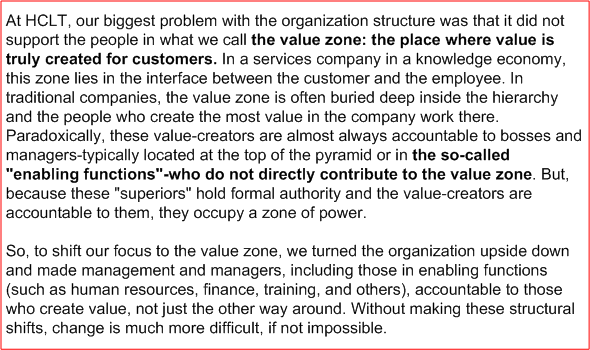
So, how did Mr. Nayar “force” the superiors who dwell in the enabling functions to be accountable to the value-creators? He did it by effectively implementing the HCLT “Smart Service Desk” (SSD) – a twist on the typical problem management system employed by most companies to resolve customer issues. Here’s how it works:
- Whenever an employee has a problem or needs information, he or she opens a ticket that is directed to the appropriate department for handling (including senior management and the CEO).
- Each ticket has a deadline for resolution.
- The system is transparent so that all could see the contents of the tickets and where they are in the process.
- The employee who had opened the ticket is the one to determine whether the resolution is satisfactory, or if the issue has been resolved at all.
Shortly after placing the SSD into execution, people “were opening tickets at an average of thirty thousand per month (at a time when there was a total of about thirty thousand employees in the company)“. Vineet sums up the system’s success as follows:
People were embracing the system. It was a victory for honesty, transparency, and openness!

Related articles
- HCL Technologies quarterly net profit rises 50 percent (news.bioscholar.com)
- Why HCL Technologies puts employees ahead of customers (tech.fortune.cnn.com)
- HCL Tech Q1 net up 50% at Rs. 496.7 crore (thehindu.com)
- Valuing Employees (Really!): Lessons from India (forbes.com)
Z6
In case you were wondering, Z6 stands for Zappos core value number 6:

I’m a huge Zappos fan and a VIP member (which means free overnight shipping for any purchase!). Thus, I get daily e-mails from zappos.com on special deals. The snippet you see above appeared at the bottom of one of those e-mails.
The joyful reason for this post is that Zappos is (rightfully) tenacious about promoting their 10 core values both internally and externally. CEO Tony Hsieh and his merry band truly understand how difficult it is to sustain and maintain a culture of joy and excellence – which is a pre-requisite to both financial and emotional success. Thus, with every chance they get, which includes the daily e-mail, they spread the word.
How about your company? Do you even know what their core values are, let alone “walk the talk“? Nah, an approach like Zappos’s won’t work there, right? It’s simply auto-assumed that writing down some inarguable altruisms and pontificating about them from time to time does the trick. There are more important issues to tend to, no?
Inner Work Life
The premise behind Theresa Amabile’s “The Progress Principle” is that individual performance in the work place is a function of the quality of one’s “Inner Work Life” (IWL). In addition, the greatest effector of a positive IWL is “continuing progress on meaningful work“.
To set the context for her subsequent findings, at the beginning of the book Ms. Amabile describes her research protocol:
“We recruited 238 people in 26 project teams in 7 companies in 3 industries. Some of the companies were small start-ups; some were well established, with marquee names. But all of the teams had one thing in common: they were composed primarily of knowledge workers, professionals whose work required them to solve complex problems creatively. Most of the teams participated in our study throughout the course of a particular project—on average, about four months. Every workday, we e-mailed everyone on the team a diary form that included several questions about that day. Most of those questions asked for numerical ratings about their inner work lives—their perceptions, emotions, and motivations during that day. The most important question allowed our respondents free rein: “Briefly describe one event from today that stands out in your mind. Amazingly, 75 percent of these e-mailed forms came back completed within twenty-four hours, yielding nearly 12,000 individual diary reports.”
The figure below shows the three tightly integrated and inseparable components of IWL and four major external forces that act upon it.
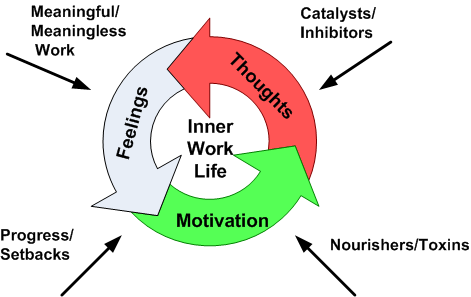
Of course, the quality of IWL can vary from month-to-month, day-to-day, and even hour-to-hour, depending on the presence and magnitude of the external forces acting upon it and the person-specific thoughts/feelings/motivation regarding said forces.
Contributors to an increase in IWL are catalysts, nourishers, meaningful work, and especially, progress on that meaningful work. Detractors are meaningless work, inhibitors, toxins, and setbacks to progress.
In orgs that are setup (either intentionally or unintentionally) as internally competitive command and control hierarchies where “me” is king, inhibitors, toxins, and setbacks abound. In great orgs, which can be structured as collaborative hierarchies or as any other pattern, catalysts, nourishers, and progress are pervasive up and down and across the structure.
Of course, the best parts of Ms. Amabile book are when she exhibits many of the heartfelt entries written by real people from her massive stash of 12,000 diary entries. Read it and weep, or read it and leap for joy, or read it and “meh“.

Related articles
Toxic Fungus
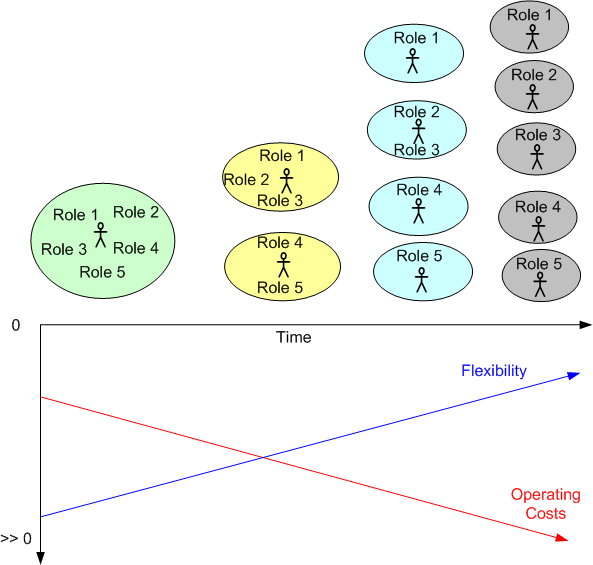
Unless due diligence is performed on the part of an org’s leadership junta/cabal/politburo, fragmentation of responsibility and unessential specialization can easily creep into “the system” – triggering a bloat in costs and increased operational rigidity. Like a toxic fungus, not only is it tough to prevent, it’s tough to eradicate. D’oh! I hate when that happens.

Why am I here?
WTF?
Meh!
D'oh!

My BTC Address



 Bulldozer00's Blog