Archive
Zero Experience
If you look at the “Categories” box on the right side of this blawg page, you’ll see that the number of posts categorized as “management” is much larger than any other category. However, except for 4 years of serving as a software “lead” on two different projects, BD00 has zero management experience over his un-illustrious career-end. Nada, zilch, the big goose egg.

So, you ask: “What gives BD00 the right to write about management practices and behaviors?” My good buddy and intellectual inferior, Mr. Albert Einstein, says it best in “Essays In Humanism“:
Many readers may ask: “What right has he to speak out about things which concern us alone, and which no newcomer should touch?” I do not think such a standpoint is justified. One who has grown up in an environment takes much for granted. On the other hand, one who has come to this country as a mature person may have a keen eye for everything peculiar and characteristic. I believe he should speak out freely on what he sees and feels, for by so doing he may perhaps prove himself useful.
Except for maybe the “mature” and “…for by so doing he may perhaps prove himself useful” parts, that’s one of the reasons why I do it. Another is that I’d love to see the guild move much more quickly toward what Gary Hamel calls “Management 2.0” instead of languishing in its 2oth century, self-serving creation.

He Said, He Thought, He Said, He Thought
In “Get Rid of the Performance Review!: How Companies Can Stop Intimidating, Start Managing–and Focus on What Really Matters“, Sam Culbert provides several, made-up, boss-subordinate exchanges to make his case for jettisoning the archaic, 1900’s “annual performance review“. For your reading pleasure, I lifted one of these depressingly funny exchanges out of the book and transformed it into a derivation of Chris Argyris’s terrific LHS-RHS format. It’s long, and it took me a bazillion years to recreate it on this stupid-arse blawg; so please read the freakin’ thing.
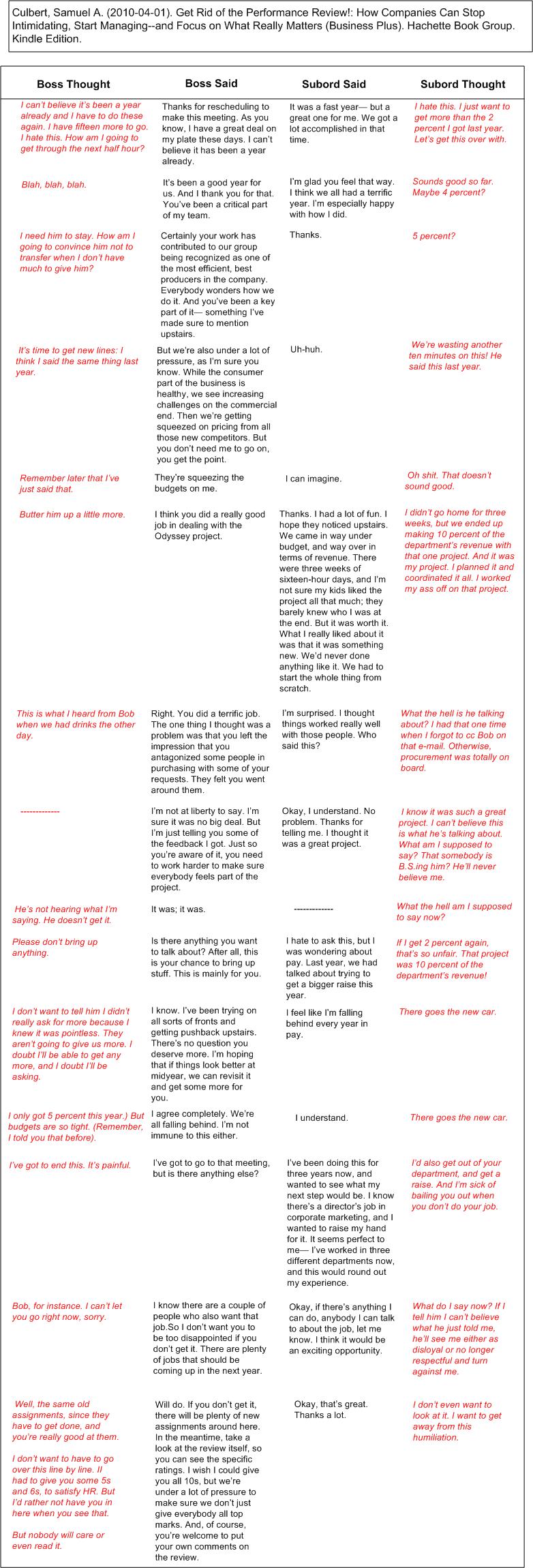
Did you notice how both the boss and the subordinate suffered from the ordeal? But of course, you don’t have to worry about experiencing similar torture because the “annual performance review” at your institution is different. Even better, your org has moved into the 21st century by implementing an alternative, more equitable and civilized way of gauging performance and giving raises.
In his hard-hitting and straight-talking book, Mr. Culbert, a UCLA management school professor and industry consultant firebrand (he’s got street cred!), really skewers C-level management. He fires his most devastating salvos at evil HR departments for sustaining the “annual performance review” disaster that sucks the motivation out of everybody within reach. And yes, he does provide viable alternatives (that won’t ever be implemented in established, status-quo-loving borgs) to HR’s beloved “annual performance review“. Buy and read the book to find out what they are.
Note: Thanks Elisabeth, for steering me toward Mr. Culbert’s blasphemous work. It has helped to reinforce my entrenched UCB and the self-righteous illusion that “I’m 100% right“. But wait! I’m not allowed to be right.
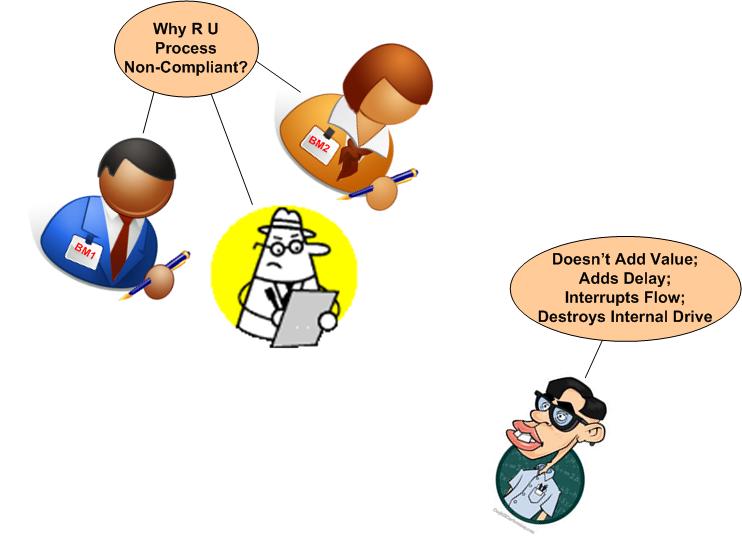
Non-Compliance
Behind One’s Back
Most reasonable people think that “talking behind one’s back” is a dishonorable and disrespectful thing to do. But aren’t many corpo performance evaluation systems designed, perhaps inadvertently, to do just that?
In some so-called performance evaluation systems, an “authorized” evaluator (manager) talks to an evaluatee’s peers to get the “real scoop” on the behavior, oops, I mean the “performance” of the evaluatee. But can’t that be interpreted (by unreasonable people, of course) as a sanctioned form of talking behind one’s back?
In these ubiquitously pervasive and taken-for-granted performance evaluation systems, when the covert, behind-the-back, intelligence gathering is complete and an “objective” judgment is concocted, it’s bestowed upon the evaluatee at the yearly, formal, face-to-face get together.
Wouldn’t it be more open, transparent, and noble to require face-to-face, peer-to-peer reviews before the dreaded “sitdown” with Don Corleone? Even better, wouldn’t it be cool if the evaluatee was authorized by the head shed to evaluate the evaluator?
“Mr. Corleone, just about every action you took last year slowed me down, dampened my intrinsic motivation, and delayed my progess. Hence, you sucked and you need to improve your performance over the next year.“
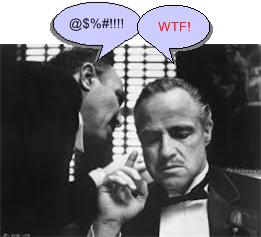
But alas, hierarchies aren’t designed for equity. Besides, quid pro quo collaboration takes too much time and we all know time is money. Chop, chop, get back to work!
To make the situation more inequitable and more “undiscussable“, some orgs institute two performance evaluation systems: the formal one described above for the brain dead DICsters down in the bilge room; and the undocumented, unpublicized, and supposedly unknown one for elite insiders.
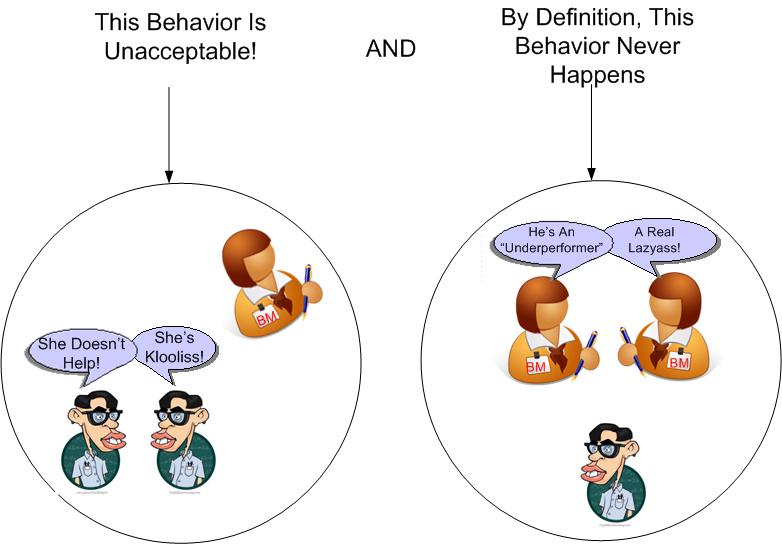
If you work in an org that has a patronizing, behind-your-back performance evaluation system, don’t even think of broaching the subject to those who have the power to change the system. As Chris Argyris has stated many times, discussing undiscussables is undiscussable.
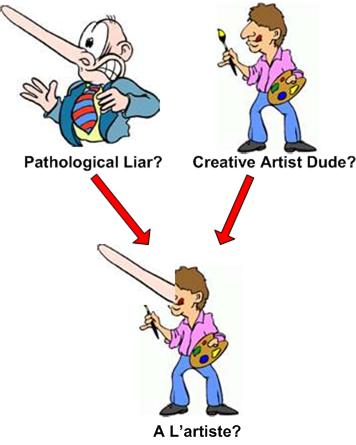
But wait! Snap out of that psychedelic funk you may have found yourself drifting into after reading the above blasphemy. Remember whose freakin’ blog you’re reading. It’s BD00’s blog – the self-proclaimed, mad, l’artiste.
Just One Measly Tweet?
I just found out from this article, “The $1.3 Trillion Price Of Not Tweeting At Work“, that Oracle’s mercurial CEO, Larry Ellison, has tweeted one, and only one, message out onto the ether. And a nasty one it is:
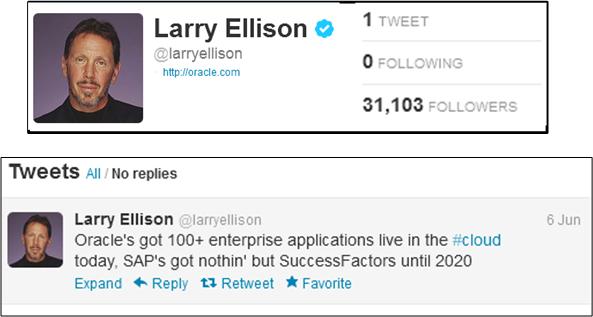
The Fast Company article’s author, HootSuite CEO Ryan Holmes, also states an interesting fact:
Among CEOs of the world’s Fortune 500 companies, a mere 20 have Twitter accounts. As social media spreads around the globe, one enclave has proven stubbornly resistant: the boardroom. Within the C-suite, perceptions remain that social media is at best a soft PR tool and at worst a time sink for already distracted employees. Without a push from the top, many of the biggest companies have been slow to take the social media plunge.
Ryan goes on to speculate that the status quo may change because of the findings in a report from the McKinsey Global Institute:
According to an analysis of 4,200 companies by the business consulting giant, social technologies stand to unlock from $900 billion to $1.3 trillion in value. At the high end, that approaches Australia’s annual GDP. Two-thirds of the value unlocked by social media rests in “improved communications and collaboration within and across enterprises”.
BD00 hopes that Mr. Holmes is right, but there’s a lot of inertia and outdated tradition motivating the mute behavior in the head shed. There’s paranoia about giving away too much information to competitors and there’s a fear that the penthouse occupants might say something that destroys the illustrious image of infallibility unconsciously burned into the minds of themselves and their minions.
Just cutting email out of the picture in favor of social sharing translates to a productivity windfall as “more enterprise information becomes accessible and searchable, rather than locked up as ‘dark matter’ in inboxes.”
Oh man, despite the risk of being served with a cease-and-desist order and/or being slapped with a slander lawsuit, I couldn’t resist the urge to do this:

Besides our buddy Larry, can you name all the faymoose people in this dastardly mugshot collage without using Google? I’d offer up a BD00.com T-shirt to the winner, but I’m all sold out.
Related articles
- CEOs and Social Media (web2.sys-con.com)
- Do Non Tweeting CEOs and Brands Leave Money on the Table? (radian6.com)
- How is Social Media Affecting Your Business? (elocal.com)
- Fortune 500 Increased Use of Social Media in 2012 – Twitter #1 (customerthink.com)
- Social Media’s Productivity Payoff (blogs.hbr.org)
1, 2, X, Y
Chris Argyris has his Model 1 and Model 2 theories of action:
- Model I: The objectives of this theory of action are to: (1) be in unilateral control; (2) win and do not lose; (3) suppress negative feelings; and (4) behave rationally.
- Model II: The objectives of this theory of action are to: (1) seek valid (testable) information; (2) create informed choice; and (3) monitor vigilantly to detect and correct error.
Douglas McGregor has his X and Y theories of motivation:
- Theory X: Employees are inherently lazy and will avoid work if they can and that they inherently dislike work.
- Theory Y: Employees may be ambitious and self-motivated and exercise self-control; they enjoy their mental and physical work duties.
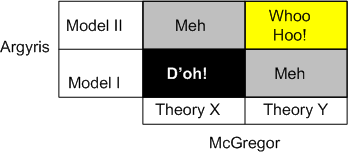
Let’s do an Argyris-McGregor mashup and see what types of enterprises emerge:
Killers Or Motivators?
It’s ironic that many of the words and phrases in “100 words that kill your proposal” are used by management and public relations spin doctors to project a false illusion of infallibility:
- Uniquely qualified, very unique, ensure, guarantee
- Premier, world-class, world-renowned, well-seasoned managers
- Leading company, leading edge, leading provider, industry leader, pioneers, cutting edge
- Committed, quality focused, dedicated, trustworthy, customer-first
How can these subjective and tacky words sink a business proposal on the one hand, but (supposedly) inspire and motivate on the other hand?

Espoused Vs. In-Use
Although we say we value openness, honesty, integrity, respect, and caring, we act in ways that undercut these values. For example, rather than being open and honest, we say one thing in public and another in private—and pretend that this is the rational thing to do. We then deny we are doing this and cover up our denial. – Chris Argyris
Guys like Chris Argyris, Russell Ackoff, and W. E. Deming have been virtually ignored over the years by the guild of professional management because of their in your face style. The potentates in the head shed don’t want to hear that they and their hand picked superstars are the main forces holding their borgs in the dark ages while the 2nd law of thermodynamics relentlessly chips away at the cozy environment that envelopes their (not-so) firm.
Chris Argyris’s theory of behavior in an organizational setting is based on two conflicting mental models of action:
- Model I: The objectives of this theory of action are to: (1) be in unilateral control; (2) win and do not lose; (3) suppress negative feelings; and (4) behave rationally.
- Model II: The objectives of this theory of action are to: (1) seek valid (testable) information; (2) create informed choice; and (3) monitor vigilantly to detect and correct error.
The purpose of Model I is to protect and defend the fabricated “self” against fundamental, disruptive change. The patterns of behavior invoked by model I are used by people to protect themselves against threats to their self-esteem and confidence and to protect groups, intergroups, and organizations to which they belong against fundamental, disruptive change. D’oh!
From over 10,000 empirical cases collected over decades of study, Mr. Argyris has discovered that most people (at all levels in an org) espouse Model II guidance while their daily theory in-use is driven by Model I. The tool he uses to expose this espoused vs. in-use model discrepancy is the left-hand-column/right-hand-column method, which goes something like this:
- In a sentence or two identify a problem that you believe is crucial and that you would like to solve in more productive ways than you have hitherto been able to produce.
- Assume that you are free to interact with the individuals involved in the problem in ways that you believe are necessary if progress is to be made. What would you say or do with the individuals involved in ways that you believe would begin to lead to progress. In the right hand column write what you said (or would say if the session is in the future). Write the conversation in the form of a play.
- In the left-hand column write whatever feelings and thoughts you had while you were speaking that you did not express. You do not have to explain why you did not make the feelings and thoughts public.
What follows is an example case titled “Submerging The Primary Issue” from Chris’s book, “Organizational Traps:Leadership, Culture, Organizational Design“. A superior (S) wrote it in regard to his relationship with a subordinate (O) regarding O’s performance.
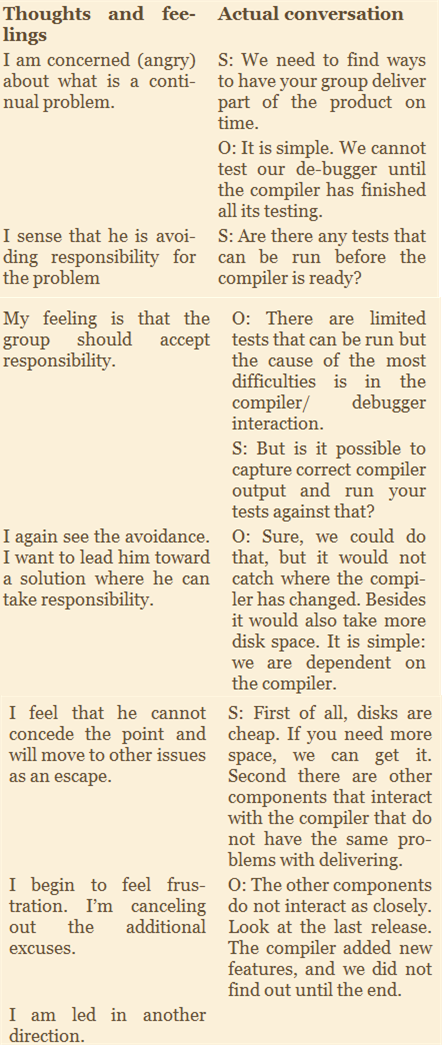
The primary issue in the superior’s mind, never directly spoken in the dialog, is his perception that the subordinate lacks a sense of responsibility. The issue that *did* end up being discussed was a technical one. (I’d love to see the same case as written by the subordinate. I’d also like to see the case re-written by the superior in a non-supervised environment.)
When Mr. Argyris pointed out the discrepancy between the left and right side themes to the case writer and 1000s of other study participants, they said they didn’t speak their true thoughts out of a concern for others. They did not want to embarrass or make others defensive. Their intention was to show respect and caring.
So, are the reasons given for speaking one way while thinking a different way legitimately altruistic, or are they simply camouflage for the desire to maintain unilateral control and “win“? The evidence Chris Argyris has amassed over the years indicates the latter. But hey, those are traits that lead to the upper echelons in corpoland, no?
Dispersion Of Ownership
Much as God was replaced by professional clergy who claim to “know” the will of God, the dispersion of ownership in a company (via the birth of the stock market) birthed the professional institution of management who claim to know the will of the owners.
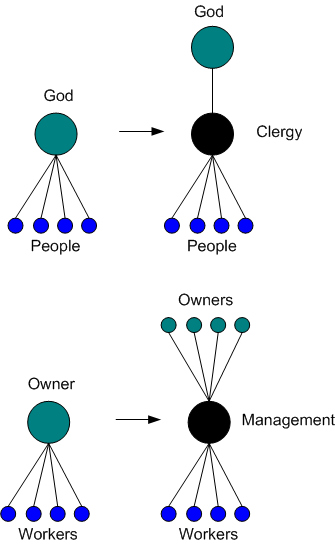
If the will of absentee owners is solely to extract maximal profit from the org, then management indeed knows the will of the owners. And since the workery can no longer communicate directly with the diluted and fragmented owner heap, their concerns and ideas are conveniently out of sight and out of mind; reinforcing the “maximal profit extraction” mindset.
Relying on the fairness of managers to balance profit with worker well-being is not much different than relying on the same behavior from a heap of unconnected, faceless owners because neither group is the original creator of the org.
Note: This post is the result of contemplation and reflection on the Russell Ackoff paper titled: “A SYSTEMIC VIEW OF TRANSFORMATIONAL LEADERSHIP“. It’s yet another unoriginal BD00 meta-post. As usual, I sketched up a picture and pasted some bogus words around it. You can probably come up with a better supporting story yourself. Give it a try.
Pragmatic?

Why am I here?
WTF?
Meh!
D'oh!

My BTC Address



 Bulldozer00's Blog