Archive
Heaps And Systems
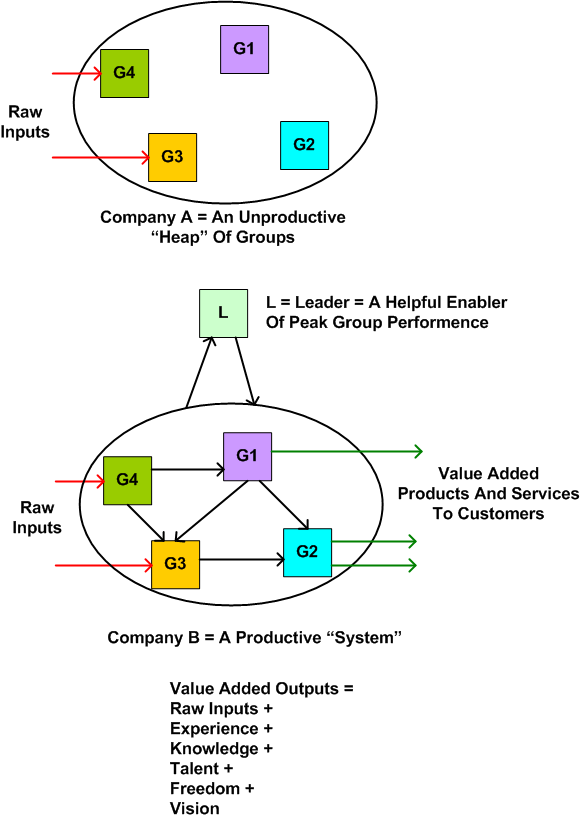
A “heap” is a collection of individual “parts”. A “system” is an intentionally designed set of interconnected parts with a purpose. The purpose of a system transcends AND includes the purpose of each of the individual parts. As an example, think of an automobile. If we disassemble one, we end up with a heap of individual parts. When these parts are assembled and interconnected in accordance with the purpose of human transportation as the goal, we may get a system. Structural design and interconnection are not enough. The system must be energized and steered so that purposeful behavior can be manifested. For a car, the energy is fuel and the steerer is a human being. For an organization of mutli-disciplined groups of people, the energy is motivation and the steerer is a leader. Without motivation and a leader, an organization of human groups is just an unproductive heap that consumes natural resources and doesn’t produce any value added output to share with the world.
The figure below shows two companies that are each comprised of 4 potentially diverse and productive groups of people. Company A is unconnected and leaderless. Thus, it just consumes resources from the external environment and produces nothing of value to share with the world. Company B is both connected and well led. What kind of company do you work for?
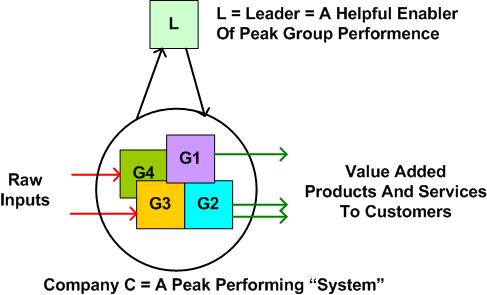
Look at company C in the illustration below. In this company, the leader has propelled his/her company to the head of the pack by creating the internal environment for, and nurturing the system’s internal groups and interfaces for peak performance. All of the internal connections and relationships between the groups are comprised of low latency and high bandwidth collaboration. Both high quality outputs and speed of execution distinguish company C from the rest of the herd.
In a high performing system, the danger of over-optimization looms in the form of inflexibility. A system optimized for a single purpose tends to harden and become resistant to change overt time – corposclerosis sets in. The trick for the leader is to create and sustain a delicate balance between optimization and flexibility that adapts with the rapidly changing external environment.
In an attempt to over-optimize performance, some leaders unknowingly morph into “managers”. They start inserting subordinate management layers of questionable value between themselves and the productive subsystems of the company. They start creating and accumulating titles that distance themselves from the productive groups. These and other symbols of status divide and alienate instead of integrate and endear. Instead of guiding, steering, and nurturing, they start commanding, controlling, and constraining. Productivity plummets and quality of workmanship deteriorates.
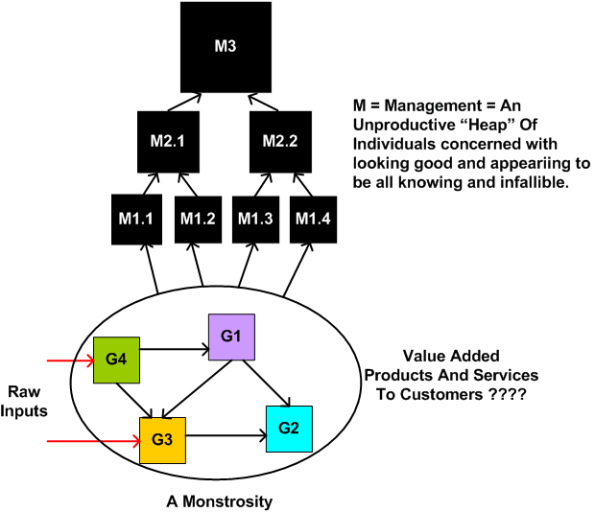
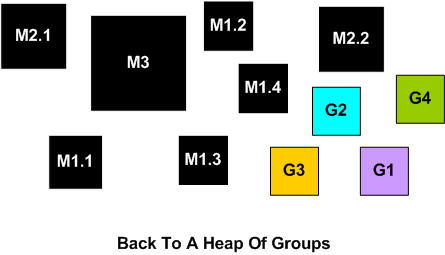
Because of increasing rules and procedures mandated by management, the internal interfaces between the formerly productive groups start transitioning into high latency and low bandwidth communication channels. In the worst case, like an overheated engine, the interfaces rupture and the system abruptly disintegrates; leaving an unconnected and purposeless heap of parts in its wake. Bummer.
Behavior And Performance
Assume that a company’s managers:
- Have a truly fair and objective system in place for judging employee behavior as good or bad
- Have a truly fair and objective system in place for judging job performance as good or bad
- Have the power to promote, fire, and tolerate (ignore) their employees.
For the moment, please indulge me by believing that assumptions 1 and 2 are true even though they are spectacularly and patently false. Given these 3 discretely valued parameters, there are 2 x 2 x 3=12 different combinations available to classify a company. The figure below shows 4 of these combos.

Which company would you want to work for? Which company comes closest to the company that you do work for?
Business Acquisition And Execution
To become and maintain a successful business, a company must both acquire and efficiently execute ongoing chunks of business. When top management values both of these critical work activities equally, then all is well. When they value one over the other, and in my business domain it’s always business acquisition that’s shown preferential treatment, then mediocrity reigns.
How do you know when top management is one sided? It’s easy, just look around. Who gets the single offices and single cubes? Who gets the bigger salaries? Who do the executives give way more face time to?
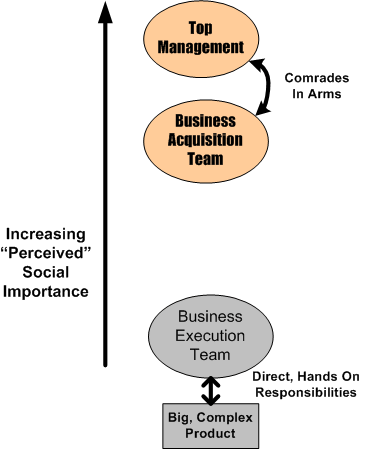
Business acquisition is glamorous and difficult, but in comparison, business execution is dirty, messy, and down right hard. When an acquisition team submits a proposal to a customer after a long and arduous courting period, it’s party time, and rightfully so. However, and this is key, the proposal doesn’t “have to work”. Products “have to work”, or else….
If a proposal is rejected and fails to acquire a chunk of business, then it’s usually because a competitor has offered up a similar or superior product for a lower price and/or a faster delivery time. The loser washes his hands clean and then just moves on to the next opportunity. It’s done and over with, kaput.
When a big, complex, and software-intensive product repeatedly and frequently fails in a customer’s day to day use of it, then continuous stress and pressure is placed on the execution team for what could be quite a long and sustained period of time. Until the execution team, usually through heroic acts of team sacrifice, makes the product behavior and performance “acceptable” to the customer, the two step chain of events is as follows: the customer pressures top management, and top management pressures the execution team. The loop of misery has been ignited. Notice that the acquisition team does not participate in the fun. In the worst case, the acquisition team merges with the top management team to apply greater pressure on the execution team.
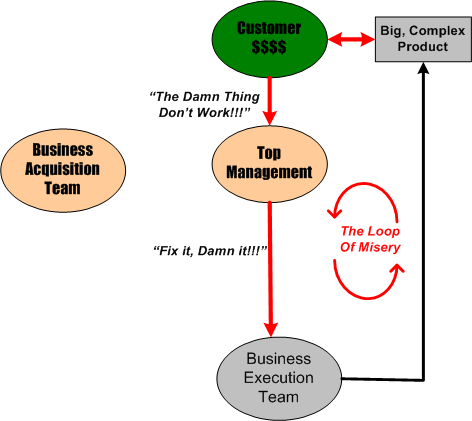
Don’t be a stupid arse like me. If you’re given the choice between participating on an acquisition team or an execution team, choose the acquisition team 🙂
Stagnation Or Growth?
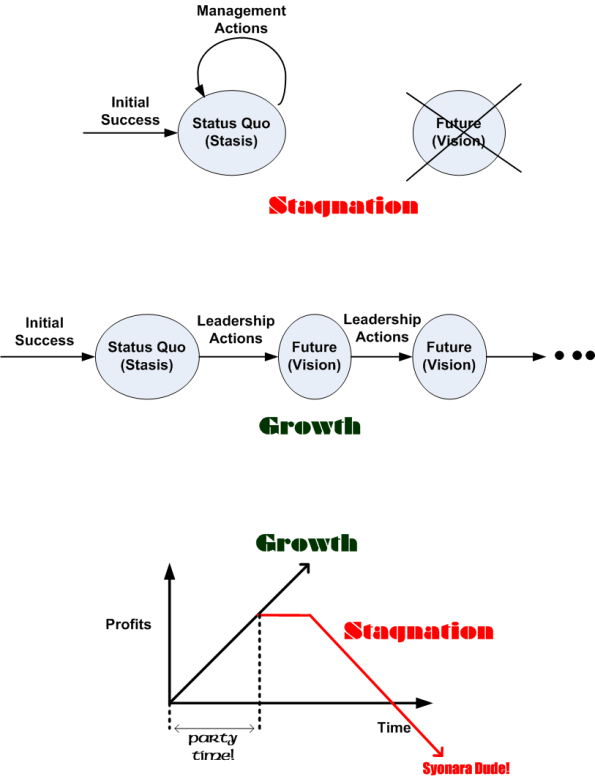
What type of system do you work in, day in and day out? Do you work for scared managers or courageous leaders?
Scouts
The figure below is intended to show a successful and profitable company operating in an external environment that’s changing over time. Since the corporation achieved its current successful state by employing strategies and practices that worked well to get it there, it naturally employs the same techniques over and over again. This causes the corpo walls to harden and protect those inside of the org from the forces of external change.

If the external winds of change are characterized by a low velocity (more like a breeze than a tornado), then the company’s success may last for quite a long time even though it’s unconsciously stuck in neutral and not adapting to the external environment. However, as the breezy external environment transforms into a maelstrom of tornadoes as a result of new competitors appearing and the sudden emergence of game changing technologies like the internet, company revenues/profits and the corpo pyramid may come tumbling down. Conscious and enlightenend company leaders know that stasis is a corpo killer, but textbook spreadsheet managers don’t.
One way to “sense” when change is needed is to formally designate a cadre of “scouts” at all functional levels of the org, from marketing all the way down the corpo steps to engineering and customer service. I first heard about the concept of scouts from Steve McConnell many years ago, before the internet and the exponential rise of third world engineering know how. At the time, I thought it was a novel idea and now I think it may be essential for survival.
As the picture below illustrates, scouts can serve as external sensors/probes that monitor and make meaning of the rapidly changing external environment. They separate the wheat from the chaff and, if they’re paid attention and nurtured, they can provide accurate information to corpo decision makers regarding which new technology and practices to embrace, and which new products to prototype and try.

Of course, dysfunctional org executives who think highly of themselves but don’t think much of their people (while simultaneously praising them as the company’s most valuable assets), will get what they deserve. They won’t create the role of a “scout” and they’ll ignore or subtlely berate self-motivated people who voluntarily perform the role of a scout. In their minds, they think they are the only ones who are capable of steering the company toward the future – using the same worn out , obsolete thinking that used to work but is virtually useless. Bummer.

Sassy!

The SAS Institute has been one of my favorite software companies to watch over the years. They were like Google before Google. The reason that I’m mentioning SAS is because while I was browsing through my notes, I stumbled upon this quote from a SAS manager:
Nothing corrodes respect between a boss and an employee more quickly than the sense that the boss has no idea what the employee is doing. Managers who understand the work that they oversee can make sure that details don’t slide. At SAS, groups agree on deadlines, and managers understand what their groups do — so unrealistically optimistic promises about time-tables and completion dates are relatively rare.
The quote came from this 2004 article in Fast Company magazine: Sanity Inc. The quote struck a chord with me back then, and it still does now. In my case, I don’t necessarily disrespect a manager that doesn’t know what I’m doing. I disrespect managers who:
- Are apathetic and show no interest in what I’m doing, regardless of whether they know the subject matter or not.
- Don’t ask me how I’m doing, and how they can help me do my job better, regardless of whether they know the subject matter or not.
- Just stop by only when they need to collect status, without wanting to hear about any bureaucratic procedural roadblocks that are, or specific people who are, hindering my progress.
- Pretend to know what I’m doing and make suggestions on what to do next, even though we both know (or, at least I know) that the manager has no clue.
How about you? What causes you to lose respect for your manager(s)?
There Are Lots Of “I”s In A Team
“Sacred Cows Make The Best Hamburger”
Do you ever get tired of hearing the old and worn out management cry: “There’s no I in team!”. In this article, I’d like to challenge that unquestioned assumption.
The left-hand figure in the graphic below depicts a man-made group with a bunch of “I”s thrown together. Since the motto is “it’s every man for himself,” the group shouldn’t really be called a team. It’s more like a heap of individual and unconnected parts. In a heap, the whole is nothing more than the sum of the parts.
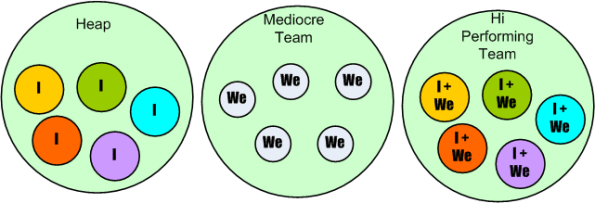
The figure in the middle of the graphic represents a group of people instilled with the “there’s no I in team” mentality. In this case, the group is more than the sum of its parts and it’s a much better problem solving structure than a heap of “I”s. However, because of the across-the-board homogeneity and lack of distinction between group members, the solutions produced by a group of “we”s are bland and mediocre, like unflavored oatmeal.
The figure on the right shows the ideal team. It’s composed of people who are motivated to succeed both individually and collectively. Relative to the other two types of groups, the team of “I + We”s is a super performer and it creates innovative solutions to problems. Thus, a high performing team is comprised of lots of “I”s.
Sadly, the vast majority of corpo organizations create hideous hybrid abominations like the one in the figure below. Yuk!
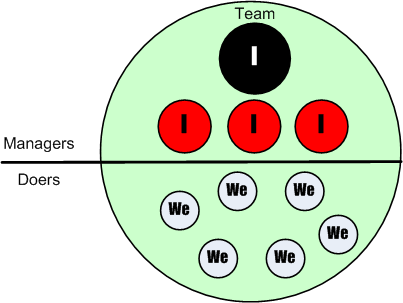
By; repeatedly espousing that “there’s no I in team!” to the doers sub-group; treating all work with the same apathetic reception regardless of relative quality; and punishing individual creativity; managers create and nurture a divided mediocracy. Of course, since they are the chosen ones, managers never follow the rules that they espouse for others. Thus, they are constantly and cleverly competing with their brethren for status and entitlement, operating as “I”s. It’s a good thing that the “we”s actually produce the outputs that allow the organization to survive, even though their products are mediocre and boring as hell.
Who’s Important?
Do you want to know who’s really valued by your organization’s so-called leadership? Just take a look at who’s located physically close to them. Look who’s got the big offices and what they’ve actually done to grow the organization. Look at who gets to go on company junkets. Look at who gets the training dollars. Are they the organization’s value producers, or are they the overhead consumers? Are they members of contracts, finance, marketing, human resources, business development, communications, compliance, or are they the people who create the value that keeps the organization alive: the engineers, the designers, the manufacturers, the integrators, the testers, the customer trainers, the customer support staff? Odds are that the people who directly create the wealth are cloistered in cubicle farms at the “back” or “bottom” of the building and treated as second class citizens. Long live those fossil managers who are stuck in the past and are ignorantly happy to operate by Ford’s , Taylor’s, and Sloane’s rules – regardless of what they say. Clueless dolts.
The Drunkard’s Walk
Assume that your company has a problem that needs to be solved. Management then creates a project and allocates resources: money, time and you, to solve the problem. The figure below shows the context that is established at project start. There’s you, the hairball problem, and a solution somewhere at the end of the project pipeline.
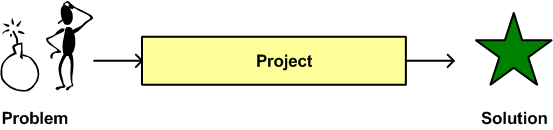
Since the best solution (out of an infinite set of possibilities) is almost always unknown a-priori, the amount of allocated money and time may not be correct. In my experience as a participant in the development and (mostly) maintenance of large, complex real-time embedded software systems, the “budgeted” amount of time and money is usually vastly underestimated. To top things off, management usually thinks that the problem-to-solution path is a linear, forward-only, sequential march to success.
The figure below shows the real drunkard’s walk that is traversed when a non-trivial problem gets solved. The start-to-end signature is person-specific. A prim and proper straight line to the solution through the official corpo process book never occurs. If you’re familiar with the problem domain and have solid experience with other similar problems, then your solution path may be less erratic than the path of others.
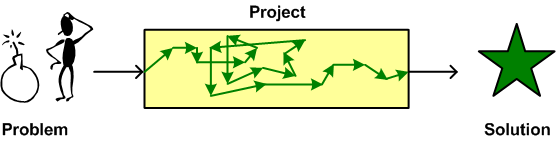
In the example above, notice how there are 3 occurrences of vector segments that go backward in time to revisit and correct mistakes. Each decision that you make to go backwards is a result of new knowledge discovery and learning. Sadly, because going backwards is a serious taboo in linear-sequential-think orgs, some people consciously decide to never go back, knowing full well that they’ve left some turds in the road for their followers to step in.
In a high pressure, micro-watched project, publicizing any regression steps to management in real-time is not a smart move. Even though it’s the truth, an unconscious force within you (ego) can cause you to lie and feign forward progress at every status reporting interval. Thus, in your manager’s mind, you’re “on schedule and under budget”. Splendid!
If you’re working on a multi-person project, then everyone else on the team is performing their version of the drunkard’s walk too. At each weekly breathalyzer test (oops! I meant status reporting meeting), everyone tries their damnest to appear sober in order to avoid a DUI .
Happy drinking!

Why am I here?
WTF?
Meh!
D'oh!

My BTC Address



 Bulldozer00's Blog