Archive
A Democratic Workplace? No Freakin’ Way!
“We’ll send our sons anywhere in the world to die for democracy,” says Ricardo Semler (CEO of Semco), “but don’t seem to apply the concept to the workplace. This is a tragic error, because people on their own developing their own solutions will develop something different“.
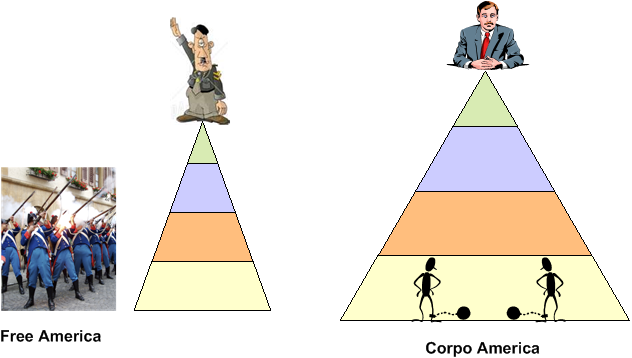
In Semler’s own firm, there are no five-year business plans (which he views as wishful thinking), but rather “a rolling rationale about numbers.” A project takes off only if a critical mass of employees decides to get involved. Staff determine when they need a leader, and then choose their own bosses in a process akin to courtship, says Semler, resulting in a corporate turnover rate of 2% over 25 years.
Interested in hearing more from Mr. Semler? Then check out this video of a lecture he gave to elite MIT business students way back in 2005:
Blasphemy! We know what’s best for all the cake eaters in our kingdom because we’re infallible, of course. That couldn’t possibly work here because our business is too different. It’s “not applicable“.
Four Managers And An Engineer
A lot of people have heard of the blockbuster movie “Four Weddings And A Funeral”, but no one has heard of the cinematic release in incubation titled “Four Managers And An Engineer“. The story line goes like this:
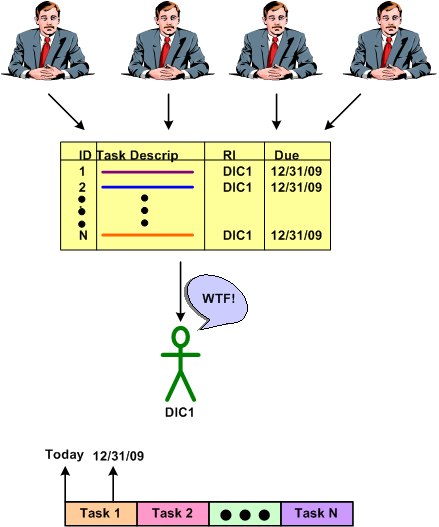
- One manager calls a “planning” meeting and invites three peer managers (actually two peers and one pseudo-manager) and one enginerd.
- The meeting host manager presents an initial powerpoint plan to the group.
- At the bottom of each and every plan page, the one enginerd’s name appears in a colored box coupled with a non-trivial task to do and a critical “need by” date.
- The enginerd points out the irony of the four-to-one ratio of managers to enginerds present at the meeting when other more important managers up the chain are crying out for higher profit numbers.
- To further build tension in the melodrama, the enginerd asks why no one else on the team was assigned any of these critically important tasks.
- One more Hershey kiss is added to the pile of poop when the enginerd graphically shows that sequentially placing the task boxes end-to-end (since they’re assigned to one bottleneck taskee) would blow the “planned” schedule out of the water.
- As the coup de grace, the enginerd asks what non-technical management tasks the managers assigned to themselves, and why they’re not in the plan with their names next to them.
- In a coordinated rage, the managers attack the engineer and bludgeon him/her to death with their blackberrys and leather bound Covey planners.
- The managers then; hide the body, replace the name of the deceased engineer on every page of the powerpoint plan with that of another enginerd, call another meeting, and invite themselves along with the next victim to their group-conspired serial killing spree.
Like another blockbuster movie, “Ground Hog Day”, the cycle repeats itself ad-infinitum. Unlike Ground Hog Day, there’s no breaking out of the loop and no transitioning to a happy Hollywood ending. The movie drones on until the audience gets bored to death and leaves the theater or the projector breaks down, whichever comes first. Wanna role in my movie? Wanna be the director? Wanna finance it?
Management Gurus
Every student of management methods has heard of the blah, blah mainstream gurus like Prahalad, Charan, Christensen, Covey, Collins et al. How many of you have heard of Argyris, Mintzberg, Ackoff, Warfield, Ackoff, Beer, Livingston? You never hear of these dudes because they’re out on the lunatic fringe. They’re heretical, in-your-face realists who tell it like it is; which rubs CEOs and self-important top management teams the wrong way, of course. Thus, their work is ignored.

Stunning, But Not Surprising
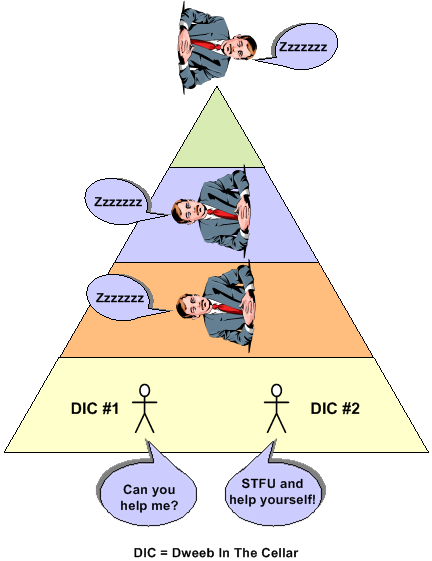
Suppose you had an innately complex product to sell. Now suppose that a potential customer comes up to you and asks for a user’s starter guide to help him/her understand your product for the purpose of making a buy decision. Would you tell that customer “We’re short-handed and have schedules to meet, so write It yourself!“? WTF!
For people who work in CCH bureaucracies but don’t know it (or who do know it, but conveniently ignore it and don’t do squat to dissolve it), this behavior between internal groups is ubiquitous, systemic, and so pervasive that it’s taken for granted. It’s stunning, but not surprising.
Surprise! GM Is Still Hosed
In a followup to my first post on GM’s initial BS attempt to dismantle their horrendous do-nothing-but-line-management’s-pocket-with-dough Command And Control Hierarchy (CCH), I submit this freshly minted AP article. It describes yet another management shake up at post-bankruptcy, taxpayer-money-sucking GM. The “new” (LOL!) leadership continues to pray that the feeble and well worn tradition of sloganeering and cajoling will stave off annihilation. Geeze, these elite hierarchs are really doing quite a job earning their seven figure paychecks, dontcha think?
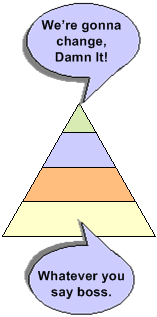
In announcing a sudden management overhaul yesterday, GM chairman and acting CEO Ed Whitacre Jr. was speaking Lutz’s words when he told employees that the bureaucracy needs to end and they can take reasonable risks without fear of being fired.
“We want you to step up. We don’t want any bureaucracy,’’ Whitacre said to about 800 GM workers. “We’re not going to make it if you won’t take a risk,’’ he said in the address, which was broadcast to employees worldwide on the Internet.
Uh, yes massa CEO, we’ll do whatever you say, dear leader. We sincerely believe that you’re a man of high integrity and impeccable credentials who speaks the truth and will lead us to the promised land. We’ll gladly storm the machine gun nests that guard the status quo for you. Blech.
Whitacre, 68, who has been frustrated with the pace of change, appointed the 77-year-old Lutz as a top adviser, creating an alliance of hard-charging veteran executives to lead the troubled company.
Yeah, that’ll do it. A 145 year duo of machine age, assembly line thinkers who probably don’t know WTF “WTF” means. Social intra-networking? Corpo-wide sharing of accessible and findable information? Sincere collaboration within and between layers of rank and status? Transparency, Authenticity, and Openness? Sorry to be so negative, but not a chance.
Sadly, I await the next big GM makeover and press release.
Unforgettable
Like telling telling someone: “You’re the worst project manager I’ve ever worked for!“, being told “You can’t lead anything!” is pretty unforgettable. I was the transmitter of the former subjective sentence, and the receiver of the latter subjective sentence – by someone who thinks it’s objective, of course. As time ticks by, I’m glad that I’m becoming more and more comfortable accepting opinions that I don’t agree with, especially the infallible opinions of those in positions of authority.

Culture Adjustment
I think that almost everyone heard about this week’s glitch in the air traffic control system that caused hours of flight delays. Here’s an interesting quote from the government’s GAO (FAA computer failure reflects growing burden on systems — Federal Computer Week):
“However, FAA faces several challenges in fulfilling NextGen’s objectives, including adjusting its culture and business practices, GAO concluded.”
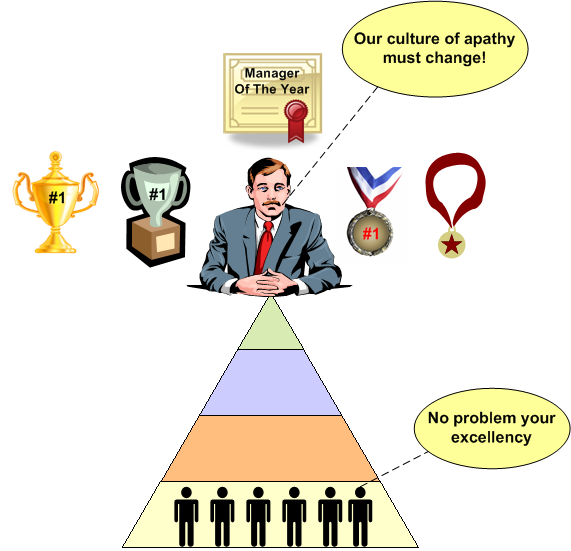
Well, duh. Every mediocre and under performing corpo borg needs to “adjust its culture and business practices”. It’s just that none of them have the competence to do it, regardless of how many titles and credentials that the corpocrats running the show adorn themselves and their sycophants with.
Partial Training
If you’re gonna spend money on training your people, do it right or don’t do it at all.
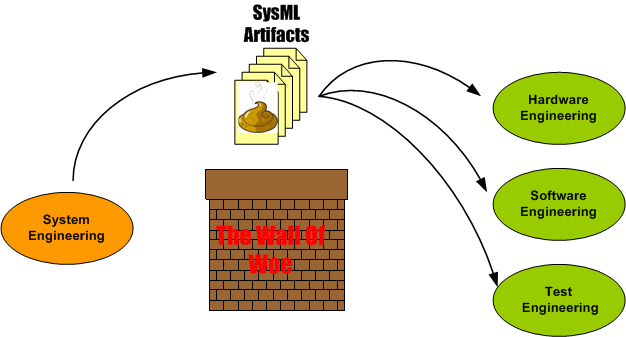
Assume that a new project is about to start up and the corpo hierarchs decide to use it as a springboard to institutionalizing SysML into its dysfunctional system engineering process. The system engineering team is then sent to a 3 day SysML training course where they get sprayed by a fire hose of detailed SysML concepts, terminology, syntax, and semantics.
Armed with their new training, the system engineering team comes back, generates a bunch of crappy, incomplete, ambiguous, and unhelpful SysML artifacts, and then dumps them on the software, hardware, and test teams. The receiving teams, under the schedule gun and not having been trained to read SysML, ignore the artifacts (while pretending otherwise) and build an unmaintainable monstrosity that just barely works – at twice the cost they would would have spent if no SysML was used. The hierarchs, after comparing product development costs before and after SysML training, declare SysML as a failure and business returns to the same old, same old. Bummer.
A Flurry Of Activity
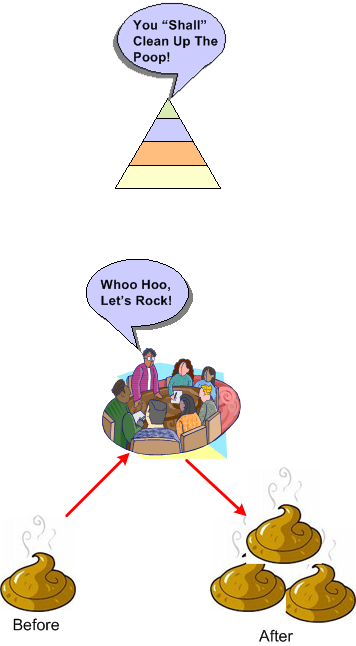
It’s always fun to watch the initial stages of euphoria emerge and then disappear when a corpo-wide initiative that’s intended to improve performance is attempted. The anointed “design” team, which is almost always filled exclusively with managers and overhead personnel who conveniently won’t have to implement the behavioral changes that they poop out of the initiative themselves, starts out full of energy and bright ideas on how to solve the performance problem. After the kickoff, a resource-burning flurry of activity ensues, with meeting after meeting, discussion after discussion, and action item after action item being tossed left and right. When the money’s gone, the time’s gone, and the smoke clears, business returns to the same old, same old.
As a hypothetical example, assume that an initiative to institute a metrics program throughout the org has been mandated from the heavens. At best, after spending a ton of money and time working on the issue, the anointed design team generates a long list of complicated metrics that “someone else” is required to collect, analyze, and act upon. The team then declares victory and self-congratulatory pats on the back abound. At worst, the team debates the issue for a few meetings, conveniently forgets it, and then moves on to some other initiative – hoping that no one notices the useless camouflage that they left in their wake. Bummer.
We Promise To Change, And We Really Mean It This Time
GM is a classic example of a toxic Command and Control Hierarchical (CCH) corpocracy. In this NY Times article, the newly anointed hierarchs and their spin doctors promise that “things will be different” in the future. Uh, OK. If you say so.
According to corpo insiders, here’s the way things were.
…employees were evaluated according to a “performance measurement process” that could fill a three-ring binder.
“We measured ourselves ten ways from Sunday,” he said. “But as soon as everything is important, nothing is important.”
Decisions were made, if at all, at a glacial pace, bogged down by endless committees, reports and reviews that astonished members of President Obama’s auto task force.
“Have we made some missteps? Yes,” said Susan Docherty, who last month was promoted to head of United States sales. “Are we going to slip back to our old ways? No.”
G.M.’s top executives prized consensus over debate, and rarely questioned its elaborate planning processes. A former G.M. executive and consultant, Rob Kleinbaum, said the culture emphasized past glories and current market share, rather than focusing on the future.
“Those values were driven from the top on down,” said Mr. Kleinbaum. “And anybody inside who protested that attitude was buried.”
In the old G.M., any changes to a product program would be reviewed by as many as 70 executives, often taking two months for a decision to wind its way through regional forums, then to a global committee, and finally to the all-powerful automotive products board.
“In the past, we might not have had the guts to bring it up,” said Mr. Reuss. “No one wanted to do anything wrong, or admit we needed to do a better job.”
In the past, G.M. rarely held back a product to add the extra touches that would improve its chances in a fiercely competitive market.
“If everybody is afraid to do anything, do we have a chance of winning?” Mr. Stephens said in one session last month.
The vice president would say, ‘I got here because I’m a better engineer than you, and now I’m going to tell you how bad a job you did.’ ”
The Aztek was half-car, half-van, and universally branded as one of the ugliest vehicles to ever hit the market. … but his job required him to defend it as if it were a thing of beauty.
Here’s what they’re doing to change their culture of fear, malaise, apathy, and mediocrity:
G.M.’s new chairman, Edward Whitacre Jr., and directors have prodded G.M. to cut layers of bureaucracy, slash its executive ranks by a third, and give broad, new responsibilities to a cadre of younger managers.
Replacing a binder full of job expectations with a one-page set of goals is just one sign of the fresh start, said Mr. Woychowski.
Mr. Lauckner came up with a new schedule that funneled all product decisions to weekly meetings of an executive committee run by Mr. Henderson and Thomas Stephens, the company’s vice chairman for product development.
Mr. Stephens has been leading meetings with staff members called “pride builders.” The goal, he said, was to increase the “emotional commitment” to building better cars and encourage people to speak their minds.
“But now we need to be open and transparent and trust each other, and be honest about our strengths and weaknesses.”
So, what do you think? Do you think that these “creative” CCH dissolving solutions and others like them will do the trick? Do you think they’ll pull it off? Is it time to invest in the “new” GM’s stock?

Why am I here?
WTF?
Meh!
D'oh!

My BTC Address



 Bulldozer00's Blog