Archive
A $1.6M Mistake – And No One Was Fired
The other day, I discovered that a human mistake made on Zappos.com’s sister web site, 6pm.com, emptied the company’s coffers of $1.6 million dollars. Being the class act that he is, here’s what CEO Tony Hsieh had to say regarding the FUBAR:
To those of you asking if anybody was fired, the answer is no, nobody was fired – this was a learning experience for all of us. Even though our terms and conditions state that we do not need to fulfill orders that are placed due to pricing mistakes, and even though this mistake cost us over $1.6 million, we felt that the right thing to do for our customers was to eat the loss and fulfill all the orders that had been placed before we discovered the problem. – Tony Hsieh, CEO, Zappos.com
If this happened at your company, what would your management do? Do ya think they’d look at it as a learning experience?
Besides Zappos.com, here are the other companies that I love. What are yours, and is the company you work for one of them?

DICbox Be Gone!
Check out the “DIC in the box” below. The DICbox is drawn around the DICster because that’s the way BMs dehumanize the person behind the DIC label. They do this, of course, in order to make their so-called job easier and to preclude getting their hands dirty with unimportant people. In a BM’s mechanistic mind, all DICs are the same and they’re interchangeable.
In a corpricracy, DICs are given work to do and, if they’re competent and self-motivated, they create high quality work products that increase the wealth of the corpricracy – in spite of the management chicanery that takes place.
 The figure below shows an expanded DICbox model with a BM integrated into the system. Since the dude is part Bozo, he doesn’t:
- have a clue (or care) what the work is,
- know (or care) what it takes to do the work,
- know (or care) what the work products are, or how to evaluate them.
That’s why there are no connections in the picture traversing from the work products or work definition flows to the BM. Of course, the BM feigns it as best he can and knows some generic technical buzzwords like “requirements”, “analysis”, “design”, etc. To a BM, all technical projects, from web site development to space shuttle development, are the same – a linear, sequential, unchangeable schedule of requirements, design, coding, testing, and delivery.
 Since the BM is in over his head, he must justify his highly compensated existence. He does this via the only option available: behavior watching. Thus, all he essentially does is intently watch for non-conformance of DIC behavior to a set of unwritten and arbitrarily made up corpo rules. He really shines when he detects a transgression and issues the boiler plate “get with the program” speech (a.k.a peek a boo visit) to coerce the DIC back into the box. If that fails, he calls in the big guns – his fellow overhead management dudes in the HR silo. But that’s another story.
OK, OK. So you want to arse me on my own turf and say: “It’s easy to whine and complain about bad management. I’m as good as you are at it.” You follow that up with “How should it be, smarty pants?“. Well here’s one model:
 I don’t think the above model needs to be accompanied with much explanation. However, I do think these caveats should be pointed out:
- The DICbox is gone.
- The “BM” label has been replaced by “Leader”.
- The work is co-defined by the leader and the doer.
- The leader knows what the work products should be (work products = “expected outcomes” in management lingo).
- The leader still watches behavior, not as an end in itself, but as a means to help the doer grow, develop, and succeed.
- The leader does what some people (like me) may consider – real work.
ICONIX SysML Training Postscript
Since I’ve noticed that my ICONIX SysML training preview post has received quite a few hits over the past several months and I haven’t written a followup post, I decided that now is the time to do it.
The Bad
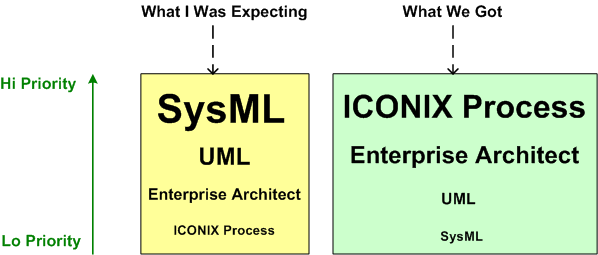
When the course was over, I felt very disappointed. Instead of focusing on SysML – which is embedded in the title of the course, SysML was given second class treatment and the main thrusts were centered on:
- Teaching the usage of the big and sprawling Enterprise Architect software modeling and code generation tool
- Teaching a “bent”, non-standard, subset of UML that supports ICONIX’s homegrown software design process: “Use Case Driven Object Modeling“
Only the last (not first) one third of the class handout covered the SysML diagrams and symbolology while the first two thirds covered UML, albeit in a subserviant role to the ICONIX process.
The Good
Although the examples in the handout material were all geared toward database-centric business transaction systems, but my company is in the business of building real-time sensor systems, the teachers facilitated the real time development of a set of use cases, robustness diagrams, and class diagrams for the sensor project we were kicking off. It was a worthwhile team building experience and it surfaced a boatload of ambiguities and misunderstandings between team members. The teachers were skilled facilitators and they did a great job keeping things moving briskly while remaining in the background and not dominating the working sessions.
The Summary
What A Deal!
Do you know those dorky self-promotional license plate holders that car dealers attach to your sparkling new vehicle before you drive it off the lot? Well, the Gold’s gym that I religiously go to has had a stack of them publicly available for sale over the past couple of months. When I first saw them next to the other items for sale, I said to myself:
“WTF? Do the clueless BMs in charge of this place really expect to sell any of those stupid, self-serving contraptions? Hell, even if they offered to pay gym members to take them, they’d still gather dust and waste shelf space until someone in the corpo chain of elites finally took responsibility and owned up to the grumpy they pinched in public.”
About a week ago, management placed the stack of crap right on the check-in counter with a sign that proudly displayed a massive reduction in price from $5 to 1$. What a deal, no?
I finally couldn’t take it anymore and I asked my fellow DIC manning the counter if her management really thought they’d be able to sell those abominations. She said she didn’t know and that she personally hadn’t sold a single one over the time they’d been placed on the market. Surprise!
I left the gym that day suggesting that she tell her bosses that a customer said that they should concentrate more on continuously satisfying their customers instead of thinking of them as moronic walking wallets. As an example of customer satisfaction, I told her to ask “them” if they could refill the woefully deflated balance balls every once in awhile. I even suggested (and it wasn’t the first time) that if they put a pump near the ball rack, I’d fill them occasionally and maybe other users would too. Knowing the typical BM mindset, they probably auto-rejected the idea because they’d be afraid that their “customers” would steal the pump.
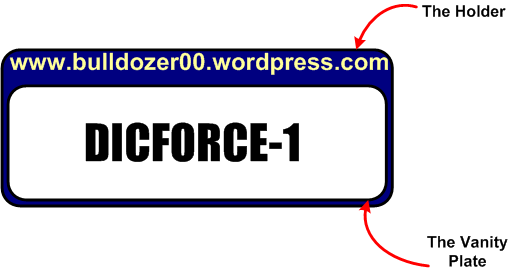
How much would you pay for my license plate holder?
Seeking Trouble
I’ve had the Kindle version of it for awhile, but I’ve finally got around to reading “Gurdjieff” by John Shirley. I’m glad I did because early in the book, this passage stirred up some internal energy:
According to the Gospel of Thomas, Jesus said, ‘ Let him who seeks continue seeking, until he finds. When he finds, he will become troubled. When he becomes troubled, he will be astonished, and he will rule over all.'”
It caused an energy surge because I’ve seeked and found trouble, deep trouble, multiple times. I’ve found that virtually everyone, both individually and collectively, behaves unconsciously according to the selfish “I” thought. Of course, this mass of humanity includes me, especially.
So, I’ve seeked, found trouble, and became astonished. However, I’ve yet to “rule over all”, which I think wasn’t meant to be taken literally. Hell, I’d settle for just ruling over my false self. How about you, have you found trouble?

Armed And Ready
How much technical acumen does a project manager need to have in order to effectively manage a software-intensive product development effort? Are Spreadsheet, Gannt chart, PERT chart, EVM, Microsoft Project skills, and a golden certificate from schools like the vaunted PMI the only tools needed to lead a multi-disciplined, technical crew of engineers to so-called victory? I think not, but you may think differently – especially (and understandably) if you’re a project/program manager.
I think effective technical project managers are rare and they sprout from the trenches of one or more of the technical disciplines: software, hardware, test, and systems engineering. Wrestling with technical problems in the mud while under schedule pressure from multiple managers to keep costs down and to deliver quality promptly is the hazing experience needed to appreciate both the financial and technical aspects of a project or program. It may seem that project and program managers are under pressure themselves from executives above them in the command and control hierarchy, but unlike the dudes at the bottom of the food chain, they can easily pass the buck when financial and technical goals aren’t met. Who do ineffective BMs pass the buck to when the execs in the heavens demand accountability for poor project performance (usually way downstream after project execution has been supposedly progressing splendidly)? Why, the dweebs in the cellar of course.
“You have to know a lot to be of help. It’s slow and tedious. You don’t have to know much to cause harm. It’s fast and instinctive.” – Rudolph Starkermann
Cranking fat heads off the project management education assembly line and arming them with the necessary but insufficient skills to lead technically smart people into the raging battle against complexity is like arming firefighters with squirt guns to put out a 5 alarm fire. All it does is perpetuate the illusion of control and prep the graduates for moving higher up on the Plan-Watch-Control-Evaluate ladder – even though they don’t have a clue as to what they’ll be planning-watching-controlling-evaluating. But hey, I like to make things up and I’m not fit to lead anything, so don’t listen to a word I say 🙂

From Searcher To Explorer
Most spiritual teachers advise students to “stop the search!”. Like many other frustrated spiritual aspirants, I don’t know of any other strategy for attaining enlightenment, an awakening, inner peace, relief from suffering, separation from ego, or whatever you want to call it.
To me, “searching” means looking for something specific, like lost keys or oil. Since I don’t have a freakin’ clue as to what “enlightenment” is and I do want to follow the advice of those who purportedly have dissolved the ego (or at least have rid themselves of ego-dominance), I’ve stopped being a searcher. As of today, I’m now (drum roll please) an explorer! Since exploring means probing and sensing for the new and unknown, that’s what I will do from now on.

OK, OK, back to reality. This post is just another self-delusional attempt to fill a new bottle with the same old wine, err, vinegar. Ergo, on with the search!
Expected Forgetfulness
BMs and CCRATs in mediocracies always require that the DIC-force conveniently forget the parade of reorgs and resource draining initiatives that they have started but have never followed through on over the years. However, they’ll be the first to remind project contributors when they “haven’t met schedule” or when their project came in “over budget“.
DIC-sters, either consciously out of fear or unconsciously from years of mind-numbing indoctrination, comply dutifully with the “expected forgetfulness” rule in order to preserve the mediocre performance that gives a mediocracy is meaning. All attempts to point out the blatantly obvious but undiscussable hippocracy of CCRAT demands for schedule and cost compliance, while simultaneously underperforming in these areas themselves, is met with swift retribution. This happens even in the extremely rare cases when a hierarch himself loses his sanity for a nanosecond and tries to right the wrong.

Waiting For Management Guidance
In “The Design Of Design“, Fred Brooks laments that he used to be able to track new developments in the entire field of software engineering – which was born in 1968. In the present age, because of massive innovation, expansion, and deep specialization requiring steep learning curves, he realizes that there’s no hope of anyone being super human enough to keep up anymore.
Since I used to try to keep abreast of all developments in the field, I felt the same way as Fred. Now, I have a strategy that keeps me from staying awake 24×7 reading books, papers, newsletters, blogs, and articles. I filter the tsunami of information down by trying to track developments only in my domain of focus; distributed and embedded real-time systems. I occasionally look into the fast moving enterprise IT technology space for cross-domain applicability of ideas, but it’s all I can do to keep abreast of my area while simultaneously doing some real application work that adds value to my company‘s products.
How about you? Do you find yourself overwhelmed by the rate and amount of information being created and disseminated in your field? Do you care about and pursue personal exploration and discovery, or do you just punch the clock and wait for the infallible geniuses in management to guide and train you in the new technologies that could keep you and your org viable? If it’s the latter, then you may (as the left portion of the figure below shows) remain stuck in the stagnant and boring “Waiting For Management Guidance” state forever. If you’re dwelling in this sad and potentially infinite state, there is still hope in the form of an “epiphany” of understanding – big daddy ain’t gonna help you grow personally or professionally.
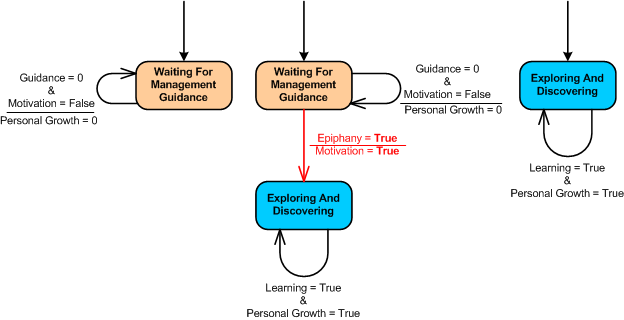
Ideally, one never wastes any time in the spirit-sucking “Waiting For Management Guidance” state. The “Exploring And Discovering” state, which is a natural gift to all human beings, would be transitioned to right out of the box. When we are born, we actually do enter this state right out of the box – so to speak. As soon as we start going to school, the institutional indoctrination starts and before we can say WTF?, we’re well on our way to the “Waiting For Management Guidance” state.
Perverted Inversion
In simplistic terms, material wealth in the form of profits is created through the delivery of products and/or services that provide some sort of perceived value to a set of customers. The figure below illustrates the priorities, from highest on the top to lowest on the bottom, of all successful product-oriented startup businesses.

Since products create the wealth that sustains a business, they receive top billing. The care and feeding of the golden geese via a supportive product development group is next in importance. At the bottom, and deservedly so, is the management of the business. Nevertheless, the fact that it’s on the priority list at all means that managing the business is important – but not as important as the product-centric activities.
Without any facts or any background research to back it up (cuz I like to make stuff up), I assert that most entrepreneurs hate doing the business management “stuff”. Some despise the mundane activities of running a business so much that their negligence can cause the fledgling enterprise to fail just as quick as launching the business without any product or service to sell. Having said that, hopefully you’ll agree that any business priority list without the product portfolio perched at the top is a sure path to annihilation. The other two arrangements of the lower priority activities (shown below) can also work, but maybe not as effectively as the initial proposed stack.
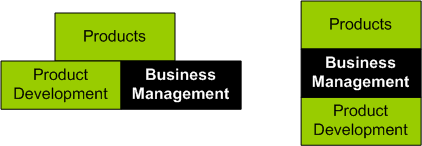
As a business thrives and grows larger, a strange perverted inversion occurs to those who lose their way (but thankfully, not all do). The business management function bubbles to the surface of the priority stack (WTF?). This happens ubiquitously across the land because hot shot, fat headed, generic managers who don’t know squat about the org’s specific product portfolio are chaufeurred in to grow the business. These immodest dudes, thinking of themselves as Godsends from MBA city, put themselves and what they do at the top of the priority stack to…… enrich themselves no matter what. Of course, these wall street stooges perform this magic act while espousing that the product set and those that create it are forever the org’s “most valuable asset“.
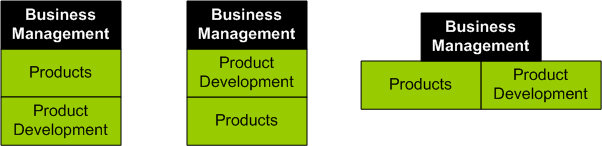
Post-startup businesses can survive with the perverted priority stack in place, but they usually muddle along with the rest of the herd and they aren’t exhilarating or engaging places to work. Do you work for one?
At a certain age institutional minds close up; they live on their intellectual fat. – William Lyon Phelps

Why am I here?
WTF?
Meh!
D'oh!

My BTC Address



 Bulldozer00's Blog