Archive
Three Types
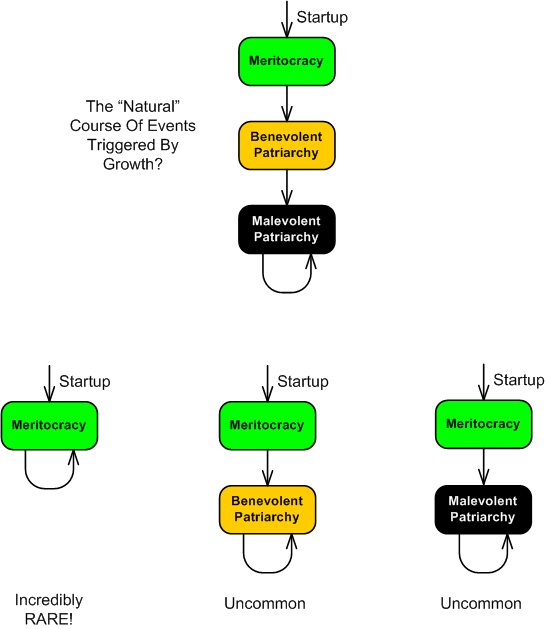
One simple (simplistic?) way of looking at how orgs of people operate is by classifying them into three abstract types:
- The Malevolent Patriarchy
- The Benevolent Patriarchy
- The Meritocracy
Since it’s so uncommon and rare to find a non-patriarchically run org (which is so pervasive that the genre includes small, husband-wife-children, families like yours and mine), I struggled with concocting the name of the third type. Got a better name?
The figure below shows a highly unscientific family of maturation trajectories that an org can take after “startup”. The ubiquitous, well worn path that is tread as an org grows in size is the Meritocracy->Benevolent Patriarchy->Malevolent Patriarchy sojourn. Note that there are no reverse transitions in any of the trajectories. That’s because reverse state changes, like a Benevolent Patriarchy-to-Meritocracy transformation, are as rare as a company remaining in the Meritocracy state throughout its lifetime.
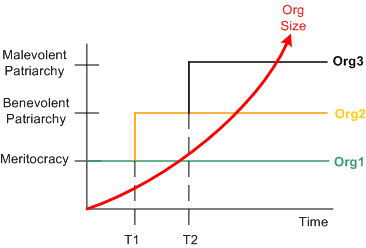
The state versus time graph below communicates the same information as the state machine family above, but from a time-centric viewpoint. Since “all models are wrong, but some are useful” (George Box), the instantaneous transition points, T1 and T2, are wrong. These insidious transitions occur so gradually and so slooowly that no one, not even the So-Called Org Leadership (SCOL), notices a state change. Bummer, no?
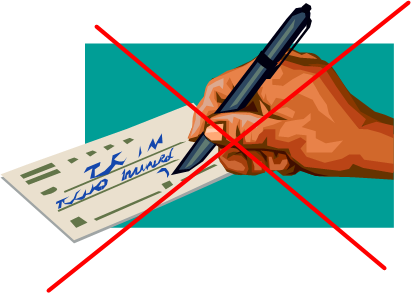
Don’t Sign That Check!
When someone presses your buttons and tries to insult you or your strongly held beliefs, you don’t have to automatically fall into a defensive position and start your own retaliatory offensive onslaught. It’s like the perp has written out a check from your checkbook, but your signature is required for him/her to cash it in.
The trick is to realize the meteoric rise in emotional temperature before your ego, or what Eckhart Tolle calls the pain body, takes over the steering wheel. Alas, even knowing this, I have the hardest time keeping the cap on the pen.
Executive Misnomer
I don’t know why the dudes at the top of the corpo food chain are called “executives”. They don’t execute anything except non-conformers. They coerce and patronize others into bidding their will – which is to make themselves rich regardless of the performance of their orgs.
- CEO = Chief Evisceration Officer
- COO = Chief Oppression Officer.
- CTO = Chief Torture Officer
Sycophant compensation committees reinforce the ubiquitous make-me-rich executive process by striving to pay execs as much as they can (to retain top “talent”) while striving to pay the DICforce as little as possible (to keep fixed costs down).

Cucumbers, Pickles, Brine
It’s been a while since I read Gerry Weinberg’s “Secrets Of Consulting“, but the cucumber-pickle-brine story has been frequently appearing (uninvited, of course) in my mind. It goes something like this:
No matter how vehemently a cucumber says he/she will not turn into a pickle if dropped into a barrel of pickles filled with brine, he/she will get pickled. No exceptions.
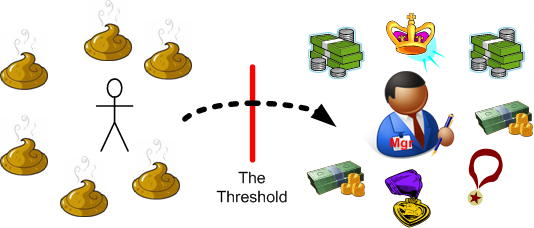
When a DIC crosses the magical threshold into the land of privilege, the guild of management, the cucumber-to-pickle transformation is inevitable. From lowly wealth creator to status taker, schedule jockey, planner, watcher, controller, evaluator. Trouble is, most cucumbers want to get pickled.
Ornament And Substance
When you’re forced to be simple, you’re forced to face the real problem. When you can’t deliver ornament, you have to deliver substance. – Paul Graham (Hackers And Painters)
Mr. Graham’s quote explains why the higher one goes up in the corpo chain of command, the more jargon-filled and superficial the communications bestowed upon the adoring DICforce below. This ornament/substance conundrum is also true for DIC to DIC communication when one DIC is a highly credentialed complexifier and obfuscator. You see, when people don’t know what they’re freakin’ talkin about and they feel the egoic need to appear infallible and all-knowing, they’re compelled to cover it up by attempting to make others feel inferior and dumb.
Alas, don’t lose your faith in humanity because it’s not the individual ornament-deliverers that are “bad”. It’s the ancient pyramidal class system that they’re an integral cog in that weaves that behavior into the fabric of their being. Because the ornament/substance dichotomy is a blind spot to them and the system automatically provides them with power and riches (at the expense of the whole), the system’s designers and maintainers have no incentive to blow up and redesign the system for optimal performance of the whole. Plus, virtually every other corpricracy is structured as a CCH, so it must be right, no?

High Level Doers
Jim Goodnight, (CEO of the SAS Institute, Inc), writes code on the side: “His first love is programming, which he likens to solving puzzles“. Marissa Meyer (Vice President, Search Products & User Experience, Google, Inc.) writes code on the side:
I still like to write some programs every year. I do some programming on the weekends. Lately it’s been more web-centric, using PHP and MySQL. The next thing I’ll try to tackle is the Google App Engine. I’m looking to do a little more programming with Python and Ruby on Rails. But I think it’s just an element of keeping my skills fresh by exploring some of these new trends and keeping my hand in coding, even if it’s on the side of core Google work. – From the book “Making It Big In Software“
Gee, do you think this low level behavior by high level employees has anything to do with why these two companies are considered insanely great by boatloads of experts and laymen? How about your company? Forget about those in the stratosphere like Jim and Marissa, do any of your front line managers do any grunge work “on the side” to keep themselves grounded in reality? Probably not, because when they made the leap into the guild of management they became too self-important for such mundane activity. Plus, because they’re expected to be infallible, they can’t be “seen” making any mistakes by the DICforce.

Approver To Approvee Ratio
Every non-trivially sized profit-making organization has a number of approvers and approvees. For approvees to be enabled to do anything of significance like, uh, create products and respond to customers, they need the blessing of one or more approvers. As the graph below implies, it’s the “or more” word duo in the previous sentence that has an ominous connotation.
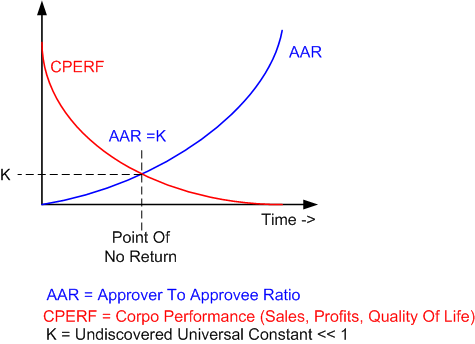
As the AAR in a group of people organized for a purpose increases, the org’s CPERF will start declining at some point in time. At a mystical value of “K”, the point of no return is reached and it’s all down hill from there. As the K threshold is exceeded, the maze of approver signatures that an approvee needs to navigate becomes untenable and the responsiveness of the “system” goes down the crapper. Even worse, the lower class approvee subgroup soon jettisons its sense of initiative and only assaults the approver fortress when a high ranking approver him/herself forces the action.
In clueless corpricracies, no one diligently watches over the AAR and prevents it from exceeding K. Quite the contrary, approvers love to hire more approvers because they have much in common with them and they love to have other approvers report to them – so they can approve the underling approver’s future requests for approval.
Approve, approve, approve your request, gently up the chain.
Sourly, sourly, sourly, sourly, work is but a drain.
Survive And Prosper
The purpose of a living system is to survive and prosper. There are different levels of systems. For example, there’s the organization, the organizational unit, the organizational group, and the organizational worker. Each of these human-composed entities can be considered a System Of Interest (SOI) unto itself and, as the figure below shows, SOIs are nested and connected.

If you believe my BS assertion that the purpose of a SOI is to survive and prosper, then each SOI may (and almost always does) choose to do whatever it can to survive, regardless of the cost to other internally nested and externally coupled systems. Of course, since everything is connected, the actions chosen by one “subsystem” to optimize its survival can (and almost always does) degrade the survival chances of those subsystems nested within it and those systems in which it is nested. For example, if a Bureaucratic Overhead Org Group (BOOG) like “purchasing” puts a boatload of Draconian procedures and forms and approval barriers in place to show how “important” they are, they degrade corpo performance by hindering timely acquisition of external equipment and services needed to get the job done. Schedules slip, which means customers aren’t delighted, and the people in other SOIs think twice about ordering tools that could make them more efficient and happy.
The dysfunction is even worse than you think. When a member of another SOI tries to point out the inefficiency of a BOOG to the so-called BOOG Leader (BOOGL), the auto-defense instinct kicks into high gear. Clever BOOGLs (and they must be clever because they got themselves appointed as a BOOGL in the first place) twist the situation out of whack. The instigator and his/her native SOI are made out to be the cause of inefficiency in the BOOG. This is done, of course, so that the BOOGL and his/her BOOG can survive and prosper. It’s so sad that ya gotta laugh…… LOL!
How Do You Like It?
Stunningly, I was once (and only once) asked by a manager how I liked my raise. It was stunning because I speculate that cosmic events like this rarely happen. Has it ever happened to you?
I told the manager that I was happy to get a raise at all. I also told him that since it was the same amount as the average company given raise, I perceived that he thought of me as an average employee. He, and no other manager has ever asked me for “raise feedback” again.
Of course, fairness and unfairness are in the eye of the beholder, or, in physicist-speak, the “observer”.

What’s REALLY Required
An understanding and application of “Systems Thinking” are pre-requisites to effective leadership in any large socio-technical group endeavor. Since business schools and pundits teach so-called business skills in disconnected, specialized, fragmented chunks and the primary component of systems thinking is the opposite of this classically entrenched Descartesian way of thinking, effective large scale leadership is nowhere to be found except in rare, small pockets of brilliance.
Systems thinking employs analytical thinking as a subordinate to its opposite – synthetic thinking. Since most (the vast majority of?) elite execs intentionally fragment their time to match their thinking style and they don’t know how to synthesize anything but an inflated and infallible image of themselves, they’re eternally stuck in the quagmire of one dimensional analytical thinking without a clue. But hey, ya gotta give them credit for knowing how to stuff their pockets with greenbacks.


Why am I here?
WTF?
Meh!
D'oh!

My BTC Address



 Bulldozer00's Blog