Archive
What’s Your ITAR?
A recent personal discovery that revealed itself to me is that “inquiring more and asserting less” is more effective than vice versa. Nonetheless, even after discovering this insight, I’m having a hard time increasing my Inquiry To Assertion Ratio (ITAR).
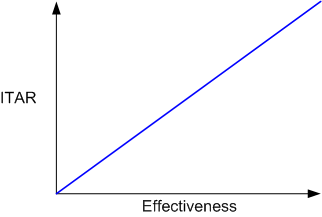
As you probably know, it’s difficult to change ingrained, long term behavior. When a social situation pops up in which the choice to inquire or assert appears, there often is no choice for me. In order to appear “in the know“, I automatically pull the trigger and make an assertion without asking any questions beforehand. However, I think I’ve made some progress. I can now often detect what I did after the fact. To improve even further, I’m hoping to reach the point where I can detect my transgression instantaneously, in the moment, so that I actually can choose to inquire or assert before I act. Ahhh, that would be nirvana, no?
In patriarchical CCH orgs, the ingrained mindset is such that the higher one moves up in the hierarchy, the lower the ITAR. That’s because BOOGLs and SCOLs unconsciously feel the need to appear infallible in front of the DICforce. Adding fuel to the fire, the DICsters fuel this behavior by expecting patriarchs to be infallible and have all the answers. It’s a self-reinforcing loop of ineffective behavior.
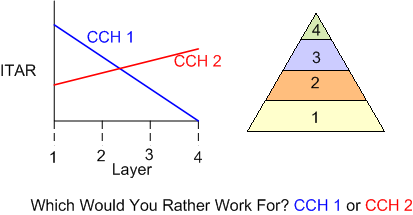 What’s your ITAR? As you age, do you find it rising – or sinking?
Add Managers And Hope
The figure below shows the result of two attempts to increase the productivity of a hypothetical DICteam. In this totally concocted and fictional example, the nervous dudes in the penthouse (not shown in the figure) keep adding specialized managers to the team to fill voids that they perceive are keeping performance from improving. However, since the SCOLs never baseline the TEAM_VALUE_ADDED metric before each brilliant move, or track its increase or decrease with time, they have no idea whether they have achieved their goal. Because SCOLsters think they’re infallible, they just auto-assume that their brilliant moves work out as expected.

Of course, it often turns out that SCOLster decisions and actions do more harm than good. As the graph in the figure for this bogus example shows, not only did the team operating cost increase by the addition of two new manager salaries to the total, the team productivity decreased because of the additional communication and coordination delays inserted into the system. Add an additional “hidden” operating cost due to the high likelihood of jockeying and infighting between the three BMs (to gain favor from the penthouse dudes), and the system performance deteriorates further. Bummer.
So how can SCOLs increase team performance without throwing more useless overhead BM bodies at the problem? For starters, they can clearly communicate the gaps they “see” to the single team coordinator and help him/her rise to the challenge by providing mentorship and advice. They also can replace the BM with a competent, non-BM (fat chance). They can also (heaven forbid) invest in better tools, infrastructure, and training for the one coordinator and team of DICmates – instead of investing that money in more BM specialists. Got any more performance increasing alternatives to the standard “add managers and hope” tactic?
Pyramid Conversion
In this Inc. blog post, Joie de Vivre hotel chain founder Chip Conley says:
The most contagious emotion in most companies is fear. Most companies do such a poor job communicating that most employees get stuck in a place of survival and don’t have a lot of room for creativity, innovation, or ingenuity.
Every survey that’s been done in the U.S. tends to show money is not the primary, secondary, or third; It’s fourth place on why people leave their jobs.
We took the Maslow pyramid and turned it into an employee pyramid with three basic themes: survival the base, succeed at the middle, and transformation at the top. Applying that to employees, it’s money, recognition, and meaning.

Once people are satisfied with how much money they are making, the next human desire they need fulfilled at work is recognition. According to Conley: “What really is meaningful to people is genuine appreciation shown in real time“. The key words are “genuine” and “real time“. I interpret this to mean; not months after a significant accomplishment has been achieved or once a year at an all hands meeting where a boring and generic “atta boy” is delivered from on-high down to the DICforce.
If you just sit in the control tower and solely monitor the numbers that result from the effort without recognizing the effort itself in the moment, then you’re behaving just like the herd and you deserve what you get – mediocrity. Mooooooooooo.

Zappos Rocks Again
As a huge, huge, huge, (did I say youuuuuuuge-uh?), fan of Tony Hsieh and Zappos.com, I blabber about them often. Zappos latest action to make the whole world, yes, the whole world, a better place is to offer up a free, yes free, download of the audio version of the best seller, yes best seller, book “Tribal Leadership“. The link is here, yes here.

Even though I’ve stalked Zappos.com for years, until recently I’ve never bought anything from them because I’m not a shoe or clothes dude. Hell, I’m an old and unredeemable person of questionable integrity and questionable character and questionable morality and questionable <<add your own trait here if you know me>>, so I renew these things about every 10 years or when they fall apart; whichever comes first. However, even with zero revenue from me, they upgraded me to VIP status. This means that with every order I place, they’ll guarantee free overnight shipping. WTF, you say? Uh, the only answer that I can give to you is: They’re fuckin’ Zappos.com dude, that”s why! Oops, I hope the F-bomb didn’t make you mad and send you to the altar to pray for me. If it did, then maybe you shouldn’t be wasting your time reading this blasphemous blog 🙂
Lopp-Sided
Michael Lopp is an engineer’s kind of manager. Besides having a great last name (can you say Lopp-sided?) and an even better pen name (“Rands In Repose“), the guy still understands and relates to down-in-the-trenches engineering work. He even drops an occasional F-bomb in his writing for dramatic effect. The dude is a rare bird and I pay attention to what he says.
Although I think the name of his latest book, “Being Geek“, is meh, there’s a lot of great stuff in there for both managers and DICs. Here’s a sampling of “culled” passages:
The story we tell ourselves when someone we like chooses to leave the group or the company is, “Everyone is replaceable.” This is true, but this is a rationalization designed to lessen the blow that, crap, someone we really like is leaving. We are losing part of the team. Professional damage is done when a team member leaves, and while they are eventually replaceable, productivity and morale take a hit.
A manager’s job is to forget. That’s what they do. They get promoted and begin the long processes of forgetting everything that got them promoted in the first place. I’m not joking. Manager amnesia will be the source of much professional consternation throughout your career.
My management strategy is to assume those closest to the problem can make the best decisions. That’s how I scale.
In defense of my brethren managers, we don’t forget everything, and during all that forgetting, we’re learning other useful things like organization politics, meeting etiquette, and the art of talking for 10 minutes without saying a thing.
The list of words that define management are revealing: direct, in charge, handle, control, and force. Looking at this list, it’s not a surprise that the term “management” has a distasteful Orwellian air.
If it’s been six months, you’ve been actively looking, and no one has told you a great story about how engineering shaped the fortunes of your company, there’s a chance that engineering doesn’t have a seat at the culture table in your company.
There’s the been-here-forever network, the I-survived-the-layoff people, and the untouchable did-something-great-once crew.
It pains me to write this, but my first question about your boss is this: is he taking the time to talk with you in a private setting? A 1:1 is a frequent, regularly scheduled meeting between you and your boss, and if it’s not happening, I, uh, don’t really know where to start. The absence of a 1:1 is the absence of mentorship, and that means your need to gather your experience in the trenches. And while there is nothing to replace “real-world experience,” I’m wondering what the value add of your boss is.
My impression is that the presence of status reports is an indication that your boss doesn’t trust the flow of information in your organization.
We’re knowledge workers, which is an awkwardly lame way of stating that we don’t actually build physical things with our hands.
Asking for the impossible is an advanced management technique, and it’s one that is particularly abhorrent to engineers. Frequent impossible requests result in an erosion of respect and a decaying of credibility.
You’re not going to engage if you don’t respect the person who is asking you to do something.
Management by crisis is exhilarating, but it values velocity over completeness; it sacrifices creativity for the illusion of progress.
Everyone is an adjustment. When you’re interacting with anyone, you leave the core you and become slightly them.

From Wanted To Unwanted
You can have a product without a business, but you can’t have a business without a product. If you build a product that people want, a business will be born either from your loins or from some copycat’s. There’s no chicken and egg dilemma here. It’s simply, product-first and business-second. Ka-ching!
But wait, that’s not all! Let’s say you do get lucky and start a biniss around a “wanted” product that you built. To sustain your business, you gotta sustain your product. That means continuously maintaining it via the addition of new value-added features and the correction of customer-annoying defects.
Upon observing the deterioration of his original ArsDigita product under the so-called leadership of “new management”, Philip Greenspun said:
Once you have a product that nobody wants, it doesn’t matter how good your management team is. – Phil Greenspun (Founders At Work, Jessica Livingston)
So, how does a “wanted” product morph into an “unwanted” product? Via neglect and indifference. That’s what happened to Phil’s baby when the vulture capitalists he hooked up with installed an incompetent “professional management team” to run ArsDigita (into the ground). By focusing on the superficial instead of the substance, the promotion instead of the maintenance, the company’s product, and then the company itself, went down hill fast:
ArsDigita grew out of the software that Greenspun wrote for managing photo.net, a popular photography site. He released the software under an open source license and was soon deluged by requests from big companies for custom features. He and some friends founded ArsDigita in 1997 to take on such consulting projects. In 2000, ArsDigita took $38 million from venture capitalists. Within weeks of the deal closing, conflict arose between the new investors and the founders. They marginalized and then fired most of the founders, who responded by retaking control of the company using a loophole the VCs had overlooked. The legal battle culminated in Greenspun’s being bought out, and a few months later the company crashed. ArsDigita was dissolved in 2002. – (Founders At Work, Jessica Livingston)

No Spin From Greenspun
Jessica Livingston interviews a boatload of founders (32 to be exact) of startup companies in her book “Founders At Work“. The most fascinating interview that I’ve read to date is with Phil Greenspun. It’s especially fascinating because it strongly reinforces “my belief system” that most corpo SCOLs are incompetent and most venture capitalists are obsessed with greed. You know how it is, relentlessly seeking out and amassing stories and evidence that irrefutably “prove” that you’re right while ignoring any and all disconfirming evidence to the contrary.
After reading the Livingston-Greenspun dialog, I was so giddy with ego-inflating joy that I wanted to copy and paste the entire interview into this post. However, I thought that would be too extravagant and probably a copyright law violation to boot. Here are some jucilicious fragments that prove beyond a shadow of a doubt that I’m absolutely right and anyone who disagrees with me is absolutely wrong. Hah Hah! Nyuk, nyuk, nyuk!
We talked to a headhunting firm, and the guy was candid with me and said, “Look, we can’t recruit a COO for you because anybody who is capable of doing that job for a company at your level would demand to be the CEO.” And I thought, “That’s kind of crazy. How could they be the CEO? They don’t know the business or the customers. How could we just plunk them down?” In retrospect, that was pretty good thinking; look at Microsoft: it took them 20 years to hand off from Bill Gates to Steve Ballmer. He needed 20 years of training to take that job. Jack Welch was at GE for 20 years before he became CEO. Sometimes it does work, but I think for these fragile little companies, just putting a generic manager at the top is oftentimes disastrous.
The guys on my Board had been employees all of their lives. You can’t turn an employee into a businessman. The employee only cares about making his boss happy. The customer might be unhappy and the shareholders are taking a beating, but if the boss is happy, the employee gets a raise.
Some of my cofounders and more experienced folks were also stretched pretty thin because of the growth. I thought, “We just need the insta-manager solution.” Which, in retrospect, is ridiculous. How could someone who didn’t know anything about the company, the customers, and the software be the CEO?
A lot of the traditional skills of a manager were kind of irrelevant when you only have two or three-person teams building something. So it was almost more like you were better off hiring a process control person or factory quality expert instead of a big executive type.
The CEO was a guy who had never been a CEO of any organization before, and he brought in his friend to be CFO. His buddy didn’t have an accounting degree and he was really bad with numbers. He couldn’t think with numbers, he couldn’t do a spreadsheet model accurately. That generated a lot of acrimony at the board meetings. I would say, “Things are going badly.” And he’d say, “Look at this beautiful spreadsheet. Look at these numbers; it’s going great.” In 5 minutes I had found ten fundamental errors in the assumptions of this spreadsheet, so I didn’t think it would be wise to use it to make business decisions. But they couldn’t see it. None of the other people on the board were engineers, so they thought, “Well, he’s the CFO, so let’s rely on his numbers.” Having inaccurate numbers kept people from making good decisions. They just thought I was a nasty and unpleasant person, criticizing this guy’s numbers, because they couldn’t see the errors. From an MIT School of Engineering standpoint, they were all innumerate.
Meanwhile, because these people didn’t know anything about the business, they were continuing to lose a lot of money. They hired a vice president of marketing who would come in at 10 a.m., leave at 3 p.m. to play basketball, and had no ideas. He wanted to change the company’s name. This was a product that was in use in 10,000 sites worldwide—so at least 10,000 programmers knew it as the ArsDigita Community System. There were thousands and thousands of people who had come to our face-to-face seminars. There were probably 100,000 people worldwide who knew of us, because it was all free. And he said, “We should change the company name because, when we hire these sales-people and they’re cold-calling customers, it will be hard for the customer to write down the name; they’ll have to spell it out.” And they did hire these professional salespeople to go around and harass potential customers, but they never really sold anything.

Loop Of Disrespect
In most companies, “respect” is either an explicit or implicit core value. Is it respectful to repeatedly watch, and covertly condone, project teams working 50-60 hour, unpaid overtime weeks for years at a time to meet some schedule that they most likely had no hand in making? Since the overtime is not paid, it isn’t tracked and future schedule estimates derived from past performances don’t accurately reflect the effort needed to get the job done. Thus, the practice is a self-reinforcing loop of disrespect. But hey, since virtually all corpricracies operate that way, the practice must not be disrespectful, right?
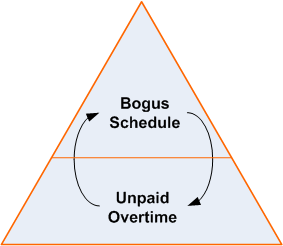
Demanding respect while not giving it, or pretending to give it, creates mediocracies. And since respect and loyalty are intimately coupled, demanding loyalty without giving respect doesn’t work too well either.
Delusions of Grandeur
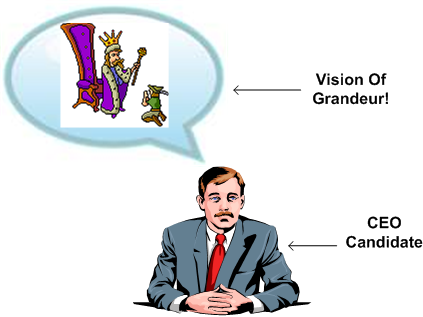
In “Founders At Work“, Jessica Livingston interviews a boatload of company founders about their personal experiences with regard to starting their companies from the ground up. Paul Graham, who co-founded “ViaWeb” and sold it to Yahoo 3 years later for a cool $45M, was asked about his search for a CEO in the early days. Here’s what he said:
The problem with all of them was that they had delusions of grandeur. This was the beginning of the Internet Bubble, remember, and I think all of these guys saw themselves as some kind of grand CEO, while we programmers labored in the kitchen cooking the food and washing the dishes. If the deal were simply that the business guy would be the public face of the company, but we would be allowed to do what we wanted and make sure everything worked right, that would have been OK. But we were worried about what might happen if one of these guys wanted to actually be the chief executive officer and tell us what our strategy should be. We’d be hosed, because they didn’t know anything about computer stuff. – Paul Graham
The Uselessness Of MBAs
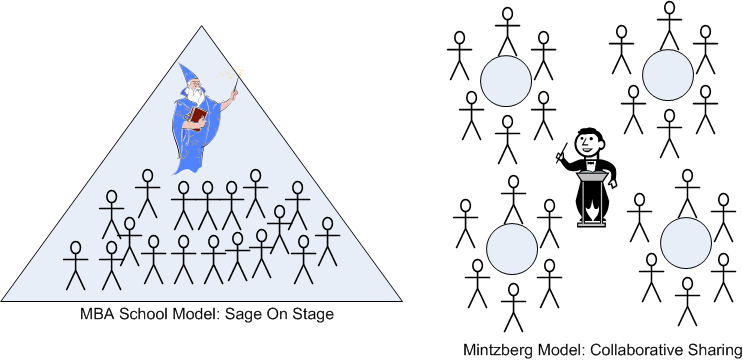
Two of my favorite management (or anti-management, if you prefer) thinkers and doers, Henry Mintzberg and Ricardo Semler, talk about the uselessness of MBA degrees for managing people in this MIT World video. In the video, Mr. Semler interviews Mr. Mintzberg shortly after the release of Mintzberg’s book, “Managers Not MBAs“, in 2005. The interview is conducted in front of a class full of MIT MBA students.
In case you’re interested, here are some of my notes:
This will work in practice, but will it work in theory 🙂
You can’t create a manager in a classroom. When you do that, all you do is create hubris.
MBA students are taught how to apply business skills in an assumed command-and-control hierarchy, not how to be a manager. B-schools don’t distinguish between the two.
Management is craft (rooted in experience), art (rooted in creativity) and analysis (rooted in science). It’s not just analysis – which is what B-schools exclusively teach.
Earn a management position first, then go to business school while you are a practicing newbie manager.
There are no naturally born surgeons, but there are many natural managers who never went to MBA school.
The problem with being in a rat race is that if you win, you’re still a rat 🙂
In a study of Harvard MBA gradutates, 10 of 19 were outright failures, 4 had questionable records, and 5 did fine.
The notion that a generic manager can parachute in and manage anything is crazy. There are exceptions like IBM’s cookie man, Lou Gerstner, but failure is the norm.
Many managers practice “Kiss up, kick down”. The dudes who receive the kisses don’t care or want to know about the “kick down” behavior.
Without action, nothing gets done. Without reflection, action is mindless. Thus, mindful action is required for success.

Why am I here?
WTF?
Meh!
D'oh!

My BTC Address



 Bulldozer00's Blog