Archive
Money, Tools, Materials, Know-How, Products
Since you’ve stopped by, check out the company-centered, system loop diagram below. The model is composed of three interdependent parts: the company, the customers, and the suppliers. In equilibrium, when all is well:
- The company produces products that are paid for, and consumed by, customers.
- The company purchases tools and materials from suppliers.
- The company uses the tools, materials, and the knowledge of its workforce to create the products that sustain the viability of the company.
- The company’s cash inflow exceeds it’s cash outflow
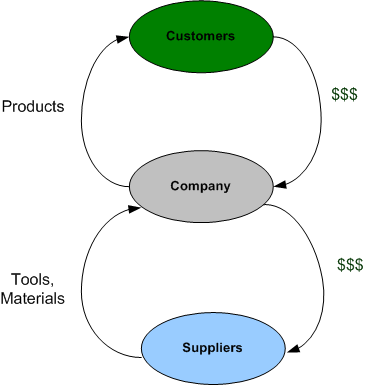
Note that if any of the links in the system get severed, the company collapses. If the products stop flowing out of the company, the life-giving cash stops flowing in. If the cash stops flowing in, the products stop flowing out. If the tools and materials stop flowing in, the products stop flowing out. From the company’s perspective, products lead to cash and cash leads to more products in a positive, self-reinforcing, feedback loop.
Using the diagram below, let’s look in more depth at the company’s cash inflows and outflows. In stable, steady-state operation, the cash inflow is managed competently by the executive team. After taking their cut of the action, the executives push some cash downward through the patriarchy to keep the operation humming and they approve of all outflows to suppliers.
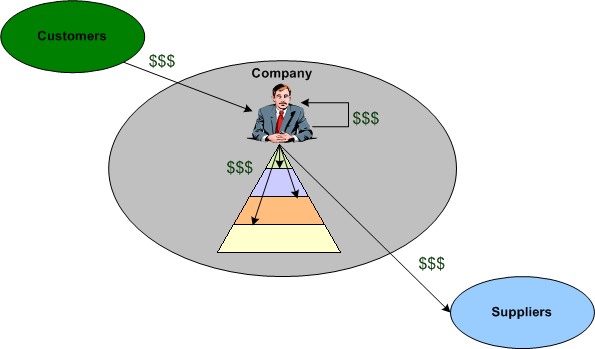
What the picture doesn’t show, is the indirect source of the customer cash – the company’s product set. Lets augment the diagram above and close the loops:
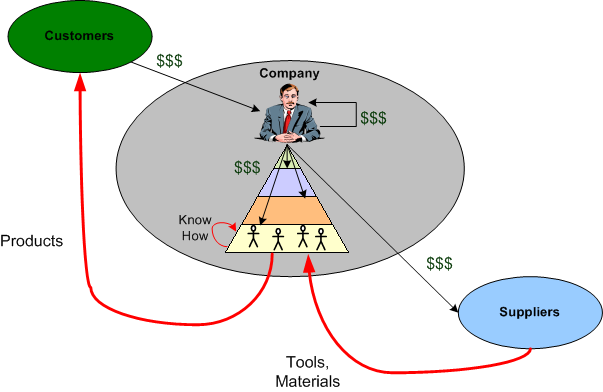
There are a bazillion external, and especially, internal threats to system viability. Externally, customers can run out of cash and suppliers can go bust. Internally, bureaucratic little Hitlers, byzantine processes, lack of investments in tools and people, inequities in status and pay, silo-to-silo infighting, and poor hiring practices are among the myriad of threats that can contribute to corpo implosion. Of course, the purpose of management is to gracefully overcome the threats. But hey, regardless of whether executives and their management appointees are the cause of success or failure, they still have the right to high status and high compensation because…. well, just because.
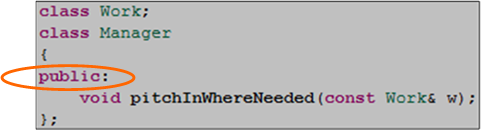
void Manager::pitchInWhereNeeded(const Work& w){}
Unless you’re a C++ programmer, you probably won’t understand the title of this post. It’s the definition of the “pitchInWhereNeeded” member function of a “Manager” class. If you look around your immediate vicinity with open eyes, that member function is most likely missing from your Manager class definition. If you’re a programmer, oops, I mean a software engineer, it’s probably also missing from your derived “SoftwareLead“, “SoftwareProjectManager“, and “SoftwareArchitect” classes too.
As the UML-annotated figure below shows, in the early twentieth century the “pitchInWhereNeeded” function was present and publicly accessible by other org objects. On revision number 1 of the “system”, as signaled by the change from “+” to “-“, its access type was changed to private. This seemingly minor change broke all existing “system” code and required all former users of the class to redesign and retest their code. D’oh!
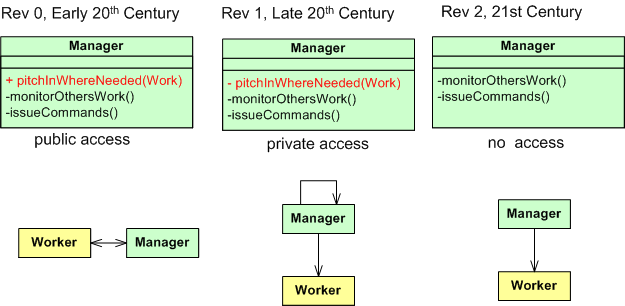
On the second revision of the Manager class, this critical, system-trust-building member function mysteriously disappeared completely. WTF?. This rev 2 version of the code didn’t break the system, but the system’s responsiveness decreased since private self -calls by manager objects to the “pitchInWhereNeeded” function were deleted and more work was pushed back into the “other” system objects. Bummer.
Monitoring And Learning
Courtesy of this Scott Berkun retweet,

I latched onto this Harvard Business School paper abstract:
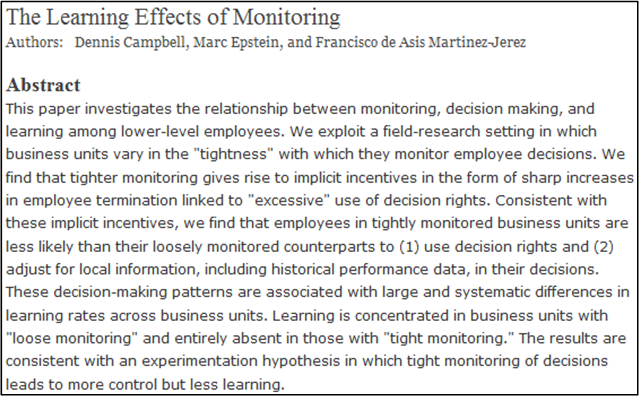
Even though the paper is laced with impeccable math and densely “irrefutable” logic, the conclusion of “looser monitoring -> more learning -> more creativity & innovation” seems intuitively obvious, doesn’t it?
Assume that the top leaders in your org embrace the idea and sincerely want to put it into action to detach the group from the status quo and propel it toward excellence. Well, fuggedaboutit. The scores of mediocre middle managers within the institution who do the monitoring will instantaneously switch into passive-aggressive mode and thwart any attempt to institute the policy. They’ll do this because it will most likely expose the fact that they are not only suppressing creativity and innovation where the rubber hits the road, but they are not adding much value to the operation themselves. How do I know this? Because that’s what I’d feel culturally forced to do. But not you, right?
Don’t You Wish….
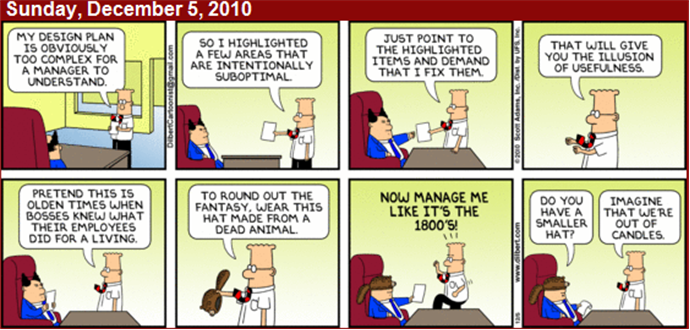
…you can have a Dilbertonian conversation with a BM (past or present) like the one below without getting fired? Of course, the elegant genius of Dilbert is that former cubicle-dweller-turned-gazillionaire Scott Adams makes you want to laugh and cry simultaneously.
Are You Still Working On That?
It’s funny enough when you work for a one dimensional manager (one dimension = schedule), but it’s even funnier when another 1D manager that has nothing to do with your project stops by to chit chat and he/she inevitably asks you:
Are you still working on that?
LOL! Being 1D, and even though he/she has no idea what it takes (or should take) to finish a project, the question can be interpreted as: Since you’re not done, you’re lazy or you’re screwing up.
When the question pops up, try this Judo move:
Should I be done? How long should it have taken?
Or, you can be really nasty and retort with:
Yes I am still working on it. Sorry, but it’s not a shallow and superficial management task like signing off on a document I haven’t read or attending an agenda-less meeting that I could check off on my TODO list.
Come on, I dare you.

Blind, Ignorant, Deaf
In “The Thought Leader Interview“, HCL Technologies CEO Vineet Nayar describes his shocking “Employees First, Customers Second” method of management to a pair of Strategy+Business magazine reporters. In keeping with my biased approach of culling only those quotes and passages that support my view of what the wildly successful company of the future looks like, I’ve assembled this self-serving list for your consideration:
Somebody said to me about the Employees First program, “Vineet, your competitors will copy this, and therefore, it will not be a differentiator.” My response was, “If our competitors can post the results of 360-degree evaluations, more power to them.”
The moment the recession hit we went out to our employees and said, “We have a problem. We’re going to solve it together.” We had thousands of ideas coming in, and we implemented them. Most of them were operational: There were no new products, services, geographies, or contracts. But HCL grew 23 percent and increased global market share by 21 percent. Our employees felt they were a part of everything we were doing, because of our inclusive approach. Even if it may take a bit longer to arrive at decisions, this approach helps ensure that implementations are smooth and that initiatives are sustained after the initial hype.
We created a 360-degree process where anybody can give feedback to anybody, including to me. We post the results internally so that all employees can see them. Good or bad, we all learn from the results. It’s open, it’s transparent, and the impact is positive. We find that this practice is motivating people to change their behavior. They try harder.
We also looked for symbolic ways to be a model of openness. One thing I did was publicly dance in front of all my employees. This was to remove the halo that a CEO has around his head. Meaningful conversation happens after you have set the stage in this way, after you make clear that you are as open as anyone else — crazy but effective.
So I held an open house with a group of employees. “I’m feeling pretty bad,” I said. “Nobody is saying what is positive about our company. Do you think I’ve unlocked a genie that is spreading demotivation?” Their answer was interesting. They said it is good to wash dirty linen in public, in this case on the blog, because it builds trust. There are no rumors. We discuss everything openly and honestly. We don’t always have solutions to problems, but at least we expose them.
Whatever trust is left in command-and-control management structures has been deeply tested during the recession. I am told that in business in general, employee trust in management is at its lowest point ever.
Even though Mr. Nayar is a breath of fresh air, I’m not too optimistic that his ideas on effective corpo governance will spread like wildfire to a company near you. You see, Ricardo Semler, CEO of Semco Inc., was Vineet Nayar twenty years before Vineet Nayar. Of course, since Mr. Semler’s version of participative management was also an all out assault on the draconian, patriarchical, system of management that pervades the globe today, he was ignored by mainstream business too.
Disconnect And Distance
If professional social networks like LinkedIn.com were around in the 1980’s, it’s highly likely that you’d be branded as an unloyal traitor for joining one. Even today, didn’t you feel a slight twinge of exhilarating fear when you joined? Uh, not me (LOL!).
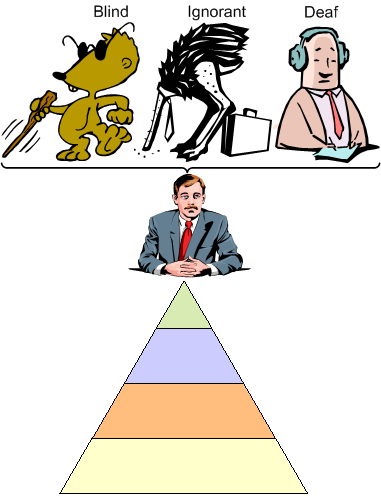
If the leaders (or should I say the “SCOL“s?) in your org are ostriches and they cling to outdated, mechanistic, FOSTMA ideas like the demand for one way loyalty without even a hint of self awareness that they need to change their mindsets, then head for the hills because your sugar daddy is most likely going downhill. If, for some reason beyond your control you think you’re stuck where you are, then simply disconnect and distance yourself from the daily shenanigans that take place in your environment.

Love Before Fear First, And Fear Before Love Second
One of Niccolo Machiavelli‘s most famous dicta is:
It is better to be feared than loved.
But wait….. that’s not the whole story. It’s certifiably time-proven and unassailable advice after you’ve parked your svelt butt on the throne, but not before. As you rise through the power rankings on your way to becoming alpha dog, it’s better to be loved than to be feared so that you can be swept into power by the very same people that you’ll need to fear you after you’ve secured Fort Knox.
You get it, right? If you’re not loved on the way up, chances are that you won’t even make it “up”. Hence, you’ve got to cleverly morph into one of those “nice guys” at work. You know, one of those stereotypical Stepford dudes that everybody speaks fondly of, but whose contributions and accomplishments are mysteriously unknown.
Thus, I, Bulldozer00, illegitimate son of Bulldozer and 00, have successfully catapulted brother Machiavelli’s quote for success into 21st century:
“Before you acquire power, it is better to be loved than feared. After you’ve acquired power, it is better to be feared than loved” – Machiavelli and Bulldozer00
Moo, hah , hah, hah. MOO HAH HAH HAH!!!!

Requisite Knowledge
In “Item 3. Design Patterns” of Stephen Dewhurst’s “C++ Common Knowledge: Essential Intermediate Programming“, he states the following:
Design patterns are often described as “micro-architectures” that can be composed with other patterns to produce a new architecture. Of course, selecting appropriate patterns and composing them effectively requires design expertise and native ability. However, even your manager will be able to understand the completed design if he or she has the requisite knowledge of patterns.
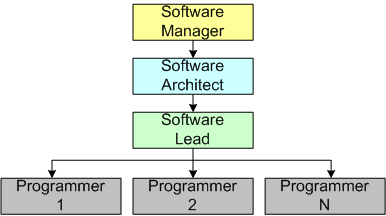
Uh, Stephen, you’re kidding, ain’t ya? In a project mini-corpricracy like the one below, you’ll be lucky if even the software lead knows what a pattern is, let alone the lofty manager. The software “Rocket-tect” will most likely know what a pattern is – but probably not how to apply it since he/she will be stuck in “lemme-show-u-how-smart-I-am” jargon-land. On the bright side, everybody in the power structure (which excludes the programmers, of course) will know what a Microsoft schedule, spreadsheet, and powerpoint deck are.
N Minus One Half
Other than chief patriarch, where do you think the best position is on a stratified N + 1 layer corpo org chart? Consider the N – 1/2 position. You know, the coveted “dotted line” reporting position where, for some strange reason, the lowly paid and respected exec admin is always listed with the exalted, treasury raiding conciglieres. Here’s why it’s my top choice for you to aspire to:
- By definition, and probably not by your accomplishments (if any), you’re over compensated since you’re so high up on the chart.
- You don’t have any direct reports or whining sub-hierarchies of people under you to placate.
- You have the job security that independent, highly paid consultants (who may actually add value) at your level of so-called expertise don’t have.
- You have unfettered access to the corpo monarch. This gives you virtually unlimited time to kiss arse.
So, are you gonna go for it? Not me. Just give me something interesting to work on with a group of competent people and a PHOR project manager who gets the RIRPRT. Oh, and of course, pay me fairly too.


Why am I here?
WTF?
Meh!
D'oh!

My BTC Address



 Bulldozer00's Blog