Archive
Culture Convergence?
Many, many articles and books targeted at executives and senior managers spew out all kinds of elixirs, formulas, and lists guaranteed to catapult a business to the top of the heap. For example, take this squeaky clean and slightly redacted list from a book that will remain unnamed.
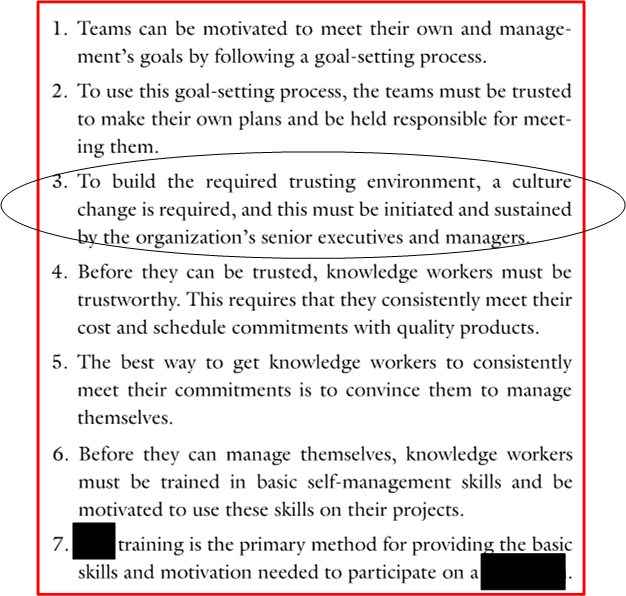
The one common, across the board demand that all these gurus impose on top leadership teams is that “you must change the culture“. The hidden assumption in these words is that one culture exists. Well, does it?…….
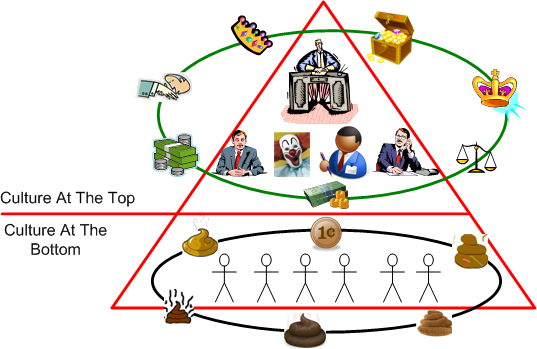
Maybe all these revered business gurus should talk about culture convergence instead of changing “the one culture“…..
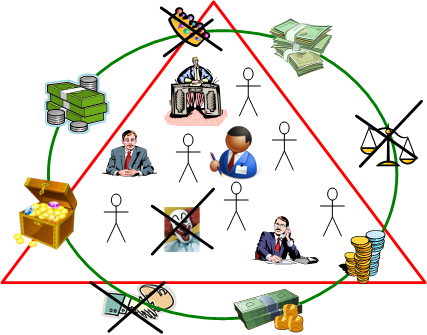
How naive of me to think that there are two or more cultures in an org, no?

Don’t Listen…. Imitate
To most (but not all) corpo execs and fatty middle managers everywhere, take heed:
“Children are never good at listening to their elders, but they never fail to imitate them.” – James Baldwin

OMG, I’m so embarrassed! In yesterday’s post, I hinted that I sort-of wanted to do away with my Father Guido Sarducci “find-the-poop-in-the-picture” pattern of immaturity. Nevertheless, if this quote from the “Wilde” man doesn’t hold a grain of truth to it, then I’m hopelessly hosed:
Life is too short to be taken seriously – Oscar Wilde
Nice And Competent
It’s prolly just me, but I can’t seem to fully accept that most people equate niceness with competence – especially in the guild of layered management. Oh sure, there are lots of cases where people are both nice and competent, but there may be more cases where people are both nice and incompetent. What does your experience indicate?
One reason why there may be a lot of people who are both nice and incompetent is because niceness can camouflage incompetence – at least temporarily, and at most, till retirement. If you’re nice, your boss won’t scrutinize your work output (if he can understand it and isn’t incompetent himself) as closely than if you’re not nice. Thus, it’s better to be nice and incompetent than to be mean and incompetent – duh. Hell, niceness counts so much at top tier DYSCOs that it’s better to be nice and incompetent than not-nice and competent. Niceness trumps competence at these back asswards citadels.
If you’re a DICster, where it’s easier to “measure” competence by the material results you either do or don’t create, the cover up of incompetence by niceness doesn’t work nearly as well than if you’re a BM, SCOL, CGH, or BOOGL in a CCH org. Why? Because it’s much harder to measure middle management output. Most managers don’t create much of anything (except for angst and turmoil), so how can their performance be meaningfully measured? Plus, the senior managers who are supposed to do the “objective” measuring of their appointees don’t want to look bad by admitting that they knighted incompetent subordinate managers and incompetent, elite staff members.
So, what about me? I’m not nice and I’m incompetent, so this blarticle doesn’t apply to me. What about you?

Note: One way for a senior manager to measure a “junior manager’s performance is to ask junior’s people how he/she is helping them to grow and do a better job. Do you think this is done often in the corpo world? Even when this skip-level technique is miraculously performed, do you think honest feedback is obtained? Why or why not?
Meritocracy Hippocracy
Thanks to software guru Ron Jeffries, I just discovered this article from “Sociation Today“: The Meritocracy Myth. In their piece, authors McNamee and Miller restate the oft espoused American dream as:
Getting ahead is ostensibly based on individual merit, which is generally viewed as a combination of factors including innate abilities, working hard, having the right attitude, and having high moral character and integrity.
They then attempt to prove that it’s a myth:
“..the really big money in America comes not from working at all but from owning, which requires no expenditure of effort, either physical or mental. In short, working hard is not in and of itself directly related to the amount of income and wealth that individuals have.”
Of course, being academics, McNamee and Miller are required to present income and wealth distribution statistics to bolster their case:

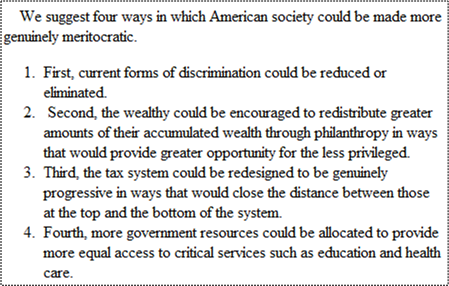
OK, so assume that they convinced “us” that the American dream has morphed into a ruse. What actions do McNamee and Miller propose to transform the myth into reality? They present these well-worn yawners:
But wait. Maybe we don’t want an ideally meritocratic society. As McNamee and Miller imply: Isn’t there a chance that the meritorious who’ve risen to the top of the income and wealth charts would develop a sense of righteous entitlement? Wouldn’t they “look down” upon those who haven’t advanced in life based on merit?
Well, yeah – ego dominated humans will be humans. But wouldn’t a system based on merit be fairer than one that keeps privileged and meritless aristocrats entrenched in power and “looking down“? Don’t you think meritorious leaders would have a greater sense of humility and compassion than aristocratic, silver-spoon-fed leaders? At least the American dream would be alive and kicking. The hope of personally creating a better life would become a reality, and not remain just a mythical pipe dream.
All ideologies end up killing people. – Jean Goss
Healthy And Stress Free
Via the Netflix “Watch Instantly” service, I recently viewed this wonderful and scary National Geographic documentary: “Stress: Portrait Of A Killer“. The program focused on the results of these two studies:
- A thirty year study on African baboon troupes by a dedicated Stanford University professor.
- A forty year study, called the “Whitehall Study“, on 18,000 British civil service employees (hint: hierarchy)
Ready to be surprised? In both studies, the results showed that the higher up in the hierarchy you ascend, the healthier and less stressed you become. Yepp, that’s right. Fuggedabout the crap that’s been drilled into your brain about the increased stress that comes with the so-called increase in “responsibility” as one ascends the corpo ladder. The reality is that the higher up you go:
- the more titles you accumulate (for your impressive LinkedIn profile),
- the more money you make for taking on more responsibility that you’re not held accountable for,
- the less “dirty and visible work” you have to do, uh, except for aimless and agenda-less meetings where you toot your own horn over others,
- the more control over “others” you have – to deflect blame when you screw up – which you never do.
How can that be stressful and detrimental to your health? By all means fellow DICsters, keep scratchin’ and clawin’ your way toward the top. It’s healthy fer ya.
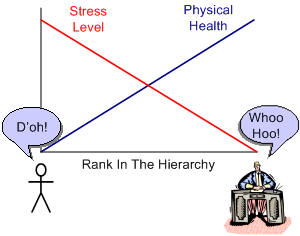
I actually wasn’t surprised by the show. Well over 20 years ago, friend and mentor William L. Livingston opened my eyes to the Whitehall study results in his epically disturbing “Have Fun At Work” book. It stunned me back then, but makes me laugh now.
To be fair, I have no doubt that there are many non-BMs in hierachical DYSCOs who do feel the increased stress their job should bring on. These are the people who thoughtfully and endlessly struggle with the conflicting demands of the wide ranging set of stakeholders who have an interest in the org’s economic and social performance. Thankfully, I have known, and do know, some of these people. How about you?
Note: If you want more detail on the documentary, check out my notes plus audio livescribe pencast on the program here.
Eclipsed!
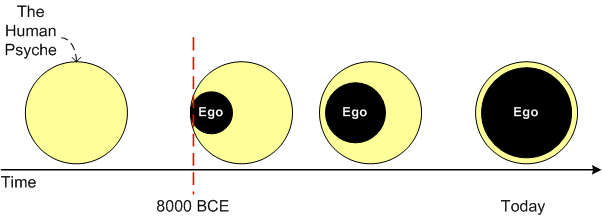
Steve Taylor‘s “The Fall” is an epic work. It’s both an academic and spiritual tour de force that covers the birth and subsequent explosion of the human ego throughout history. Using documented evidence from a wide range of archaeologists and anthropologists, he presents (what I opine is) an overwhelming argument that there is no innate “selfish gene“. You know, the one that everyone seemingly takes for granted and conveniently blames for man’s inhumanity to man.
In a nutshell, Mr. Taylor asserts that before 8000 BCE (yes, he goes all the way back to the dawn of man and painstakingly traces the life of the ego right up to us) all the available historical evidence points to the non-existence of war, oppression, patriarchy, and human exploitation of others. Please bookmark this page, read the book for the juicy details, and report your personal conclusions back here. Regardless of whether your UCB has been altered, I’d love to hear your before-and-after thoughts on the subject.
We’d Do This?
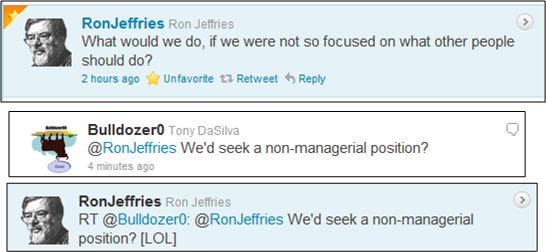
Wise ole’ Ron Jeffries and dumb ole’ Bulldozer00 go back… way, way back. Ron prolly won’t remember the multi-week e-exchange we had, but back in the 90’s we engaged in a passionate, tete-ah-tete tango on the merits and “perceived lack-thereof” of the eXtreme Programming (XP) software development process. That historic exchange (which changed the course of history!) actually happened before the invention of social networking and effortless person-to-person comm – OMG!.
After the dust was settled, the chaw was spat, the pistols were re-loaded, and the ‘nads were comfortably repositioned back into the sack, Ron graciously sent me a signed copy of “Extreme Programming Installed“. I’ll never forget his generous gesture.
FOSTMA And NASHMA
Whoo Hoo! I thought of a positive complement to my negative FOSTMA acronym. It’s, it’s, it’s….. NASHMA = Nayar, Semler, Hsieh MAnagement:
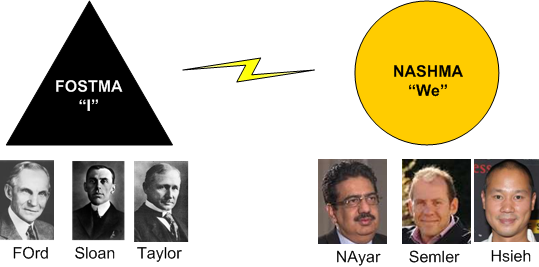
Of course, in order to prevent chaos, NASHMA orgs still have hierarchical structures, but they’re not run as stratified caste system CCHs. In NASHMA orgs, there’s real, two way accountability; and symmetric relationships exist up and down all levels. Most managers in NASHMA groups are PHORs and not STSJs who spend all their “valuable” time planning, watching, controlling, and evaluating.
Now mind you, to avoid the trap of dualistic thinking, an org shouldn’t be judged as fully belonging to one class or the other. There can be pockets of FOSTMA groups in a NASHMA org and vice versa. Nevertheless, my scientifically collected and analyzed data revealed this current distribution of institutions along the FOSTMA-NASHMA continuum:
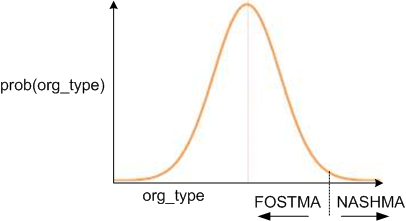
Over time, hopefully the threshold will move to the left – increasing the currently miniscule NASHMA to FOSTMA ratio. However, there will always be powerful and scary psychological forces opposing the movement.
Loki Is Not Loco
Never heard of “Loki”? Check it out here: The Loki Library.
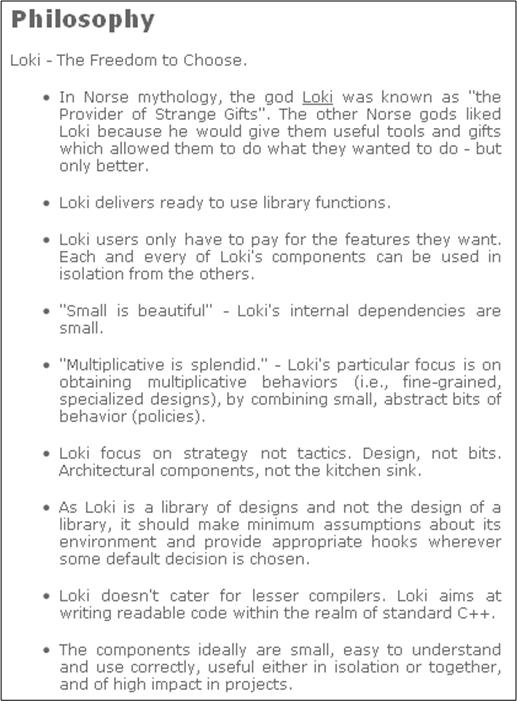
The Loki team has developed the best philosophy for programming library design that I’ve ever seen. It’s not so abstract that you can’t figure out what they mean, and they know that the real bang for the buck comes from disciplined dependency management and small, flat components. Judge for yourself:
How about you? Have you seen better?
Dilbert Disservice
Merry Christmas and Ho, Ho, Ho! Dear reader, if you don’t want to be negatively influenced today, then please move on and don’t read any further.
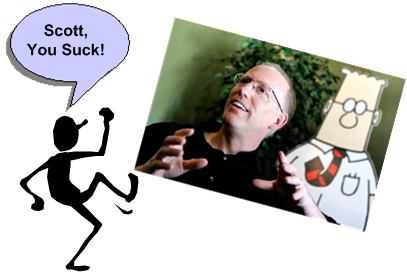
Before Dilbert and Scott Adams rocketed to fame and fortune by speaking about the unspeakable, DICsters toiling down in the boiler room at least had hope that the grass was greener on the other side. However, the Dilbert strip has unveiled what many didn’t know prior to its public emergence: the grass most likely isn’t greener “over there“.
Every day, Dilbert and his cohorts drive home the point that dysfunctional corpricracies are as ubiquitous and pervasive as the weeds in your garden. The strip has actually helped CCFs by demotivating DICsters from leaving toxic environments – because now they think that “it’s the same everywhere“. D’oh!

Why am I here?
WTF?
Meh!
D'oh!

My BTC Address



 Bulldozer00's Blog