Archive
Another Rare Gem
At Saab Sensis, we use Atlassian‘s Confluence wiki and Jira issue tracking tools for intra-project communications. They are wonderful, easy to use, and instantaneously fluid communication tools that increase productivity relative to the sole use of paper documents and fragmented, agenda-less meetings.
After reading this article by Atlassian employee John Rotenstein, “It’s the Culture, Stupid!“, I’ve added the company to my list of faves:

So, how did Atlassian squeeze into the esteemed BD00 list of faves? Here are the snippets that did the trick:
- Atlassian’s CEOs have instilled an information culture throughout the company with the core value of “Open Company, No Bullshit”. The result is a bottom-up democracy of information where information sharing is the norm and information hoarding is a foreign concept.
- The very act of using a wiki, with its easy access to information and default ‘open’ nature of information, led to an information culture in Atlassian of openness and sharing.
- Where ever possible, information is made accessible to all staff. Instead of sending person-to-person emails, relevant information is placed on the wiki for all staff to read. Instead of storing information in documents (eg Word files), information is entered directly onto the wiki so that it is searchable and accessible to all staff — even from home! New staff members, upon joining the company, have immediate access to all historical information kept on the wiki.
- From the very beginning, Atlassian founders Mike Cannon-Brookes and Scott Farquhar had a firm belief in having an ‘Open Company’. Unlike other companies that kept information in silos, their vision has always been of a company that has open information by default.
Regarding number 1, I love when employees and executives use everyday language within and without the company – not the carefully crafted, robo-management jargon that wall-streeters and elitist big-wigs want to hear.
Regarding number 4, I love how the company policy toward information is open by default; not closed by default like the moo-herd.
Note: With a tinge of regret, I replaced Saab Sensis with Atlassian in my list of faves. It’s a good company and I really do like working there, but after a bit of reflection and re-evaluation, it’s just not in the same class. In BD00’s whacky and weird world (where you don’t wanna go because the sky is pink and water flows uphill), Saab Sensis is a notch above the sea of CLORGs and DYSCOs that dot the landscape, but a notch below these world class organizations.
Pick Your Tyranny
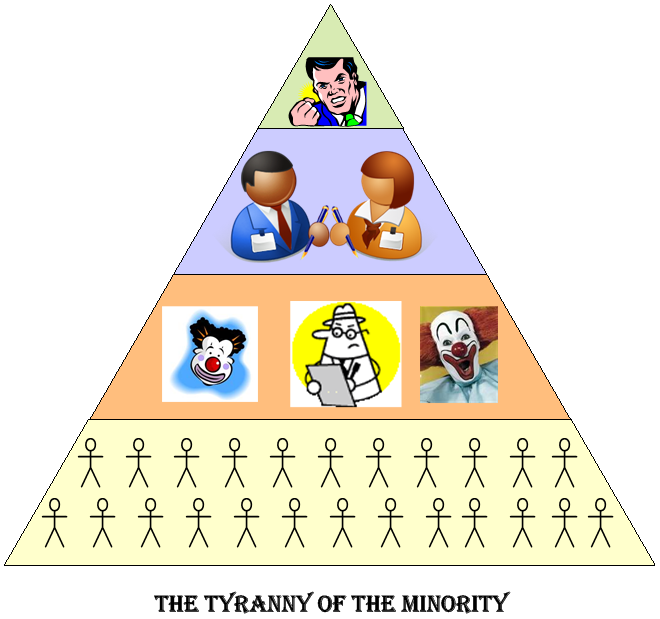
Given the choice between “tyranny of the majority” and “tyranny of the minority“, I’d choose the former every time – especially when the minority is a junta in the latter case. In representational democracies like the good ole USA, the “representational” aspect decreases the chance of being governed by the “tyranny of the majority“. In really bad corpricracies, the “tyranny of the minority” is the rule and, since it’s a subtle form of tyranny, everyone up and down the ladder of importance accepts it in quiet desperation – with no questions asked.
Manager Types II
This post is an updated refinement of BD00’s class hierarchy for the manager types previously presented in the UCBH post. For your viewing displeasure, I’ve reproduced the “rev 0” version of the inheritance tree here:
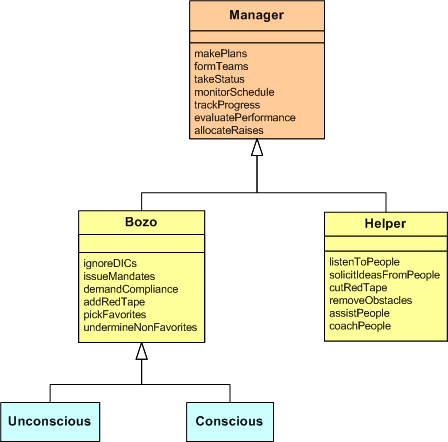
The “rev 1” version, with all class operations elided because they’re not important for understanding the message I want to get across, is shown below. The absence of the “Tweener” in rev 0, which inherits the attributes and operations from both the “Bozo” and “Helper” classes, was a major mistake.
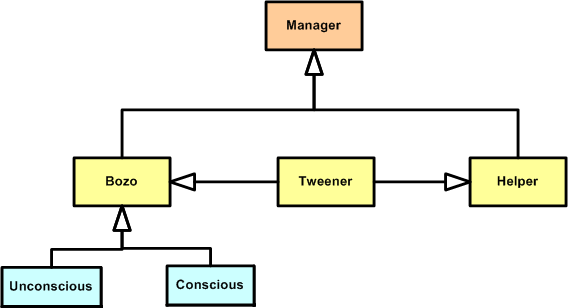
“Rev 1” is a much more accurate mental model of the manager kingdom because, as the probability density function below shows, the vast majority of manager “objects” are of the relatively boring, harmless, and ho-hum “Tweener” type.
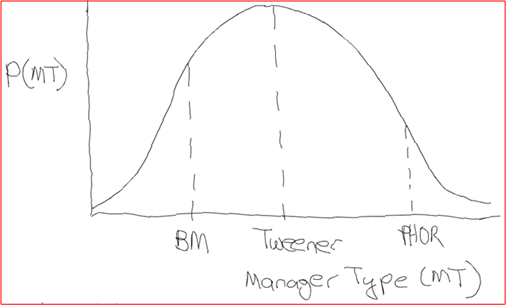
If you look closely at the threshold locations in the scraggly drawn probability distribution, BD00 has postulated that even though the population is comprised mostly of “Tweeners“, there are more BMs than PHORs. Do you agree?
Luckily and happily, BD00 has never worked for, or with, a conscious BM. But he’s directly heard, and indirectly read, several stories from those poor souls who have (are you one of them?). Thus, BD00 is convinced that they do exist in nature.
All models are wrong. Some, however, are useful – George Box
One Size Fits All
On Bjarne Stroustrup’s FAQ page, he state’s his opinion on the utility of object oriented programming:
The strength of OOP is that there are many problems that can be usefully expressed using class hierarchies – the main weakness of OOP is that too many people try to force too many problems into a hierarchical mould. Not every program should be object-oriented. As alternatives, consider plain classes, generic programming, and free-standing functions (as in math, C, and Fortran).
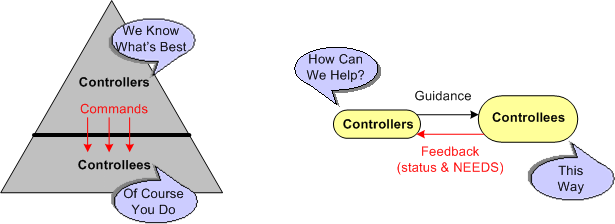
The same could be said of organizations of people, no? Of course, in a purposeful org of people and machines, the goal is to produce and distribute material wealth to all stakeholders: products/services to its customers and financial well-being to its employees and owners. Thus, some sort of controller-controllee structure is required to keep the org from deviating too far from its purpose. There are alternative structures to hierarchy but, as Bjarne sez, “too many people try to force too many problems into a hierarchical mould“. Bummer.
A Missing Core Value?
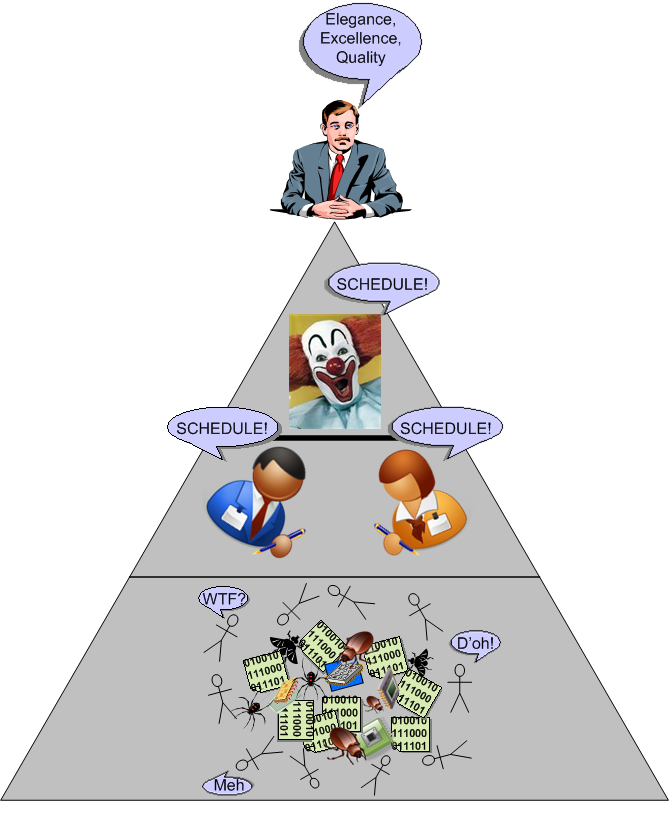
I’d venture to say that every technology company has phrases similar to “elegant products“, “technical excellence“, “innovative solutions“, and “quality first” smartly written in its mission and/or core values statements. I’d also venture to say that “schedule is king” is not explicitly inscribed in those WORN documents.
Regardless of what is espoused in their cutesy mission and core values statements, all mediocre and underperforming corpricracies operate day-to-day as if “schedule is king” is their top priority. How many times have you heard managers say the words “quality“, “elegance“, or “excellence” when discussing or reviewing a project? Now, how many times have you heard the word “schedule” uttered by managers?
If “quality“, “elegance“, or “excellence” are never mentioned because they’re “auto-assumed” to be present in all project endeavors, then why write them down? If “meeting schedule at all costs” is really what drives day-to-day behavior in the DYSCO, then why not write it down and put it at the top of the list?
No Reflection
In “Seeing Your Company as a System“, uber systems thinker Russell Ackoff is quoted as saying:
“Experience is not the best teacher; it is not even a good teacher. It is too slow, too imprecise, and too ambiguous.” Organizations have to learn and adapt through experimentation, which he (Ackoff) said “is faster, more precise, and less ambiguous. We have to design systems which are managed experimentally, as opposed to experientially.” – Russell Ackoff
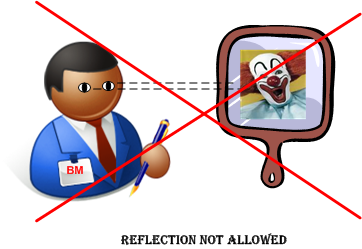
Judging whether an experiment is a success, failure, or something in between, requires the ability to pause and reflect on the results (or lack thereof) being achieved while the experiment is in operation.
In borgs run by self-perceived infallible popes, there is no experimentation and there is no reflection. Orders from above are assumed to be “right” and their execution is never perceived to be an experiment. They are undoubtedly based on an unquestioned, proven theory (usually Theory X) that’s underpinned by a set of rock solid axioms. If success doesn’t manifest as a result of carrying out papal orders, it’s auto-assumed to be the fault of the congregation, or (in less borgy institutions) mysterious supernatural forces beyond papal control. It’s unconscionable to think that the orders themselves were the cause of failure. Why? Because pauses during, and reflection after, execution are not allowed.
Sergeant Schultz Defense
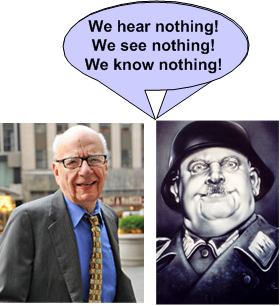
We’ve heard it before, we’re hearing it now from formerly unassailable media mogul Rupert Murdoch, and we’ll hear it again from other self-important papal figures. Yawn.
What will we hear, you ask? Well, it’s the ubiquitous Sergeant Schultz defense: “I hear nothing, I see nothing, I know nothing“. But ya know, the hot shot dudes who whip out this get-out-of-jail-free card may actually be right. If they “skillingfully” setup their borg’s structure and culture so that they can’t know, then they won’t.
The MFC
In The Management Myth, Matthew Stewart rags about how, despite the proven inapplicability of FOSTMA techniques in the 21st century, “modern” management theory continuously repackages the same old wine (vinegar?) in a new bottle via the Management Fad Cycle (MFC). MBA snake oil salesmen simply use new words to cloak the same worn and tired underlying themes in order to make a buck.
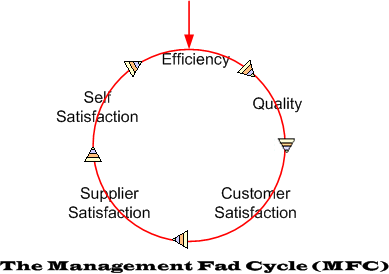
The thing that makes modern management theory so painful to read isn’t usually the dearth of reliable empirical data. It’s that maddening papal infallibility. – Matthew Stewart
Adders, Subtractors, Creators
In a perfect world, every person involved in an org is either a value creator or a value adder. Although there are a handful of hard to find examples of the (almost) perfect org, the landscape is littered with these types of mediocre and poor performing orgs:

Keep Outta The Kitchen!
… there is nothing more difficult to carry out, nor more doubtful of success, nor more dangerous to handle, than to initiate a new order of things. For the reformer makes enemies of all those who profit by the old order, and only lukewarm defenders in all those who would profit by the new order… – Niccolo Machiavelli
In all companies, both leading and lagging, it’s only natural that people at all levels in the hierarchy will complain about various aspects of day-to-day operations that they feel are holding them and the company back. At leading companies, gripes are actively solicited, listened to, and thoughtfully evaluated. Those deemed to be valid are acted upon to improve performance and morale. At laggard borgs, all gripes that cry out for a deviation from the status quo are either pooh-poohed away as non-issues (especially if they bubble up from the bottom) or they’re outright ignored.
In the sad extreme, leaders toiling in laggard borgs who know that valid gripes are slooowly killing the enterprise, feel powerless to act. It’s sad because, even though they have the stature and power to influence change, they don’t feel it’s worth the effort to champion and diligently follow through on a much needed change initiative. By keepin’ outta the kitchen cuz they can’t stand the heat, they religiously follow Harry Truman‘s sage advice.


Why am I here?
WTF?
Meh!
D'oh!

My BTC Address



 Bulldozer00's Blog