Archive
Supported By, Not Partitioned Among
“A design flows from a chief designer, supported by a design team, not partitioned among one.” – Fred Brooks
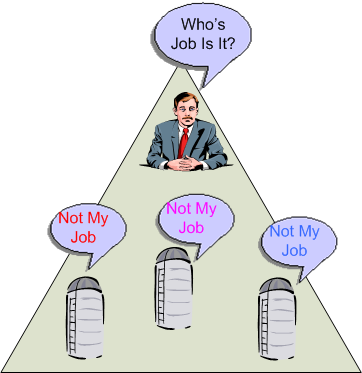
partitioning == silos == fragmented scopes of responsibility == it’s someone else’s job == uncontrolled increase in entropy == a mess == pissed off customers == pissed off managers == disengaged workers
“Who advocates … for the product itself—its conceptual integrity, its efficiency, its economy, its robustness? Often, no one.” – Fred Brooks
Note for non-programmers: “==” is the C++ programming language’s logical equality operator. If the operator’s left operand equates to its right operand, then the expression is true. For example, the expression “1 == 1” (hopefully) evaluates to true.
Knowing this, do you think the compound expression sandwiched between the two Brooks’s quotes evaluates to true? If not, where does the chain break?
Morally Irresponsible Stooges
In the first place, it is clear that the degradation of the position of the scientist as an independent worker and thinker to that of a morally irresponsible stooge in a science factory has proceeded even more rapidly and devastatingly than I had expected. The subordination of those who ought to think to those who have the administrative power is ruinous to the morale of the scientist, and quite to the same extent, the objective scientific output of the nation. – Norbert Wiener.
By stealing Norby’s quote and replacing a few words, we can make up this nasty, vitriolic, equivalent passage (cuz I like to make stuff up):
In the first place, it is clear that the degradation of the position of the product creator/developer as an independent worker and thinker to that of a morally irresponsible stooge in a corpocracy has proceeded even more rapidly and devastatingly than I had expected. The subordination of those who ought to think to those who have the bureaucratic power is ruinous to the morale of the wealth creator, and quite to the same extent, the productive output of the CCF. – Bulldozer00.
These days, exploiters are more valued than explorers and makers. In the good ole days (boo hoo!) and in most present day startup companies, the exploiters were/are also the explorers and makers, but because of a lack of respect and support for the species, the multi-disciplined systems thinker and doer has gone the way of the dinosaur. It’s only getting worse because as complexity grows, the need for renaissance men and women to harness the increase in complexity’s dark twin, entropy, is accelerating.
A Newly Discovered Universal Constant
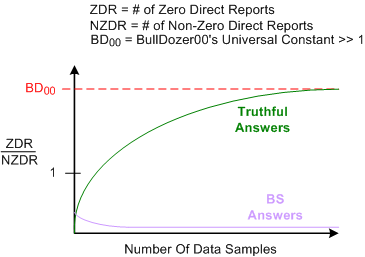
The next time you meet someone with a title of “manager of xxx” or “director of yyy”, ask the dude how many subordinates (a.k.a. DICs) directly report to him/her to be “managed” or “directed”. As you acquire data samples, keep a running tally over time of the ratio of the number of people who truthfully retort with an answer of Zero Direct Reports (ZDR) to the number of people who truthfully reply with an answer of Non-Zero Direct Reports (NZDR). My theory is that, as the number of collected “samples” grows, a truthful ZDR-to-NZDR ratio will increase and then level off to some yet undiscovered universal constant (like the speed of light in a vacuum, Avogadro’s number, or Boltzmann’s constant). Also, the ratio will settle out to a value much greater than one.
My bogus theory is based on the hypothesis that most people covet the esteemed title of “manager” and “director” because it’ll (at least temporarily) jack up their social standing compared to other “non-manager” low lifes and get them higher starting salaries and bonuses if they decide to jump ship. I also hypothesize that most self-proclaimed and artificially-anointed managers/directors who have zero direct reports will fib about it – especially if they’re highly confident that you won’t be able to verify their response as truthful. My advice is to flip the bozo bit from MBAB to IAB whenever you uncover a manager/director with zero direct reports who proclaims he/she has one or more direct reports under his/her control.
Since there seems to be a boatload of managers and directors aggregated there, LinkedIn.com is a fertile experimental lab for collecting data points. So, if you’re interested in exploring this cock-a-mamy, made up theory founded on no basis whatsoever, you can start there – especially if you’re a recruiter of managers and directors for your clients or your company.
So, why don’t I do my own data collecting and number crunching? Because: 1) I have no interest in doing it, 2) I project that I’d become depressed at my findings, and 3) I’m a lazy ass who likes to sit back and make stuff up that pisses some people off and ignites a chuckle in other downtrodden and incorrigible people like me. Of course, this assumes that there actually are others like me. D’oh!
A conscience is what feels bad when everything else feels so good. – Steven Wright
Dark Hero
In Dark Hero of the Information Age: In Search of Norbert Wiener The Father of Cybernetics, authors Flo Conway and Jim Siegelman trace the life of Mr. Wiener from child prodigy to his creation of the interdisciplinary science of cybernetics. As a student of the weak (very weak) connection between academic and spiritual intelligence, I found the following book excerpt fascinating:
Since his youth, Wiener was mindful that his best ideas originated in a place beneath his awareness, “at a level of consciousness so low that much of it happens in my sleep.” He described the process by which ideas would come to him in sudden flashes of insight and dreamlike, hypnoid states:
Very often these moments seem to arise on waking up; but probably this really means that sometime during the night I have undergone the process of deconfusion which is necessary to establish my ideas…. It is probably more usual for it to take place in the so-called hypnoidal state in which one is awaiting sleep, and it is closely associated with those hypnagogic images which have some of the sensory solidity of hallucinations. The subterranean process convinced him that “when I think, my ideas are my masters rather than my servants.”
Barbara corroborated her father’s observation. “He frequently did not know how he came by his answers. They would sneak up on him in the middle of the night or descend out of a cloud,” she said. Yet, because Wiener’s mental processes were elusive even to him, “he lived in fear that ideas would lose interest in him and wander off to present themselves to somebody else.”
This description of how and when ideas instantaneously appear out of the void of nothingness aligns closely with those people who say their best ideas strike them: in the shower, on vacation, out in nature, during meditation, while driving to work, exercising, or doing something they love. In situations like these, the mind is relaxed, humming along at a low rpm rate, and naturally prepared for fresh ideas. Every person is capable of receiving great ideas because it’s an innate ability – a gift from god, so to speak. Most people just don’t realize it.
I haven’t heard many stories of a great idea being birthed in a drab, corpo-supplied, cubicular environment under the watchful eyes of a manager. Have you?
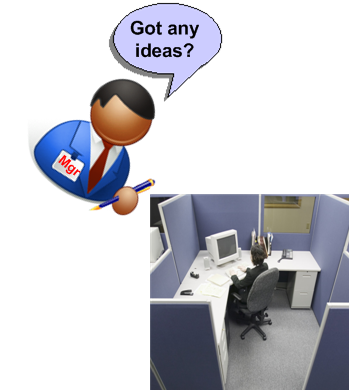 Note: The picture above is wrong. Exept for “what’s your status?“, BMs don’t ask DICs for anything. Since they know everything, they just tell DICs what to do.
Not Baffling
“Increasingly, people seem to misinterpret complexity as sophistication, which is baffling—the incomprehensible should cause suspicion rather than admiration. Possibly this trend results from a mistaken belief that using a somewhat mysterious device confers an aura of power on the user.” – Niklaus Wirth
Niklaus, it’s not baffling. People do it because, in a society that adores academic intelligence over all else, they don’t want to look and feel stupid in front of others. By acting as though they admire an incomprehensible monstrosity that they don’t understand, the people around them (especially the creators of the untenable complexity) will think they are smart and sophisticated too.

Regardless of whether the “misinterpretation” happens consciously or unconsciously, it’s ego driven. I know this because I’ve done it many times…….. both consciously and unconsciously.
“The intuitive mind is a sacred gift and the rational mind is a faithful servant. We have created a society that honors the servant and has forgotten the gift.” – Albert Einstein
The Best Defense
In “The Design Of Design“, Fred Brooks states:
The best defense against requirements creep is schedule urgency.
Unfortunately, “schedule urgency” is also the best defense against building a high quality and enduring system. Corners get cut, algorithm vetting is skipped, in-situ documentation is eschewed, alternative designs aren’t investigated, and mistakes get conveniently overlooked.
Yes, “schedule urgency” is indeed a powerful weapon. Wield it carefully, lest you impale yourself.

High And Low Tides
I’m lucky to have a job with variety. Most of the time, I’m either specifying, designing, writing, documenting, or fixing software that enhances or keeps our product portfolio viable. However, not all project work is equi-important to the company’s prosperity.
Some of the projects that I work on are bland, menial, and they don’t contribute much to the development of my company. When I work on these types of projects, I tend to feel guilty, overpaid, and like an under-performer. Accordingly, my behavior changes to align with those feelings. I turn inward, I’ m less interactive with others, and I’m less likely to observe, sense, and provide “controversial” input on socio-technical issues that I perceive to be holding the company back.
On the other side of the coin, when I work on challenging and intense work that I perceive is propelling the company forward, I gravitate towards ego-centric feelings of arrogance and superiority. I feel underpaid, under-appreciated, and overworked (boo hoo!). I become a “legend in my own mind“.
In either mode of behavior, it’s real easy to lose perspective and alienate co-workers and leaders. The key to balanced behavior during these high and low tides, which I haven’t yet figured out how to turn, is to recognize when I’m deep into one mode or the other.
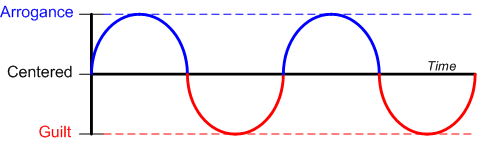
How about you? Do you oscillate between extremes? Do you continuously dwell in one of the extreme states? Are you always Buddha-centered? If so, how do you know you are?
Expected Forgetfulness
BMs and CCRATs in mediocracies always require that the DIC-force conveniently forget the parade of reorgs and resource draining initiatives that they have started but have never followed through on over the years. However, they’ll be the first to remind project contributors when they “haven’t met schedule” or when their project came in “over budget“.
DIC-sters, either consciously out of fear or unconsciously from years of mind-numbing indoctrination, comply dutifully with the “expected forgetfulness” rule in order to preserve the mediocre performance that gives a mediocracy is meaning. All attempts to point out the blatantly obvious but undiscussable hippocracy of CCRAT demands for schedule and cost compliance, while simultaneously underperforming in these areas themselves, is met with swift retribution. This happens even in the extremely rare cases when a hierarch himself loses his sanity for a nanosecond and tries to right the wrong.

Services And Outcomes
In an e-mail from friend and mentor Bill Livingston, he said:
If duty is focused on method and practices, there can be no responsibility either for meeting the objective or for any consequences of services. If goal attainment is chosen paramount, there can be no limitations on methodology. Duty for professional services is given by authority. Responsibility for outcomes must be willingly taken by the designer. – William L. Livingston
Think about how obsessed most companies (especially large ones run by fat heads) are with regard to following standard corpo policies, rules, methods, and practices. In other words, red freakin’ tape. In these abominations that have lost their way, if one is a good soldier and loyally follows the unchangeable rules inscribed in stone by the dudes in the head shed, there can be no repercussions for failure to achieve goals. After all, since the corpocrats created the operational rule set and they’re (of course) infallible, that means the rule set is perfect. Hence, if you follow the rules to the letter but cause a disaster, you’re absolved.

Unconstrained To Constrain
As I continue to slowly inhale Fred Brooks‘s book, “The Design Of Design“, I’m giddily uncovering all kinds of diamonds in the rough. Fred states:
“If designers use a structured annotation or software tool during design it will restrict the ease of having vague ideas, impeding conceptual design.”
Ain’t that the truth? Don’t those handcuffing “standard document templates, processes, procedures, work instructions” that you’re required to follow to ensure quality (lol!) frustratingly constrain you from doing your best work?
Along the same lines, Fred hits another home run in my ballpark (which is devoid of adoring and paying fans, of course):
“I believe that a generic diagramming tool, with features such as automatic layout of trees, automatic rerouting of relationship arrows, and searchable nodes, is better suited to (design) tree capture. Microsoft Visio or SmartDraw might be such a choice.”
Man, this one almost made me faint and lose consciousness. I live, eat, and breath “Visio”. Every picture that you’ve seen in this blog and every design effort that I undertake at work starts with, and ends with, Visio – which is the greatest tool of expression I’ve ever used. I’ve tried “handcuffers” like Artisan Studio and Enterprise Architect as software design aids, but they were too frustratingly complex and constraining to allow me to conjure up self-satisfying designs.
All designs must eventually be constrained so that they can be built and exploited for profit. But in order to constrain, one must be unconstrained. How’s that for a zen-like paradox?


Why am I here?
WTF?
Meh!
D'oh!

My BTC Address



 Bulldozer00's Blog