Archive
Zappos Rocks Again
As a huge, huge, huge, (did I say youuuuuuuge-uh?), fan of Tony Hsieh and Zappos.com, I blabber about them often. Zappos latest action to make the whole world, yes, the whole world, a better place is to offer up a free, yes free, download of the audio version of the best seller, yes best seller, book “Tribal Leadership“. The link is here, yes here.

Even though I’ve stalked Zappos.com for years, until recently I’ve never bought anything from them because I’m not a shoe or clothes dude. Hell, I’m an old and unredeemable person of questionable integrity and questionable character and questionable morality and questionable <<add your own trait here if you know me>>, so I renew these things about every 10 years or when they fall apart; whichever comes first. However, even with zero revenue from me, they upgraded me to VIP status. This means that with every order I place, they’ll guarantee free overnight shipping. WTF, you say? Uh, the only answer that I can give to you is: They’re fuckin’ Zappos.com dude, that”s why! Oops, I hope the F-bomb didn’t make you mad and send you to the altar to pray for me. If it did, then maybe you shouldn’t be wasting your time reading this blasphemous blog 🙂
Lopp-Sided
Michael Lopp is an engineer’s kind of manager. Besides having a great last name (can you say Lopp-sided?) and an even better pen name (“Rands In Repose“), the guy still understands and relates to down-in-the-trenches engineering work. He even drops an occasional F-bomb in his writing for dramatic effect. The dude is a rare bird and I pay attention to what he says.
Although I think the name of his latest book, “Being Geek“, is meh, there’s a lot of great stuff in there for both managers and DICs. Here’s a sampling of “culled” passages:
The story we tell ourselves when someone we like chooses to leave the group or the company is, “Everyone is replaceable.” This is true, but this is a rationalization designed to lessen the blow that, crap, someone we really like is leaving. We are losing part of the team. Professional damage is done when a team member leaves, and while they are eventually replaceable, productivity and morale take a hit.
A manager’s job is to forget. That’s what they do. They get promoted and begin the long processes of forgetting everything that got them promoted in the first place. I’m not joking. Manager amnesia will be the source of much professional consternation throughout your career.
My management strategy is to assume those closest to the problem can make the best decisions. That’s how I scale.
In defense of my brethren managers, we don’t forget everything, and during all that forgetting, we’re learning other useful things like organization politics, meeting etiquette, and the art of talking for 10 minutes without saying a thing.
The list of words that define management are revealing: direct, in charge, handle, control, and force. Looking at this list, it’s not a surprise that the term “management” has a distasteful Orwellian air.
If it’s been six months, you’ve been actively looking, and no one has told you a great story about how engineering shaped the fortunes of your company, there’s a chance that engineering doesn’t have a seat at the culture table in your company.
There’s the been-here-forever network, the I-survived-the-layoff people, and the untouchable did-something-great-once crew.
It pains me to write this, but my first question about your boss is this: is he taking the time to talk with you in a private setting? A 1:1 is a frequent, regularly scheduled meeting between you and your boss, and if it’s not happening, I, uh, don’t really know where to start. The absence of a 1:1 is the absence of mentorship, and that means your need to gather your experience in the trenches. And while there is nothing to replace “real-world experience,” I’m wondering what the value add of your boss is.
My impression is that the presence of status reports is an indication that your boss doesn’t trust the flow of information in your organization.
We’re knowledge workers, which is an awkwardly lame way of stating that we don’t actually build physical things with our hands.
Asking for the impossible is an advanced management technique, and it’s one that is particularly abhorrent to engineers. Frequent impossible requests result in an erosion of respect and a decaying of credibility.
You’re not going to engage if you don’t respect the person who is asking you to do something.
Management by crisis is exhilarating, but it values velocity over completeness; it sacrifices creativity for the illusion of progress.
Everyone is an adjustment. When you’re interacting with anyone, you leave the core you and become slightly them.

Busy Doing Nothing
The British created a civil service job in 1803 calling for a man to stand on the Cliffs of Dover. The man was supposed to ring a bell if he saw Napolean coming….. The job was abolished in 1945. – Robert Townsend.
The battle of Waterloo, in which Napolean’s army was routed, was fought in 1815. Thus, the series of dudes who stood guard for 130 years after the fall of the egotistical French emperor were busy doing nothing but pissing and pooping off the cliffs every few hours – and gettin’ paid for it.

In “Ackoff’s Best: His Classic Writings On Management“, uber systems thinker Russell Ackoff rails against bureaucracies:
A bureaucracy is an organization whose principle objective is to keep people busy doing nothing. They are preoccupied with what we call make-work…. The problem created by people who are busy doing nothing is that they frequently obstruct others who have real work to do. They impose unproductive requirements on others…. Bureaucracies obstruct development. They retard improvement of quality of life…. Bureaucrats want all parts of an organization to conform to one set of rules and regulations…. Conformity is treated as good in itself, an ultimate good. – Russell Ackoff
Mr. Ackoff not only rages against the machine, he advises on how to beat the system with a bevy of hilarious real-life examples in which individuals successfully “fought city hall” and won. He follows each ditty with a moral. Buy the book and read it for the delicious details of every battle.
From Wanted To Unwanted
You can have a product without a business, but you can’t have a business without a product. If you build a product that people want, a business will be born either from your loins or from some copycat’s. There’s no chicken and egg dilemma here. It’s simply, product-first and business-second. Ka-ching!
But wait, that’s not all! Let’s say you do get lucky and start a biniss around a “wanted” product that you built. To sustain your business, you gotta sustain your product. That means continuously maintaining it via the addition of new value-added features and the correction of customer-annoying defects.
Upon observing the deterioration of his original ArsDigita product under the so-called leadership of “new management”, Philip Greenspun said:
Once you have a product that nobody wants, it doesn’t matter how good your management team is. – Phil Greenspun (Founders At Work, Jessica Livingston)
So, how does a “wanted” product morph into an “unwanted” product? Via neglect and indifference. That’s what happened to Phil’s baby when the vulture capitalists he hooked up with installed an incompetent “professional management team” to run ArsDigita (into the ground). By focusing on the superficial instead of the substance, the promotion instead of the maintenance, the company’s product, and then the company itself, went down hill fast:
ArsDigita grew out of the software that Greenspun wrote for managing photo.net, a popular photography site. He released the software under an open source license and was soon deluged by requests from big companies for custom features. He and some friends founded ArsDigita in 1997 to take on such consulting projects. In 2000, ArsDigita took $38 million from venture capitalists. Within weeks of the deal closing, conflict arose between the new investors and the founders. They marginalized and then fired most of the founders, who responded by retaking control of the company using a loophole the VCs had overlooked. The legal battle culminated in Greenspun’s being bought out, and a few months later the company crashed. ArsDigita was dissolved in 2002. – (Founders At Work, Jessica Livingston)

Inability To Assimilate
In this Federal Computer Week magazine blog post, the author laments about the inability to hire talented people into the government borg:
- “The supervisors here are sycophants who are only interested in their careers.”
- “My experience is (more or less) a third of folks (management and labor) are amazing and functional well beyond pay and expectations. Another third are limited, work-reward clock-punchers. The last third are untrainable and unfireable.”
- “I’ve seen one too many occasions of “hiring teams” not hiring the best qualified but hiring friends that don’t meet the job requirements. “
- “The federal human resources processes do not necessarily match skills and education with job positions. “
- “We have more layers of management and more keep getting added without adding any workers.”
- “There are contracting personnel put in jobs who have not a clue about true contracting processes. These individual are put in position because of favoritism.”
- “Most middle-level managers want to demonstrate they are in control.”
Of course, the statements above only apply to government bloat-ocracies, no?

Ty Detmer
Remember Philadelphia Eagles quarterback Ty Detmer? The DETMER metric, which was introduced in yesterday’s post and stands for Decision-To-Meeting-Ratio, is named after Ty. Hah, hah – just joking. There’s no connection between Detmer and DETMER. DETMER is a bogus metric acronym that I concocted and, for some weird reason, Ty’s name repeatedly comes to my defective mind every time I think of it. Time for a straight jacket and meds?
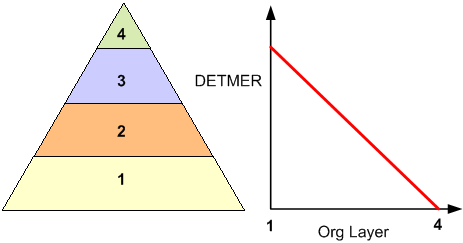
The figure below shows a madeup DETMER vs layer-of-importance curve for a typical corpricracy. The higher one moves up in the caste system, the more useless no-decision meetings one gets to attend. At these egofests, peer SCOLs psychologically duel with each other “under the covers” to prove “I’m great and you’re not“. It’s like a gaggle of peacocks struttin’ around in front of each other showing off how much prettier their plumes are. Of course, few if any important decisions are arrived at during these aristocratic social events. At the highest levels in the CCF, every hour of every day is booked with these “Dancing With The Czars” assemblies.
Meetings and Decisions
Orgs of people exist for a purpose. In order to continuously fulfill the org’s purpose in a changing external environment, its members need to make decisions regarding what to do and when to do it in order to counter unfavorable changes that are at odds with the org’s purpose. Since people need to know who will do what, when they’ll do it, and how they’ll coordinate with others to collectively counter external threats, decision-making meetings are held at all levels to decide such issues of importance.
The figure below introduces the Decision-To-Meeting-Ratio (DETMER) metric. It also shows the divergence of this metric for two competing orgs who initially had the same DETMER value at an arbitrary time, T=0. Assuming (and it’s a bad assumption) that all decisions made at each meeting are effective, as the DETMER goes to zero nothing changes for the good within the org walls. People do the same thing everyday, even as the environmental conditions outside the walls relentlessly change. Voila, a bureaucracy led by a cadre of Bozeltines emerges. Bummer.

Zero Time, Zero Cost
In “The Politics Of Projects“, Robert Block states that orgs “don’t want projects, they want products“. Thus, the left side of the graph below shows the ideal project profile; zero cost and zero time. A twitch of Samantha Stevens’s nose and, voila, a marketable product appears out of thin air and the revenue stream starts flowin’ into the corpo coffers.
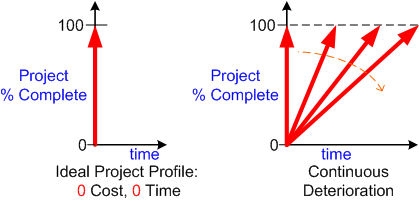
Based on a first order linear approximation, all earthly product development orgs get one of the performance lines on the right side of the figure. There are so many variables involved in the messy and chaotic process from viable idea to product that it’s often a crap shoot at predicting the slope and time-to-100-percent-complete end point of the performance line:
- Experience of the project team
- Cohesiveness of the project team
- Enthusiasm of the project team
- Clarity of roles and responsibilities of each team member
- Expertise in the product application domain
- Efficacy of the development tool set
- Quality of information available to, and exchanged between, project members
- Amount and frequency of meddling from external, non-project groups and individuals
- <Add your own performance influencing variable here>
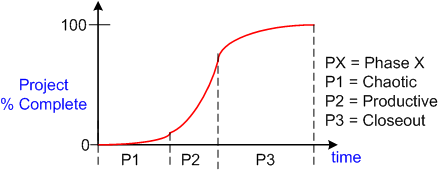
To a second order approximation, the S-curve below shows real world project performance as a function of time. The slope of the performance trajectory (% progress per unit time) is not constant as the previous first order linear model implies. It starts out small during the chaotic phase, increases during the productive stage, then decreases during the closeout phase. The objective is to minimize the time spent in phases P1, P2, and P3 without sacrificing quality or burning out the project team via overwork.
 Assume (and it’s a bad assumption) that there’s an objective and accurate way of measuring “% complete” at any given time for a project. Now, assume that you’ve diligently tracked and accumulated a set of performance curves for a variety of large and small projects and a variety of teams over the years. Armed with this data and given a new project with a specific assigned team, do you think you could accurately estimate the time-to-completion of the new project? Why or why not?
Dissed By Someone “Important”
The impeccably credentialed and self-revered Ian Mitroff dissed me out of the blue via a private message on LinkedIn:
“You are an absolute relativist which is not very interesting or relevant.”
Based on the following quote, Mr. Mitroff might label Shakespeare as an uninteresting, absolute relativist too:
There is nothing either good or bad, but thinking makes it so. – William Shakespeare
Damn it Willie, nothing is relative! It’s not good or bad, it’s one or the other. Since my judgment is infallible, it’s whichever I say it is.
Feeling compelled to reply to the self-anointed “father of crisis management“, my bruised and battered ego retorted with:
“I’m sorry, oh exalted professor. Thanks for your irrelevant opinion.”
Me thinks that Ian may be one of those professors that Ken Robinson says: “solely uses his body to transport his head around“. I hate to prematurely judge people, but it sure feels good to be bad.
“A conscience is what feels bad when everything else feels so good.” – Steven Wright

Delusions of Grandeur
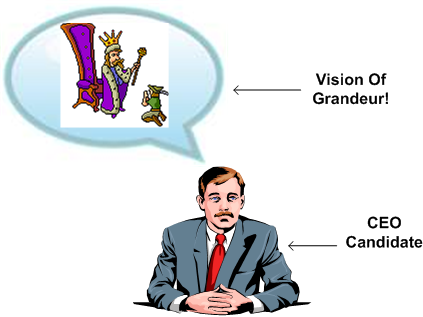
In “Founders At Work“, Jessica Livingston interviews a boatload of company founders about their personal experiences with regard to starting their companies from the ground up. Paul Graham, who co-founded “ViaWeb” and sold it to Yahoo 3 years later for a cool $45M, was asked about his search for a CEO in the early days. Here’s what he said:
The problem with all of them was that they had delusions of grandeur. This was the beginning of the Internet Bubble, remember, and I think all of these guys saw themselves as some kind of grand CEO, while we programmers labored in the kitchen cooking the food and washing the dishes. If the deal were simply that the business guy would be the public face of the company, but we would be allowed to do what we wanted and make sure everything worked right, that would have been OK. But we were worried about what might happen if one of these guys wanted to actually be the chief executive officer and tell us what our strategy should be. We’d be hosed, because they didn’t know anything about computer stuff. – Paul Graham

Why am I here?
WTF?
Meh!
D'oh!

My BTC Address



 Bulldozer00's Blog