Archive
The Boundary
Mr. Watts Humphrey‘s final book, titled “Leadership, Teamwork, and Trust: Building a Competitive Software Capability” was recently released and I’ve been reading it online. Since I’m in the front end of the book, before the TSP–PSP crap, I mean “stuff“, is placed into the limelight for sale, I’m enjoying what Watts and co-author James W. Over have written about the 21st century “management of knowledge workers problem“. Knowledge workers manipulate knowledge in the confines of their heads to create new knowledge. Physical laborers manipulate material objects to create new objects. Since, unlike physical work, knowledge work is invisible, Humphrey and Over (rightly) assert that knowledge work can’t be managed by traditional, early 20th century, management methods. In their own words:
Knowledge workers take what is known, and after modifying and extending it, they combine it with other related knowledge to actually create new knowledge. This means they are working at the boundary between what is known and what is unknown. They are extending our total storehouse of knowledge, and in doing so, they are creating economic value. – Watts Humphrey & James W. Over
But Watts and Over seem inconsistent to me (and it’s probably just me). They talk about the boundary ‘tween the known and the unknown, yet they advocate the heavyweight pre-planning of tasks down to the 10 hour level of granularity. When you know in advance that you’ll be spending a large portion of your time exploring and fumbling around in unknown territory, it’s delusional for others who don’t have to do the work themselves to expect you to chunk and pre-plan your tasks in 10 hour increments, no?

Nothing is impossible for the man who doesn’t have to do it himself. – A. H. Weiler
Mangled Model
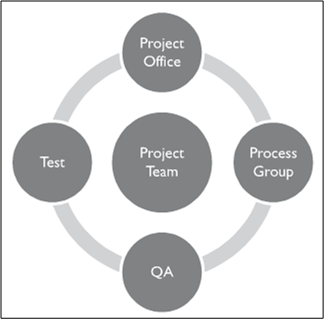
In their book, “Leadership, Teamwork, and Trust: Building a Competitive Software Capability“, Watts Humphrey and James Over model a typical software project system via the diagram below (note that they have separate Quality Assurance and Test groups and they put the “project office” on top).
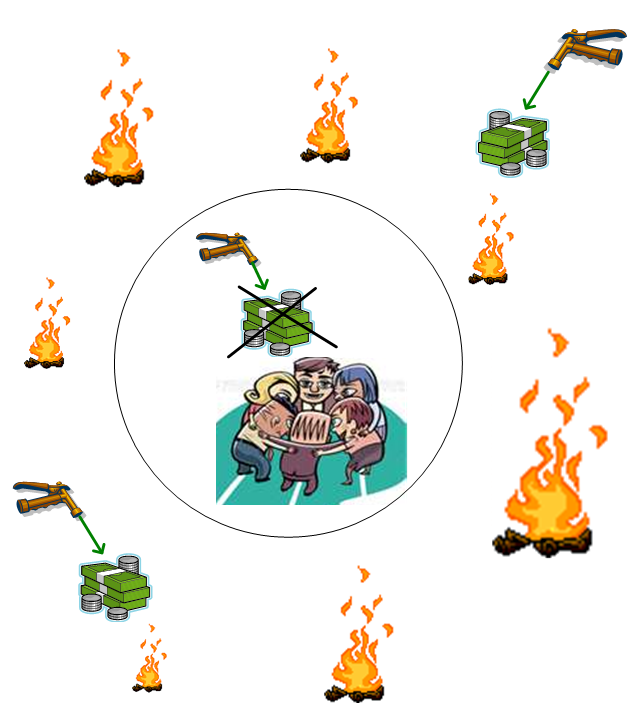
Bulldozer00 would have modeled the typical project system like this:

Of course, the immature and childish BD00 model would be “inappropriate” for inclusion into a serious book that assumes impeccable, business-like behavior and maturity emanating from each sub-group. Oh, and the book wouldn’t sell many copies to the deep pocketed audience that it targets. D’oh!
When The Spigot Runs Dry
It was recently hinted to me that, for a legitimate business reason, the fun and exciting distributed systems IR&D (Internal Research and Development) software project that I’m working on might get canned. I sadly agree that if there are no customers for a product, and day-to-day fires are burning all over the place, it’s most definitely a legitimate business reason to turn off the financial spigot.
In addition to the “hint“, several important technical people have been reassigned to other maintenance projects. Bummer, but shite happens.
A Free Pass
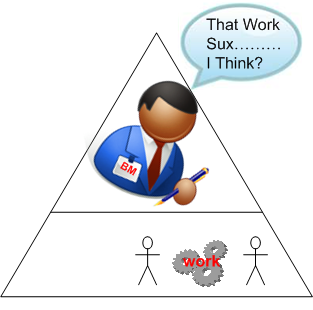
In a culture of blame, and its Siamese twin, fear, any non-manager group member who consistently asks tough questions and points out shoddy, incomplete, ambiguous work becomes a group target for retribution. This defensive peer group behavior is a natural response to redirect attention away from the stank and to squelch criticism. The funny thing is, managers in CCHs are given a free pass to ask tough questions and criticize without fear of retribution. It helps that managers don’t produce any work products that can be scrutinized by DICsters – if they wanted to. Even if managers did pitch in by leading by example, most DICkies wouldn’t point out flaws because of……. fear of downstream retribution.
Ironically, because of the hierarchical mindset ingrained into all members of a DYSCO, and even though bad managers don’t have to worry about being tarred and feathered by the DICforce, most managers at the workface are incapable of asking the tough questions. Watts Humphrey summarizes this managerial shortcoming nicely:
However, as (Peter) Drucker pointed out, managers can’t manage knowledge work. This means that they cannot plan knowledge work, they cannot monitor and track such work, and they cannot determine and report on job status. – Watts Humphrey & James Over
Cultures of blame and fear of retribution go hand in hand with command and control hierarchies like peas and carrots, Jenny and Forrest. To expect otherwise is to be delusional.
Apples And Oranges
In “Leadership, Teamwork, and Trust“, Watts Humphrey and James Over build a case against the classic “Test To Remove Defects” mindset (see the left portion of the figure below). They assert that testing alone is not enough to ensure quality – especially as software systems grow larger and commensurately more complex. Their solution to the problem (shown on the right of the figure below) calls for more reviews and inspections, but I’m confused as to when they’re supposed to occur: before, after, or interwoven with design/coding?
If you compare the left and right hand sides of the figure, you may have come to the same conclusion as I have: it seems like an apples to oranges comparison? The left portion seems more “concrete” than the right portion, no? Since they’re not enumerated on the right, are the “concrete” design and code/build tasks shown on the left subsumed within the more generic “Product Development” box on the right?
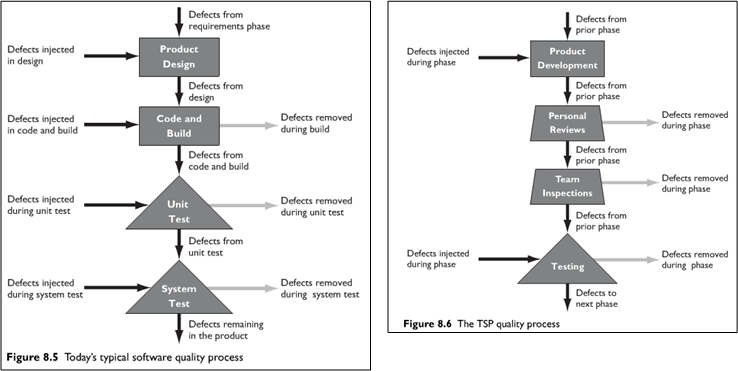
In order to un-confuse myself, I generated the equivalent of the Humphrey/Over TSP (Team Software Process) quality process diagram on the right using the diagram on the left as the starting reference point. Here’s the resulting apples-to-apples comparison:
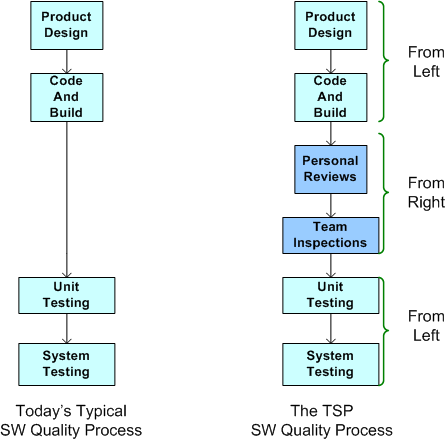 If this is what Humphrey and Over meant, then I’m no longer confused. Their TSP approach to software quality is to supplement unit and system testing with reviews and inspections before testing occurs. I wish they said that in the first place. Maybe they did, but I missed it.
Inchies
So, what’s an Inchie? It’s an “INfallibility CHIp“. An Inchie is an invisible, but paradoxically real corpo currency that is the opposite of a demerit. An increasing Inchie stash is required to move up in a corpo caste system. The higher up you are in a CLORG, the more Inchies you have been awarded, and the more infallible you’ve become.
At level 0 down in the basement, you begin the game with 0 Inchies and you start making your moves – climbing the ladder Inchie by Inchie. Be careful and keep watch over your Inchie stash though, cuz your peers will try to steal your Inchies when you’re not looking.
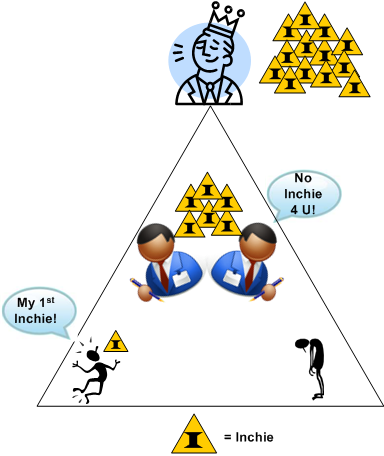 Alas, even though you now know that Inchies exist, don’t get your hopes up. You see, the criteria managers at level N (where N > 0) use for disbursing Inchies down to the less infallible people at level N-1 are random. Even among managers within a given level, the award criteria is arbitrarily different. Plus, to make the game more difficult, the dudes who awarded you your Inchies can take them back whenever they feel the need to “scratch your Inchie” – especially if you piss them off with career ending moves. D’oh!
Once you make it to the top of the pyramid with your big bag o’ Inchies, not only have you amassed the most Inchies in the DYSCO, but you’re given the keys to the Inchie minting machine. This gives you the opportunity to fabricate an unlimited number of Inchies to add to your display case and to sprinkle upon your sycophant crew as you please. You’ve become a 100% infallible god in the DYSCO microcosm. Whoo Hoo and Kuh-nInchie-wah!
Mismatch
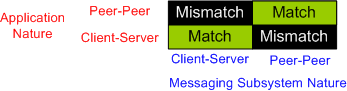
Assume that you’re tasked to create a two component, distributed software system as shown in the figure below. The nature of the application is such that during runtime, component 1 will continuously transmit a “bursty“, asynchronous stream of messages to component 2. During evolution of the system in the future, you know that more and more stages will be tacked on to the “pipeline“, with each stage adding value to a growing customer base (if you don’t screw it up and hatch a BBoM).

Note that the relationship between application components is peer-to-peer and not client-server like this:

One question is this: “Why on earth would anyone choose a client-server messaging system (with peer-to-peer capability tacked on) over a peer-to-peer messaging system for this class of application?“. The question especially applies to product organizations that strive to develop distinctly elegant and innovative solutions – which hopefully includes yours. A second question is: “What would technologically savvy customers think?“. Of course, if you think your customers are dumb-asses (and you won’t be in business for long if you do) and can’t tell the difference, then the situation is a “don’t care“, no?
Flouting Convention
As software-centric systems get more complex, one of the most effective tools for preventing the creation of monstrous BBoMs downstream is “layering”. The figure below shows a generic model of the layering concept.

When you use layering, you partition your system into a vertical stack with the most “exciting” application-specific functions and objects at the top of the stack and the more mundane and boring functionality down in the basement. In a pure layered system, the higher layers depend on the services provided by the lower levels and there are no dependencies the other way. The cleaner and crisper your inter-layer boundaries, the lower your maintenance cost and frustration.
The figure below shows the conventional approach of representing an inheritance hierarchy in an object oriented design. What’s wrong with this picture? Relative to the layered model, it’s “upside down“. The most general class is on top and the most domain-specific class is at the bottom. WTF and D’oh!
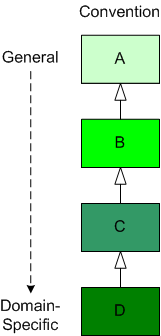
Since “layering” has been around much longer than object-orientation, Bulldozer00 thinks that a layered, object-oriented software system should always be presented to stakeholders like this:
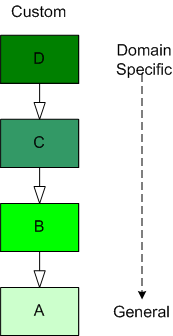
This method of representation aligns cleanly with the layered “view” of the system and is thus, less confusing and dis-orienting to all audiences, dontcha think? To hell with convention, – at least in this situation.
Horse And Buggy
Werner Vogels is Amazon.com’s Chief Technology Officer and author of the blog “All Things Distributed – Building Scalable And Robust Distributed Systems“. I just couldn’t stop myself from laughing when he announced that fellow distributed-systems guru Steve Vinoski had just joined Twitter:

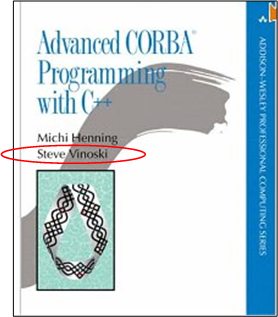
Specifically, the last sentence put me in stitches. As you can see from the book cover below, Steve is a CORBA expert and way back in the dark ages he was a CORBA advocate. However, he’s moved into the 21st century and left that horse and buggy behind – unlike others who cling to their horse whips and ostracize those who point out the obvious.

Why am I here?
WTF?
Meh!
D'oh!

My BTC Address



 Bulldozer00's Blog