Archive
Up, Down, Sideways
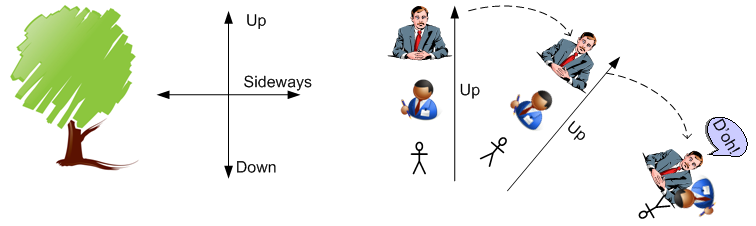
In order for a tree to remain viable throughout its lifetime, it must grow upwards, sideways (think leaves), and downward (think roots). In BD00’s tortured mind, a lot of people seem myopically focused solely on growing up.
Dream, Mess, Catastrophe
To build high quality, successful, long-lived, “Big” software, you must design it in terms of layers (that’s why the ISO ISO model for network architecture has 7, crisply defined layers). If you don’t leverage the tool of layering (and its close cousin – leveling) in an attempt to manage complexity, then: your baby won’t have much conceptual integrity; you’ll go insane; and you’ll be the unproud owner of a big ball of mud that sucks down maintenance funds like a Dyson and may crumble to pieces at the slightest provocation. D’oh!
The figure below shows a reference model for a layered application. Note that even though we have a neat stack, we can’t tell if we have a winner on our hands.

By adding the inter-layer dependencies to the reference architecture, the true character of our software system will be revealed:

In the “Maintenance Dream“, the inter-layer APIs are crisply defined and empathetically exposed in the form a well documented interfaces, abstractions, and code examples. The programmer(s) of a given layer only have to know what they have to provide to the users above them and what the next layer below lovingly provides to them. Ah, life is good.
Next, shuffle on over to the “Maintenance Mess“. Here, we have crisply defined layers, but the allocation of functionality to the layers has been hosed up ( a violation of the principle of “leveling“) and there’s a beast in the making. Thus, in order for App Layer programmers to be productive, they have to stuff their head with knowledge/understanding of all the sub-layer APIs to get their jobs done. Hopefully, their heads don’t explode and they don’t run for the exits.
Finally, skip on over to the (shhh!) “Maintenance Catastrophe“. Here, we have both a leveling mess and an incoherent set of incomprehensible (to mere mortals) inter-layer APIs. In the worst case: the layers aren’t discernible from one another; it takes “forever” to on-board new project members; it takes forever to fix bugs; it takes forever to add features; and it takes an heroic effort to keep the abomination alive and kicking. Double D’oh!
Forever == Lots Of Cash
In orgs that have only ever created “Maintenance Messes and Catastrophies“, since they’ve never experienced a “Maintenance Dream“, they think that high maintenance costs, busted schedules, and buggy releases are the norm. How do you explain the color green to someone who’s spent his/her whole life immersed in a world of red?
Behind The Scenes
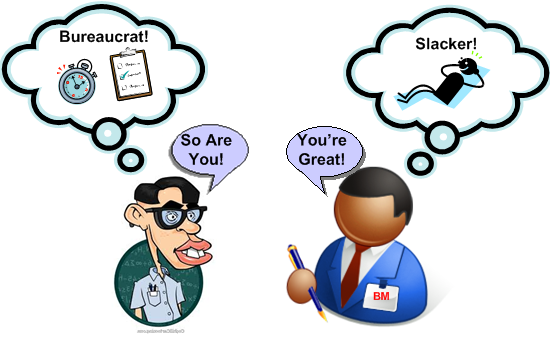
In really dysfunctional orgs, do you think much of this goes on……?
Complexity, Evolution, Growth
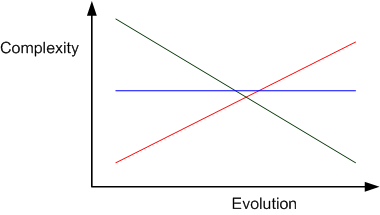
Is an increase in complexity required for evolution to occur?
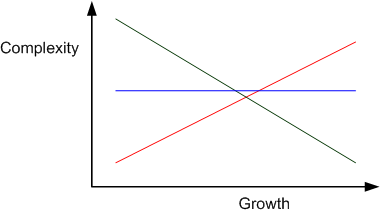
Likewise, is an increase in complexity required for growth to occur?
Fill In The Blanks
While doodling around with my e-sketchpad on a quiet Sunday morning, I conjured up the series of drawings you see below. However, when I tried to make up a BS story that tied the series together in a semi-coherent manner, I failed.
Rather than throwing the series of pics away, it occurred to me to ask for your help. So, can you help me out by filling in the blanks? Think of my plea for your right-brained help as a constrained exercise in creative writing.
The comments section is now open! Please come on down and give it a shot.
—————————————————————————————————————————
<<blank 1>>
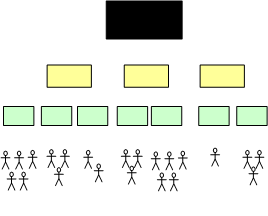
<<blank2>>
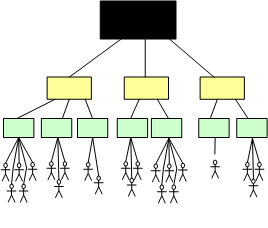
<<blank3>>
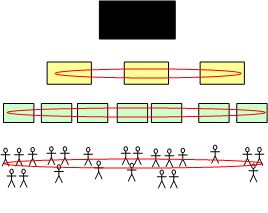
<<blank4>>
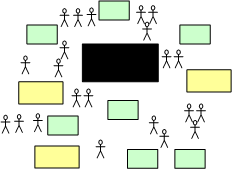
<<blank5>>
Lacking Smarts
Check out the title of this article and have a LOL with (or at) BD00: “People Aren’t Smart Enough for Democracy to Flourish, Scientists Say“.
The research, led by David Dunning, a psychologist at Cornell University, shows that incompetent people are inherently unable to judge the competence of other people, or the quality of those people’s ideas.
D’oh! Too stupid to judge. That’s BD00 in a nutshell when he attempts to unfairly scald the guild of management and its continued, often subtle, application of Tayloristic techniques in the 21st century.
…democracies rarely or never elect the best leaders. Their advantage over dictatorships or other forms of government is merely that they effectively prevent lower-than-average candidates from becoming leaders.
If that’s “merely” true for democracies, then un-democracies must merely suck. How well do you think undemocratic boards of directors do in choosing executives and how well undemocratic executives do in anointing subordinate managers and how well undemocratic managers do in hiring DICsters and how well DICs do in….? Oops, I almost forgot that DICs aren’t allowed to choose or anoint.
Of course, this research on incompetence doesn’t apply to the elites who run institutions because boards of directors, executives, and managers are infallibly competent in their profession.
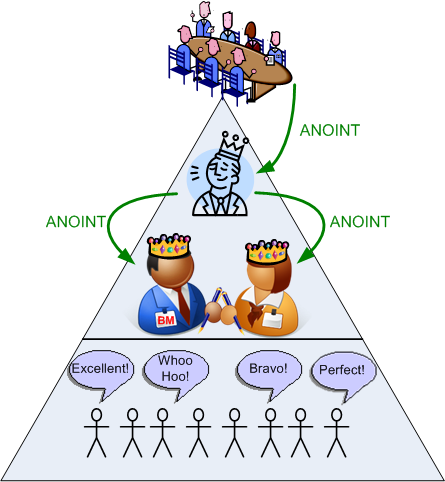
Ya gotta love this Wikipedia definition of anointment:
To anoint is to pour or smear with perfumed oil, milk, water, melted butter or other substances, a process employed ritually by many religions. People and things are anointed to symbolize the introduction of a sacramental or divine influence, a holy emanation, spirit, power or God.
At my anointment, I want to be smeared with… peanut butter and melted Godiva chocolate. How about you? What’s your substance of choice – assuming you have a choice?
Dynamic Loop Of Demise
Uh Oh! Is Google going down the turd hole? First, in “Why I Left Google“, newly minted Microsoft employee James Whittaker says:
..my last three months working for Google was a whirlwind of desperation, trying in vain to get my passion back. The Google I was passionate about was a technology company that empowered its employees to innovate. In such an environment you don’t have to be part of some executive’s inner circle to succeed. The Google I left was an advertising company with a single corporate-mandated focus.
Then, in “Google’s Mounting Trash Pile“, Paul Whyte writes:
Google’s engineering culture has been an incredible asset. But the record shows that without some discipline, that asset can subtly but inevitably work against Google in its mission as a titan of Internet search and software.
On the one hand, Mr. Whittaker bailed because he felt the dense fog of bureaucracy and a narrowing focus descending upon the company. On the other hand, the (not unreasonable) pressure to jettison bogus research projects with no revenue stream in sight seems to be draining the passion and engagement out of the workforce. Can a vicious, self-reinforcing loop be in the making? Increase In Pressure For Profits -> Decrease In Reseach Funding -> Decrease In Employee Passion -> Decrease In Number And Quality Of Products -> Increase In Pressure For Profits.

I don’t think this dynamic loop of demise is one of Peter Senge‘s “Fifth Discipline” archetypes, but maybe it should be.
Loving All That Is
Because it’s very different from any other “religious” book that I’ve ever read, I really like “The Most Rapid and Direct Means to Eternal Bliss” (free pdf download here). In the book, mysterious Michael Langford lays down step by step instructions for five spiritual practices:
- THE AWARENESS WATCHING AWARENESS METHOD
- THE ABANDON RELEASE METHOD
- THE ETERNAL METHOD
- THE INFINITE SPACE METHOD
- THE LOVING-ALL METHOD
To give you a taste of the book’s style and content, here is the procedure for THE LOVING-ALL METHOD:

Love your thoughts, your feelings, your body, your actions, the objects you see, the people you see, every input from each of your senses, every word you utter, every word spoken to you. Piece of cake, no?
The other night, I went to bed with a strong resolve to start practicing THE LOVING-ALL METHOD “tomorrow“. When I woke up the next morning, within seconds I deviated from the plan. My shoulder ached from a touch of arthritis and I automatically thought and said “Ow – damn shoulder!“. Upon discovering my transgression a few milliseconds later, I thought “D’oh!” and gave up. Maybe I’ll give it another spirited try in the future.
It’s weird. When I read a spiritual book that “clicks” (and not many of them do), I experience a sense of peace and serenity during the read. But as soon as I close the cover, the feeling dissolves and IT takes over once again – and it’s hard to love IT; very hard.

Fish On Fridays IV
Earlier this week, sometimes-guest-blogger fishypoo submitted some content for today’s entry to BD00 for “approval“.

Here it is, fishypoo’s b’fore and afta “process improvement” flowchart submittal:
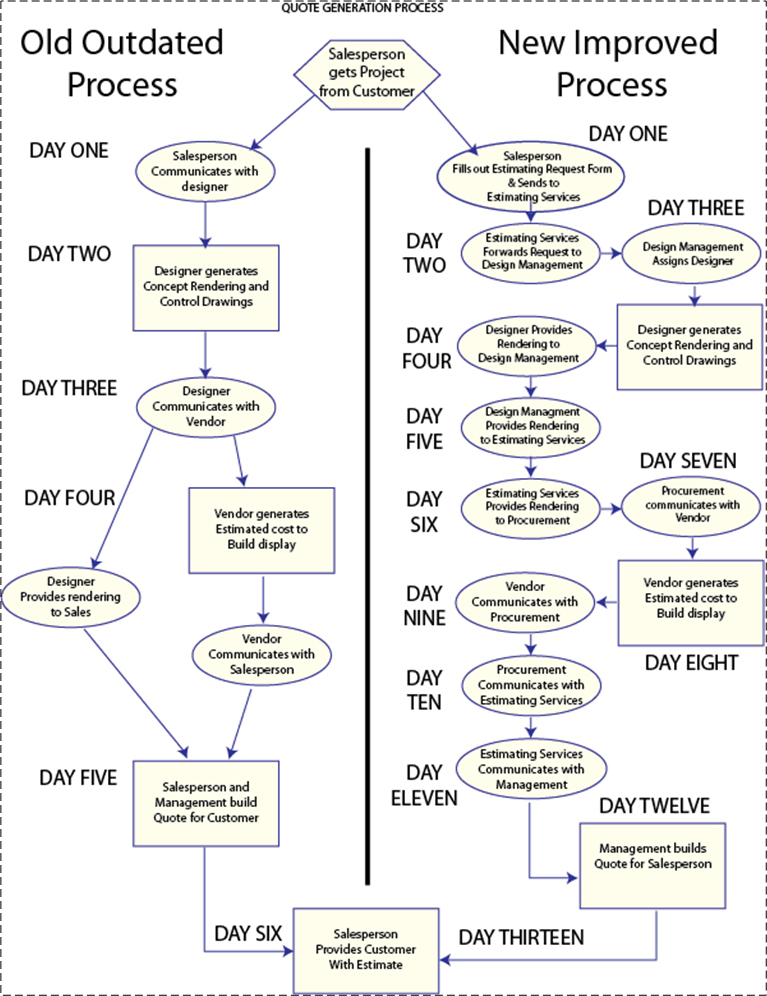
With a 2X increase in delay from input to output and the addition of three new “enabling” actors,
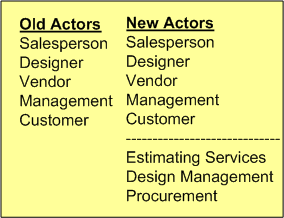
the new process is a slam dunk and a shining example of the value-added that can be achieved from doggedly performing continuous improvement.
Four Attributes
Assume that every commercial enterprise can be “objectively” (LOL!) characterized by the following four discrete attributes:
- Trustworthiness [untrustful | trustful]
- Transparency [closed | open]
- Fairness [unfair | fair]
- Product_Quality [crappy | meh | excellent]
If I did the math right, there are 2*2*2*3 = 24 attribute combos. At one end of the spectrum, we have orgs that are untrustful, closed, unfair producers of crappy products and services. At the other end of the spectrum we have enterprises that are trustful, open, fair producers of excellent products and services.
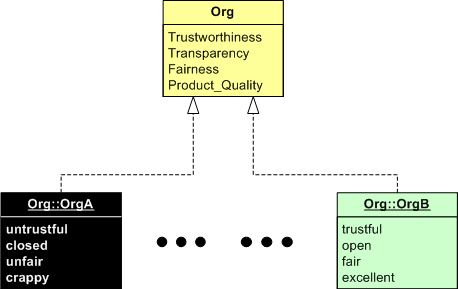
So, what do you think the ratio of OrgAs to OrgBs is in the world, and why? Do you think the ratio is increasing or decreasing as civilization advances? Do you think the four attributes are uncorrelated or are they intimately coupled? Can an untrustful, closed, and unfair org produce excellent products and services? Given an OrgA, can it transform into an OrgB? Given an OrgB, can it transform into an OrgA? Which transformation is more likely?

Why am I here?
WTF?
Meh!
D'oh!

My BTC Address



 Bulldozer00's Blog