Archive
Forgive Me

If you have read many of my posts, you may have formed the opinion that I’m rabidly against bozo managers who are members of a hierarchically structured organization. That’s not quite right. I’m not against them as individual persons. I’m against the behaviors that they are compelled to manifest and the decisions that they have to make because of the archaic structure that they are an integral part of. It doesn’t matter who the particular individuals are in a command & control hierarchy. Unless they are enlightened (and very few are), they will auto-behave in ways that are detrimental in the long term to customers, owners, and employees. Not detrimental to themselves and their brethren, of course.
A colleague who dogmatically worships at the alter of corpo-man recently told me that I was jealous of hierarchs. He said that I wanted to be “just like them”. Hmmm, interesting opinion, no? Since nothing is impossible, I guess that could be true. Deep down I just may be an imposter and a fraud 🙂 . In Thorstein Veblen‘s “theory of the leisure class“, he proposes that the middle class in “developed” countries doesn’t hold hierarchs accountable for the havoc they wreak because the middle class wants to be “just like them”.
I’ve often thought of what I would do if I was offered to be knighted by a hierarchical corpo king. Whenever I think of that possibility, it reminds me of the Galileo and Pope Urban story. Galileo, as you probably know, subscribed to the Copernican theory that the earth was NOT the center of the universe. In the all powerful eyes of the hierarchical church and its rabid followers, any such thinking was sacrilegious blasphemy – curiosity was a sin. Before Urban was given the papal throne, he was a friend of Galileo’s. Urban was intrigued by Galileo’s logic and compelling evidence that the earth revolved around the sun. Bingo, as soon as he became pope, Urban instantaneously flipped into a corpo droid incapable of independent thought. He gave Galileo a tour of the torture chambers and placed him under house arrest for the last years of his life. Uh, so much for friendship.
Ironically, in a standard command and control corpo hierarchy, the only way anyone has any chance of changing things for the better is if he/she secures a corpo title from the sitting politburo. Since I think I could possibly make a positive difference, I’d actually be tempted to take on an institutional title and become a corpo man. Alas, I don’t think I’d do it because I don’t have the psychological strength to withstand the corpo peer pressure to flip – just like pope Urban didn’t have. Bummer 😦
Collapsing The Wavefunction
I’m in the process of reading a third book on quantum physics. It’s called “The Self-Aware Universe”, and it is written by physicist Amit Gotswami. According to Q-physics, no localized object exists until a conscious observation is made. The universe is comprised of non-localized, infinitely distributed “waves” described by Schrodinger’s wave function equation. The wave function equation characterizes the “waviness” of matter and it displaces Newton’s F=ma as the universal law of motion. Even though Newton has been convincingly dethroned as the king of “materialistic reality”, Q-physics is consistent with Newton’s classical physics for “big” objects, which are all comprised of quantum waves. Thus, for (almost) all practical purposes, Newton’s laws can be leveraged in the macro world to “control” and enhance our environment to some extent.
When a subjective and conscious observation is made and discrete objects are “detected” at a point in space and time, the instantaneous collapse of the wave function occurs. The figure below woefully attempts to graphically depict this mysterious and miraculous process. On the left, we have “no”-things, just an infinite collection of waves. On the right, we have a bunch of (supposedly) independent “some”-things after the collapse. If, as most rational and educated people think, conscious observation is subjective and person specific, then why is there so much consensus on the post-collapse appearance of the world? In other words, why do most people see the same set of objects after they each independently and subjectively collapse the wave function? If you’re thinking that I have an answer for this subjective vs. consensus enigma, then you’re mistaken. I’m dumbfounded but enamored with the mystery of it all. How about you?

Suppose that you and I separately “collapse the wave function” and (miraculously?) agree on the appearance of the external world the engulfs us. Referring to the example above, assume that we transcend the first communication barrier between us and we agree that a post-collapse triangle exists, a rectangle exists, a pair of ellipses exist, etc.
Now assume that the group of objects that we’ve manifested (created ?) is comprised of people and some type of observable behavior emanating from that group is “bothering” us. Also, assume that we want to influence the group to change it’s behavior so that we are less distressed. What do we do? We consciously form a personal System-Of-Interest (SOI) and we try to understand what’s causing us the distress. We try to make sense of the dynamic interactions taking place between those people encircled in our own personal SOI and then we act to change it. Here’s where our original consensus starts to diverge. Since, as the figure below illustrates, our personally created SOIs will most likely be different, our interpretation of who and what is causing us our distress will be different. Thus, our ideas and thoughts regarding corrective actions will be different.
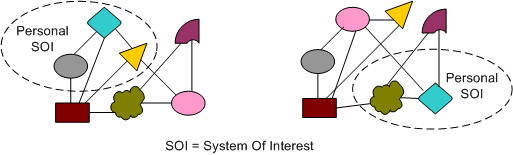
Note that even though we initially agreed on the number and types of objects=people present in our collapsed wave function worlds, the number and nature of the connections between those people are likely to be different for you and me. In the SOI example above, my SOI on the left contains three people and yours on the right only contains two. My SOI on the left doesn’t include the pink ellipse in the “problem” sub-group but yours on the right does. Your SOI doesn’t include an interface ‘tween the gray ellipse and blue diamond but mine does. Thus, our interpretations of what ails us will most likely differ. Add a third, fourth, fifth, etc., SOI to the mix and all kinds of diverging interpretations will emerge.
Now, apply this example to a work environment. If I’m the “boss” and you disagree with my interpretation of the problem situation, but are “afraid” of speaking truth to power because of standard stifling corpo culture norms, then you may just go along with my interpretation even though you’re pretty sure that your interpretation and solution is “right”. Since I’m the boss, all knowing and all powerful, I’m always “right” – even if I’m not. 🙂
Transcend AND Include
Before Newton, religion and superstition were used by most human beings to explain what they saw and felt day-to-day. Depending on what religion you subscribed to, all kinds of wild theories were proposed to explain events and happenings that were not easily understood. Then Newton came along and busted all the myths with his “principia”. Newton’s classical physics was relatively easily understood. Objective experimentation confirmed that it worked admirably in predicting the motions and positions of “macro” objects as a function of the forces acting on them. Classical physics “proved” that all material objects are separate and the only way one object can affect another is by impressing an external force on it. In addition, thanks to Einstein’s brilliance, forces cannot travel faster than the speed of light. Thus, two objects at the ends of the universe are independent of each other and effectively isolated from each other.
Then, along came quantum physics, which, as the picture below shows, was found to transcend and include classical physics. For macro-sized objects on the scale of the things that we experience, the rock solid and experimentally verified maths that underly quantum physics transform into Newton’s equations. Thus, Newton’s equations are not absolute; they are “approximations”. However, at the atomic scale and smaller, quantum physics busts the new, Newton-derived, myths that there even are objects.
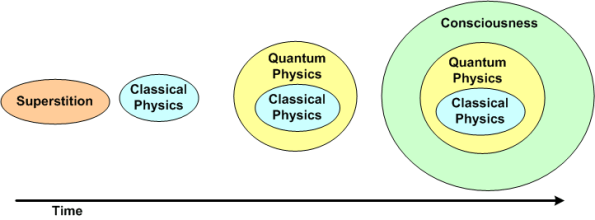
According to Q-physics, everything is a superposition of continuous, non-local, spread out waves until a subjective conscious observation is made. The point at which a conscious observation is made is called the “collapse of the wavefunction”. WTF? In addition, any two “consciously observed” objects (remember, according to Q-physics there are no such things as objects until a conscious observation is made) that ever interacted, remain “entangled” and associated regardless of how far apart they are. An observation on one of them instantaneously affects the other – violating Einstein’s maximum speed-of-light discovery. Again, WTF?
The addition of subjective consciousness into the previously objective world of physics has thrown a huge monkey wrench into the world of science. Consciousness, which is subjective, has collided with science, which (up until now?) is purely objective. So, like Q-physics transcends and includes C-physics, does consciousness transcend and include Q-physics? If so, what will be the next discovery in the world of science?
Netflix Culture
I’m constantly scouring the landscape for companies with cultures that stand apart from the herd (moooo!). Via my e-friend Byron Davies’ discovery, I’ve just added another gem to my list: Netflix. Here’s the link that triggered the addition: Netflix Culture. It’s a simple, unadorned (content over format), behemoth 128 page presentation, but it’s so authentically different and norm-busting that it’ll stir your emotions (yuk, can’t have emotions in business, right?) if you’re a culture hound like me. Just in case you’re curious, but short on time, here are some zingers that rang my bell:
- The real company values, as opposed to the nice sounding values, are shown by who gets rewarded, promoted, or let go.
- We particularly value these nine skills and behaviors: judgment, communication, impact, curiosity, innovation, courage, passion, honesty, selflessness.
- You focus on results and not process.
- You challenge prevailing assumptions when warranted, and suggest better approaches.
- You say what you think, even if it’s controversial.
- You question actions inconsistent with our values.
- You only say things about fellow employees you will say to their face.
- You share information openly and proactively.
- It’s about effectiveness, not effort or hard work.
- Responsible people thrive on freedom and are worthy of freedom.
- Most companies curtail freedom as they grow bigger and to avoid errors, thus, we try to increase freedom.
- Process-focus drives talent to leave.
- The key to managing growth and complexity is to increase talent density; not to institute more freedom-constraining processes.
- We value simplicity, not the simplistic.
- Freedom is not absolute, a few basic and common sense rules are needed.
- In environments that demand creativity, fixing errors is cheaper than (fruitlessly) trying to prevent them via religious process adherence.
- Regularly scheduled strategy and context meetings.
- Flexibility is more important than efficiency in the long term.
- Set the context for your people instead of trying to control them.
- Highly aligned and loosely coupled as opposed to monolithic or siloed.
- Goal: fast, flexible AND big.
- Titles are not very helpful (all major league pitchers aren’t major league talents).
- No centrally administered “raise pools” every year.
- Whether Netflix is prospering or floundering, we pay at the top of the market.
- It’s a healthy idea, not a traitorous one, to understand what other firms would pay you, by interviewing and talking to peers at other companies.
- No bonuses, just include in salary. No free stock options – just big salary; and let people decide where to invest it.
- Rapid innovation AND excellent execution, creativity AND discipline, are required for continuous growth.
Here is my number one zinger:
- Netflix vacation and tracking policy: there is no vacation policy or tracking.
You read it right. One day, an employee pointed out that “we don’t track hours worked per day, night, or on weekends, so why do we track vacation days?“. The Netflix leadership responded to the challenge by removing the “N days per year” vacation rule. Pretty rad, removing rules instead of continuously piling them on, no?
Even if you’re extremely skeptical and can’t believe the Netflix leadership “walks the talk”, you gotta at least give them credit for writing down, in detail and with underlying rationale, the culture that they’re trying to build – so that they could be held accountable. No?

Cisco CEO “Gets It”
Cisco Systems Inc. CEO John Chambers “gets it”. In this interview, he states:
“Today’s world requires a different leadership style — moving more into a collaboration and teamwork, including learning how to use Web 2.0 technologies. If you had told me I’d be video blogging and blogging, I would have said, no way. And yet our 20-somethings in the company really pushed me to use that more.”
Ossified corpo executive teams that still operate according to the 1920’s doctrine of separation, closed door meetings, and infrequently used, one-way communication channels, deserve what they get – mediocrity and a disconnected work force.
On the subject of interviewing potential leaders, Mr. Chambers also “gets it”:
“Then I ask them who are the best people you recruited and developed, and where are they today? And that tells an awful lot.”
He knows that in order to build a viable, sustainable, and robust company, you’ve got to actively develop people and not just sit on your throne issuing brilliant commands from an omniscient position of superiority.
No Good Deed
Let’s say that the system engineering culture at your hierarchically structured corpo org is such that virtually all work products handed off (down?) to hardware, software and test engineers are incomplete, inconsistent, fragmented, and filled with incomprehensible ambiguity. Another word that describes this type of low quality work is “camouflage”. Since it is baked into the “culture”, camouflage is expected, it’s taken for granted, and it’s burned into everyone’s mind that “that’s the way it is and that’s the way it always will be”.
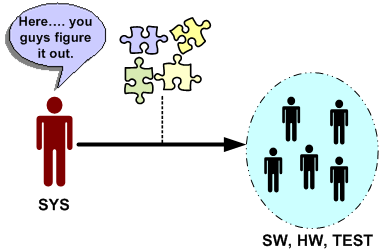
Now, assume that someone comes along and breaks from the herd. He/she produces coherent, understandable, and directly usable outputs for the SW and HW and TEST engineers to make rapid downstream progress. How do you think the maverick system engineer would be treated by his/her peers? If you guessed: “with open arms”, then you are wrong. Statements like “that’s too much detail”, “it took too much time”, “you’re not supposed to do that”, “that’s not what our process says we should do”, etc, will reign down on the maverick. No good deed goes unpunished. Sic.
Why would this seemingly irrational and dysfunctional behavior occur? Because hirearchical corpo cultures don’t accept “change” without a fight, regardless of whether the change is good or bad. By embracing change, the changees have to first acknowledge the fact that what they were doing before the change wasn’t working. For engineers, or non-engineers with an engineering mindset of infallibility, this level of self-awareness doesn’t exist. If a maverick can’t handle the psychological peer pressure to return to the norm and produce shoddy work products, then the status quo will remain entrenched. Sadly but surely, this is what everyone wants, including management, and even more outrageously, the HW, SW, and TEST engineers. Bummer.
Analysis Paralysis Vs. 59 Minutes
“If I had an hour to save the world, I would spend 59 minutes defining the problem and one minute finding solutions” – Albert Einstein
If they didn’t know that Einstein said the quote above, MBA taught and metrics-obsessed “go-go-go” textbook managers would propose that the person who did say it was a slacker who suffered from “analysis paralysis”. In the Nike age of “just do it” and a culture of “act first and think later” (in order to show immediate progress regardless of downstream consequences), not following Einstein’s sage advice often leads to massive financial or human damage when applied to big, multi-variable hairball problems.
The choice between “act first, think later” (AFTL) and “think first, act later” (TFAL) is not so simple. For small, one dimensional problems where after-the-fact mistakes can be detected quickly and readjustments can be made equally as quickly, AFTL is the best way to go. However, most managers, because they are measured on schedule and cost performance and not on quality (which is notoriously difficult to articulate and quantify), apply the AFTL approach exclusively. They behave this way regardless if the situation cries out for TFAL because that’s the way that hierarchical structured corpo orgs work. Since the long term downstream effects of crappy decisions may not be traceable back to the manager who made them, and he/she will likely be gone when the damage is discovered, everybody else loses – except the manager, of course. Leaders TFAL and managers AFTL.
Quantum Consciousness
In their wonderful book “Quantum Enigma” (I just finished reading it twice in a row, back-to-back), physicists Kuttner and Rosenblum assert that quantum theory is the most battle-tested scientific theory of all time. In its 80 year existence, it has never failed any experimental test hurled at it by the most brilliant academic minds, past and present.
If my understanding is correct, and it might not be because of the nature of the subject matter, quantum theory says that nothing material exists until it is consciously observed. Hmmm, that sounds like the same thing spiritual teachers have been asserting for thousands of years before the development of quantum theory.
On the extremely small scale of sub-atomic sizes, that assertion has been proven many times over by employing the scientific way – experimentation. One classic example is that depending on which experiment you consciously choose to perform, you can prove that light is either a mass-less continuous wave or a stream of discrete and separate particles of mass. The reason why we can’t recreate paradoxical experiments similar to that with large macro-sized objects like people is because the technology needed to do it is not available, yet. Bummer.
Another assertion quantum theory makes is that two entangled objects can instantaneously influence one another, regardless of how far apart they are spaced. This assertion effectively voids Einstein’s proof that no physical entity can travel faster than the speed of light in a vacuum. Einstein called this “spooky action at a distance” and he spent a good deal of time trying to poke holes into quantum assertions like entanglement. Hmmm, sounds like quantum theory says everything is connected with everything else. More spiritual heresy?
The figure below shows a stack that hypothetically connects science to spirituality. It’s an expanded version of the science only, psychology-to-quantum physics stack presented in Kuttner’s and Rosenblum’s book. I subjectively added the non-scientific thoughts, feelings, and behavior layers to the top, and the consciousness, awareness, and no-thing layers to the bottom.
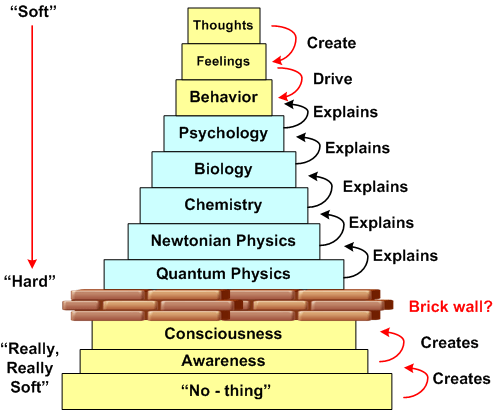
Because quantum theory butts up against consciousness, and they seem to be separated by an unexplainable brick wall, Kuttner and Rosenblum explore the seemingly mysterious connection between them in their book. As they say, “when experts don’t agree, you can pick your own expert to believe in“.
Functional Allocation VIII
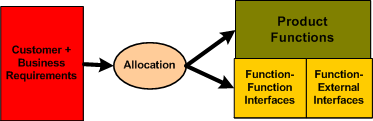
Typically, the first type of allocation work performed on a large and complex product is the shall-to-function (STF) allocation task. The figure below shows the inputs and outputs of the STF allocation process. Note that it is not enough to simply identify, enumerate, and define the product functions in isolation. An integral sub-activity of the process is to conjure up and define the internal and external functional interfaces. Since the dynamic interactions between the entities in an operational system (human or inanimate) give the system its power, I assert that interface definition is the most important part of any allocation process.
The figure below illustrates two alternate STF allocation outputs produced by different people. On the left, a bland list of unconnected product functions have been identified, but the functional structure has not been defined. On the right, the abstract functional product structure, defined by which functions are required to interact with other functions, is explicitly defined.
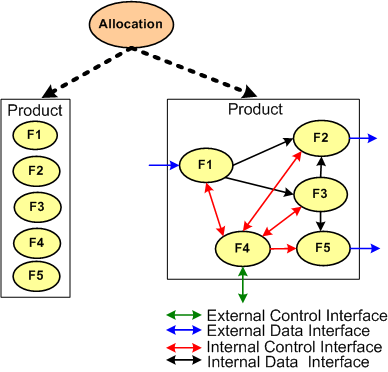
If the detailed design of each product function will require specialized domain expertise, then releasing a raw function list on the left to the downstream process can result in all kinds of counter productive behavior between the specialists whose functions need to communicate with each other in order to contribute to the product’s operation. Each function “owner” will each try to dictate the interface details to the “others” based on the local optimization of his/her own functional piece(s) of the product. Disrespect between team members and/or groups may ensue and bad blood may be spilled. In addition, even when the time consuming and contentious interface decision process is completed, the finished product will most likely suffer from a lack of holistic “conceptual integrity” because of the multitude of disparate interface specifications.
It is the lead system engineer’s or architect’s duty to define the function list and the interfaces that bind them together at the right level of detail that will preserve the conceptual integrity of the product. The danger is that if the system design owner goes too far, then the interfaces may end up being over-constrained and stifling to the function designers. Given a choice between leaving the interface design up to the team or doing it yourself, which approach would you choose?
Functional Allocation VII
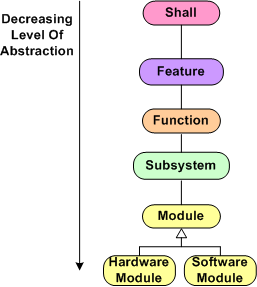
Here we are at blarticle number 7 on the unglamorous and boring topic of “Functional Allocation”. Once again, for a reference point of discussion, I present the hypothetical allocation tree below (your company does have a guidepost like this, doesn’t it?). In summary, product “shalls” are allocated to features, which are allocated to functions, which are allocated to subsystems, which are allocated to software and hardware modules. Depending on the size and complexity of the product to be built, one or more levels of abstraction can be skipped because the value added may not be worth the effort expended. For a simple software-only system that will run on Commercial-Off-The-Shelf (COTS) hardware, the only “allocation” work required to be performed is a shall-to-software module mapping.
During the performance of any intellectually challenging human endeavor, mistakes will be made and learning will take place in real-time as the task is performed. That’s how fallible humans work, period. Thus for the output of such a task like “allocation” to be of high quality, an iterative and low latency feedback loop approach should be executed. When one qualified person is involved, and there is only one “allocation” phase to be performed (e.g. shall-to-module), there isn’t a problem. All the mistake-making, learning, and looping activity takes place within a single mind at the speed of thought. For (hopefully) long periods of time, there are no distractions or external roadblocks to interrupt the performance of the task.
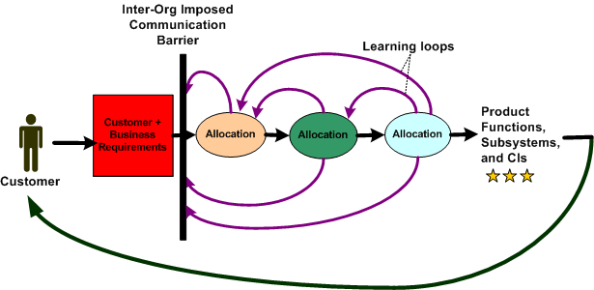
For a big and complex multi-technology product where multiple levels of “allocation” need to be performed and multiple people and/or specialized groups need to be involved, all kinds of socio-technical obstacles and roadblocks to downstream success will naturally emerge. The figure below shows an effective product development process where iteration and loop-based learning is unobstructed. Communication flows freely between the development groups and organizations to correct mistakes and converge on an effective solution . Everything turns out hunky dory and the customer gets a 5 star product that he/she/they want and the product meets all expectations.
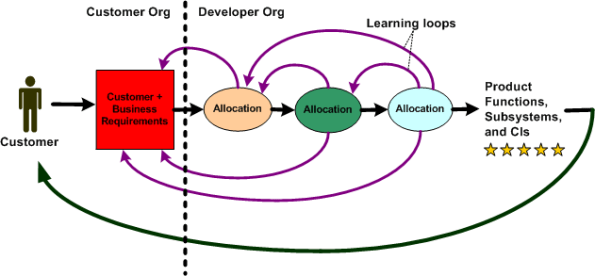
The figure below shows a dysfunctional product development process. For one reason or another, communication feedback from the developer org’s “allocation” groups is cut off from the customer organization. Since questions of understanding don’t get answered and mistakes/errors/ambiguities in the customer requirements go uncorrected, the end product delivered back to the customer underperforms and nobody ends up very happy. Bummer.
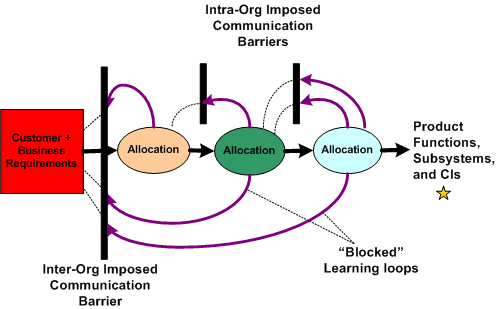
The figure below illustrates the worst possible case for everybody involved – a real mess. Not only do the customer and developer orgs not communicate; the “allocation” groups within the developer org don’t, or are prohibited from, communicating effectively with each other. The product that emerges from such a sequential linear-think process is a real stinker, oink oink. The money’s gone. the time’s gone, and the damn thang may not even work, let alone perform marginally.
Obviously, this situation is a massive failure of corpo leadership and sadly, I assert that it is the norm across the land. It is the norm because almost all big customer and developer orgs are structured as hierarchies of rank and stature with “standard” processes in place that require all kinds and numbers of unqualified people to “be in the loop” and approve (disapprove?) of every little step forward – lest their egos be hurt. Can a systemic, pervasive, baked-in problem like this be solved? If so, who, if anybody, has the ability to solve it? Can a single person overcome the massive forces of nature that keep a hierarchical ecosystem like this viable?
“The Biggest problem To Communication Is The Illusion That It Has Taken Place.” – George Bernard Shaw

Why am I here?
WTF?
Meh!
D'oh!

My BTC Address



 Bulldozer00's Blog