Archive
Contrasting Cultures
Because it’s a numerically unquantifiable and highly spiritual topic, I’ve always been fascinated by the subject of “company culture”. Leaders can’t directly create and control the cultural behavior they want in their org. At best, they can try to put an environment and set of incentives in place so that the culture they want spontaneously emerges.
IMHO, the most effective method for catalyzing the formation of a desired culture is to lead by example. As Ghandi once said, “be the change you’d like to see in the world”. When executives behave in contradiction to the culture they want, they deserve what they get – an apathetic, mistrusting, and disengaged workforce. Blech, and meh.
Here’s a great and short article that compares four radically different, but financially successful, company cultures: four cultures. Since they’re all deemed successful , there is no one perfect culture that an org can strive for.
Which cultural environment would you like to work in?
Not Of This Earth
Did you ever hear of a company named SEMCO? If not, then you’re missing out on one of the greatest corporate success stories on the planet. The CEO, Ricardo Semler, is perhaps the smartest and most courageous executive to ever lead a for-proft company. Semco and Semler are so different and “out there” that they may not be of this earth.
Check out these snippets (followed by my snarky comments) from the SEMCO Survival Manual:
“Only people who have respect for their followers can be leaders.“
Amen. How does SEMCO determine which people can become, and remain, a leader in their organization? Read on.
“There is no space at the Semco Group for formalities. The doors are always open and people should say what they really think, without worries or inhibitions.”
Unlike the vast majority of corpos that are clones of each other, there’s no “checking your personality at the door” at Semco.
“Unions are an important method of protecting workers. Unionization is free within the company. The Semco Group believes that constant relationships with unions are healthy for the company and the employees. The presence of union members at the company is always welcome.“
Rather than taking the standard corpo “unions are enemies” stance, SEMCO treats unions as partners. Wow, what a concept.
“Based on the fact that everyone can say what they think, rumors and gossip should not be stimulated. Any attempt to harm another person is looked on very seriously. Take part and speak openly of what you are thinking in order to improve things.“
Wow, more weird concepts, “saying what you think” and “speaking openly“. How uncorpo and disrespectful of the SEMCO leadership for promoting such lunacy in writing.
“Every six months you will fill in a questionnaire and say what you really think about your immediate superior.”
Cool rule, eh? Every six months you get to say how you feel about your “leader“. If he/she isn’t measuring up, they get demoted.
“Have an opinion, put yourself forward as a candidate, always say what you think – do not be just another cog in the wheel. State your opinion about everything that interests you, even if you weren’t asked for it. Be active about your feelings.”
OMG! Stating your opinion even when you aren’t asked for it? Arrrrgh! More blasphemy that should be punishable by death. Feelings in the workplace? There’s no place for expressing feelings in the workplace. Feelings are for the weak and un-promotable.
“We want everybody to participate; opinions will always be welcome and should be spontaneous.”
Spontaneous espousal of opinions? More sacrilege that is unacceptable at 99% of all corpo clones. In the land of the clones, before publicly stating your opinion, you must always think it over carefully and ensure that your words won’t offend a single soul – especially one with a big title and high stature. If the words will offend anyone, then keep your piehole shut.
“Watch the results closely and ask any questions you want – there are no issues that cannot be discussed. “
OMG again! There are no “undiscussable topics” at SEMCO? That can’t be. They’re lying through their teeth. It’s obvious that this policy can’t be applied in practice.
After reading all the above lies, I’m convinced that SEMCO doesn’t exist. No company can do all that, make money, and stay in business. No freakin’ way. If SEMCO-styled companies do exist in the good ole USA, they must be found out and closed down at all costs. It’s unacceptable to “us” real capitalists to operate a company in such an unpatriotic way. Quick, someone mobilize the corpo SWAT team. We’re goin’ on a kill mission to snuff out this abomination.
Two Playbooks
When revenues and/or profits go flat or they start eroding, one of the 3 textbook moves that a mediocre company usually make is to reorganize (yet again). The other two moves in the utterly uncreative and standard MBA playbook are: 2) fire people; 3) instill fear via coercion and adding more rigid/constraining processes to extract more productivity from the value creation team at the bottom of the corpo hierarchy. Sometimes, especially in a time of crisis, all three actions are executed. Notice that all 3 moves are attempts to cut costs and not to raise revenues. Raising revenues requires exploring, discovering, and finding new customers along with developing successful new products that open up new markets. These actions require creativity, innovation, new ways of thinking, leadership, and courage. Sadly, these attributes are not the forte of mechanistic and Newtonian MBAs who are trained to solely look at data and compute fancy state-of-the art derivative business metrics.
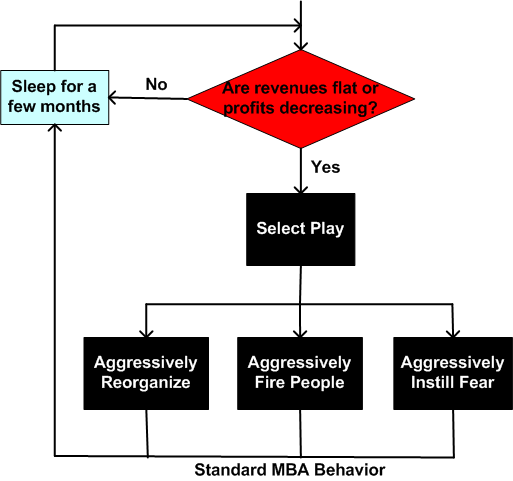
When a company reorganizes, which is the least painful action that can be applied to the productive members at the bottom of the org, grand new titles are created, groups are renamed, and new layers are added/subtracted. Management temporarily feels better and optimism permeates the top of the stratified pyramid. The people down in the dirty boiler room know better. Since the reorg usually consists of shuffling the same people with the same old crusted mindsets into new positions, no deep and lasting change happens. If, during the reorg, people with new ideas are promoted from the bottom or brought in from the outside, they are quickly “set in their place” by the old guard that remains. They get absorbed by the borg. Blech.

Imposers And Imposees
“Never tell people how to do things. Tell them what to do and they will surprise you with their ingenuity.” – George S. Patton
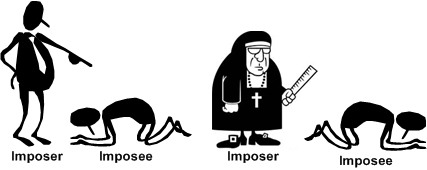
Isn’t it amazing at how people and groups, especially those in positions of authority, are always exhorting others to perform work exactly the way that they want the work to be done? Instead of carefully clarifying “what” needs to be done, which is much more difficult and requires leadership over management, the “imposers” obsess over every little detail of the “how” – which is management over leadership. Leaders focus on the “what”, but managers obsess over the “how”. What’s really mind-boggling, is that if you ask an imposer for helpful examples of excellence that they’ve personally created before they were promoted from an imposee to an imposer, you get some kind of evasive smokescreen answer, or some combo of body and facial movement that conveys this message: “it’s taboo for you to ask that question”. When that happens, credibility and professional respect, extremely tough to earn but easily lost, go right down the crapper. Is asking for leadership-by-example a disrespectful thing to do? In dysfunctional orgs where there are few, if any leadership-by-examples of excellence, asking probing questions is considered an act of subordination that is not easily forgiven or forgotten.
Under the veil of “industry best practices”, and the unspoken but clearly understood directive that imposees are required to learn the details of the “how” fully and instantaneously on their own time, the pounding into submission by imposers continues. The pounding only stops when enough camouflage has been generated by the imposee(s) to anesthesize the imposers into thinking that they’ve prevailed. It’s only a temporary high. Sooner or later, everyone finds out, sometimes spectacularly, that the neglected “what” is FUBAR. In dysfunctional organizations that behave in accordance with these “industry worst practices”, it’s no wonder that the majority of employees become cynical, apathetic, disengaged, and disgruntled camouflage creators.
“You do not lead by hitting people over the head – that’s assault, not leadership” – Dwight D. Eisenhower
So, am I a “do as I say not as I do” imposer and hippocrate? Well, I try not to be one, but I might be failing miserably at it. Judge for yourself by reading one or more of the rants on this blog. Do I overdo it sometimes or, uhhh, always? Decide for yourself.
A Classic Response
In a product development organization, when schedules are consistently missed, costs are rising, and profits are decreasing, a classic management response is to add more “oversight” to turn things around. This sincere, but often counterproductive response to deteriorating performance, exacerbates the mess by adding more cost and further slowing progress.
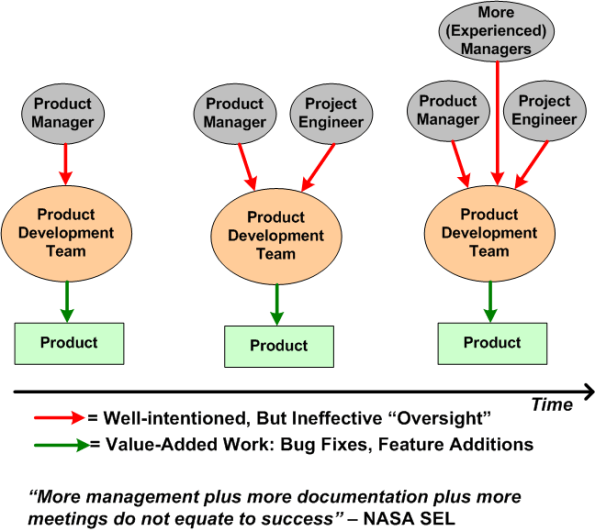
The above figure graphically shows the deterioration in performance over time ignited by the “classic response” to perceived poor execution. The additions to the management team somehow magnify the illusion of control that managers think they have over the product development/maintenance process. The act of piling on more management serves as an anesthesia that temporarily relieves the pain of poor performance. When the numbers show that performance hasn’t improved, the next step is to keep the top heavy structure in place, but replace one or more members of the management team with “proven” managers. Sick city.
So what’s an alternative to the “classic response”? Take a look at the figure below. In this response, the product manager rolls up his/her sleeves and gets dirty with the product development team. She dives deep into the product infrastructure and scours the landscape for missing information, erroneous information, and “camouflage”. Armed with this realistic, unfiltered “status” data, effective decisions can be made and productive direction can be given. In addition, by visibly doing some non-status-taking and non-schedule-hawking work, credibility and trust (which are difficult to acquire but easy to lose) are gained.
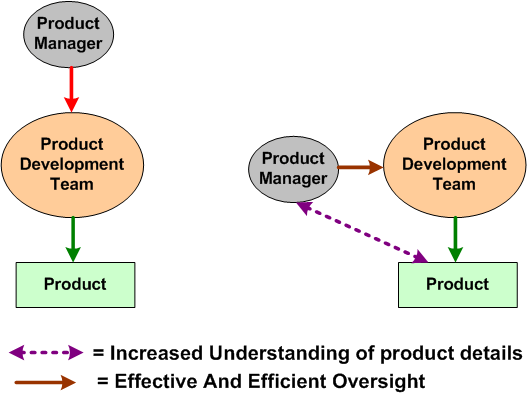
Sadly, during the transition from doer to manager, an automatic mindset switch occurs. Instead of growing into a 3D status taker plus schedule jockey PLUS, most importantly, a helper, only the first two responsibilities are internalized. “I’ve arrived and I don’t have to do any hard, messy work anymore”. Even worse, upper management innocently, but surely, encourages this post-transition mindset because it’s the same mindset that guides their behavior. Bummer.
“You have to know a lot to be of help. Learning is slow and tedious. You don’t have to know much to cause harm. It’s fast and instinctive.” – Rudolph Starkermann
Heaps And Systems
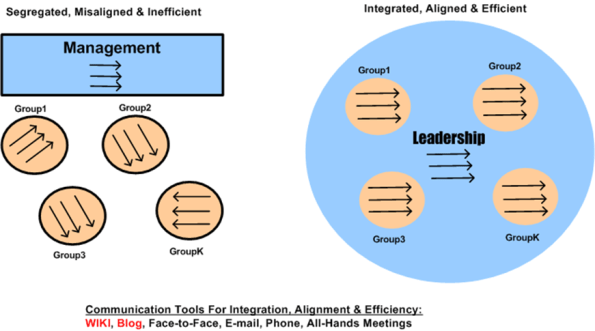
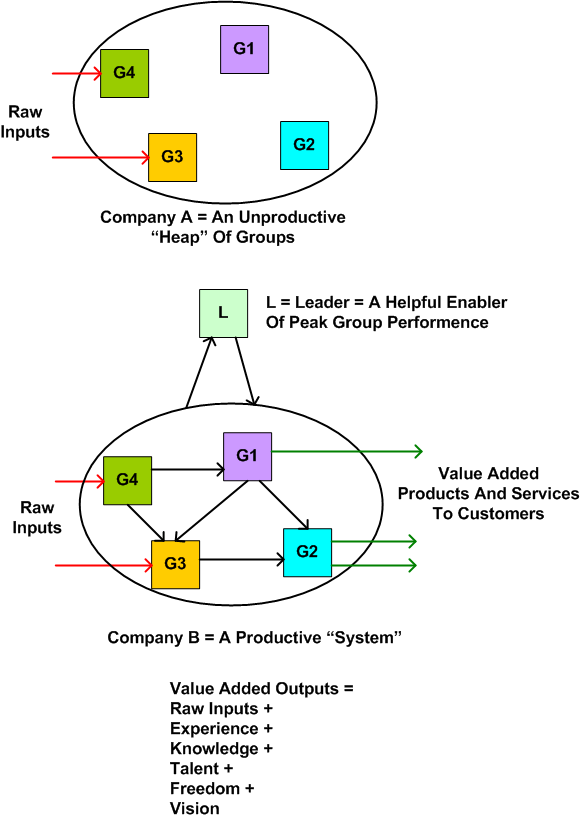
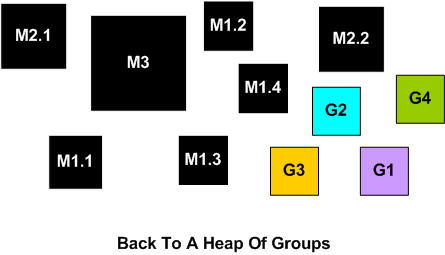
A “heap” is a collection of individual “parts”. A “system” is an intentionally designed set of interconnected parts with a purpose. The purpose of a system transcends AND includes the purpose of each of the individual parts. As an example, think of an automobile. If we disassemble one, we end up with a heap of individual parts. When these parts are assembled and interconnected in accordance with the purpose of human transportation as the goal, we may get a system. Structural design and interconnection are not enough. The system must be energized and steered so that purposeful behavior can be manifested. For a car, the energy is fuel and the steerer is a human being. For an organization of mutli-disciplined groups of people, the energy is motivation and the steerer is a leader. Without motivation and a leader, an organization of human groups is just an unproductive heap that consumes natural resources and doesn’t produce any value added output to share with the world.
The figure below shows two companies that are each comprised of 4 potentially diverse and productive groups of people. Company A is unconnected and leaderless. Thus, it just consumes resources from the external environment and produces nothing of value to share with the world. Company B is both connected and well led. What kind of company do you work for?
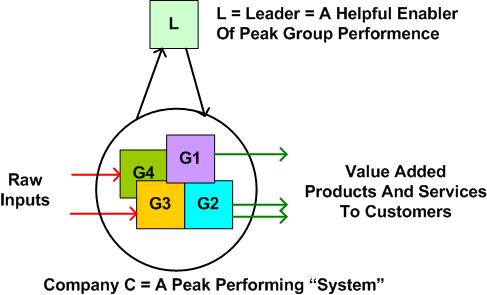
Look at company C in the illustration below. In this company, the leader has propelled his/her company to the head of the pack by creating the internal environment for, and nurturing the system’s internal groups and interfaces for peak performance. All of the internal connections and relationships between the groups are comprised of low latency and high bandwidth collaboration. Both high quality outputs and speed of execution distinguish company C from the rest of the herd.
In a high performing system, the danger of over-optimization looms in the form of inflexibility. A system optimized for a single purpose tends to harden and become resistant to change overt time – corposclerosis sets in. The trick for the leader is to create and sustain a delicate balance between optimization and flexibility that adapts with the rapidly changing external environment.
In an attempt to over-optimize performance, some leaders unknowingly morph into “managers”. They start inserting subordinate management layers of questionable value between themselves and the productive subsystems of the company. They start creating and accumulating titles that distance themselves from the productive groups. These and other symbols of status divide and alienate instead of integrate and endear. Instead of guiding, steering, and nurturing, they start commanding, controlling, and constraining. Productivity plummets and quality of workmanship deteriorates.
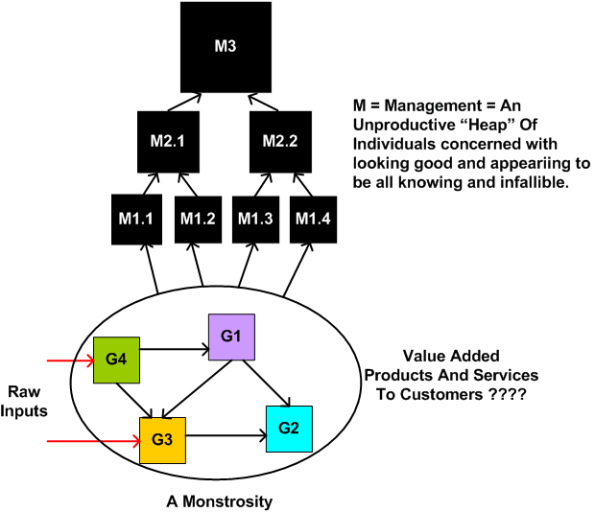
Because of increasing rules and procedures mandated by management, the internal interfaces between the formerly productive groups start transitioning into high latency and low bandwidth communication channels. In the worst case, like an overheated engine, the interfaces rupture and the system abruptly disintegrates; leaving an unconnected and purposeless heap of parts in its wake. Bummer.
Scouts
The figure below is intended to show a successful and profitable company operating in an external environment that’s changing over time. Since the corporation achieved its current successful state by employing strategies and practices that worked well to get it there, it naturally employs the same techniques over and over again. This causes the corpo walls to harden and protect those inside of the org from the forces of external change.

If the external winds of change are characterized by a low velocity (more like a breeze than a tornado), then the company’s success may last for quite a long time even though it’s unconsciously stuck in neutral and not adapting to the external environment. However, as the breezy external environment transforms into a maelstrom of tornadoes as a result of new competitors appearing and the sudden emergence of game changing technologies like the internet, company revenues/profits and the corpo pyramid may come tumbling down. Conscious and enlightenend company leaders know that stasis is a corpo killer, but textbook spreadsheet managers don’t.
One way to “sense” when change is needed is to formally designate a cadre of “scouts” at all functional levels of the org, from marketing all the way down the corpo steps to engineering and customer service. I first heard about the concept of scouts from Steve McConnell many years ago, before the internet and the exponential rise of third world engineering know how. At the time, I thought it was a novel idea and now I think it may be essential for survival.
As the picture below illustrates, scouts can serve as external sensors/probes that monitor and make meaning of the rapidly changing external environment. They separate the wheat from the chaff and, if they’re paid attention and nurtured, they can provide accurate information to corpo decision makers regarding which new technology and practices to embrace, and which new products to prototype and try.

Of course, dysfunctional org executives who think highly of themselves but don’t think much of their people (while simultaneously praising them as the company’s most valuable assets), will get what they deserve. They won’t create the role of a “scout” and they’ll ignore or subtlely berate self-motivated people who voluntarily perform the role of a scout. In their minds, they think they are the only ones who are capable of steering the company toward the future – using the same worn out , obsolete thinking that used to work but is virtually useless. Bummer.


Why am I here?
WTF?
Meh!
D'oh!

My BTC Address



 Bulldozer00's Blog