Archive
A $1.6M Mistake – And No One Was Fired
The other day, I discovered that a human mistake made on Zappos.com’s sister web site, 6pm.com, emptied the company’s coffers of $1.6 million dollars. Being the class act that he is, here’s what CEO Tony Hsieh had to say regarding the FUBAR:
To those of you asking if anybody was fired, the answer is no, nobody was fired – this was a learning experience for all of us. Even though our terms and conditions state that we do not need to fulfill orders that are placed due to pricing mistakes, and even though this mistake cost us over $1.6 million, we felt that the right thing to do for our customers was to eat the loss and fulfill all the orders that had been placed before we discovered the problem. – Tony Hsieh, CEO, Zappos.com
If this happened at your company, what would your management do? Do ya think they’d look at it as a learning experience?
Besides Zappos.com, here are the other companies that I love. What are yours, and is the company you work for one of them?

DICbox Be Gone!
Check out the “DIC in the box” below. The DICbox is drawn around the DICster because that’s the way BMs dehumanize the person behind the DIC label. They do this, of course, in order to make their so-called job easier and to preclude getting their hands dirty with unimportant people. In a BM’s mechanistic mind, all DICs are the same and they’re interchangeable.
In a corpricracy, DICs are given work to do and, if they’re competent and self-motivated, they create high quality work products that increase the wealth of the corpricracy – in spite of the management chicanery that takes place.
 The figure below shows an expanded DICbox model with a BM integrated into the system. Since the dude is part Bozo, he doesn’t:
- have a clue (or care) what the work is,
- know (or care) what it takes to do the work,
- know (or care) what the work products are, or how to evaluate them.
That’s why there are no connections in the picture traversing from the work products or work definition flows to the BM. Of course, the BM feigns it as best he can and knows some generic technical buzzwords like “requirements”, “analysis”, “design”, etc. To a BM, all technical projects, from web site development to space shuttle development, are the same – a linear, sequential, unchangeable schedule of requirements, design, coding, testing, and delivery.
 Since the BM is in over his head, he must justify his highly compensated existence. He does this via the only option available: behavior watching. Thus, all he essentially does is intently watch for non-conformance of DIC behavior to a set of unwritten and arbitrarily made up corpo rules. He really shines when he detects a transgression and issues the boiler plate “get with the program” speech (a.k.a peek a boo visit) to coerce the DIC back into the box. If that fails, he calls in the big guns – his fellow overhead management dudes in the HR silo. But that’s another story.
OK, OK. So you want to arse me on my own turf and say: “It’s easy to whine and complain about bad management. I’m as good as you are at it.” You follow that up with “How should it be, smarty pants?“. Well here’s one model:
 I don’t think the above model needs to be accompanied with much explanation. However, I do think these caveats should be pointed out:
- The DICbox is gone.
- The “BM” label has been replaced by “Leader”.
- The work is co-defined by the leader and the doer.
- The leader knows what the work products should be (work products = “expected outcomes” in management lingo).
- The leader still watches behavior, not as an end in itself, but as a means to help the doer grow, develop, and succeed.
- The leader does what some people (like me) may consider – real work.
Viable, Vulnerable, Doomed II
As the title indicates, this blow-sst is an extension of yesterday’s inane blabberfest. While yesterday’s lesson (<— lol!) dealt with the static structure of Viable, Vulnerable, and Doomed (VVD) orgs, today’s BS-fest talks about the dynamic behavior of VVD social groups. Behold that if you’re conscious and you concentrate on observing the world around you, the structure plus behavior of an org will clearly and unambiguously reveal over time what it does. Forget what its so-called leaders say it does, observe for yourself how the stratified monolith is structured, how it behaves, and what it actually produces. If you’re diligent and astute, you’ll discover the principle of POSIWID: the Purpose Of a System Is What It Does (not what it’s leadership says it does).
The UML diagram below shows a state machine model of: the mutually exclusive states of a VVV system, the transitions between the states, and the events that trigger the transitions. But wait…… VVV? What happened to VVD? Well, in a dumbass attempt to inject levity and fruitlessly retain your interest, I changed the name of the “Doomed” state to “”Vucked” so that all states start with the letter “V”. Stupid, no?
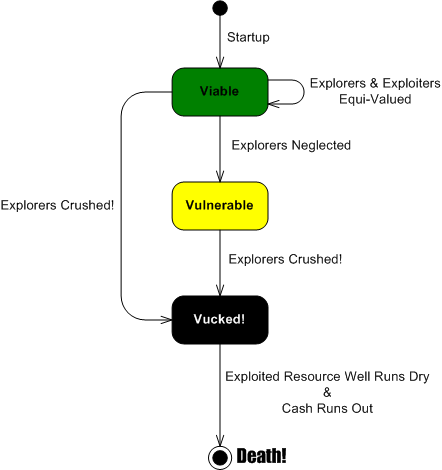
Virtually all startup companies initialize into the viable state. After all, if they didn’t have a product or service that a market didn’t want to consume, they wouldn’t be born as a viable entity, right? Over time, if they neglect their explorers and single mindedly, greedily, milk their product/service to death, eventually they’d become vulnerable to competitors. If the leadership becomes drunk with success and their heads expand too far, they start resenting and rejecting their explorers – they become vucked!
Unless, as the figure below shows, an epiphany in the head shed occurs (and the chances of that occurring in fat headed executives rolling in dough are incredibly slim) it’s death to the org and all its membership – including the innocents who had no hand in the implosion. This ain’t a hollywood story so there’s no happy ending.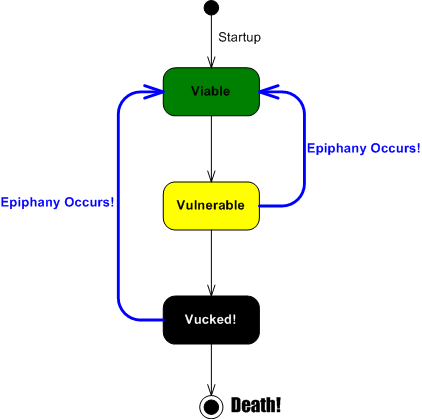
Making A Living
In “Stewardship: Choosing Service Over Self-Interest“, Peter Block comically states:
No one should be able to make a living simply planning, watching, controlling, or evaluating the actions of others.
If corpo granite heads everywhere took that statement to heart (which they can’t, and thus won’t), they’d eliminate themselves and all the layers below them in an instant – poof! Alas, that ain’t gonna happen cuz someone’s gotta look pretty, run the show, and suck up the dough. Seriously, someone really does have to run the show to keep the CCF viable.
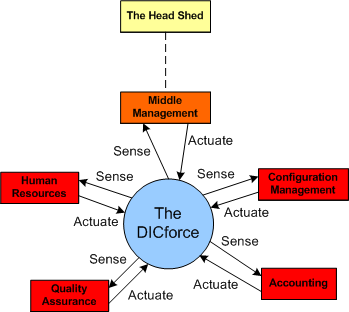
Actually, the dudes in the penthouse have others do the PWCE dirty work for them. The thugs in middle management and the pure overhead departments like Human Resources, Quality Assurance, Configuration Management, and Accounting serve nicely as the lower level sensors, alarm detectors, and actuators in the system. Because of this sleight of hand, the DICforce often targets their ire at those “support” functions and not where it rightfully ought to be targeted – the high priests living it up in the self-congratulatory head shed.
Make Me More Effective
In this blog post, 15 great leadership questions, executive and leadership coach John M. McKee asks leaders how often they ask their people:
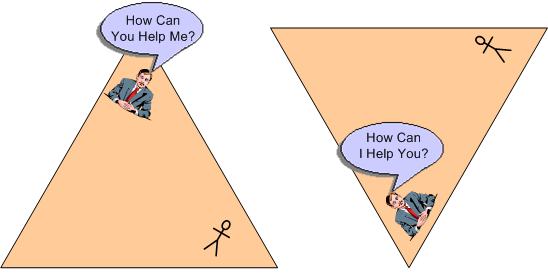
What can I do to make you more effective?
LOL. I’d wager that most leaders don’t ask this question at all. Managers cleverly ask and expect the opposite:
What can you do to make me more effective?
The higher one goes up in a corpo pyramid, the more this question gets asked either explicitly or (more likely) implicitly. You see, one unwritten rule (of many) in CCH bureaucracies is that lesser subordinates are required to make their bosses look good and expect nothing in return except the prevailing industry wage and benefits package. Expecting managers to actively facilitate high quality work and value creation is relegated to a distant second.
The problem with any unwritten law is that you don’t know where to go to erase it. – Glaser and Way
At the beginning of a project, an anointed leader once asked me: “What do you need?“. I was stunned, tongue-tied, and I didn’t know how to respond. Later, when I had some time to think about what I needed, I made my request. Sadly, I didn’t get what I needed but that didn’t really matter that much to me. Just the fact that he asked me the question was enough to instill a feeling of lasting trust and respect within me.
Failure, Failure, Failure
There are tons of experts, articles, books, and references on the ephemeral topic of “change”. Over the years, I’ve read my fair share of books on change and one of the best that I’ve stumbled upon (so far) is “It Starts with One: Changing Individuals Changes Organizations“. Authors Black and Gregersen assert that the 3 major brain barriers to organizational change are:
- The failure to see
- The failure to move
- The failure to finish
The book is targeted at leaders who’ve “seen” that major change is needed and who feel compelled to move their orgs into the future. It provides a boatload of examples and solid, pragmatic advice on how leaders can help the DICforce see, move, and follow through on cross cutting change initiatives.
Black and Gregersen should follow up their nice work with a book on a more pervasive problem; the failure of corpo leaders to “see” the need for change in themselves. The sequel would advise the boatloads of leaders in this category to get off their duffs and continuously probe, sense, and decide what changes are needed for their orgs to remain viable in a fast changing and hostile external business environment.
At a certain age institutional minds close up; they live on their intellectual fat. – William Lyon Phelps
Bad leaders fail to “see” the need for change until a crisis jolts them into reality. That’s because the dudes in the head shed get comfortable with past successes and feel no sense of urgency to change anything – regardless of what they say. To paraphrase Carolyn Wells; ” actions, or a lack thereof, lie louder than words“.

Bone Rattlers

Peter Senge is a colleague of dear, departed Russell Ackoff. Peter recently wrote a passionate tribute to his friend on the Ackoff Center Weblog and he rang my bell with these bone-rattling quotes:
So long as people think in fragmented ways they will act similarly – Peter Senge
The inherited traditions over generations toward patriarchy, authoritarian views of leadership, and rigid systems of institutional power will not change in a generation – Peter Senge
How long will we preserve the belief that power comes from institutional position versus connection to the creative flow of the universe? – Peter Senge
The forces for change come from “life’s longing for itself,” not from ego-based human striving – Peter Senge
That last quote is really a zinger because I’ve been wrestling with my ego ever since I finally came to the realization that it dominates my (and the vast majority of other people’s) thinking and external behavior. Sadly, I (the real self) don’t have the upper hand on the “I” (the imposter) thought, but some day I hope to do so. Hence, my spiritual quest continues in a seemingly self-referential infinite looping attempt to use the ego to beat the ego into submission.
How about you? Do you realize that you’re not living up to your full potential because your ego is in charge? Do you care, or is everything just peachy keen for you the way you are?
Managers And Leaders
Naturally, everyone has their own personal opinion regarding the difference between a leader and a manager. Of course, I have one too:
Manager = Status Taker and Schedule Jockey (STSJ)
Leader = People Helper and Obstacle Remover (PHOR) first, and STSJ second
Of course, the STSJ function is necessary (but not sufficient) to stay in business, but the PHOR function is required to increase profitability, instill trust, and build a joyful workplace. In order to grow into a PHOR, a candidate for leadership has got to communicate, and frequently. Hell, if a leadership candidate doesn’t communicate with his/her people, how’s he/she going to know what they need and what socio-technical obstacles must be removed for them to excel? All non-communicators are STSJs – which means the number of STSJs (a.k.a BMs) pervading corpo America is HUGE-UH.
If you have more managers than leaders in your organization, then you’re most likely not having any fun during your daily stint within the halls of your institution. If you have zero leaders in your organization, then your work life is probably horrific. If you have all leaders in your organization then you’re most likely in heaven.
If any organism fails to fulfill its potentialities, it becomes sick. – William James
What’s the Manager-To-Leader ratio (MTL) in your organization? If you’re “in charge” of a group of people, are you a manager or a leader according to my unscientific, concocted (I like to make stuff up) criteria ?

Thinking Is Not Allowed
I’m not very good at flying by the seat of my pants during encounters with bozeltine managers who demand answers to complex questions on-the-spot, in real-time. When I spontaneously find myself in those situations, I tend to get flustered and make stuff up (more than I normally do (which is a lot)) to appease those in authority.
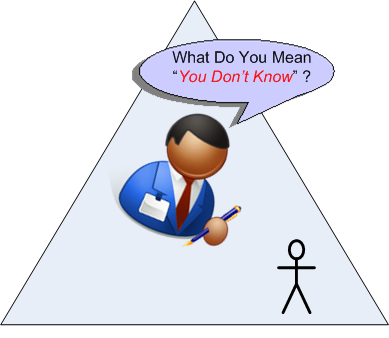
Rather than calmly saying “(please) let me think about it and get back to you“, I tend to cave and pull some stanky chit out of my arse. Maybe it’s because of the perception that “thinking” isn’t allowed? Maybe it’s because of the expectation that everyone should be perfectly all-knowing? If BMs were conscious of their irrational behavior when they ask for information, then they’d say “please think about it and get back to me“. But then, they wouldn’t be BMs. They’d be, heaven forbid, empathetic leaders.
Engage Me, Please
Since many people spend a large amount of time at work, or thinking about work, I’ve been on a perpetual search for the keys to developing, and more importantly, sustaining an inspirational culture that brings daily joy to all. I’m keenly interested in the topic because an inspiring company culture, like quality, is ephemeral, hard to quantify, and hard to bring to fruition.
In this blog post, “The Hole In The Soul Of Business“, Gary Hamel laments the fact that so many business leaders come up empty when it comes to the creation and sustainment of an engaging company culture.
In my last post, I cited a survey that found that only 20% of employees are truly engaged in their work — heart and soul. As a student of management, I’m depressed by the fact that so many people find work depressing. In the study, respondents laid much of the blame for their lassitude on uncommunicative and egocentric managers…
Why is it that managers are so willing to acknowledge the idea of a company dedicated to timeless human values and yet so unwilling to become practical advocates for those values within their own organizations? I have a hunch. I think corporate life is so manifestly inhuman—so mechanical, mundane and materialistic—that any attempt to inject a spiritual note into the overtly secular proceedings just feels wildly out of place—the workplace equivalent of reading a Bible in a brothel.
The first step toward getting rid of a bad habit is admitting that you have a problem in the first place. Alas, uncommunicative and egocentric managers never admit that there is a problem. That’s because they’re infallible, of course.


Why am I here?
WTF?
Meh!
D'oh!

My BTC Address



 Bulldozer00's Blog