Archive
Leader Or Dictator?

After reading Chetan Dhruve’s “Why Your Boss Is Programmed To Be A Dictator“, I’ve had a change of heart. I’ve concluded that hierarchy is a symptom and not the dominant cause of dysfunctional corpricracies. In his book, Mr. Dhruve skillfully develops a compelling case that the lack of the right to vote managers into and out of higher status slots in the hierarchy is the real cause of poor org-wide performance and DIC-force suffering in the workplace.
Mr. Dhruve asserts that there are two canonical forms of power systems: leaderships and dictatorships. By his definition, leaders are elected into power by those they lead, and dictators assume power by any other means. In corpricracies, dictators don’t assume power by shedding blood, they assume power in a civilized manner; by anointment from higher status dictators.
The unquestioned assumption in dictatorships is that superior status equates directly with superior knowledge and judgment. In corpo dictatorships, un-submissive subjects aren’t killed. They’re marginalized at best, and fired at worst. Chetan closes his masterpiece with a brilliant quote targeted at anyone in any power structure:
If you aren’t elected, you’re a dictator – Chetan Dhruve

Love Before Fear First, And Fear Before Love Second
One of Niccolo Machiavelli‘s most famous dicta is:
It is better to be feared than loved.
But wait….. that’s not the whole story. It’s certifiably time-proven and unassailable advice after you’ve parked your svelt butt on the throne, but not before. As you rise through the power rankings on your way to becoming alpha dog, it’s better to be loved than to be feared so that you can be swept into power by the very same people that you’ll need to fear you after you’ve secured Fort Knox.
You get it, right? If you’re not loved on the way up, chances are that you won’t even make it “up”. Hence, you’ve got to cleverly morph into one of those “nice guys” at work. You know, one of those stereotypical Stepford dudes that everybody speaks fondly of, but whose contributions and accomplishments are mysteriously unknown.
Thus, I, Bulldozer00, illegitimate son of Bulldozer and 00, have successfully catapulted brother Machiavelli’s quote for success into 21st century:
“Before you acquire power, it is better to be loved than feared. After you’ve acquired power, it is better to be feared than loved” – Machiavelli and Bulldozer00
Moo, hah , hah, hah. MOO HAH HAH HAH!!!!

Successful Dictatorship
I’m intrigued by, and respectful of, enigmatic guys like Steve Jobs. Despite reports of being an explosive control freak and a micro-manager, he continuously inspires his troops to greater heights. John Sculley, the CEO at Apple Inc. before Jobs seized the reins, gives a fascinating interview about his time at Apple and working with Mr. Jobs in this blarticle: “John Sculley On Steve Jobs“.
On the dogmatic “the customer is always right” theme:
He (Jobs) said, “How can I possibly ask somebody what a graphics-based computer ought to be when they have no idea what a graphic based computer is? No one has ever seen one before.”
On bucking the traditional advice to avoid micro-managing your people:
“He (Jobs) was a person of huge vision. But he was also a person that believed in the precise detail of every step. He was methodical and careful about everything — a perfectionist to the end.”
On leadership skills:
“He (Jobs) was extremely charismatic and extremely compelling in getting people to join up with him and he got people to believe in his visions even before the products existed.”
On the “bozo” (lol) issue:
“The other thing about Steve was that he did not respect large organizations. He felt that they were bureaucratic and ineffective. He would basically call them “bozos.” “
On the dogmatic “leaders should remain cool, composed and unemotional at all times (to feign an image of complete self-control)”:
“Steve would shift between being highly charismatic and motivating and getting them excited to feel like they are part of something insanely great. And on the other hand he would be almost merciless in terms of rejecting their work until he felt it had reached the level of perfection that was good enough to go into – in this case, the Macintosh.”
On the natural entropy-driven deterioration of once vibrant orgs into corpricracies:
And you can see today the tremendous problem Sony has had for at least the last 15 years as the digital consumer electronics industry has emerged. They have been totally stove-piped in their organization. The software people don’t talk to the hardware people, who don’t talk to the component people, who don’t talk to the design people. They argue between their organizations and they are big and bureaucratic.
On the “power of less” and beating complexity into submission with simplicity:
He’s a minimalist and constantly reducing things to their simplest level. It’s not simplistic. It’s simplified. Steve is a systems designer. He simplifies complexity.
Being a biased and incorrigibly self-serving bozeltine myself, I cherry-picked this Sculley quote for last to promote my real agenda:
Engineers are far more important than managers at Apple — and designers are at the top of the hierarchy.

Empowerment Examples
Everyone’s heard of the worn and tired “employee empowerment” exhortation, but does anyone really walk the talk? Here are two specific and quantifiable empowerment examples from the same company. You be the judge.
Example 1 (via Gary Hamel: HCL’s Vineet Nayar on its ‘Management Makeover’ – Gary Hamel’s Management 2.0 – WSJ):
For example, our annual planning process for FY 2010 included a review of business plans for HCL customer accounts not only by top management but by 8,000 people throughout the organization. Under the program, dubbed My Blueprint, the plans were available on a portal where customer-facing employees, who would be charged with implementing those plans, could comment on them. This produced a flood of feedback and prompted the re-engineering of several plans.
Example 2 (via The world’s most modern management – In India):
Every employee rates their boss, their boss’ boss, and any three other company managers they choose, on 18 questions using a 1-5 scale. Such 360-degree evaluations are not uncommon, but at HCL all results are posted online for every employee to see.
Stylistic Versatility
Except for his interviews with several famous people that were involved in the development of successful software systems, consuming Sam Lightstone’s “Making It Big In Software” didn’t do a whole lot for me. However, when he wasn’t writing like a know-it-all patriarch, Sam did provide several nuggets of wisdom to absorb. One of those nuggets was the disclosure of Hay & McBer’s 6 leadership styles as uncovered via a study of 3,871 executives. For your convenience (uh, actually my convenience), I’ve copied and pasted the leadership style table below.
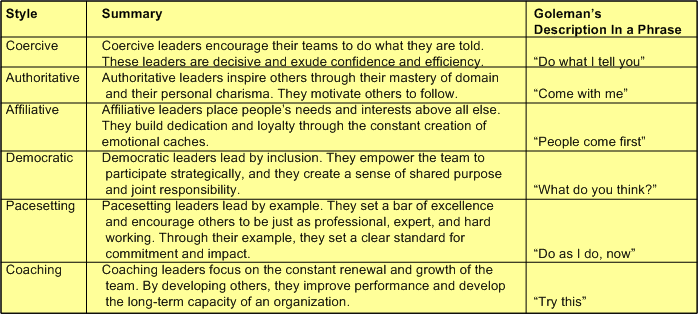
Lightstone rightly says that the versatile leader (and how many versatile, multidimensional leaders do you know?) applies the right style at the right time:
- Use coercion only in crises situations
- Use authority when charting a new course
- Use affiliation to heal a team
- Use democracy for collaboration
- Use pacesetting for sprints
- Use coaching for improvement
Regarding effectiveness of style, Lightstone writes:
Although each style has its pros and cons, (Daniel) Goleman’s article citing the Hay and McBer research found that the coercive and pacesetting styles have the most negative impact on an organizations. Nobody likes to be bullied, and the hallmark of a coercive style is a dictatorial approach. Pacesetting styles force employees to run at a pace that might not be comfortable or sustainable for them.
I think that BOOGLs, BUTTs, and CGHs, of which there are many, are one dimensional SCOLs who apply the only style they know, coercion, in all situations. These one-trick-pony dudes and dudettes either don’t believe the other five styles exist, or they don’t utilize the styles because they’re expected to be “in control” at all times by the toxic culture that pervades the corpricracy.
I’m not a leader, so I don’t/can’t practice applying any of the Hay & McBer styles. How about you? Are you a versatile leader, or are you a culturally conditioned control freak?
Is This A CEO Talking?
From Who’ll Catalyze Change: Us or Them? – Harvard Business Review, HCL Technologies CEO Vineet Nayar says:
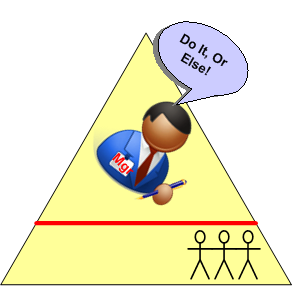
We at HCL have embraced a philosophy that’s based on an inversion of the management pyramid, with managers becoming as responsible to employees as employees are to managers.
Vineet’s joking, right? Nah, he’s fibbing to cover up the reality that he rules with a Stalinistic iron fist at HCL, no? This joker follows up with an even bigger whopper:
Too many people caution us about acting on instinct and conviction. But we must surround ourselves with employees that dare to try new things in new ways. They may not achieve perfect results, but if they focus on getting better each day with one more attempt, they will solve many problems that appear unsolvable.
Acting on “instinct and conviction” and not on objectively measured scientific “proof” (that really camouflages subjective, random, self-serving, opinion)? WTF? This Vineet dude needs to be cast out of the guild of management and “put in his place“, no?

I Found Another Gem
Whoo hoo! I’ve stumbled upon another rare gem in a massive pile of ugly rocks. As the graphic below shows, I’ve added HCL Technologies to my list of favorite companies. Led by their visionary CEO, Vineet Nayar, HCL is one of the few models for successful companies of the future. Since the vast majority of corpo Executive Teams are stuck in the mechanistic Sloan/Taylor mindset of the 1900s with no intention of changing the way they manage, err, impose control, it’s always refreshing and exciting to discover a new game changer.

So, how do I decide whether a company is a cut above the rest? Via subjective evaluation of external observations, of course. Financial performance, which is of course important, is of secondary concern. Here’s my unscientific list of “research” methods:
* Read third party accounts of experience given by former and current non-management employees.
* Read, listen, and watch interviews with CEOs and executives.
* Scour publicly available mission statements, visions, core values and cultural descriptions for authenticity, lack of corpo jargon, and attention to detail.
* Stay away from glossy annual reports – which are all clones of each other.
* Ignore whatever the hand picked company spokesperson(s) say – propaganda city.
Of course, my methods aren’t perfect, but do you know of any better ones?
Related Articles
- Why HCL Technologies puts employees ahead of customers (tech.fortune.cnn.com)
- HCL Technologies Annual Revenues up 24.1 % YoY; Quarterly Revenues up by 21.5% YoY and 7.7% Sequentially; Europe Annual Revenues up by 20.6% YoY in FY10 (prnewswire.com)
- Management Innovation: Extreme Management Makeover (petervan.wordpress.com)
- Indian outsourcer HCL Technologies quarterly profit up 6.9 percent to $74M on strong demand (taragana.com)
Two Paths
As a small group of people assembled for a purpose greater than each individual grows, some form of structure is required to prevent chaos from reigning. The top path shows the emergence of a group of integral coordinators while the bottom path shows a traditional, stratified CCH being born.
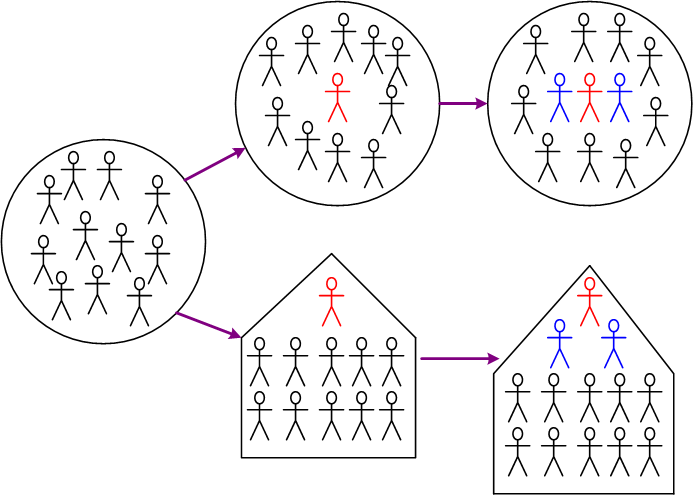 Which group would you rather be a part of? If you say you’d rather be a part of the “circular” group and you’re lucky enough to be a part of one, you’re still likely to get hosed down the road. You see, if your group continues to grow, it will naturally gravitate toward the pyramidal CCH caste system. That is, unless your natural or democratically chosen group leaders don’t morph into CGHs or BOOGLs and they actively prevent the subtle transformation from taking place.
 If you’re currently embedded in a CCH and one of its leaders bravely attempts to change the structure to a circular, participative meritocracy, fugg-ed-aboud-it. The change agent will get crushed by his/her clanthinking BOOGL and SCOL peers, who ironically espouse that they want circular behavior while still preserving the stratified CCH.
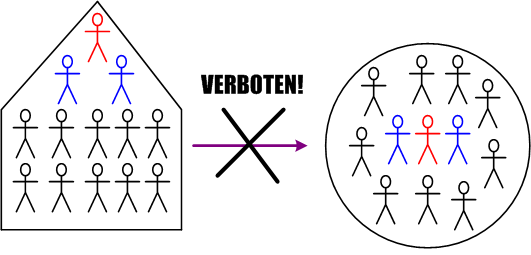
Pyramid Conversion
In this Inc. blog post, Joie de Vivre hotel chain founder Chip Conley says:
The most contagious emotion in most companies is fear. Most companies do such a poor job communicating that most employees get stuck in a place of survival and don’t have a lot of room for creativity, innovation, or ingenuity.
Every survey that’s been done in the U.S. tends to show money is not the primary, secondary, or third; It’s fourth place on why people leave their jobs.
We took the Maslow pyramid and turned it into an employee pyramid with three basic themes: survival the base, succeed at the middle, and transformation at the top. Applying that to employees, it’s money, recognition, and meaning.

Once people are satisfied with how much money they are making, the next human desire they need fulfilled at work is recognition. According to Conley: “What really is meaningful to people is genuine appreciation shown in real time“. The key words are “genuine” and “real time“. I interpret this to mean; not months after a significant accomplishment has been achieved or once a year at an all hands meeting where a boring and generic “atta boy” is delivered from on-high down to the DICforce.
If you just sit in the control tower and solely monitor the numbers that result from the effort without recognizing the effort itself in the moment, then you’re behaving just like the herd and you deserve what you get – mediocrity. Mooooooooooo.

Zappos Rocks Again
As a huge, huge, huge, (did I say youuuuuuuge-uh?), fan of Tony Hsieh and Zappos.com, I blabber about them often. Zappos latest action to make the whole world, yes, the whole world, a better place is to offer up a free, yes free, download of the audio version of the best seller, yes best seller, book “Tribal Leadership“. The link is here, yes here.

Even though I’ve stalked Zappos.com for years, until recently I’ve never bought anything from them because I’m not a shoe or clothes dude. Hell, I’m an old and unredeemable person of questionable integrity and questionable character and questionable morality and questionable <<add your own trait here if you know me>>, so I renew these things about every 10 years or when they fall apart; whichever comes first. However, even with zero revenue from me, they upgraded me to VIP status. This means that with every order I place, they’ll guarantee free overnight shipping. WTF, you say? Uh, the only answer that I can give to you is: They’re fuckin’ Zappos.com dude, that”s why! Oops, I hope the F-bomb didn’t make you mad and send you to the altar to pray for me. If it did, then maybe you shouldn’t be wasting your time reading this blasphemous blog 🙂

Why am I here?
WTF?
Meh!
D'oh!

My BTC Address



 Bulldozer00's Blog