Archive
The D’oh Threshold
The figure below introduces the concept of the “D’oh Threshold“. Every institution has their own purely subjective “D’oh Threshold“. It is arbitrarily set by whoever is in charge.
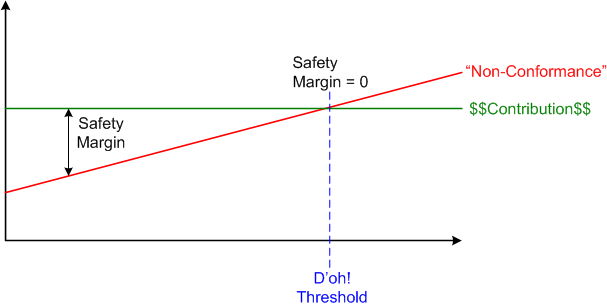
The more bureaucratic or dictatorial the org, the more the threshold shifts to the left (the less the positive safety margin and the more the negative safety margin). Since bureaucrats and dictators care more about conformance to their arbitrary and personally concocted rules than contribution to the “whole“, the “D’oh Threshold” wobbles all over the place. Its setting can vary month to month, day to day, minute to minute, group to group, individual to individual – depending on the emotional state and perceptions of those who run the circus.
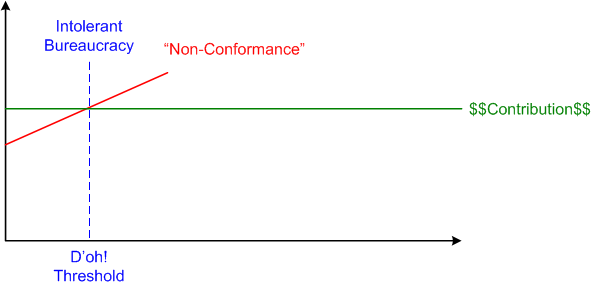
When humans are involved in organized group efforts, there is no escape from subjectivity. But in high performing orgs, the “D’oh Threshold” set point is relatively stationary, far to the right, and everybody knows where they stand.
The Value Zone
Even though it’s been on my Kindle for a year, I just finished reading HCLT CEO Vineet Nayar‘s book, “Employees First, Customers Second“. It was low on my priority list because I already had read a slew of articles about the book when it was first released.
In EFCS, Vineet describes “the value zone” and “the so-called enabling functions” as follows:
So, how did Mr. Nayar “force” the superiors who dwell in the enabling functions to be accountable to the value-creators? He did it by effectively implementing the HCLT “Smart Service Desk” (SSD) – a twist on the typical problem management system employed by most companies to resolve customer issues. Here’s how it works:
- Whenever an employee has a problem or needs information, he or she opens a ticket that is directed to the appropriate department for handling (including senior management and the CEO).
- Each ticket has a deadline for resolution.
- The system is transparent so that all could see the contents of the tickets and where they are in the process.
- The employee who had opened the ticket is the one to determine whether the resolution is satisfactory, or if the issue has been resolved at all.
Shortly after placing the SSD into execution, people “were opening tickets at an average of thirty thousand per month (at a time when there was a total of about thirty thousand employees in the company)“. Vineet sums up the system’s success as follows:
People were embracing the system. It was a victory for honesty, transparency, and openness!

Related articles
- HCL Technologies quarterly net profit rises 50 percent (news.bioscholar.com)
- Why HCL Technologies puts employees ahead of customers (tech.fortune.cnn.com)
- HCL Tech Q1 net up 50% at Rs. 496.7 crore (thehindu.com)
- Valuing Employees (Really!): Lessons from India (forbes.com)
Miraculous Recovery
It’s a miracle, a true blue spectacle, a miracle come true – Barry Manilow
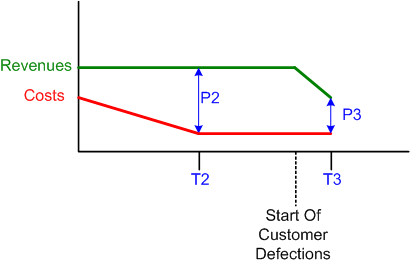
The business equation is as simple as can be: profits = revenues – costs. For the moment, assume that increasing revenues is not in the cards. Thus, as the graph below shows, the only way of increasing profits is to reduce costs.

By far, the quickest, most efficient, and least challenging method of reducing costs is by shrinking the org. However, the well known unintended consequences of reducing costs by jettisoning people are:
- increased workload on those producers “lucky enough” to remain
- the loss of bottom up trust and loyalty,
- lowered morale, increased apathy and skepticism
- less engagement, lowered productivity
- the loss of even more good people seeking out a better future
Unless these not-so-visible unintended consequences are compensated for (which they usually aren’t), the increase in profits may be short-lived. Sometime later, revenues may start decreasing as a result of customer defections triggered by deteriorating product and service quality.
As the system dynamics influence diagram below shows, the start of customer defections may trigger a vicious downward spiral into oblivion in the form of a positive feedback loop. An increase in customer defections leads to an acceleration in the decrease in profits, which leads to an increase in cost cutting measures, which accelerates decreased product/service quality, which increases the number of customer defections.

Once the vicious cycle commences, unless the loop is broken somehow, the extinction of the org and all of its “innards” is a forgone conclusion:

So, how can the cycle be broken? Well duh, by increasing revenues. So, how can revenues be increased? By somehow “miraculously”:
- Creating new products/services that customers want and competitors don’t have yet
- Enhancing the existing product/service portfolio to distinguish the org’s offerings from the moo herd’s crappy products/services
But wait, you say. How can an org enhance their products and/or create new ones with no capital to invest because of decreasing (or no) profits? Then, uh, that’s where the “miraculously” comes in.

In a tough business environment, it doesn’t take much to cut costs (that’s what dime-a-dozen MBAs and mercenary hatchet men are for). It takes talent, ingenuity, lots of luck, and real leadership to increase revenues when little to no investment resources are available. No matter how sincere, text book exhortations, rah rah speeches, and appeals for increased focus/dedication/loyalty (with no reciprocating commitment for compensation should the ship be righted), aren’t characteristic of real leadership. They’re manifestations of fear.
The Null Set
Few would argue that Martin Luther King and Albert Einstein didn’t change the world for the betterment of the human race. These two stunningly similar quotes unveil one of the keys to their hard won success:
Many people fear nothing more terribly than to take a position which stands out sharply and clearly from prevailing opinion. – Martin Luther King
Few people are capable of expressing with equanimity opinions which differ from the prejudices of their social environment. Most people are even incapable of forming such opinions. – Albert Einstein
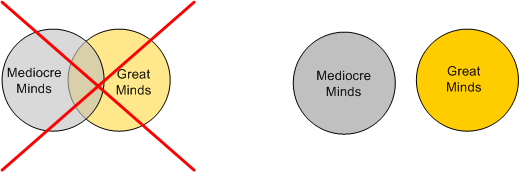
Something tells me that this is an ironic twist on the cliche that “great minds think alike“. Great minds think alike, but so do mediocre minds. It’s just that on matters of importance, great minds don’t think like mediocre minds. D’oh!
Sanity, Stability, Insanity, Instability
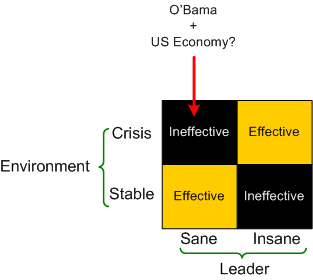
Because of the seemingly outrageous premises upon which the book is based, I found Nassir Ghaemi’s “A First-Rate Madness: Uncovering the Links Between Leadership and Mental Illness” fascinating. Mr. Ghaemi asserts that mentally healthy leaders do a great job in times of stability, but they fail miserably in times of crisis due to something akin to acquired “hubris syndrome“. On the flip side, he asserts that mentally unhealthy leaders, being more empathic ans less susceptible to hubris syndrome, are effective in times of crisis, but woefully ineffective in stable times.
What follows is the impressive list of leaders Mr. Ghaemi “analyzes” to promote his view. First, the wackos: William Tecumseh Sherman, Ted Turner, Winston Churchill, Abraham Lincoln, Mahatma Gandhi, Martin Luther King Jr., Franklin D. Roosevelt, and John F. Kennedy. Next, the sane dudes: Richard Nixon, George McClellan, Neville Chamberlain, George W. Bush, and Tony Blair. He also “delicately” addresses where Adolph Hitler fits into his scheme of things.
Here are several passages that I highlighted on my Kindle and shared on Twitter:
We are left with a dilemma. Mental health—sanity—does not ensure good leadership; in fact, it often entails the reverse. Mental illness can produce great leaders, but if the illness is too severe, or treated with the wrong drugs, it produces failure or, sometimes, evil. The relationship between mental illness and leadership turns out to be quite complex, but it certainly isn’t consistent with the common assumption that sanity is good, and insanity bad.
Depression makes leaders more realistic and empathic, and mania makes them more creative and resilient. Depression can occur by itself, and can provide some of these benefits. When it occurs along with mania—bipolar disorder—even more leadership skills can ensue. A key aspect of mania is the liberation of one’s thought processes.
Creativity may have to do less with solving problems than with finding the right problems to solve. Creative scientists sometimes discover problems that others never realized. Their solutions aren’t as novel as is their recognition that those problems existed to begin with.
In a strong economy, the ideal business leader is the corporate type, the man who makes the trains run on time, the organizational leader. He may not be particularly creative, but he doesn’t need new ideas; he only needs to keep going what’s going. Arthur Koestler called this kind of executive the Commissar; much as a Soviet bureaucrat administers the state, the corporate executive administers the company. This is not a minor matter; administration is no easy task; but with this approach, all is well only when all that matters is administration.
When the economy is in crisis, when profits have fallen, when consumers no longer demand one’s goods or competitors produce better ones, then the Commissar fails; the corporate executive takes a backseat to the entrepreneur, whom Koestler called the Yogi. This is the crisis leader, the creative businessman who either produces new ideas that navigate the old company through changing times or, more often, produces new companies to meet changing needs.
Yet absence of evidence is not evidence of absence. Like Gandhi, King tried to commit suicide as a teenager; in fact, King made two attempts. It is surprising how little this fact is recalled.
Many people fear nothing more terribly than to take a position which stands out sharply and clearly from prevailing opinion. The tendency of most is to adopt a view that is so ambiguous that it will include everything and so popular that it will include everybody. . . . The saving of our world from pending doom will come, not through the complacent adjustment of the conforming majority, but through the creative maladjustment of a nonconforming minority.
Mentally healthy leaders like George W. Bush make decisions, but refuse to modify them when they do not work well.
Still, given the challenges, some might well ask: Why take the risk? Why not just exclude the mentally ill from positions of power? As we’ve seen, such a stance would have deprived humanity of Lincoln, Churchill, Roosevelt, and Kennedy. But there’s an even more fundamental reason not to restrict leadership roles to the mentally healthy: they make bad leaders in times of crisis—just when we need good leadership most.
Most of us think and act similarly. Most people have a hard time admitting error, apologizing, changing our minds. It takes more than a typical amount of self-awareness to realize that one is wrong and to admit it.
“Proud mediocrity” resists the notion that what is common, and thus normal, may not be best.
Regardless of whether you agree with his analyses and conclusions after you’re done reading the book, I think you’ll have enjoyed the reading experience.”
Personal And Social
No Reflection
In “Seeing Your Company as a System“, uber systems thinker Russell Ackoff is quoted as saying:
“Experience is not the best teacher; it is not even a good teacher. It is too slow, too imprecise, and too ambiguous.” Organizations have to learn and adapt through experimentation, which he (Ackoff) said “is faster, more precise, and less ambiguous. We have to design systems which are managed experimentally, as opposed to experientially.” – Russell Ackoff
Judging whether an experiment is a success, failure, or something in between, requires the ability to pause and reflect on the results (or lack thereof) being achieved while the experiment is in operation.
In borgs run by self-perceived infallible popes, there is no experimentation and there is no reflection. Orders from above are assumed to be “right” and their execution is never perceived to be an experiment. They are undoubtedly based on an unquestioned, proven theory (usually Theory X) that’s underpinned by a set of rock solid axioms. If success doesn’t manifest as a result of carrying out papal orders, it’s auto-assumed to be the fault of the congregation, or (in less borgy institutions) mysterious supernatural forces beyond papal control. It’s unconscionable to think that the orders themselves were the cause of failure. Why? Because pauses during, and reflection after, execution are not allowed.

Keep Outta The Kitchen!
… there is nothing more difficult to carry out, nor more doubtful of success, nor more dangerous to handle, than to initiate a new order of things. For the reformer makes enemies of all those who profit by the old order, and only lukewarm defenders in all those who would profit by the new order… – Niccolo Machiavelli
In all companies, both leading and lagging, it’s only natural that people at all levels in the hierarchy will complain about various aspects of day-to-day operations that they feel are holding them and the company back. At leading companies, gripes are actively solicited, listened to, and thoughtfully evaluated. Those deemed to be valid are acted upon to improve performance and morale. At laggard borgs, all gripes that cry out for a deviation from the status quo are either pooh-poohed away as non-issues (especially if they bubble up from the bottom) or they’re outright ignored.
In the sad extreme, leaders toiling in laggard borgs who know that valid gripes are slooowly killing the enterprise, feel powerless to act. It’s sad because, even though they have the stature and power to influence change, they don’t feel it’s worth the effort to champion and diligently follow through on a much needed change initiative. By keepin’ outta the kitchen cuz they can’t stand the heat, they religiously follow Harry Truman‘s sage advice.

Rimshot

Research In Motion (RIM) is the creator of the wildly successful Blackberry phone. However, even with the recent release of the well-respected (but too late to the game) Playbook tablet, RIM’s financial and market positions have started to erode as a result of the iPhone and Android onslaught.
Either RIM is shot, or they’re well on their way to being shot – as in “out of business“. For the details, check out “RIM gets handed open letter from disgruntled employee, quickly responds in kind — Engadget“.
The interesting aspect to this “open-letter-from-disgruntled-employee-to-management” case is that the anonymous employee is a senior executive and not a DIC; nor even a manager from a flabby middle borg layer. This fact just about seals the deal – RIM is probably shot.
Another serious piece of evidence that forbears the impending implosion of the RIM corpricracy is the totally predictable and papally infallible response from the corpo spin team:

Of course, as the papal response implies, the open letter writer is a traitorous, agenda-seeking coward and “the senior management team at RIM is fully aware of and aggressively addressing both the company’s challenges and its opportunities“.
But wait! The flood gates have opened and there appear to be several more traitorous, anonymous cowards in the borg that are coming forward. Gee, RIM’s hiring processes must suck to allow all these unethical yellow bellies through the door, no?

What’s On Your List?
In Russell Ackoff‘s “Idealized Design” method, he suggests that designers assume that the system they’re trying to improve/re-design exploded last night and it no longer exists. D’oh! He does this in order to put a jackhammer to the layers of unquestioned, un-noticed, outdated, and hard-wired assumptions that reside in every designer’s mind.
So, if you were part of an emergency task force charged with re-designing your no-longer-existing org, what candidate list of ideas would you concoct? To help jumpstart your underused, but innately powerful creative talents, here’s an outrageous example list that I stole from a raging lunatic:
- Provide two computer monitors for every employee and religiously refresh workstations every three years.
- Provide two projectors and multiple whiteboards in each conference room. Ensure a plentiful supply of working markers. No exclusive executive conference rooms – all rooms equally accessible to all, with negotiated overrides.
- Physically co-locate all product and project teams for the duration. Disallow a rotating door where projectees can come and go as they please or management pleases – with rare exceptions of course.
- Put round tables in every conference room.
- Distribute executive and middle manager offices throughout the org. No bunching in a cloistered, elitist corner, space, or glistening building with HR/Marketing/PR/finance/contracts or other overhead functions.
- Require every manager in the org with direct reports to periodically ask each direct report: “How can I help you do your job better?” at frequent one-on-one meetings. If a manager has too many direct reports – then fix it somehow.
- Require every manager who has managers reporting to him/her to ask each of his/her subordinate managers: “Can you give me an example of how you helped one or more of your direct reports to grow and develop this year?“.
- Require periodic, skip-level manager-subordinate meetings where the manager triggers the conversation and then just listens.
- If “schedule is king” all the time, then write it into your prioritized core values list – just above “engineering excellence and elegant products“. If your core values list contains conflicting values, then prioritize it.
- Carefully and continuously monitor group (not individual) interaction protocols and behaviors. Diligently prevent protocol bloat and convert tightly coupled, synchronous client-server relationships into loosely couple, asynchronous, peer-to-peer exchanges.
- Explicitly budget X days of user-chosen training to every person in the org and enforce the policy’s execution.
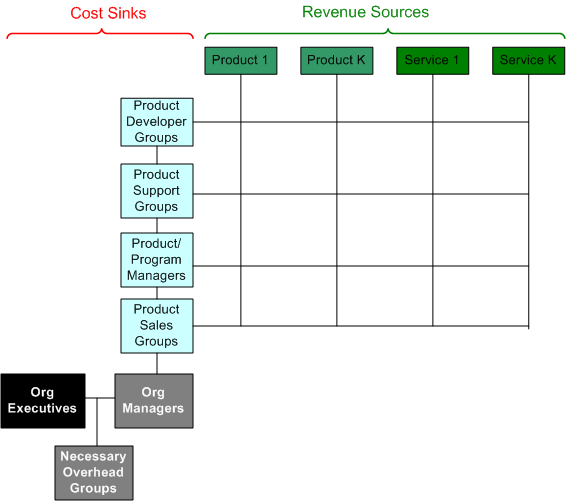
- To reinforce why the org exists and de-emphasize who is “more important” than who, publish a product and/or service-centric org chart with products/services across the top and groups, including all managers, down the side. Preferably, the managers should be on the bottom propping up the org. (See figure below).
- Abandon the “employee-in-a-box” classification and reward system. Pay each person enough so that pay isn’t an issue, and publicly publish all salaries as a self-regulating mechanism.
- Create policy making and problem solving councils up and down the org. Members must consist of three levels of titles and include both affectees in addition to effectors.
- Give leadees a say regarding who their leaders are. Publicly publish all reviews of leaders by leadees.
- Require periodic job rotations to reduce the org’s truck number.
- Frequently survey the entire org for ideas and problem hot spots. Visibly act on at least concern within a relatively short amount of time after each survey.
- Provide every employee with an org credit card and budget a fixed amount of money where no approvals are required for purchases. Fix the purchasing system to make it ridiculously easy for expenses to be submitted.

Why am I here?
WTF?
Meh!
D'oh!

My BTC Address



 Bulldozer00's Blog