Archive
Idiomatic Idiot
Programming idioms are the language-specific, more concrete equivalent of design patterns. I remember watching a video interview with C++ creator Bjarne Stroustrup in which he recommended that programmers learn how to program idiomatically in 5, yes 5, different languages. WTF? I’ve been working in C++ for years now and it seemed like forever before I could comfortably program this way. There’s at least one whole book out there that teaches idiomatic programming in C++. Sheesh!
I think that to remain idiomatically competent in a language, one has got to work in the language almost daily for a long, sustained period of time. How can one do this with 5 languages? Maybe it’s just me – I am an Idiomatic Idiot.
How many languages could you confidently say you know how to program idiomatically in?
Access Change
To ensure consistency across our application component set in the team project that I’m currently working on, I’m required to inherit from a common base class that resides in a lower, infrastructure layer. However, since my class resides in the topmost, domain-specific layer of our stack, I want to discourage others from inheriting from it – but (as far as I know) there’s no simple way in C++ to do this (no contorted singletons please – it’s overkill).
In addition to inserting a /*we’ll fire you if you inherit from this class!*/ type comment and removing the virtual keyword from all overridden member functions, I recently discovered an additional, trivial way of discouraging others from inheriting from a class that is intended to be a leaf in an inheritance tree. It may already be an existing C++ idiom that I haven’t stumbled across, but I’ll call it “access change” just in case it isn’t.
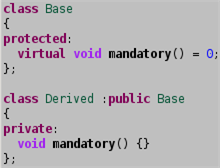
The figure below shows what I mean by “access change“. As you can see in the Derived class, in addition to leaving the virtual keyword out of the Derived::mandatory() function definition, I also changed its access qualifier from protected to private.
What do you think? Are there any downsides to this technique? Are there any other “gentle” ways to discourage, but not prevent, other C++ programmers from deriving from a class you wrote that wasn’t intended to be used as a base class?

Why am I here?
WTF?
Meh!
D'oh!

My BTC Address



 Bulldozer00's Blog