Archive
Dweeb In the Cellar
Check out the figure below and please heed the advice it dispenses. If you’re a Dweeb In the Cellar (DIC), don’t piss off the people in the highlighted boxes above you. As a DIC, you can (almost) safely piss off anyone else in the corpo caste system. However, each cookie cutter corpo command & control hierarchy is slightly, just slightly, different. For example, if your direct boss and one of his level 1 peers are great friends, you can’t piss the friend off either. As you might guess, it’s usually OK to piss your fellow DICs off, but again, each corpo org is slightly different.

Pray Or Play
Do you follow the rulebook and worship at the altar of the corpo pyramid, or do you break the rules in defiance of the chain of command to get stuff done in a timely fashion and add value to your organization? To some extent, everyone has to obey some basic ground rules so that chaos won’t reign, but do you question those rules from time to time to evaluate whether they’re still applicable? Do you experience pangs of fear when you ask tough questions that “aren’t supposed to be asked”? How do you ask a tough question without implying that someone is being ineffective? As just another dweeb stuck in a vertical silo at the bottom of the corpocracy, how can you point out cross-silo communication problems without pissing “important” people off? Do you faithfully, quietly, and unquestioningly sit behind the pew and pray, or do you at least try to play – in spite of the chance of incurring a potential career ending injury?

Directagers
Director of communications, director of operations, director of engineering, director of marketing, director of strategy. Yada, yada, yada. Everyone is, or wants to become, a “Director” of something. The ultimate directorship, of course, is to be elected to sit on one or more cushy Boards Of “Directors”.
Not discounting the title of “Chief”, the title of “Director” seems to have overtaken “Manager” as the coveted corpo title dujour. Compared to an honorable and esteemed “Director”, a “Manager” is now almost as unimportant as an “associate”, or equivalently, an “in-duh-vidual contributor” (gasp!). The title of “Manager” is……. so yesterday.
So what’s the next title to be inserted into the divisive corpo caste system, the “Directager“? Come on, take a guess.

Hierarchical Growth
I’m currently in the process of reading Donella Meadows’s Thinking In Systems. Donella says that successful hierarchical systems grow from the bottom up, one layer at a time.
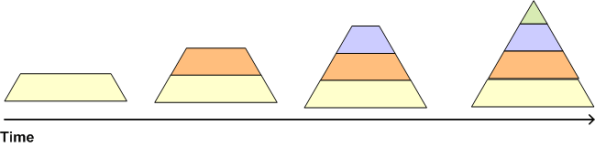 In the case of a human-made system of humans, as an assembled group of people becomes successful at what it does, it starts growing horizontally. The group finds a way to extract what it needs to sustain and grow itself (like money in exchange for products and services) from its surrounding environment.

In order to keep the group aligned and coordinated, the next higher level is formed from a small sub-group within the first level. Both levels feed each other in a mutually beneficial relationship and the organization keeps growing sideways. At a certain point, the second level becomes wide enough to require a third level to keep it synchronized with the group’s overall organizational goals. As growth continues, more and more layers are needed to keep the overall system from diverging from its true purpose.
At some unpredictable point in time, a strange and seemingly irrational inversion starts taking place as growth continues. The smaller, but higher layers in the hierarchy start consuming a more disproportionate share of the fruits of the organizational effort. The original, mutually beneficial, two way relationship transforms into an unbalanced one way relationship that is strangely accepted and taken for granted by everyone at all levels.
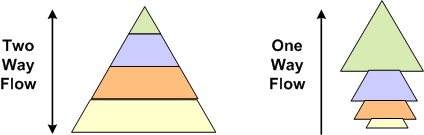
As a result of the imbalance, the bottom layers begin to atrophy from a lack of nourishment. As the one way upward flow of nourishment continues, the weight of the top layers increases and the strength of the lower layers decreases. In the worst case, the organization loses its balance and comes crashing to earth in a disintegrated mess.

In the early stages of growth, everyone in the organization fully understands that each successive layer is put in place to take care of the layer below it, and vice versa. When this understanding gets lost, all is lost. It’s just a matter of time until disaster strikes. Can the process be reversed? Sure it can, by restoring the balance and never losing sight of why the upper layers were created in the first place.
Mista Level
“Design is an intimate act of communication between the designer and the designed” – W. L. Livingston
I’m currently in the process of developing an algorithm that is required to accumulate and correlate a set of incoming, fragmented messages in real-time for the purpose of producing an integrated and unified output message for downstream users.
The figure below shows a context diagram centered around the algorithm under development. The input is an unending, 24×7, high speed, fragmented stream of messages that can exhibit a fair amount of variety in behavior, including lost and/or corrupted and/or misordered fragments. In addition, fragmented message streams from multiple “sources” can be interlaced with each other in a non-deterministic manner. The algorithm needs to: separate the input streams by source, maintain/update an internal real-time database that tracks all sources, and periodically transmit source-specific output reports when certain validation conditions are satisfied.

After studying literally 1000s of pages of technical information that describe the problem context that constrains the algorithm, I started sketching out and “playing” with candidate algorithm solutions at an arbitrary and subjective level of abstraction. Call this level of abstraction level 0. After looping around and around in the L0 thought space, I “subjectively decided” that I needed a second, more detailed but less abstract, level of definition, L1.
After maniacally spinning around within and between the two necessarily entangled hierarchical levels of definition, I arrived at a point of subjectively perceived stability in the design.
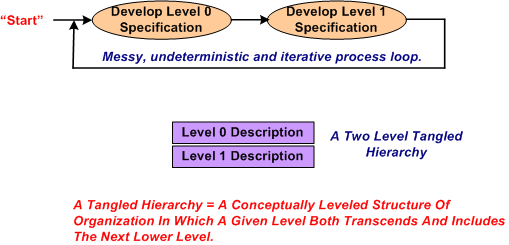
After receiving feedback from a fellow project stakeholder who needed an even more abstract level of description to communicate with other, non-development stakeholders, I decided that I mista level. However, I was able to quickly conjure up an L-1 description from the pre-existing lower level L0 and L1 descriptions.

Could I have started the algorithm development at L-1 and iteratively drilled downward? Could I have started at L1 and iteratively “syntegrated” upward? Would a one level-only (L-1, L0, or L1) specification be sufficient for all downstream stakeholders to use? The answers to all these questions, and others like them are highly subjective. I chose the jagged and discontinuous path that I traversed based on real-time situational assessment in the now, not based on some one-size-fits-all, step-by-step corpo approved procedure.
Who’s That Masked Man?
I’m very skeptical of management consultants, but the dudes at VitalSmarts are really good. They are responsible for the wonderful “crucial” pair of books:
I’ve read both of these along with Influencer. They’re all very “down to earth” and highly accessible tomes that detail what works and what doesn’t work in terms of leading organizations of people. Their simple and “executable” advice is backed by academic research and, most importantly, their direct experiences from interacting with lots and lots (thousands) of real people in working organizations around the globe.
The following snippet from their latest e-newsletter caught my eye:
“People are excellent at masking ability problems.”
Man, ain’t that the truth! Along with you, I ‘ve put the “mask ” on many times, both willingly and unwillingly. The question is: “what would cause people to do this?”.
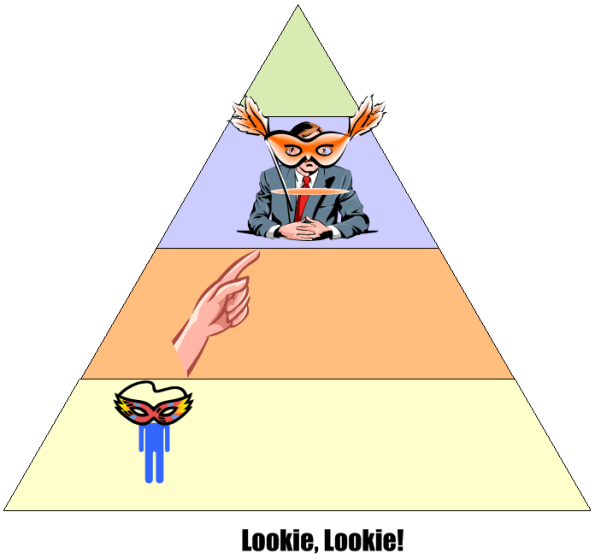
I think the main reason why people try to feign expertise is because they are stuck working in archaic corpo CCHs (Command & Control Hierarchies). All CCH orgs unquestioningly assume that everyone within the pyramid walls is supremely competent, regardless of whether they are or not. In a CCH, anyone who dares to persistently point out “ability” problems is excommunicated, regardless of how much evidence is presented to prove the case so that a beneficial change can be made. Heaven forbid the case where a lower level masked associate points to the huge masks being worn by one or more of the obviously infallible managers entrenched in an upper echelon. Retribution is swift and unambiguous.
Forgive Me

If you have read many of my posts, you may have formed the opinion that I’m rabidly against bozo managers who are members of a hierarchically structured organization. That’s not quite right. I’m not against them as individual persons. I’m against the behaviors that they are compelled to manifest and the decisions that they have to make because of the archaic structure that they are an integral part of. It doesn’t matter who the particular individuals are in a command & control hierarchy. Unless they are enlightened (and very few are), they will auto-behave in ways that are detrimental in the long term to customers, owners, and employees. Not detrimental to themselves and their brethren, of course.
A colleague who dogmatically worships at the alter of corpo-man recently told me that I was jealous of hierarchs. He said that I wanted to be “just like them”. Hmmm, interesting opinion, no? Since nothing is impossible, I guess that could be true. Deep down I just may be an imposter and a fraud 🙂 . In Thorstein Veblen‘s “theory of the leisure class“, he proposes that the middle class in “developed” countries doesn’t hold hierarchs accountable for the havoc they wreak because the middle class wants to be “just like them”.
I’ve often thought of what I would do if I was offered to be knighted by a hierarchical corpo king. Whenever I think of that possibility, it reminds me of the Galileo and Pope Urban story. Galileo, as you probably know, subscribed to the Copernican theory that the earth was NOT the center of the universe. In the all powerful eyes of the hierarchical church and its rabid followers, any such thinking was sacrilegious blasphemy – curiosity was a sin. Before Urban was given the papal throne, he was a friend of Galileo’s. Urban was intrigued by Galileo’s logic and compelling evidence that the earth revolved around the sun. Bingo, as soon as he became pope, Urban instantaneously flipped into a corpo droid incapable of independent thought. He gave Galileo a tour of the torture chambers and placed him under house arrest for the last years of his life. Uh, so much for friendship.
Ironically, in a standard command and control corpo hierarchy, the only way anyone has any chance of changing things for the better is if he/she secures a corpo title from the sitting politburo. Since I think I could possibly make a positive difference, I’d actually be tempted to take on an institutional title and become a corpo man. Alas, I don’t think I’d do it because I don’t have the psychological strength to withstand the corpo peer pressure to flip – just like pope Urban didn’t have. Bummer 😦
Clanthink, Groupthink, Spreadthink
Everyone has heard of the term “groupthink“. However, have you ever heard of the terms “clanthink” or “spreadthink” applied to a group of people? John Warfield, a prolific systems thinker who’s been ignored for decades by the mainstream, defines these three types of psychological phenomena as follows:
Clanthink = Everyone in the group believes in the idea/concept, but it’s outright wrong. Those outside of the group that don’t believe the idea/concept are ostracized, tortured, killed……. or all of the above.
Groupthink = Everyone believes in the idea/concept, but tantalizingly, it could be either wrong or right. If the group is wrong and all of the the individuals outside of the groupthink circle of membership remain steadfastly silent out of fear of persecution, then the group, and those that that they lead, all suffer.
Spreadthink = Everyone in the group places a different level of importance and meaning on the idea/concept.
Classic clanthink examples are: 1) the massive group of flat-earthers back in Columbus’ time; 2) the church-brainwashed, sun-revolves-around-the-earth-because-humans-are-the-center-of-the-universe gang back in the Galileo era. Can you think of others, besides whack jobs like: Hitler’s inner circle, Enron executives, George W. Bush WMD disciples, the Moonies, scientologists?
Groupthink is a weaker, but much more common form of clanthink. The cult size is much smaller, but there are many more groupthink groups than clanthink groups, especially in the business domain. Just about every organization in the world is infected with groupthink to some extent because they are hierarchically structured. Hierarchically structured pyramids of rank, privilege, and I’m-smarter-than-you step-ladder-idiots are especially rife with the stank of groupthink. The higher up you go, the more groupthinkage there is. Why? Because (almost) everyone wants to get to the head shed in order to acquire the material riches and titles that hierarchs sprinkle upon themselves. Thus, the exclusive club members: 1) unconsciously accept whatever idea/concept/method the next hierarch above them espouses, 2) kiss ass, and 3) say “yes massa” in order to facilitate their next step up the gold plated ladder of privilege.
In my mind, spreadthink is the most interesting concept in Warfield’s trio. Each person is, duhhhh, an individual. Thus, each person will naturally have an internally created, different opinion on any given issue. In environments that facilitate/enable/catalyze the public externalization of each individual person’s true thoughts and opinions, spreadthink will naturally emerge. In such a situation, assuming that the group has an a-priori agreement on how to make and execute a decision, the “best” course of action may be achieved. Hierarchies, by the physical and meta-physical shackles that the pyramidal structural pattern imposes on their members, are anathema to the diversity of spreadthink. Bummer, cuz the corpo pyramid, an unnatural structure of human creation, hubris, and self-aggrandizement, isn’t gonna go away soon.
Hierarchy will never go away. Never. – Tom Peters
Reconfiguration
Understandably, companies that achieve success in a business area strive to maintain the behaviors that got them there. However, as they work to continuously stabilize themselves, the external world keeps changing around them. Sometimes the change is gradual, and other times it’s instantaneous and explosive. Regardless of the rate and magnitude of change, if the company does not adapt to the new external situation, they’re hosed.
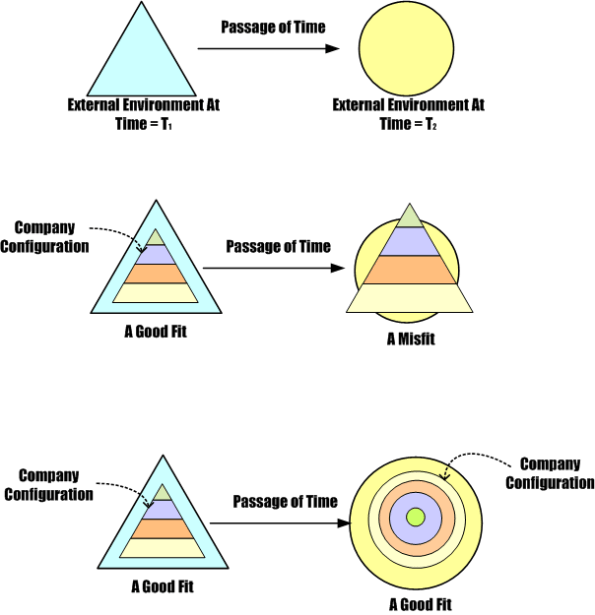
“When you’re through changing, you’re through.” – Bruce Barton
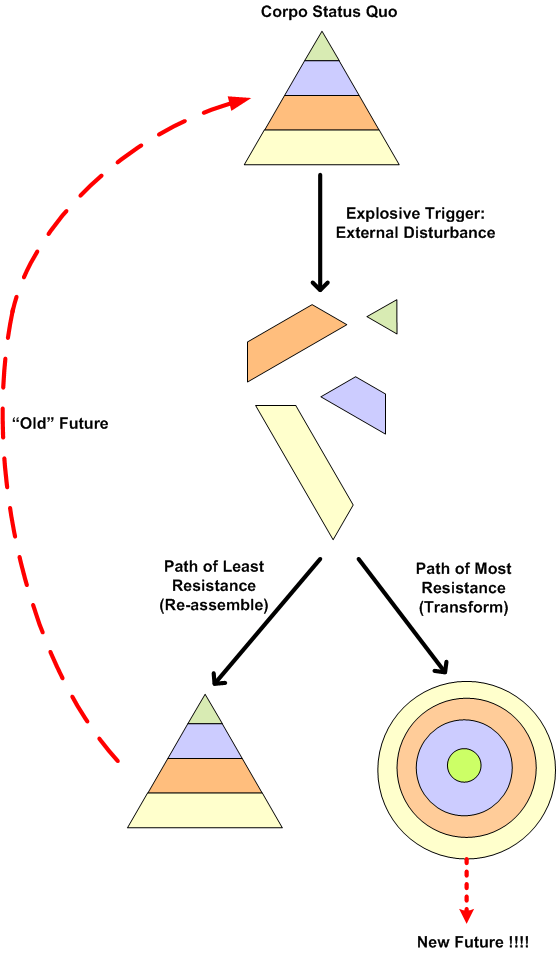
“Without deviation from the norm, progress is not possible.” – Frank Zappa
One Level Removed
Assume that you’re on the third level or higher in a hierarchical corporate (dis)organization. If you want to know what’s really going on so that you can take action to keep improving the org’s performance, ask the people below you, one level removed. Do it frequently, and do it periodically. If you have lots of people that indirectly report to you two levels down, you could listen to their inputs in small groups or, even better, randomly pick a different person every week to listen to.
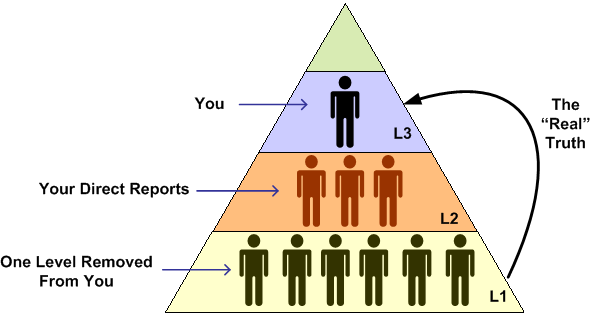
Why should you do this? Since you hand-picked your direct reports and you directly control their salaries, they’ll naturally tend to distort the truth if it makes them or you look bad. You’ll tend to unquestioningly believe them just so you can continue to feel warm and fuzzy inside. If you don’t have a machismo culture of fear that hierarchical structures auto-instill into the lower segments of the org, then at least some of the courageous people two levels down will tell you the truth as they see it. Otherwise, they won’t tell you anything of substance, so don’t waste your time trying to find out the true state of things.
Why don’t most managers frequently survey those people one level removed? Because as one rises up the corpo ladder: they usually get lazier, they get disconnected from the real work that creates and sustains value, and their head expands. Bummer.
“The day soldiers stop bringing you their problems is the day you have stopped leading them. They have either lost confidence that you can help or concluded that you don’t care. Either case is a failure of leadership.” – Karl Popper

Why am I here?
WTF?
Meh!
D'oh!

My BTC Address



 Bulldozer00's Blog