Archive
Guilt And Coercion
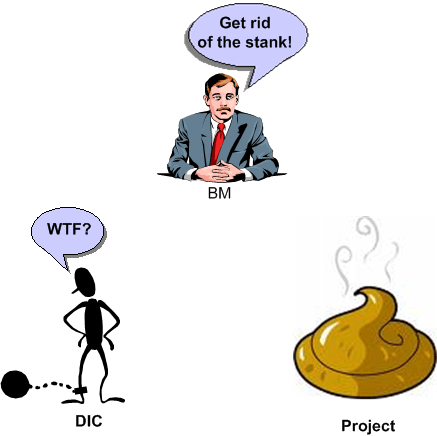
In a classic CCH (Command and Control Hierarchy), the only two tools of motivation known to BMs (Bozo Managers) for getting people to sign up for no-win projects are Guilt and Coercion. Bad CCH BMs use both, and really bad BMs with a sweatshop mentality use coercion exclusively. Attempts to instill guilt are often prefaced with “Don’t you wannabe a team player?” or “It’s very important for the company”. A classic coercive one-liner is “Do this project or else!”
So, why don’t many smart DICs (Dweebs In the Cellar) step up and volunteer to lead tough projects? One reason is because smart DICs know that the toxic, fragmented, and stifling environment (created and nurtured by the very same BMs who are coercing and inflicting guilt) guarantees failure. Another reason is because textbook CCHs are bureaucracies and not meritocracies – regardless of what they espouse. Thus, all work is treated the same and everyone gets the same 3% raise no matter how hard they work or how much they neglect their own lives to “get the job done” . Can you think of other reasons?
Standard CCH Blueprint
The figure below is a “bent” UML (Unified Modeling Language) class diagram of a standard corpo CCH (Command and Control Hierarchy). Association connectors were left off because the diagram would be a mess and the only really important relationships are the adjacent step-by-step vertical connections. Each box represents a “classifier”, which is a blueprint for stamping out objects that behave according to the classifier blueprint. The top compartment contains the classifier name, the second compartment contains its attributes, and the third compartment houses the classifier’s behaviors. Except for the DIC Product Development Team, the attributes of all other classifiers were elided away because the intent was to focus on the standard cookie-cutter behaviors of each object in the “system”. Of course, the org you work for is not an instantiation of this system, right?

Initiative Initiation
Assume that the graph below describes the rise and fall of a hypothetical CCH (Command and Control Hierarchical) business. During the party time phase of increasing profits (whoo hoo!), the CCH corpocrats in charge pat themselves on the back, stuff their pockets, and slowly inflate their heads with bravado and delusions of infallibility.
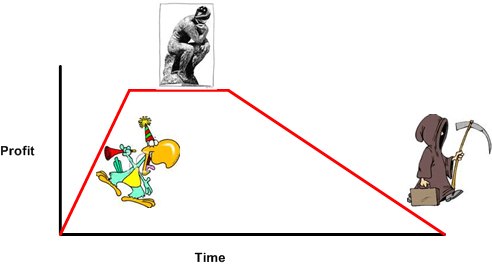
In order to extend the increasing profit trajectory, an undetectable status quo preserving mindset slowly but surely kicks in. Hell, if it ain’t broke, don’t touch the damn thang. Since what the CCH (so-called) leadership is doing is working, any individual or group from within or without the cathedral walls who tries to deviate significantly from the norm is swiftly “dealt with” by the corpocrats in charge. Everthing needs to get approved by a gauntlet of “important” people. However, while the shackles are being tightened and the ability to scale for success is being snuffed, the external environment keeps changing relentlessly in accordance with the second law of thermodynamics. Profit starts eroding and tension starts ratcheting upwards. Out of fear of annihilation, the cuffs are tightened further and the death dive has begun. Bummer.
During the free fall to obscurity, the now brain-dead and immobile corpocrats in charge start “taking aggressive action” to stem the flow of red ink. Platitudes and Matt Foley-like motivational speeches are foisted upon the DICs (Dweebs In the Cellar) in frantic attempts to self-medicate away the pain of stasis and failure. Initiatives with cute and inspiring names are started but never finished (because it takes real hands-on leadership, sweat, and work to follow through). As corposclerosis accelerates, silver-bullet-bearing consultants are brought in and the frequency of initiative initiation increases. Calls for accountability of “them” pervade the corpocracy from the top down and vice versa.
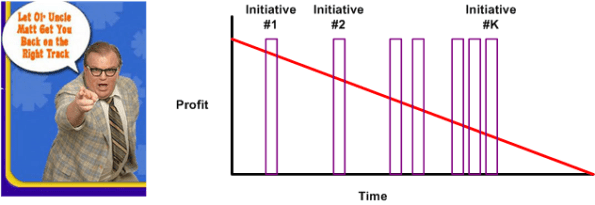
After being hammered by pleas to “improve performance” and being pounded by the endless tsunamis of hollow initiatives, the DICs disconnect and distance themselves from the lunacy being doled out by the omnipotent dudes in the politboro. Since the DICs expect the corpocrats to effect the “turnaround” and the corpocrats expect the DICs to strap on their Nikes and “just do it”, no one takes ownership and nothing of substance changes. As you might surmise, it’s a Shakespearian tragedy with no happy ending. Bummer squared.
Leaderless CCHs deserve what they get; a fearful, disconnected workforce and a roller coaster ride to oblivion.
Gift Wrap
In dysfunctional corpocracies, it’s not only acceptable, but it’s expected that STSJs (Status Takers and Schedule Jockeys) will routinely drop turd-bombs on DICs (Dweebs In the Cellar) when schedules, no matter how far off the mark they are, are not met.
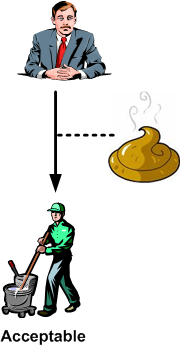
However, it’s socially unacceptable for a DIC to hurl a turd-coil skyward toward an STSJ. Nevertheless, if a DIC has been trained to “communicate effectively” and is clever and skillful enough, a gift-wrapped turd-ball may be accepted “temporarily” by an STSJ – until he/she opens the box. Thus, the best course of action for DICS “privileged” enough to work in a one way command and control hierarchy is to flush turd-bombs down the toilet when they are discovered. Whoosh!

Particular Individuals Don’t Matter
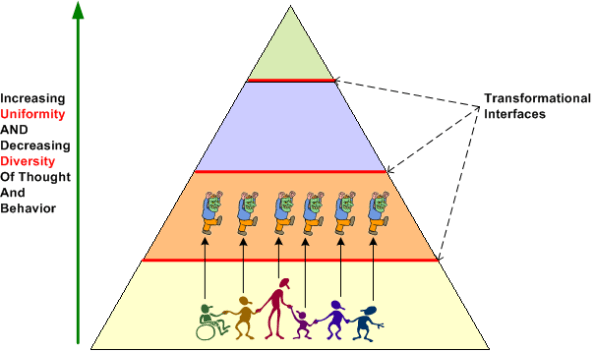
It doesn’t matter who the particular individuals in a corpocracy are. No matter how smart and well meaning they are, the awesome power of the pyramidal structure of woe to suppress their individuality and transform them into zombie clones tasked to guard the status-quo will prevail. How many of you have seen and experienced the ascension of smart, and formerly-effective, people into the ranks of the elite, only to be instantaneously transformed into ineffective druids?
Must Be An Outsider
One must be an outsider to escape being scalded for pointing out problems within a corpocracy. Unlike insiders (except for the obligatory, once a year, watered down employee survey), outsider opinions are actually solicited by the infallible hierarchs (who confidently and assuredly think they run the show). In addition, outsider pundits with “impeccable credentials” actually get paid for their analysis and recommendations! That’s why Weinberg’s “Secrets of Consulting” is in my reading queue.

Sadly, even if the situation on the left in the above diagram never happens in your org, DICs won’t stand up and expose turds that threaten the well being of the corpocracy because the image is dogmatically burned into their mind. There’s a reason why the story of the “emperor’s new clothes” is so funny and well known. The boy who pointed out his “highny”-ness’ s wardrobe malfunction was outside of the emperor’s kiss-ass court. Had he been an insider, it would have been “off with his head”.
Galileo And Kepler
To reinforce my anti-corpocracy UCB (Unshakeable Cognitive Burden), I just finished reading “The Age Of Heretics: A History Of The Radical Thinkers Who Reinvented Corporate Management“. It’s the second time in the last few months that I stumbled across the Galileo-Pope Urban story. The first time was in W. L. Livingston’s forthcoming “Design For Prevention”. Here’s a snippet from “Heretics”:
Why does Galileo Galilei have the reputation of a heretic, while his seventeenth-century fellow scientist Johannes Kepler does not? Because Kepler evaded the Church. Galileo sought to change it. The professor from Pisa spent the last third of his life arguing, with increasing fervor, that the Christian doctrines and even Bibles should be rewritten to conform to the realities he had seen through his telescope. Many of the cardinals and Church officials who censured and imprisoned him recognized the validity of the new cosmology and physics that Galileo championed, but they didn’t want to shake up their system too quickly. Too many monks and village priests clung to Ptolemy and Aristotle. The “people” would rebel at any sudden revision of the “truth.” Galileo didn’t care. Like many other heretics, past and present, he thought at first that the truth would set the institution free. He only had to show people what he had seen, and they would naturally adapt. When people doubted observations that to him were obvious, he lost his tact. He made enemies (some said needlessly) of the Jesuits, who fought bitterly to see him condemned, and he closed one of his notorious tracts, the Dialogue on the Great World Systems, with a snide lampoon of the views of Pope Urban VIII. Until then Urban had been his patron and champion. Ten months after publication in 1633, Galileo was on trial in Rome.

Here’s a snippet that is written further along in the book:
Even the Roman Catholic church eventually admitted that Galileo’s cosmology was correct—after 359 years.

Bummer. Behind the illusory cloak of modern civility, irrational and insane institutional behavior hasn’t changed much over the years. Heretics are still reviled by the bozos in power who will do whatever it takes to retain that power, and more importantly, the personal riches that automatically go along with it. Today’s well meaning but unconscious corpocrats are simply much more clever at veiling the methods that they use to annihilate heretics, even when individual heretics arise from their own ranks. Kepler rules!
Status Takers And Schedule Jockeys

Whoo hoo! I’ve been promoted to “manager” by the Gods from above. I’m not a DIC (Dweeb In the Cellar) anymore. I’ve transitioned to the easy life of “taking status and riding the schedule”. Now I can shut down my brain because I don’t have to think or create anymore. I just have to walk around and: poll for status, look worried when people fall behind schedule, and “nicely” exert pressure on the team to perform. To top it all off, I got a big raise because of my “increase in responsibility”! Man, I love corpocracies and hieararchical gigs.
Disconnected DICs
Without continuous, sincere, hard work from the leadership in a CCH (Command and Control Hierarchy) structure of human organization, it is all but guaranteed that the communication gap size between adjacent layers will exponentially increase when one traverses from the top level down to the bottom level.
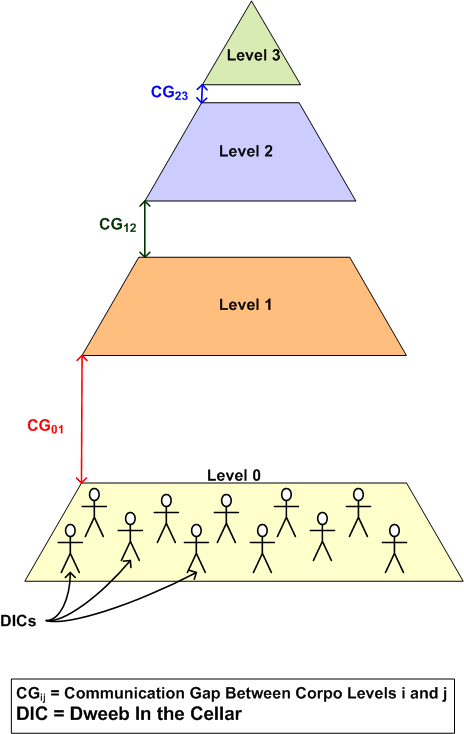
The communication gap between two non-adjacent levels is even wider, culminating with a gap size of infinity between the DICs at Level=0 and the corpo hierarchs at Level=MAX. Bummer.
Distributed Vs. Centralized Control
The figure below models two different configurations of a globally controlled, purposeful system of components. In the top half of the figure, the system controller keeps the producers aligned with the goal of producing high quality value stream outputs by periodically sampling status and issuing individualized, producer-specific, commands. This type of system configuration may work fine as long as:
- the producer status reports are truthful
- the controller understands what the status reports mean so that effective command guidance can be issued when problems manifest.
If the producer status reports aren’t truthful (politics, culture of fear, etc.), then the command guidance issued by the controller will not be effective. If the controller is clueless, then it doesn’t matter if the status reports are truthful. The system will become “hosed”, because the inevitable production problems that arise over time won’t get solved. As you might guess, when the status reports aren’t truthful and the controller is clueless, all is lost. Bummer.

The system configuration in the bottom half of the figure is designed to implement the “trust but verify” policy. In this design, the global controller directly receives samples of the value streams in addition to the producer status reports. The integration of value stream samples to the information cache available to the controller takes care of the “untruthful status report” risk. Again, if the controller is clueless, the system will get hosed. In fact, there is no system configuration that will work when the controller is incompetent.
How many system controllers do you know that actually sample and evaluate value stream outputs? For those that don’t, why do you think they don’t?
The system design below says “syonara dude” to the global omnipotent and omniscient controller. Each producer cell has its own local, closely coupled, and knowledgeable controller. Each local controller has a much smaller scope and workload than the previous two monolithic global controller designs. In addition, a single clueless local controller may be compensated for if the collective controller group has put into place a well defined, fair, and transparent set of criteria for replacement.

What types of systems does your organization have in place? Centrally controlled types, distributed control types, a mixture of both, hybrids? Which ones work well? How do you see yourself in your org? Are you a producer, a local controller, both a local controller and a producer, an overconfident global controller, a narcissistic controller of global controllers, a supreme controller of controllers who control other controllers who control yet other controllers? Do you sample and evaluate the value stream?

Why am I here?
WTF?
Meh!
D'oh!

My BTC Address



 Bulldozer00's Blog