Archive
Regardless Of Agile Or Waterfall
The figure below depicts an architectural view of a real-time embedded sub-system that I and a team of 8 others built and delivered 10 (freakin!) years ago. At revision number 9, the diagram ended up being the final “as-built” model of the 20,000+ lines-of-code system. Since the software was written in C and, thus, not object-oriented, I chose not to use UML to capture the design at the time. Doing so would have introduced an impedance mismatch and a large intellectual gap of misunderstanding between the procedural C code base and the OO design artifacts. I used structured analysis and functional decomposition to concoct the design and I employed “pseudo” Data Flow Diagrams (DFD) instead.
At the beginning of this “waterfall” project, I created revision 0 of the diagram as the first “build-to” snapshot. Of course, as learning accrued and the system evolved throughout development, I diligently kept the diagram updated and synchronized with the code base in true PAYGO fashion.
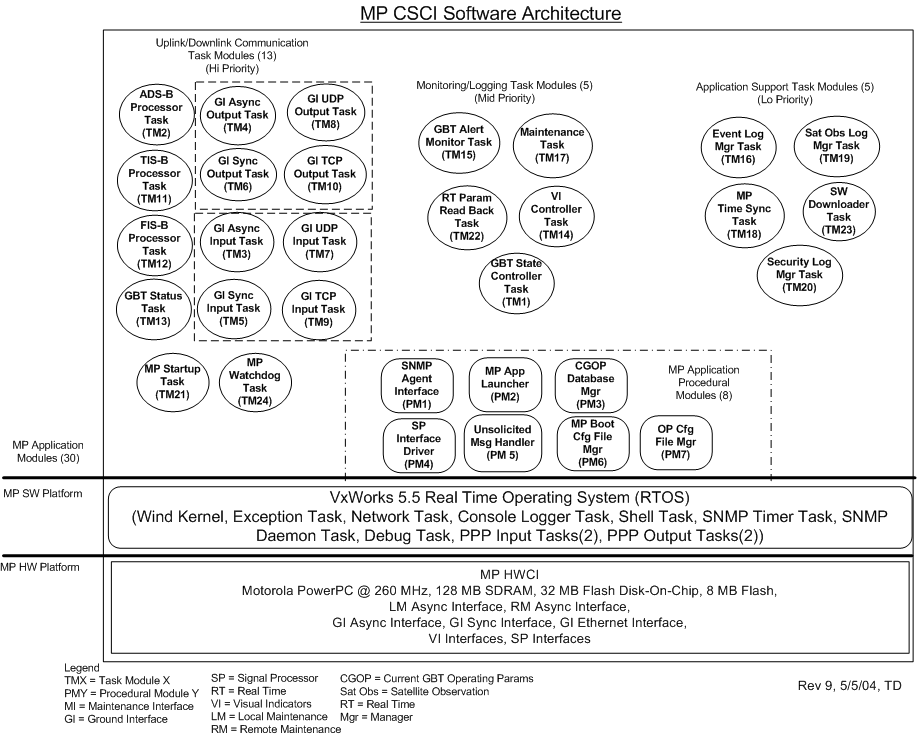
As you can see from the picture, the system of 30+ asynchronous application tasks ran under the tutelage of the industrial-strength VxWorks Real Time Operating System (RTOS). Asynchronous inter-task communication was performed via message passing through a series of lock-protected queues. The embedded physical board was powered by a Motorola PowerPC CPU (remember those dinosaurs?). The board housed a myriad of serial and ethernet interface ports for communication to other external sub-systems.
The above diagram was not the sole artifact that I used to record the design. It was simply the highest level, catch-all, overview of the system. I also developed a complementary set of lower level functional diagrams; each of which captured a sliced view of an end-to-end strand of critical functionality. One of these diagrams, the “Uplink/Downlink Processing View“, is shown below. Note that the final “as-built” diagram settled out as revision number 5.

The purpose of this post was simply to give you a taste of how I typically design and evolve a non-trivial software-intensive system that I can’t entirely keep in my head. I use the same PAYGO process for all of my efforts regardless of whether the project is being managed as an agile or waterfall endeavor. To me, project process is way over-emphasized and overblown. “Business Value” creation ultimately distills down to architecture, design, coding, and testing at all levels of abstraction.
Trivial Trivia
I was going through some old project stuff and stumbled upon the chart below. I developed it back when I was the software lead of a nine person sub-team on an embedded system product development effort:

Putting all those indecipherable acronyms adorning the chart aside, note that the project was performed in 2004 – a mere 3 years after the famous “Agile Manifesto” was hatched. I can’t remember if I knew about (or read) the manifesto at the time, but I do know that Tom Gilb’s “Evo“ and Barry Boehm’s “Spiral“ processes had radically changed my worldview of software development. Specifically, the (now-obvious) concept of incremental development and delivery rang my bell as the best way to mitigate risk on challenging, software-intensive, projects.
As the chart illustrates, the actual hand-off of each of the seven builds (to the system integration test team) was pretty much dead nuts right on target. Despite the fact that the project front end (requirements definition and software design) was managed as a “waterfall” endeavor, the targets were met. Thus, I’m led to believe the following trivial trivia:
Not all agile projects succeed and not all waterfall projects fail.

Why am I here?
WTF?
Meh!
D'oh!

My BTC Address



 Bulldozer00's Blog