Archive
From Wanted To Unwanted
You can have a product without a business, but you can’t have a business without a product. If you build a product that people want, a business will be born either from your loins or from some copycat’s. There’s no chicken and egg dilemma here. It’s simply, product-first and business-second. Ka-ching!
But wait, that’s not all! Let’s say you do get lucky and start a biniss around a “wanted” product that you built. To sustain your business, you gotta sustain your product. That means continuously maintaining it via the addition of new value-added features and the correction of customer-annoying defects.
Upon observing the deterioration of his original ArsDigita product under the so-called leadership of “new management”, Philip Greenspun said:
Once you have a product that nobody wants, it doesn’t matter how good your management team is. – Phil Greenspun (Founders At Work, Jessica Livingston)
So, how does a “wanted” product morph into an “unwanted” product? Via neglect and indifference. That’s what happened to Phil’s baby when the vulture capitalists he hooked up with installed an incompetent “professional management team” to run ArsDigita (into the ground). By focusing on the superficial instead of the substance, the promotion instead of the maintenance, the company’s product, and then the company itself, went down hill fast:
ArsDigita grew out of the software that Greenspun wrote for managing photo.net, a popular photography site. He released the software under an open source license and was soon deluged by requests from big companies for custom features. He and some friends founded ArsDigita in 1997 to take on such consulting projects. In 2000, ArsDigita took $38 million from venture capitalists. Within weeks of the deal closing, conflict arose between the new investors and the founders. They marginalized and then fired most of the founders, who responded by retaking control of the company using a loophole the VCs had overlooked. The legal battle culminated in Greenspun’s being bought out, and a few months later the company crashed. ArsDigita was dissolved in 2002. – (Founders At Work, Jessica Livingston)

All My Children
When rearranging the chairs within their stratified and siloed command and control hierarchies fails (and it almost always fails) to improve performance, mechanistically thinking patriarchs often resort to the ubiquitous centralize/decentralize cycle. However, the c/d cycle is also a stone cold loser for improving performance because all it does is spawn mini command and control patriarchies – just like daddy’s. The mindsets of daddy and his sons don’t change, so neither does performance – duh! But hey, at least there’s a lot of action taking place and it looks impressive to outsiders – til the duplication of work and resources is realized and the move back to centralization takes place.

Plan, Plan, Plan…. Blah, Blah, Blah.
Preface
People followed Martin Luther King of their own free will because he had a dream, not a plan. – Simon Sinek
On the other hand, know-it-all business school trained weenies will profess (in a patriachical and condescending tone):
Failing to plan is planning to fail – Unknown
Irrelevant Intro
When I started this relatively loooong blarticle, I had no freakin’ idea where it would go but I followed where it led me. Led by the unknown into the unknown – it was the keystone cops leading the three (nyuk nyuk nyuk) stooges (whoo, whoo, whoo, boink, plunk, pssst!).
As usual, I didn’t have a meticulously well formed plan for this time-waster ( <- for you, heh, heh) in my fallible cranium and I made many mid-course corrections as I crab-walked like a drunken sailor toward the finish line. Hell, I didn’t even know where the freakin’ finish line was. I stopped iteratively writing/drawing when I subjectively concluded that….. tada, “I’ve arrived!”. Such is the nature of exploration, discovery, and exposition, no? If you disagree, why?
Pristine Profile – Full Steam Ahead!
The figure below shows the shape of a pristine, planned, cost vs time profile at “project start” for a long term, resource-intensive, project to do something “big and grand for the world”. Some one or some group has consulted their crystal ball and concocted a cost vs schedule curve based on vague, subjective criteria, and bolstered by a set of ridiculously optimistic assumptions and a bogus risk register “required for signoff“. To coverup the impending calamity, the schedule has been enunciated to the troops as “aggressive“. BTW, have you ever heard of a non-aggressively scheduled big project?

It’s interesting to note that the dudes/dudettes who “craft” cost profiles for big quagmire projects are never the ones who’ll roll up their sleeves, get dirty, and actually do the downstream work. Even if the esteemed planners are smart enough to actually humbly ask for estimates from those who will do the work, they automatically chop them down to size based on whim, fancy, and political correctness. <- LOL!
Typical Profile – Bummer
The figure below shows (in hindsight) the actual vs planned cost curve for a hypothetical “bummer” project. The project started out overestimated (yes, I actually said overestimated), and then, as the cost encroached into uncomfortable territory, the plan became, uh, optimistic. Since it was underestimated for “political reasons” (what other reason is there?), but no one had a clue as to whether the plan was sane, no acknowledgement of the mistake was made during the entire execution and no replanning was done. The loss accumulated and accumulated until end game – whatever that means.

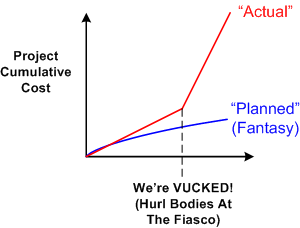
Crisis Profile – We’re Vucked!
The figure below shows (in hindsight) the actual vs planned cost curve for a hypothetical “vucked” project. Cost-wise, the project started out OK, but because it was discovered that technical progress wasn’t really, uh, technical progress, bodies were thrown onto the bonfire. Again, the financial loss accumulated and accumulated until end game – whatever that means.
Replan Profile – Fantasy Revisited
The figure below shows (in hindsight) the actual vs planned cost curve for a hypothetical “fantasy revisited” project. Cost-wise, the project started out OK (snore, snore, Zzzzz), but because it was discovered that technical progress wasn’t really, uh, technical progress, bodies were thrown on the bonfire. But his time, someone with a conscience actually fessed up (yeah, some people are like that, believe it or not) and the project was replanned in real-time, during execution. Alas, this is not Hollywood and the financial loss accumulated and accumulated until end game – whatever that means.

Iterative, Incremental Profile – No Freakin’ Way
Alright, alright. As everyone knows, and this especially includes you, it’s easy to rag about everyone and everything – “everything sux and everyone’s an a-hole; blah, blah, blah…. aargh!”. What about an alternative, Mr. Smarty Pants? Even though I have no idea if it’ll work, try this one on for size (and it’s definitely not original).
The figure below shows (in hindsight) the actual vs planned cost curve for a hypothetical “no freakin’ way” project. But wait a minute, you cry. There’s only one curve! Shouldn’t there be two curves you freakin’ bozeltine? There’s only one because the actual IS the planned. This can be the case because if the planning increments are small enough, they can almost equate to the actual expenditures. At each release and re-evaluation point, the real thing, which is the product or service that is being provided (product and service are unknown concepts to bureaucrats and executive fatheads), is both objectively and subjectively evaluated by the people who will be using the damn thing in the future. If they say “This thing sux!”, its fini, kaput, end game before scheduled end game. If they say “Good job so far! I can envision this thing helping me do my job better with a few tweaks and these added features”, then it’s onward. The chances are high that with this type of rapid and dynamic learning SCRBF system in place, projects that should be killed will be killed, and projects that should continue will continue. Agree, or disagree? What say you?

This hypothetical project is called “No Freakin’ Way” because there is “no freakin’ way” that the system of co-dependent failure designed and kept in place by hierarchs in both contractor and contractee institutions will ever embrace it. What do you think?
Wealth And Effort
Any form of “ism” can work if it creates and sustains a large middle class that feels it can make it to the top of the pyramid of privilege by the fruits of their own labor. As soon as the bubble bursts and the middle class feels that the rich keep getting richer without any effort and the poor keep getting poorer regardless of effort, all is lost and a revolution is in the offing. Sure, a powerful police force may temporarily stave off the revolution, but not forever. Over time, the innate human desire for liberty trumps oppression like water dissolves rock.

In the USA, democracy and the right of every person to vote has worked pretty well to stave off the destruction of the middle class. However, when rich elites gain publicly invisible control over all political parties and force the government to allow them to operate unfettered without any oversight, the result is extreme capitalism and the potential fall of the middle class. I don’t know if it’s happening in America, but it sure seems like it. When big fat corpo bureaucracies demand and get capitalism on the way up and socialism (bailouts) on the way down, there’s no risk of consequences to their behavior and they have no reason to change their middle class busting ways. “Too big to fail” and “too little to succeed” sux for the middle class. Let them eat cake.
Failure, Failure, Failure
There are tons of experts, articles, books, and references on the ephemeral topic of “change”. Over the years, I’ve read my fair share of books on change and one of the best that I’ve stumbled upon (so far) is “It Starts with One: Changing Individuals Changes Organizations“. Authors Black and Gregersen assert that the 3 major brain barriers to organizational change are:
- The failure to see
- The failure to move
- The failure to finish
The book is targeted at leaders who’ve “seen” that major change is needed and who feel compelled to move their orgs into the future. It provides a boatload of examples and solid, pragmatic advice on how leaders can help the DICforce see, move, and follow through on cross cutting change initiatives.
Black and Gregersen should follow up their nice work with a book on a more pervasive problem; the failure of corpo leaders to “see” the need for change in themselves. The sequel would advise the boatloads of leaders in this category to get off their duffs and continuously probe, sense, and decide what changes are needed for their orgs to remain viable in a fast changing and hostile external business environment.
At a certain age institutional minds close up; they live on their intellectual fat. – William Lyon Phelps
Bad leaders fail to “see” the need for change until a crisis jolts them into reality. That’s because the dudes in the head shed get comfortable with past successes and feel no sense of urgency to change anything – regardless of what they say. To paraphrase Carolyn Wells; ” actions, or a lack thereof, lie louder than words“.

Committee Performance Metrics
A favorite and frequent activity undertaken by corpocrats everywhere is the formation of committees and special task forces to “aggressively” tackle and solve pressing org problems that are negatively affecting the performance of the corpocracy’s DICforce. The typical cycle of events is as follows:
- 1) The committee of elites is formed to “help” the DICforce do their jobs better.
- 2) After: a) several months of meetings with half-assed attendance, b) infinite BS sessions where nothin’ of substance is produced or propagated downward, c) there’s no detectable performance improvement from those dwelling in the cellar, and d) gobs of money have been consumed, the committee sponsor (a.k.a. the money supplier) asks for measures of performance to judge whether his/her investment is paying off.
- 3) The committee conjures up some BS “camouflage” metrics that feign problem solving prowess and progress (see the figure below for examples).
- 4) The sponsor buys into the BS set of metrics and the resource drain continues.
- 5) Go to step 2).
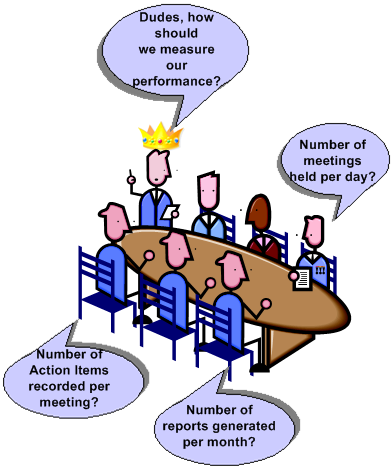
You’d think that a meaningful metric could be obtained by periodically polling the people that the elite committee is supposed to be helping – the DICforce. Do you think many committees, councils, task forces, centers of excellence, yada-yada-yada, do this? If not, why do you think that is the case?
A Flurry Of Activity
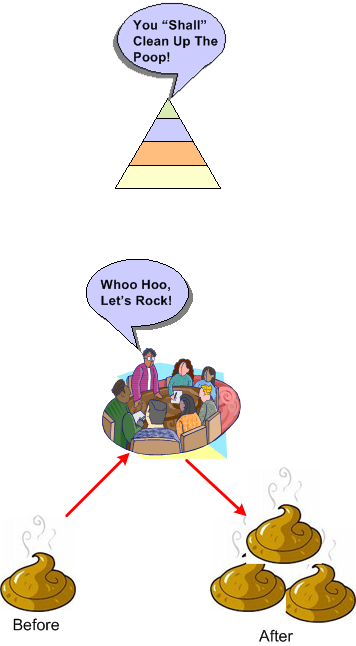
It’s always fun to watch the initial stages of euphoria emerge and then disappear when a corpo-wide initiative that’s intended to improve performance is attempted. The anointed “design” team, which is almost always filled exclusively with managers and overhead personnel who conveniently won’t have to implement the behavioral changes that they poop out of the initiative themselves, starts out full of energy and bright ideas on how to solve the performance problem. After the kickoff, a resource-burning flurry of activity ensues, with meeting after meeting, discussion after discussion, and action item after action item being tossed left and right. When the money’s gone, the time’s gone, and the smoke clears, business returns to the same old, same old.
As a hypothetical example, assume that an initiative to institute a metrics program throughout the org has been mandated from the heavens. At best, after spending a ton of money and time working on the issue, the anointed design team generates a long list of complicated metrics that “someone else” is required to collect, analyze, and act upon. The team then declares victory and self-congratulatory pats on the back abound. At worst, the team debates the issue for a few meetings, conveniently forgets it, and then moves on to some other initiative – hoping that no one notices the useless camouflage that they left in their wake. Bummer.
Initiative Initiation
Assume that the graph below describes the rise and fall of a hypothetical CCH (Command and Control Hierarchical) business. During the party time phase of increasing profits (whoo hoo!), the CCH corpocrats in charge pat themselves on the back, stuff their pockets, and slowly inflate their heads with bravado and delusions of infallibility.
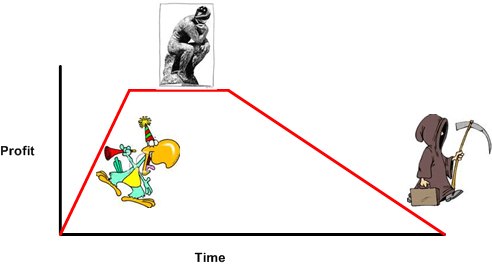
In order to extend the increasing profit trajectory, an undetectable status quo preserving mindset slowly but surely kicks in. Hell, if it ain’t broke, don’t touch the damn thang. Since what the CCH (so-called) leadership is doing is working, any individual or group from within or without the cathedral walls who tries to deviate significantly from the norm is swiftly “dealt with” by the corpocrats in charge. Everthing needs to get approved by a gauntlet of “important” people. However, while the shackles are being tightened and the ability to scale for success is being snuffed, the external environment keeps changing relentlessly in accordance with the second law of thermodynamics. Profit starts eroding and tension starts ratcheting upwards. Out of fear of annihilation, the cuffs are tightened further and the death dive has begun. Bummer.
During the free fall to obscurity, the now brain-dead and immobile corpocrats in charge start “taking aggressive action” to stem the flow of red ink. Platitudes and Matt Foley-like motivational speeches are foisted upon the DICs (Dweebs In the Cellar) in frantic attempts to self-medicate away the pain of stasis and failure. Initiatives with cute and inspiring names are started but never finished (because it takes real hands-on leadership, sweat, and work to follow through). As corposclerosis accelerates, silver-bullet-bearing consultants are brought in and the frequency of initiative initiation increases. Calls for accountability of “them” pervade the corpocracy from the top down and vice versa.
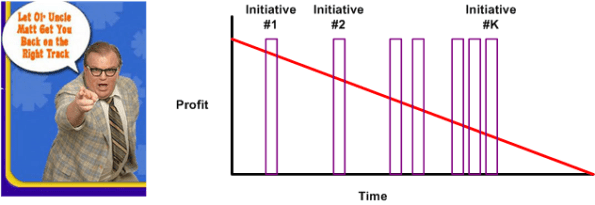
After being hammered by pleas to “improve performance” and being pounded by the endless tsunamis of hollow initiatives, the DICs disconnect and distance themselves from the lunacy being doled out by the omnipotent dudes in the politboro. Since the DICs expect the corpocrats to effect the “turnaround” and the corpocrats expect the DICs to strap on their Nikes and “just do it”, no one takes ownership and nothing of substance changes. As you might surmise, it’s a Shakespearian tragedy with no happy ending. Bummer squared.
Leaderless CCHs deserve what they get; a fearful, disconnected workforce and a roller coaster ride to oblivion.
A Professional Failure
I’m a professional failure. Why? Because I’m pretty sure that I’ve never satisfied any unreasonable schedule that I was ever “given” to meet. Since almost all schedules are unreasonable, then, by definition, I’m a professional failure. Hell, it didn’t even matter if I was the one who created the unreasonable schedule in the first place, I’ve failed. Bummer.

Looking back, I think that I’ve figured out why I underperformed (<– that’s management-speak for “failed”). It’s simply that the problem solving projects that I’ve worked on have been grossly underestimated. Why is that? Because they all required learning something new and acquiring new knowledge in the problem area of pecuniary interest.
So, how can you know if a given schedule is unreasonable, and does it matter if you conclude that meeting the schedule is a lost cause? You most likely can’t, and no, it doesn’t matter. Assume that, based on personal experience and a deep “knowing” of what’s involved in a project, you actually can determine that the schedule is a laughable, but innocent, lie. There’s nothing you can do about it. If you speak up, at best, you’ll be ignored. At worst, you’ll receive multiple peek-a-boo visits from one or more STSJs (Status Taker and Schedule Jockey) who don’t have to do any of the project work themselves.
How about you, have you been a perpetual failure like me? Of course not. Your resume says here that you have been 100% successful on every project you’ve worked on; and that implies that you’ve met every schedule. But wait, every other resume in my stack says the same thing. Damn! How am I gonna decide among all of these perfect people who gets the job?
Evasion And Abdication
One way to evade or abdicate responsibility is to never write anything down. Writing something down is a form of commitment because other people can see what you wrote, and archive it, and use it to hold you accountable.
“The palest of ink is better than the best memory.” – Chinese proverb
As a rule, managers don’t write down what they’ve signed up to do because they don’t “do” anything of substance. Of course, everyone in a standard cookie-cutter corpo hierarchy unquestioningly accepts that it’s “not a manager’s job” to do or commit to anything. Managers do, however, insist that others write things down because without the written word a manager can’t periodically poll for status and hold others accountable when schedules are missed.
On the other hand, really bad managers love to conjure up and write down what work others are required to do and when that work is due (even when they don’t have a klue what the work is). It’s the best of both worlds because they can hold others accountable without having to be held accountable themselves (whoopee!).
Even if managers are held accountable for poor team performance by higher up meta-managers (who also don’t write down their non-existent commitments), they don’t experience a guilty conscience because they fall back on the “the team failed and not me because it’s not my job” mentality.
When was the last time your immediate manager asked you “what problems are you having and how can I help?” or told you “let me know when you run into a problem so that I can try my best to help you“?

Disclaimer: I don’t have any badges or credentials and I just make things up, so don’t believe a word I say.

Why am I here?
WTF?
Meh!
D'oh!

My BTC Address



 Bulldozer00's Blog