Archive
Stirred, And Then Unstirred
When a cock-eyed idea for a blog post appears in my discombobulated mind, I sometimes write the post to completion and promptly place it in the publication queue. At other times, I simply toss a link, some sentences, and/or a quick picture on the page and store it away for future elaboration in my “drafts” folder. As a result, I have over 100 drafts stored in the underground catacombs of this site. The oldest one is dated back to 3/10/2009!

Every once in awhile, when I’m suffering from writer’s block, I browse through the drafts pile in reverse chronological order to select my next earth-shattering post. However, since for me writing is all about emotion (positive or, most likely negative), I often find myself chucking many drafts into the trash. For those drafts, the second time around is just a dispassionate “meh“.
Since all emotions naturally ebb and flow, it makes sense that what stirs me today may not stir me tomorrow – and vice versa. But that’s a wonderful thing because when emotions stop changing, life sucks the big ‘un. When I “successfully” force emotions to stay longer with me than nature meant them to stay with me, I tend to get myself into trouble. Does this apply to you too?
Crucial Skills: Choking Up
I’ve talked about the Vital Smarts dudes before, and they continue to impress. In this post, Crucial Skills: Choking Up, Vital Smarts principal Al Switzler gives some sound advice to a client regarding the phenomenon of unexpected and unwanted emotional seizure during a Crucial Conversation (CC).
When a conversation flips from”normal” to crucial, either or both participants will experience one or more of these symptoms:
1 Some people’s faces turn red.
2 Some people can feel their pulse—often in their temples.
3 Some people’s breathing changes—it speeds up, or lengthens.
4 People’s voices can increase or decrease in volume.
5 There may be churning in the gut or butterflies in the stomach.
In my case, numbers 3 and 4 rear their ugly heads when I find myself in the midst of an unexpected CC (how about you?). When the 3-4 duo instantaneously appears, I’ve learned to detect the change immediately. However, since I think “control” is overrated, over sought, and often an excuse to obscure truth, I often choose to let the truth, as I see it, fly via an unacceptable emotional rant 🙂 .
“Never apologize for showing feeling. When you do so, you apologize for the truth.” – Benjamin Disraeli
On the flip side, Al makes a lot of sense when he recommends switching over to proven CC skills upon detection of your changed physical state. When one succeeds at this, it defuses the situation and facilitates an exchange of understanding ‘tween the CC participants. First, he advises you to “step out of the content and rebuild safety” by calling a time out. Then, when the symptoms dissipate, re-enter the content and have a frank exchange of views. You do this by “starting with heart”, of course, to establish a collaborative and nurturing environment for progressing forward.
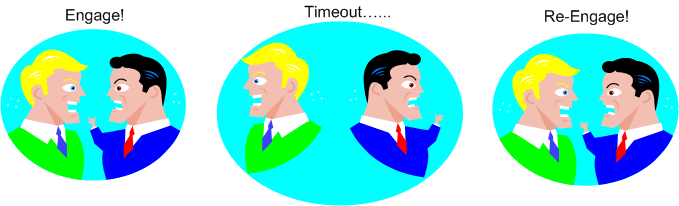
Emotional Messaging
I don’t know about you, but when I feel strongly about topic that I know pretty well, it’s difficult for me to talk about the topic without mixing emotional meaning together with the verbal content of what I’m trying to communicate. Is that a bad thing? In the standard business mindset of a bygone era, it IS a bad thing. It’s “not professional” to show emotion. Those who can keep their emotions in check are annointed as leaders of the corpo castle. Robots rule and there is no room for humanity. Since all leadees watch their leaders closely, and most of the leadees naturally tend to emulate their leaders in the hope of moving up the corpo pyramid to success, mechanistic leaders innocently and unconsciously create mediocre “oatmeal” organizations.
In this day and age of knowledge commoditization, openness, and candor, emotion may be exactly what is needed to catapult an organization to the top. In order to lead, you must not only be competent, but passionate and inspiring. Those words imply the requirement for emotional communication to me.
Without emotional involvement, project outputs tend to be “meh” – cold, bland and mediocre. Classic MBA managers prefer the measurable over the meaningful. Not me. How about you?

Why am I here?
WTF?
Meh!
D'oh!

My BTC Address



 Bulldozer00's Blog