Archive
No Good Deed
Let’s say that the system engineering culture at your hierarchically structured corpo org is such that virtually all work products handed off (down?) to hardware, software and test engineers are incomplete, inconsistent, fragmented, and filled with incomprehensible ambiguity. Another word that describes this type of low quality work is “camouflage”. Since it is baked into the “culture”, camouflage is expected, it’s taken for granted, and it’s burned into everyone’s mind that “that’s the way it is and that’s the way it always will be”.
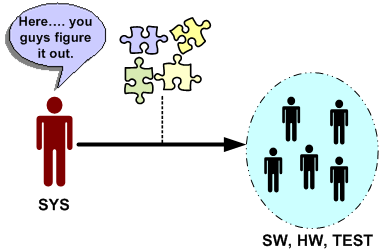
Now, assume that someone comes along and breaks from the herd. He/she produces coherent, understandable, and directly usable outputs for the SW and HW and TEST engineers to make rapid downstream progress. How do you think the maverick system engineer would be treated by his/her peers? If you guessed: “with open arms”, then you are wrong. Statements like “that’s too much detail”, “it took too much time”, “you’re not supposed to do that”, “that’s not what our process says we should do”, etc, will reign down on the maverick. No good deed goes unpunished. Sic.
Why would this seemingly irrational and dysfunctional behavior occur? Because hirearchical corpo cultures don’t accept “change” without a fight, regardless of whether the change is good or bad. By embracing change, the changees have to first acknowledge the fact that what they were doing before the change wasn’t working. For engineers, or non-engineers with an engineering mindset of infallibility, this level of self-awareness doesn’t exist. If a maverick can’t handle the psychological peer pressure to return to the norm and produce shoddy work products, then the status quo will remain entrenched. Sadly but surely, this is what everyone wants, including management, and even more outrageously, the HW, SW, and TEST engineers. Bummer.
Amazappos.com

This morning, I stumbled upon a New York Times article announcing that purchase of Zappos.com by the behemoth that is Amazon.com (I’ve owned shares in Amazon.com for over 10 years). From the article:
- “Amazon initially sought to pay cash, but Zappos asked for an all-stock deal, this person said.The extra cash and restricted stock for employees is meant to keep them on board and preserve the company’s culture, the person said. The deal is expected to close in the fall.”
- “Zappos appears to engender friendly feelings even among some of its smaller competitors. Korey Buzzell, who runs the independent site Shoe-Store.net, said Zappos had been an amicable competitor in the past, sending customers to his site when it could not fulfill their orders.”
Since (because of its totally unique and far out culture) Zappos is currently my favorite company to externally watch and follow, I was initially bummed. However after reading Zappos CEO Tony Hsieh’s down-to-earth, understandable, and jargon-less letter to employees, I’m actually excited about the future potential of Amazappos.com.
Here are some snippets from Hsieh’s letter that rang my bell and changed my feelings toward the deal. Notice how many times the word “culture” is used.
- “For Zappos, our vision remains the same: delivering happiness to customers, employees, and vendors. We just want to get there faster.”
- “Amazon supports us in continuing to grow our vision as an independent entity, under the Zappos brand and with our unique culture.“
- “Our culture at Zappos is unique and always evolving and changing, because one of our core values is to Embrace and Drive Change. What happens to our culture is up to us, which has always been true. Just like before, we are in control of our destiny and how our culture evolves.“
- “They are not looking to have their folks come in and run Zappos unless we ask them to. That being said, they have a lot of experience and expertise in a lot of areas, so we’re very excited about the opportunities to tap into their knowledge, expertise, and resources, especially on the technology side.“
- “We learned that they truly wanted us to continue to build the Zappos brand and continue to build the Zappos culture in our own unique way. I think “unique” was their way of saying “fun and a little weird.” 🙂 “
- “Amazon focuses on low prices, vast selection and convenience to make their customers happy, while Zappos does it through developing relationships, creating personal emotional connections, and delivering high touch (“WOW”) customer service.“
- “Jeff Bezos (CEO of Amazon) made it clear that he had a great deal of respect for our culture and that Amazon would look to protect it.“
- “Our mission remains the same: delivering happiness to all of our stakeholders, including our employees, our customers, and our vendors.“
- “We do not have any plans to move any departments, nor does Amazon want us to because they recognize that our culture is what makes the Zappos brand special.”
- “This is not a cash transaction. This is a stock exchange. Our shareholders and option holders will be issued approximately 10 million Amazon shares on a fully converted basis.“
I was also stunned by the disclosure that Zappos.com, which grew into a $1B company over 10 years selling a commodity product – shoes, only has (had?) 100 shareholders. I wish I was one, but now I am!
BTW, Hsieh’s e-letter has a really great video of Amazon CEO Jeff Bezos’ intro to Zappos employees embedded within it. He describes his values, and more interestingly, how Amazon got started. He also unembarassingly and openly shares some of the stupid mistakes that he made in piloting Amazon to where it is today.
Contrasting Cultures
Because it’s a numerically unquantifiable and highly spiritual topic, I’ve always been fascinated by the subject of “company culture”. Leaders can’t directly create and control the cultural behavior they want in their org. At best, they can try to put an environment and set of incentives in place so that the culture they want spontaneously emerges.
IMHO, the most effective method for catalyzing the formation of a desired culture is to lead by example. As Ghandi once said, “be the change you’d like to see in the world”. When executives behave in contradiction to the culture they want, they deserve what they get – an apathetic, mistrusting, and disengaged workforce. Blech, and meh.
Here’s a great and short article that compares four radically different, but financially successful, company cultures: four cultures. Since they’re all deemed successful , there is no one perfect culture that an org can strive for.
Which cultural environment would you like to work in?
Not Of This Earth
Did you ever hear of a company named SEMCO? If not, then you’re missing out on one of the greatest corporate success stories on the planet. The CEO, Ricardo Semler, is perhaps the smartest and most courageous executive to ever lead a for-proft company. Semco and Semler are so different and “out there” that they may not be of this earth.
Check out these snippets (followed by my snarky comments) from the SEMCO Survival Manual:
“Only people who have respect for their followers can be leaders.“
Amen. How does SEMCO determine which people can become, and remain, a leader in their organization? Read on.
“There is no space at the Semco Group for formalities. The doors are always open and people should say what they really think, without worries or inhibitions.”
Unlike the vast majority of corpos that are clones of each other, there’s no “checking your personality at the door” at Semco.
“Unions are an important method of protecting workers. Unionization is free within the company. The Semco Group believes that constant relationships with unions are healthy for the company and the employees. The presence of union members at the company is always welcome.“
Rather than taking the standard corpo “unions are enemies” stance, SEMCO treats unions as partners. Wow, what a concept.
“Based on the fact that everyone can say what they think, rumors and gossip should not be stimulated. Any attempt to harm another person is looked on very seriously. Take part and speak openly of what you are thinking in order to improve things.“
Wow, more weird concepts, “saying what you think” and “speaking openly“. How uncorpo and disrespectful of the SEMCO leadership for promoting such lunacy in writing.
“Every six months you will fill in a questionnaire and say what you really think about your immediate superior.”
Cool rule, eh? Every six months you get to say how you feel about your “leader“. If he/she isn’t measuring up, they get demoted.
“Have an opinion, put yourself forward as a candidate, always say what you think – do not be just another cog in the wheel. State your opinion about everything that interests you, even if you weren’t asked for it. Be active about your feelings.”
OMG! Stating your opinion even when you aren’t asked for it? Arrrrgh! More blasphemy that should be punishable by death. Feelings in the workplace? There’s no place for expressing feelings in the workplace. Feelings are for the weak and un-promotable.
“We want everybody to participate; opinions will always be welcome and should be spontaneous.”
Spontaneous espousal of opinions? More sacrilege that is unacceptable at 99% of all corpo clones. In the land of the clones, before publicly stating your opinion, you must always think it over carefully and ensure that your words won’t offend a single soul – especially one with a big title and high stature. If the words will offend anyone, then keep your piehole shut.
“Watch the results closely and ask any questions you want – there are no issues that cannot be discussed. “
OMG again! There are no “undiscussable topics” at SEMCO? That can’t be. They’re lying through their teeth. It’s obvious that this policy can’t be applied in practice.
After reading all the above lies, I’m convinced that SEMCO doesn’t exist. No company can do all that, make money, and stay in business. No freakin’ way. If SEMCO-styled companies do exist in the good ole USA, they must be found out and closed down at all costs. It’s unacceptable to “us” real capitalists to operate a company in such an unpatriotic way. Quick, someone mobilize the corpo SWAT team. We’re goin’ on a kill mission to snuff out this abomination.
Business Acquisition And Execution
To become and maintain a successful business, a company must both acquire and efficiently execute ongoing chunks of business. When top management values both of these critical work activities equally, then all is well. When they value one over the other, and in my business domain it’s always business acquisition that’s shown preferential treatment, then mediocrity reigns.
How do you know when top management is one sided? It’s easy, just look around. Who gets the single offices and single cubes? Who gets the bigger salaries? Who do the executives give way more face time to?
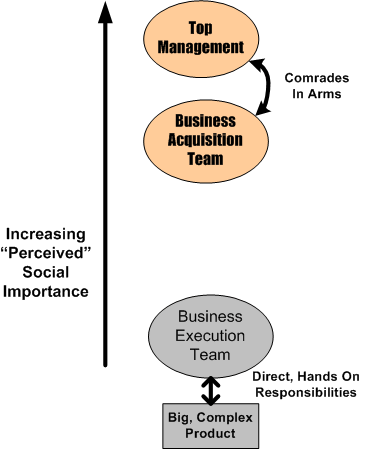
Business acquisition is glamorous and difficult, but in comparison, business execution is dirty, messy, and down right hard. When an acquisition team submits a proposal to a customer after a long and arduous courting period, it’s party time, and rightfully so. However, and this is key, the proposal doesn’t “have to work”. Products “have to work”, or else….
If a proposal is rejected and fails to acquire a chunk of business, then it’s usually because a competitor has offered up a similar or superior product for a lower price and/or a faster delivery time. The loser washes his hands clean and then just moves on to the next opportunity. It’s done and over with, kaput.
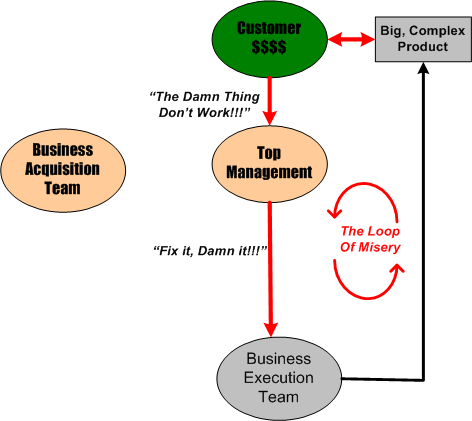
When a big, complex, and software-intensive product repeatedly and frequently fails in a customer’s day to day use of it, then continuous stress and pressure is placed on the execution team for what could be quite a long and sustained period of time. Until the execution team, usually through heroic acts of team sacrifice, makes the product behavior and performance “acceptable” to the customer, the two step chain of events is as follows: the customer pressures top management, and top management pressures the execution team. The loop of misery has been ignited. Notice that the acquisition team does not participate in the fun. In the worst case, the acquisition team merges with the top management team to apply greater pressure on the execution team.
Don’t be a stupid arse like me. If you’re given the choice between participating on an acquisition team or an execution team, choose the acquisition team 🙂

Why am I here?
WTF?
Meh!
D'oh!

My BTC Address



 Bulldozer00's Blog