Archive
Culture Convergence?
Many, many articles and books targeted at executives and senior managers spew out all kinds of elixirs, formulas, and lists guaranteed to catapult a business to the top of the heap. For example, take this squeaky clean and slightly redacted list from a book that will remain unnamed.
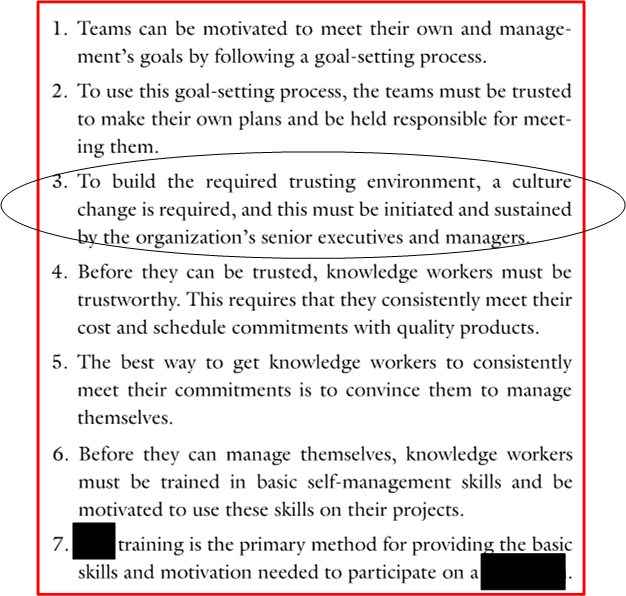
The one common, across the board demand that all these gurus impose on top leadership teams is that “you must change the culture“. The hidden assumption in these words is that one culture exists. Well, does it?…….
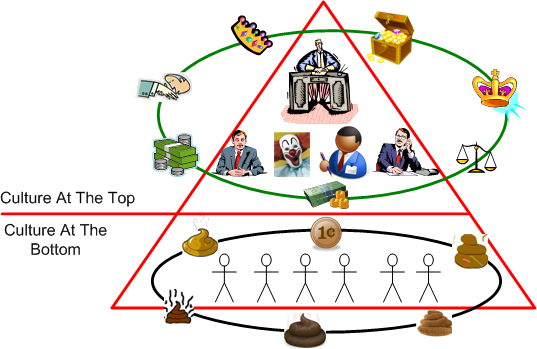
Maybe all these revered business gurus should talk about culture convergence instead of changing “the one culture“…..
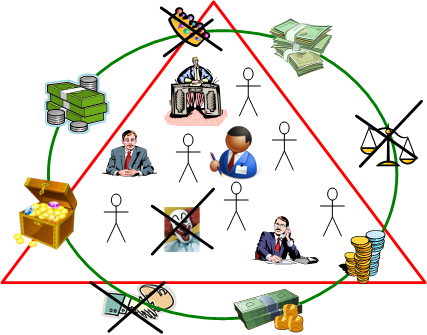
How naive of me to think that there are two or more cultures in an org, no?

Repeat Champion
Fortune magazine recently hatched its coveted list of the “Best 100 Companies to work for in 2011“. Two top ten winners, repeat champion SAS, and Zappos.com, have been on my faves list for a loooong time. Who’s on your list?

Peer Relationships
As you move up into the Bozone layers in a DYSCO, in addition to honing your Kiss-Up-Kick-Down skills, your horizontal relationships with your peers mysteriously start to change…..

Of course, the diagram is totally wrong and it lacks credible scientific evidence to back it up, no? Hey, what do you expect from a L’artiste?
Nice And Competent
It’s prolly just me, but I can’t seem to fully accept that most people equate niceness with competence – especially in the guild of layered management. Oh sure, there are lots of cases where people are both nice and competent, but there may be more cases where people are both nice and incompetent. What does your experience indicate?
One reason why there may be a lot of people who are both nice and incompetent is because niceness can camouflage incompetence – at least temporarily, and at most, till retirement. If you’re nice, your boss won’t scrutinize your work output (if he can understand it and isn’t incompetent himself) as closely than if you’re not nice. Thus, it’s better to be nice and incompetent than to be mean and incompetent – duh. Hell, niceness counts so much at top tier DYSCOs that it’s better to be nice and incompetent than not-nice and competent. Niceness trumps competence at these back asswards citadels.
If you’re a DICster, where it’s easier to “measure” competence by the material results you either do or don’t create, the cover up of incompetence by niceness doesn’t work nearly as well than if you’re a BM, SCOL, CGH, or BOOGL in a CCH org. Why? Because it’s much harder to measure middle management output. Most managers don’t create much of anything (except for angst and turmoil), so how can their performance be meaningfully measured? Plus, the senior managers who are supposed to do the “objective” measuring of their appointees don’t want to look bad by admitting that they knighted incompetent subordinate managers and incompetent, elite staff members.
So, what about me? I’m not nice and I’m incompetent, so this blarticle doesn’t apply to me. What about you?

Note: One way for a senior manager to measure a “junior manager’s performance is to ask junior’s people how he/she is helping them to grow and do a better job. Do you think this is done often in the corpo world? Even when this skip-level technique is miraculously performed, do you think honest feedback is obtained? Why or why not?
It Has To Be This Way
This Fortune blarticle, “When you’re the boss, who gives you reviews?”, starts out with:
“A chief executive at a fast growing tech start-up recently approached executive coach Dave Kashen with an all-too common problem. The CEO frequently reached out to his executive team for feedback, but whenever he sought their opinions, his subordinates seemed to shut down and withdraw.”
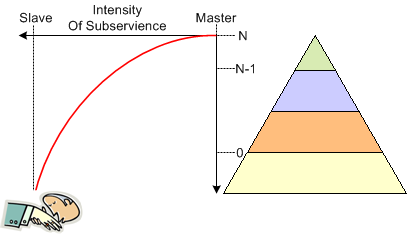
Well, duh. This systemic behavior is the result of the cultural environment that CCH forms of governance auto-install into each bozone layer – all the way down the pyramidal stack. In corpo CCHs, the dudes at level N-1 are “taught” by the system to be subservient to their bosses at level N. Dudes at level N-2 are “taught” to be even more subservient to the bosses at level N than their own boss man at level N-1.
This “that’s just the way it has to be” indoctrination is so successful that it works the other way too. The dudes at level N are “taught” by the system to require subservience by the lessers at all levels below them. I wonder if the flustered CEO in the quote realizes this.
If the corpo system wasn’t designed to work this way, there would be anarchy and annihilation. No “ifs“, “ands“, or “buts” about it……… right?
FOSTMA And NASHMA
Whoo Hoo! I thought of a positive complement to my negative FOSTMA acronym. It’s, it’s, it’s….. NASHMA = Nayar, Semler, Hsieh MAnagement:
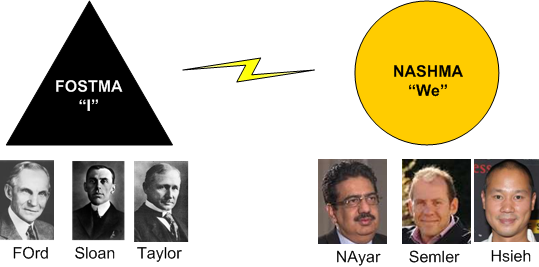
Of course, in order to prevent chaos, NASHMA orgs still have hierarchical structures, but they’re not run as stratified caste system CCHs. In NASHMA orgs, there’s real, two way accountability; and symmetric relationships exist up and down all levels. Most managers in NASHMA groups are PHORs and not STSJs who spend all their “valuable” time planning, watching, controlling, and evaluating.
Now mind you, to avoid the trap of dualistic thinking, an org shouldn’t be judged as fully belonging to one class or the other. There can be pockets of FOSTMA groups in a NASHMA org and vice versa. Nevertheless, my scientifically collected and analyzed data revealed this current distribution of institutions along the FOSTMA-NASHMA continuum:
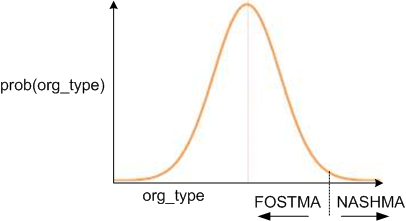
Over time, hopefully the threshold will move to the left – increasing the currently miniscule NASHMA to FOSTMA ratio. However, there will always be powerful and scary psychological forces opposing the movement.
Double Loop Learning
Chris Aryris is a giant in the field of organizational development. LinkedIn e-colleague Gene Bellinger recently posted this classic Argyris article, “Teaching Smart People How To Learn“, to his “Systems Thinking” group. In the missive, Mr. Argyris gives a great example of double loop learning:
I have coined the terms ‘‘single loop’’ and ‘‘double loop’’ learning…. To give a simple analogy: a thermostat that automatically turns on the heat whenever the temperature in a room drops below 68 degrees is a good example of single-loop learning. A thermostat that could ask, ‘‘Why am I set at 68 degrees?’’ and then explore whether or not some other temperature might more economically achieve the goal of heating the room would be engaging in double-loop learning.
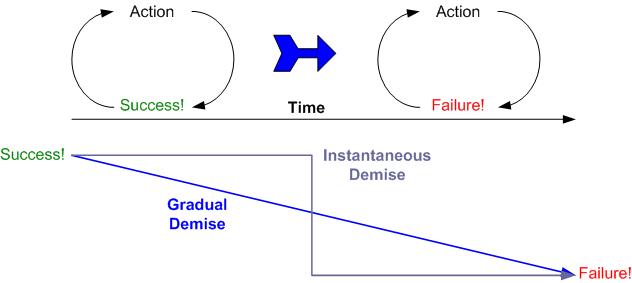
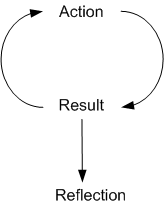
Because of the Law Of Impermanence (LOI), it’s inevitable that what worked in the past won’t work at some unknowable time in the future. The top half of the figger below illustrates the LOI in action. On the left, we have a successful org or individual happily humming along. The successful “entity” repeatedly performs actions that lead to success. As long as the external environment doesn’t change, this self-reinforcing loop of success can be sustained for quite a long time. However, since the LOI is constantly and relentlessly operating in the background, insanely doing the same thing over and over again will eventually guarantee failure. The failure may occur instantaneously like a broken axle while driving on the freeway, or it may manifest gradually like an excruciating death by a thousand cuts. Bummer.
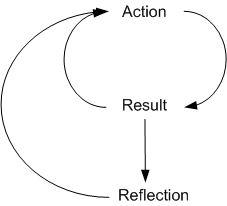
Possibly the only way of keeping the LOI at bay is to institute double loop learning. The figger below shows the painful, transformational process of adding a second action-result-reflection loop to the system. By adding the skill of reflection, deteriorating results can be detected and action can be periodically tuned to accommodate a changing world.
Just because “deteriorating results can be detected and action can be tuned” doesn’t mean they will be. The forces against truthful org and individual reflection on poor results are formidable. Denial, angst, and fear, which are all dysfunctions of the individual and collective human ego, conspire against improving system robustness and viability via change. Reorgs, appointing the same people to funky new titles, bumping up compensation/perks, cutting costs, and attempting to apply all other textbook management tools amount to wrapping bandaids around a massive hemorrhage. Double bummer.
The hardest aspect of getting a double learning loop into operation is connecting the “Reflection” node back to the “Action” node so that actions can be changed. As I know too well, it’s relatively easy to reflect on one’s actions while exhibiting the same insane behavior over and over and over and over………..
“Without deviation from the norm, progress is not possible.” – Frank Zappa
Monitoring And Learning
Courtesy of this Scott Berkun retweet,

I latched onto this Harvard Business School paper abstract:
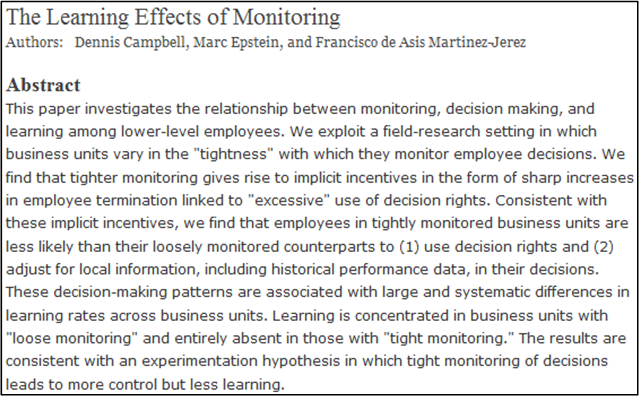
Even though the paper is laced with impeccable math and densely “irrefutable” logic, the conclusion of “looser monitoring -> more learning -> more creativity & innovation” seems intuitively obvious, doesn’t it?
Assume that the top leaders in your org embrace the idea and sincerely want to put it into action to detach the group from the status quo and propel it toward excellence. Well, fuggedaboutit. The scores of mediocre middle managers within the institution who do the monitoring will instantaneously switch into passive-aggressive mode and thwart any attempt to institute the policy. They’ll do this because it will most likely expose the fact that they are not only suppressing creativity and innovation where the rubber hits the road, but they are not adding much value to the operation themselves. How do I know this? Because that’s what I’d feel culturally forced to do. But not you, right?
Recursive Behavior
Information hoarding by individuals and orgs used to lead to success in the past, but information sharing is one necessary but insufficient key to success today.
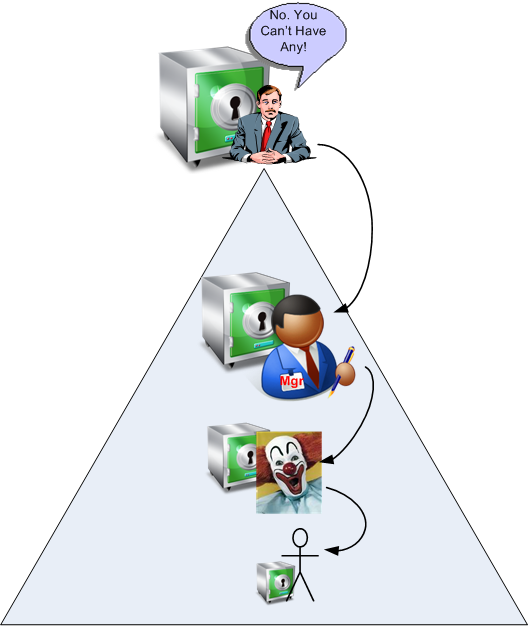
In this century, if the dudes in the penthouse at the top of the pyramid keep all the good stuff locked up in the unspoken name of mistrust, it’s highly likely that this anti-collaborative behavior will be recursively reproduced down the chain of command. Hell, if that behavior led to success for the corpo SCOLs and CGHs, then it will work for the DIC-force too, no?
“Trust is the bandwidth of communication.” – Karl-Erik Sveiby
Requisite Knowledge
In “Item 3. Design Patterns” of Stephen Dewhurst’s “C++ Common Knowledge: Essential Intermediate Programming“, he states the following:
Design patterns are often described as “micro-architectures” that can be composed with other patterns to produce a new architecture. Of course, selecting appropriate patterns and composing them effectively requires design expertise and native ability. However, even your manager will be able to understand the completed design if he or she has the requisite knowledge of patterns.
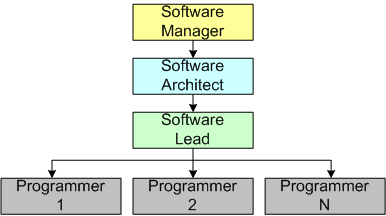
Uh, Stephen, you’re kidding, ain’t ya? In a project mini-corpricracy like the one below, you’ll be lucky if even the software lead knows what a pattern is, let alone the lofty manager. The software “Rocket-tect” will most likely know what a pattern is – but probably not how to apply it since he/she will be stuck in “lemme-show-u-how-smart-I-am” jargon-land. On the bright side, everybody in the power structure (which excludes the programmers, of course) will know what a Microsoft schedule, spreadsheet, and powerpoint deck are.

Why am I here?
WTF?
Meh!
D'oh!

My BTC Address



 Bulldozer00's Blog