Archive
Proprietary Sneeze
In stodgy, arrogant, and paranoid corpocracies, everything is marked as proprietary: the company letterhead, the standard powerpoint layout, all documented processes (that (shhhh!) nobody follows), every e-mail, every conversation, the company newsletter, the recipes in the cafeteria, etc. Hell, when someone sneezes it’s deemed proprietary. Geez, what up wit dat?
“Lighten up Francis” – Sergeant Hulka (from the movie “Stripes”)
Heaven forbid that a competitor gets its slimy hands on any of your proprietary “stuff”. OMG, they’ll put you out of business by using all of your world-changing intellectual property against you. Anyone caught disclosing anything about the corpo innards will swiftly receive a peek-a-boo visit from a high ranking corpocrat, right?
To be fair, there probably is some stuff that really is proprietary, like some domain-specific algorithms and/or some custom hardware modules. But gimme a break Einstein. Regardless of what you espouse, the ubiquitous Bell curve says that you’re most likely not all that (pause for a yawn) great. Although you, like the vast majority of corpo citadels on the landscape, think and espouse that you’re obviously a cut above the rest, you’re not. Deal with it. Remove the camouflage that everyone is aware of, but is forbidden to discuss.
When you explicitly “allow” your people to discuss the undiscussables in a truly open and receptive environment without publicly or privately tarring and feathering them, then you’ve taken the first courageous step toward differentiating yourself from the herd. Mooo!

Note: I’m just a Dilbertonian DIC (Dweeb In the Cellar) who makes things up, so don’t believe a word I say.
Accountability
Everybody loves to talk about “holding people accountable!”. You know, in the sense of “Bring Me The Head Of Alfredo Garcia“. The dilemma is that lots of people want to hold others accountable without being held accountable themselves. Management wants to hold the workforce accountable, but not vice-versa. The DICforce wants to hold management accountable, but not vice-versa.
When managers clearly define, specify, and communicate expected employee outputs along with the times that those outputs are due, then they have the information to hold an employee “accountable” if those requirements are not met. However, bad managers (of which there are many) aren’t competent enough to know how to clearly define, specify, and communicate what specifically is needed to get the job done. They do, however, know how to specify and monitor due dates – because it doesn’t require much brain matter to do so. Any wino off the street could be hired to dictate and watch unrealistic due dates.
On the other side of the fence, since bad managers don’t contribute anything to the org other than “status taking and schedule jockeying“, employees have no reliable and honest way of holding managers accountable (even if they were “allowed” to; which they aren’t). What’s an employee supposed to do? Call out a manager for not “taking status and watching schedule“? Yeah, right.
Sooooooo. Once you become a manager, a rare good one or a ubiquitous bad one, you’ve got it made. Your buddies who anointed you into the management guild won’t hold you accountable because it’ll make them look bad for choosing you (and of course, they can’t look bad in front of the troops because they have to maintain the illusion of infallibility). Your employees won’t hold you accountable either, because they want to remain hassle-free and you most likely don’t contribute anything of substance that is publicly and scrutably visible. It’s the best of both worlds and, in management lingo, a “win-win” situation.


Right, Right, Right.
Great leaders get the right info to the right people at the right time. They don’t hide behind the “it’s not my job” cliche. They don’t just “delegate this” and “delegate that” like a card dealer at a casino. They don’t just sit back in their throne, get manicures, and “review and approve”. They don’t just passively collect “status and schedule” information. They don’t set ambiguous and indecipherable direction, and then change it at will whenever it suits their personal agenda. They don’t mandate the latest management “technique” after they read about it in a 2 page Harvard Business Review article.
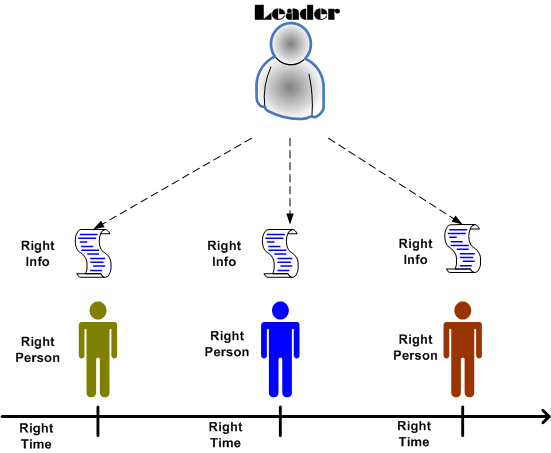
If getting the right info to the right people at the right time requires a leader to generate some of the information him/herself, then they do it.
Delegating only works when the delegator works too. – Robert Half
Hierarchical Growth
I’m currently in the process of reading Donella Meadows’s Thinking In Systems. Donella says that successful hierarchical systems grow from the bottom up, one layer at a time.
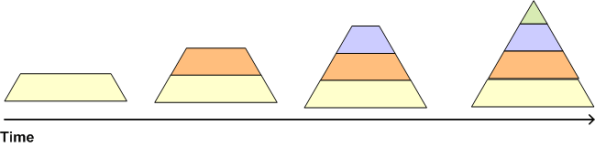 In the case of a human-made system of humans, as an assembled group of people becomes successful at what it does, it starts growing horizontally. The group finds a way to extract what it needs to sustain and grow itself (like money in exchange for products and services) from its surrounding environment.

In order to keep the group aligned and coordinated, the next higher level is formed from a small sub-group within the first level. Both levels feed each other in a mutually beneficial relationship and the organization keeps growing sideways. At a certain point, the second level becomes wide enough to require a third level to keep it synchronized with the group’s overall organizational goals. As growth continues, more and more layers are needed to keep the overall system from diverging from its true purpose.
At some unpredictable point in time, a strange and seemingly irrational inversion starts taking place as growth continues. The smaller, but higher layers in the hierarchy start consuming a more disproportionate share of the fruits of the organizational effort. The original, mutually beneficial, two way relationship transforms into an unbalanced one way relationship that is strangely accepted and taken for granted by everyone at all levels.
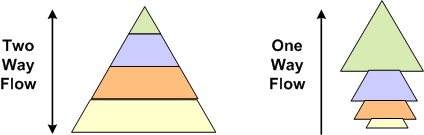
As a result of the imbalance, the bottom layers begin to atrophy from a lack of nourishment. As the one way upward flow of nourishment continues, the weight of the top layers increases and the strength of the lower layers decreases. In the worst case, the organization loses its balance and comes crashing to earth in a disintegrated mess.

In the early stages of growth, everyone in the organization fully understands that each successive layer is put in place to take care of the layer below it, and vice versa. When this understanding gets lost, all is lost. It’s just a matter of time until disaster strikes. Can the process be reversed? Sure it can, by restoring the balance and never losing sight of why the upper layers were created in the first place.
Who’s That Masked Man?
I’m very skeptical of management consultants, but the dudes at VitalSmarts are really good. They are responsible for the wonderful “crucial” pair of books:
I’ve read both of these along with Influencer. They’re all very “down to earth” and highly accessible tomes that detail what works and what doesn’t work in terms of leading organizations of people. Their simple and “executable” advice is backed by academic research and, most importantly, their direct experiences from interacting with lots and lots (thousands) of real people in working organizations around the globe.
The following snippet from their latest e-newsletter caught my eye:
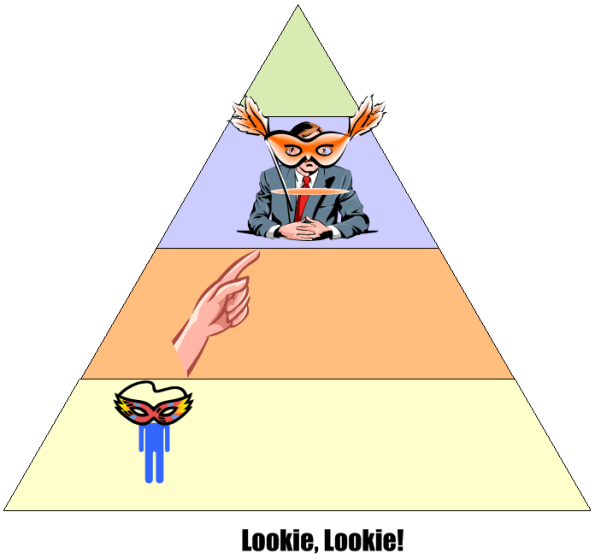
“People are excellent at masking ability problems.”
Man, ain’t that the truth! Along with you, I ‘ve put the “mask ” on many times, both willingly and unwillingly. The question is: “what would cause people to do this?”.
I think the main reason why people try to feign expertise is because they are stuck working in archaic corpo CCHs (Command & Control Hierarchies). All CCH orgs unquestioningly assume that everyone within the pyramid walls is supremely competent, regardless of whether they are or not. In a CCH, anyone who dares to persistently point out “ability” problems is excommunicated, regardless of how much evidence is presented to prove the case so that a beneficial change can be made. Heaven forbid the case where a lower level masked associate points to the huge masks being worn by one or more of the obviously infallible managers entrenched in an upper echelon. Retribution is swift and unambiguous.
Favorite Companies
Over the years, I’ve been on a constant watch for unique companies. By unique, I mean those that stand apart from the rest of the herd in the way that the executive leadership balances the needs of all stakeholders – not just the shareholders, or especially, themselves. Of course, unless you’ve worked at a company, it’s pretty tough to know if the company really lives up to its core values and “walks the talk”. That’s because all companies project the image that they are great places to work, regardless of whether they really are.
So, how do I decide whether a company is a cut above the rest? Via subjective evaluation of external observations, of course. Here’s my unscientific list of “research” methods:
- Read third party accounts of experience given by former and current non-management employees.
- Read, listen, and watch multiple interviews with CEOs and executives.
- Scour publicly available mission statements, visions, core values and cultural descriptions for authenticity, lack of corpo jargon, and attention to detail.
- Stay away from glossy annual reports.
- Ignore whatever the hand picked company spokesperson(s) say.
Of course, my methods aren’t perfect, but do you know of any better ones?
Here’s my current list of faves. What are yours?
Netflix Culture
I’m constantly scouring the landscape for companies with cultures that stand apart from the herd (moooo!). Via my e-friend Byron Davies’ discovery, I’ve just added another gem to my list: Netflix. Here’s the link that triggered the addition: Netflix Culture. It’s a simple, unadorned (content over format), behemoth 128 page presentation, but it’s so authentically different and norm-busting that it’ll stir your emotions (yuk, can’t have emotions in business, right?) if you’re a culture hound like me. Just in case you’re curious, but short on time, here are some zingers that rang my bell:
- The real company values, as opposed to the nice sounding values, are shown by who gets rewarded, promoted, or let go.
- We particularly value these nine skills and behaviors: judgment, communication, impact, curiosity, innovation, courage, passion, honesty, selflessness.
- You focus on results and not process.
- You challenge prevailing assumptions when warranted, and suggest better approaches.
- You say what you think, even if it’s controversial.
- You question actions inconsistent with our values.
- You only say things about fellow employees you will say to their face.
- You share information openly and proactively.
- It’s about effectiveness, not effort or hard work.
- Responsible people thrive on freedom and are worthy of freedom.
- Most companies curtail freedom as they grow bigger and to avoid errors, thus, we try to increase freedom.
- Process-focus drives talent to leave.
- The key to managing growth and complexity is to increase talent density; not to institute more freedom-constraining processes.
- We value simplicity, not the simplistic.
- Freedom is not absolute, a few basic and common sense rules are needed.
- In environments that demand creativity, fixing errors is cheaper than (fruitlessly) trying to prevent them via religious process adherence.
- Regularly scheduled strategy and context meetings.
- Flexibility is more important than efficiency in the long term.
- Set the context for your people instead of trying to control them.
- Highly aligned and loosely coupled as opposed to monolithic or siloed.
- Goal: fast, flexible AND big.
- Titles are not very helpful (all major league pitchers aren’t major league talents).
- No centrally administered “raise pools” every year.
- Whether Netflix is prospering or floundering, we pay at the top of the market.
- It’s a healthy idea, not a traitorous one, to understand what other firms would pay you, by interviewing and talking to peers at other companies.
- No bonuses, just include in salary. No free stock options – just big salary; and let people decide where to invest it.
- Rapid innovation AND excellent execution, creativity AND discipline, are required for continuous growth.
Here is my number one zinger:
- Netflix vacation and tracking policy: there is no vacation policy or tracking.
You read it right. One day, an employee pointed out that “we don’t track hours worked per day, night, or on weekends, so why do we track vacation days?“. The Netflix leadership responded to the challenge by removing the “N days per year” vacation rule. Pretty rad, removing rules instead of continuously piling them on, no?
Even if you’re extremely skeptical and can’t believe the Netflix leadership “walks the talk”, you gotta at least give them credit for writing down, in detail and with underlying rationale, the culture that they’re trying to build – so that they could be held accountable. No?
No Good Deed
Let’s say that the system engineering culture at your hierarchically structured corpo org is such that virtually all work products handed off (down?) to hardware, software and test engineers are incomplete, inconsistent, fragmented, and filled with incomprehensible ambiguity. Another word that describes this type of low quality work is “camouflage”. Since it is baked into the “culture”, camouflage is expected, it’s taken for granted, and it’s burned into everyone’s mind that “that’s the way it is and that’s the way it always will be”.
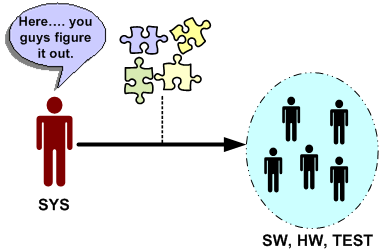
Now, assume that someone comes along and breaks from the herd. He/she produces coherent, understandable, and directly usable outputs for the SW and HW and TEST engineers to make rapid downstream progress. How do you think the maverick system engineer would be treated by his/her peers? If you guessed: “with open arms”, then you are wrong. Statements like “that’s too much detail”, “it took too much time”, “you’re not supposed to do that”, “that’s not what our process says we should do”, etc, will reign down on the maverick. No good deed goes unpunished. Sic.
Why would this seemingly irrational and dysfunctional behavior occur? Because hirearchical corpo cultures don’t accept “change” without a fight, regardless of whether the change is good or bad. By embracing change, the changees have to first acknowledge the fact that what they were doing before the change wasn’t working. For engineers, or non-engineers with an engineering mindset of infallibility, this level of self-awareness doesn’t exist. If a maverick can’t handle the psychological peer pressure to return to the norm and produce shoddy work products, then the status quo will remain entrenched. Sadly but surely, this is what everyone wants, including management, and even more outrageously, the HW, SW, and TEST engineers. Bummer.
Analysis Paralysis Vs. 59 Minutes
“If I had an hour to save the world, I would spend 59 minutes defining the problem and one minute finding solutions” – Albert Einstein
If they didn’t know that Einstein said the quote above, MBA taught and metrics-obsessed “go-go-go” textbook managers would propose that the person who did say it was a slacker who suffered from “analysis paralysis”. In the Nike age of “just do it” and a culture of “act first and think later” (in order to show immediate progress regardless of downstream consequences), not following Einstein’s sage advice often leads to massive financial or human damage when applied to big, multi-variable hairball problems.
The choice between “act first, think later” (AFTL) and “think first, act later” (TFAL) is not so simple. For small, one dimensional problems where after-the-fact mistakes can be detected quickly and readjustments can be made equally as quickly, AFTL is the best way to go. However, most managers, because they are measured on schedule and cost performance and not on quality (which is notoriously difficult to articulate and quantify), apply the AFTL approach exclusively. They behave this way regardless if the situation cries out for TFAL because that’s the way that hierarchical structured corpo orgs work. Since the long term downstream effects of crappy decisions may not be traceable back to the manager who made them, and he/she will likely be gone when the damage is discovered, everybody else loses – except the manager, of course. Leaders TFAL and managers AFTL.
Heaps And Systems
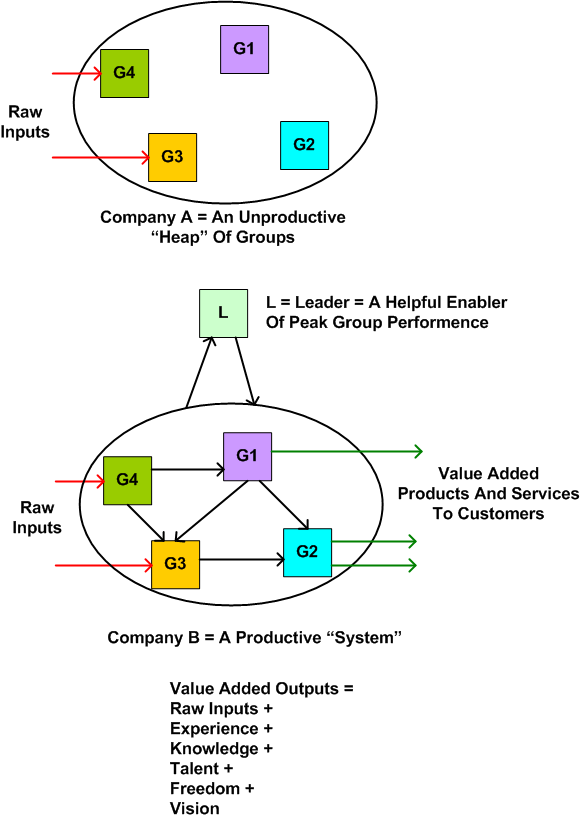
A “heap” is a collection of individual “parts”. A “system” is an intentionally designed set of interconnected parts with a purpose. The purpose of a system transcends AND includes the purpose of each of the individual parts. As an example, think of an automobile. If we disassemble one, we end up with a heap of individual parts. When these parts are assembled and interconnected in accordance with the purpose of human transportation as the goal, we may get a system. Structural design and interconnection are not enough. The system must be energized and steered so that purposeful behavior can be manifested. For a car, the energy is fuel and the steerer is a human being. For an organization of mutli-disciplined groups of people, the energy is motivation and the steerer is a leader. Without motivation and a leader, an organization of human groups is just an unproductive heap that consumes natural resources and doesn’t produce any value added output to share with the world.
The figure below shows two companies that are each comprised of 4 potentially diverse and productive groups of people. Company A is unconnected and leaderless. Thus, it just consumes resources from the external environment and produces nothing of value to share with the world. Company B is both connected and well led. What kind of company do you work for?
Look at company C in the illustration below. In this company, the leader has propelled his/her company to the head of the pack by creating the internal environment for, and nurturing the system’s internal groups and interfaces for peak performance. All of the internal connections and relationships between the groups are comprised of low latency and high bandwidth collaboration. Both high quality outputs and speed of execution distinguish company C from the rest of the herd.
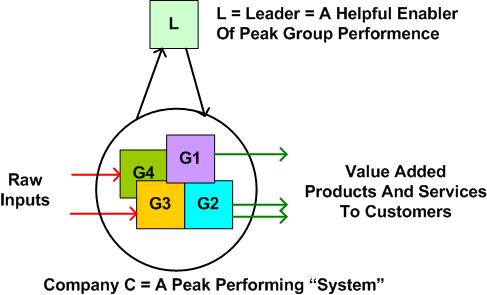
In a high performing system, the danger of over-optimization looms in the form of inflexibility. A system optimized for a single purpose tends to harden and become resistant to change overt time – corposclerosis sets in. The trick for the leader is to create and sustain a delicate balance between optimization and flexibility that adapts with the rapidly changing external environment.
In an attempt to over-optimize performance, some leaders unknowingly morph into “managers”. They start inserting subordinate management layers of questionable value between themselves and the productive subsystems of the company. They start creating and accumulating titles that distance themselves from the productive groups. These and other symbols of status divide and alienate instead of integrate and endear. Instead of guiding, steering, and nurturing, they start commanding, controlling, and constraining. Productivity plummets and quality of workmanship deteriorates.
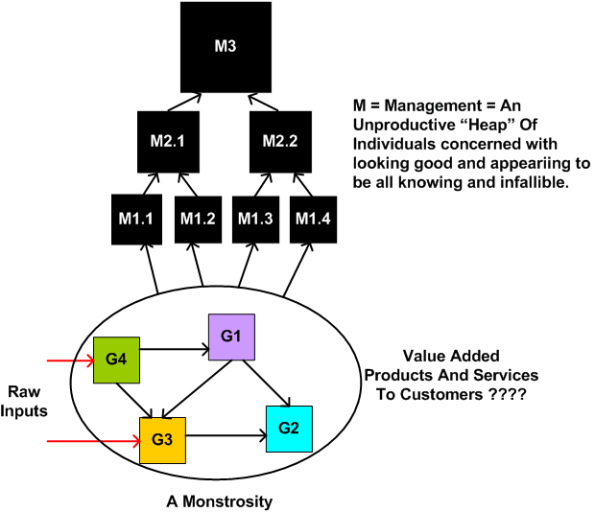
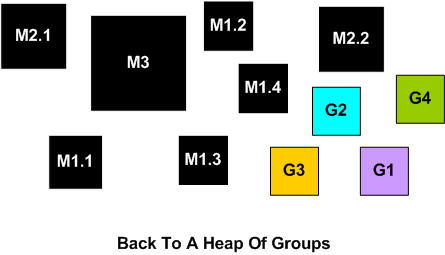
Because of increasing rules and procedures mandated by management, the internal interfaces between the formerly productive groups start transitioning into high latency and low bandwidth communication channels. In the worst case, like an overheated engine, the interfaces rupture and the system abruptly disintegrates; leaving an unconnected and purposeless heap of parts in its wake. Bummer.

Why am I here?
WTF?
Meh!
D'oh!

My BTC Address



 Bulldozer00's Blog