Archive
Guilt And Coercion
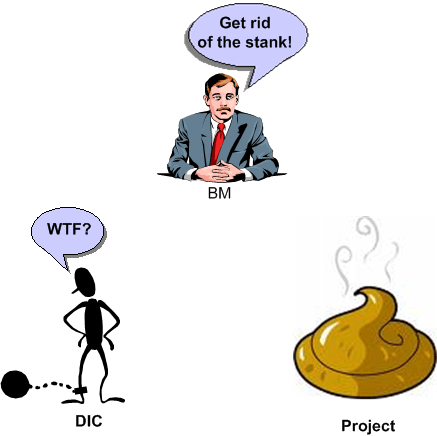
In a classic CCH (Command and Control Hierarchy), the only two tools of motivation known to BMs (Bozo Managers) for getting people to sign up for no-win projects are Guilt and Coercion. Bad CCH BMs use both, and really bad BMs with a sweatshop mentality use coercion exclusively. Attempts to instill guilt are often prefaced with “Don’t you wannabe a team player?” or “It’s very important for the company”. A classic coercive one-liner is “Do this project or else!”
So, why don’t many smart DICs (Dweebs In the Cellar) step up and volunteer to lead tough projects? One reason is because smart DICs know that the toxic, fragmented, and stifling environment (created and nurtured by the very same BMs who are coercing and inflicting guilt) guarantees failure. Another reason is because textbook CCHs are bureaucracies and not meritocracies – regardless of what they espouse. Thus, all work is treated the same and everyone gets the same 3% raise no matter how hard they work or how much they neglect their own lives to “get the job done” . Can you think of other reasons?
Orchestrated Reviews
If you think your design is perfect, it means you haven’t shown it to anyone yet – Harry Hillaker
Open, frequent, and well-engineered reviews and demonstrations are great ways to uncover and fix mistakes and errors before they grow into downstream money and time sucking abominations. In spite of this, some project cultures innocently but surely thwart effective reviews.
Out of fear of criticism, designers in dysfunctional cultures take precautions against “looking bad“. Camouflage is generated in the form of too much or too little detail. Subject matter experts are left off the list of reviewers in order to uphold a false image of infallibility.
Another survival tactic is to pre-load the reviewer list with friends and cream puffs who won’t point out errors and ambiguities for fear of losing their status as nice people and good team players. In really fearful cultures, tough reviewers who consistently point out nasty and potential budget-busting errors are tarred and feathered so that they never provide substantive input again. In the worst cases, reviews and demonstrations aren’t even performed at all. Bummer.

Linear Culture, Iterative Culture
A Linear Think Technical Culture (LTTC) equates error with sin. Thus, iteration to remove errors and mistakes is “not allowed” and schedules don’t provide for slack time in between sprints to regroup, reflect and improve quality . In really bad LTTCs, errors and mistakes are covered up so that the “perpetrators” don’t get punished for being less than perfect. An Iterative Think Technical Culture (ITTC) embraces the reality that people make mistakes and encourages continuous error removal, especially on intellectually demanding tasks.
The figure below shows the first phase of a hypothetical two phase project and the relative schedule performance of the two contrasting cultures. Because of the lack of “Fix Errors” periods, the LTTC reaches the phase I handoff transition point earlier .

The next figure shows the schedule performance of phase II in our hypothetical project. The LTTC team gets a head start out of the gate but soon gets bogged down correcting fubars made during phase I. The ITTC team, having caught and fixed most of their turds much closer to the point in time at which they were made, finishes phase II before the LTTC team hands off their work to the phase III team (or the customer if phase II is that last activity in the project).

It appears that project teams with an ITTC always trump LTTC teams. However, if the project complexity, which is usually intimately tied to its size, is low enough, an LTTC team can outperform an ITTC team. The figure below illustrates a most-likely-immeasurable “critical project size” metric at which ITTC teams start outperforming LTTC teams.
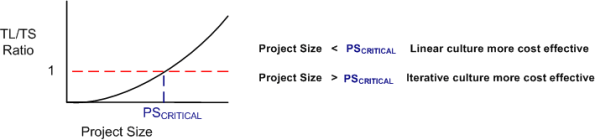
The mysterious critical-project-size metric can be highly variable between companies, and even between groups within a company. With highly trained, competent, and experienced people, an LTTC team can outperform an ITTC team at larger and larger critical project sizes. What kind of culture are you immersed in?
What Would It be Like?
In this TED video, Sir Ken Robinson asks: “What would the world be like if all knowledge was instantaneously accessible to everyone at any time?” My less ambitious question is “What would the workplace culture be like if every manager, from the pinnacle of power all the way down the chain, made it his/her top (but obviously not only) priority to ensure that every one of his/her direct reports has continuous access to the tools, training, and information to get their jobs done?

Malcontents
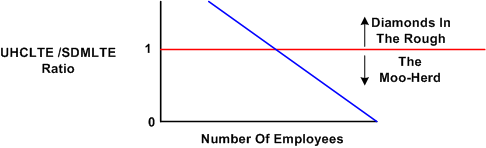
Everyone’s heard of the stereotypical, disgruntled, malcontented, long time employee (SDMLTE) who “can’t wait to retire”. Why is this Dilbertonian image a stereotype? Because it’s so ubiquitous that it’s unquestioningly accepted by the vast majority of people as “that’s the way it is everywhere”. Well, is it? Do you really think that every organization on this earth has a surplus of SDMLTEs? Call me idealistic, but I assert “no”.
I opine that there are few (very, very, very, very, few) companies whose old warhorses, graybeards and bluehairs are uncommon, happy, content, long time employees (UHCLTE). Compared to the moo-herd of corpocracies that litter the land, these scarce diamonds in the rough have a huge UHCLTE to SDMLTE ratio. I’ll also profer that as a company gets larger, its UHCLTE to SDMLTE ratio decreases. That’s because as a company grows in size, bad management increases while great leadership decreases within the citadel walls – regardless of what the corpo stewards repeatedly espouse. Bummer.
Different Views
In all triangular CCHs (Command and Control Hierarchies), the DICs (Dweebs In the Cellar) directly create the value added outputs that sustain the enterprise. It’s management’s job (I think?) to ensure that the quality of those outputs is high enough for customers to want to buy the CCH’s products and services over competing CCHs. Of course, there are many ways to accomplish this. One is to inspect the outputs, a second is to get customer feedback, a third is to directly sample intermediate points in the value stream, and a trio of closely coupled others is to; personally descend to the cellar, observe what the DICs see, listen to what the DICs have to say regarding the issues/obstacles they face, and act “aggressively” (corpo-speak for “effectively”) to resolve those issues/obstacles. Note that the verbs, which require “hard work”, are emphasized.
The simple, dorky figure below tries to convey the difference in viewpoint between the DICs and the apex dwellers. Unlike the hierarchs, who operate freely and do whatever they want whenever they want, the DICs operate within a fragmented web of constraining “support” processes and “direction” from former DICs-turned-mini-hierarchs (picture mini-me in the Austin Powers movie franchise). Over time, since the hierarchs (and more importantly, the mini-hierarchs in training) stay away from the dirty and musty cellar and don’t do anything of substance to improve the environment, the stratification increases, the latency from raw input to value-added output increases, and the quality of output decreases. Bummer.
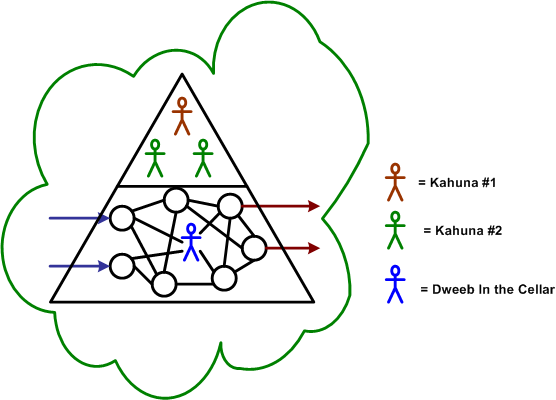
In CCHs with stay-at-home corpocrats, the deterioration in responsiveness and quality often gets detected at that point in time in which the real issues that are wreaking havoc are virtually unsolvable. Even then, the so-called leadership team stays away from the boiler room, speculating from afar at the causes of the performance deterioration. Out of all the methods for continuously monitoring and improving DIC performance, I assert (with no backing scientific evidence, of course) that frequent, periodic trips to the cellar to rub elbow grease with the DICs is the only true way of improving performance. Even if it’s impractical for the supreme hierarchs to do this, it’s not impractical for the mini-hierarchs, dontcha think?

Gift Wrap
In dysfunctional corpocracies, it’s not only acceptable, but it’s expected that STSJs (Status Takers and Schedule Jockeys) will routinely drop turd-bombs on DICs (Dweebs In the Cellar) when schedules, no matter how far off the mark they are, are not met.
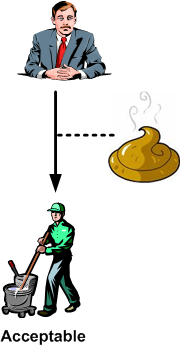
However, it’s socially unacceptable for a DIC to hurl a turd-coil skyward toward an STSJ. Nevertheless, if a DIC has been trained to “communicate effectively” and is clever and skillful enough, a gift-wrapped turd-ball may be accepted “temporarily” by an STSJ – until he/she opens the box. Thus, the best course of action for DICS “privileged” enough to work in a one way command and control hierarchy is to flush turd-bombs down the toilet when they are discovered. Whoosh!

Best Of The Best
The breadth of variety of companies, markets, customers, industries, products, and services in the world is so wide and diverse that it can be daunting to develop objectively measurable criteria for “best in class” that cuts across all of the variability.
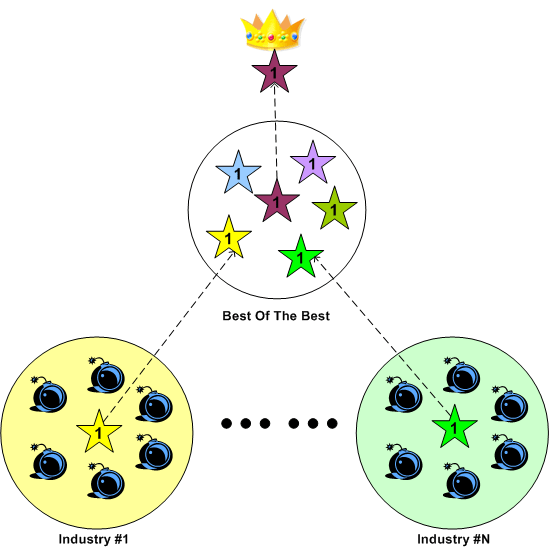
Being a simpleton, my pseudo-measurable criteria for a “best in class” company is:
- Everybody (except for the inevitable handful of malcontents (like me?) found in all organizations) who works in the company sincerely feels good about themselves, their co-workers, the products they build, their customers, and the company leadership.
That’s it. That’s my sole criterion (I told you I was a simpleton). Of course, the classical financial measures like year-over-year revenue growth, profitability, yada, yada, yada, matter too, but in my uncredentialed and unscholarly mind, those metrics are secondary. They’re secondary because good numbers are unsustainable unless the touchy-feely criterion is continuously satisfied.
The dilemma with any kind of “feel good” criteria is that there aren’t many good ways of measuring them. Nevertheless, one of my favorite companies, zappos.com, has conjured up a great way of doing it. Every year, CEO Tony Hsieh sends an e-mail out to all of his employees and solicits their thoughts on the Zappos culture. All the responses are then integrated and published, unedited, in a hard copy “Zappos Culture Book”.
The Zappos culture book is available free of charge to anyone who emails Tony (tony@zappos.com). Earlier this year, I e-mailed Tony and asked for a copy of the book. Lo and behold, I received the 400+ page tome, free-of-charge, four days later. I poured through the 100’s of employee, executive, and partner testimonials regarding Zappos’s actual performance against their espoused cultural values. I found no negative entries in the entire book. There were two, just two, lukewarm assessments of the company’s cultural performance. Of course, skeptics will say that the book entries were censored, and maybe they were, but I doubt it.
How would your company fare if it compiled a yearly culture book similar to Zappos’s? Would your company even entertain the idea? Would anyone feel comfortable proposing the idea? Is the concept of a culture book only applicable to consumer products companies like Zappos.com, or could its value be industry-independent?
Note: Zappos.com was recently bought out by Amazon.com. It should be interesting to see if the yearly Zappos culture book gets squashed by Jeff Bezos et al.
Particular Individuals Don’t Matter
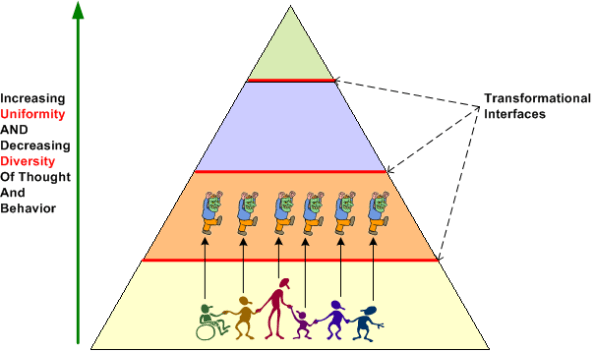
It doesn’t matter who the particular individuals in a corpocracy are. No matter how smart and well meaning they are, the awesome power of the pyramidal structure of woe to suppress their individuality and transform them into zombie clones tasked to guard the status-quo will prevail. How many of you have seen and experienced the ascension of smart, and formerly-effective, people into the ranks of the elite, only to be instantaneously transformed into ineffective druids?
Let’s Be Careful Out There!
Based on a recommendation from fellow whack-job W. L. Livingston, I’m currently trying to read “The Theory Of The Leisure Class” by Thorstein Veblen (cool name, eh?). Man, this guy’s a tough read. The vocabulary that Thor(?) uses and his huge paragraphs often cause my CPU to overheat and spew blue smoke, but the self-imposed intellectual torture is worth the pain.
I love exploring the ideas and thoughts of guys like Veblen because they are so far off the beaten path and mind stretching that they cause new, but previously unused synaptic sub-networks to be instantaneously created in my brain. For me, spiritual and intellectual growth is painful but inspiring. The acts of continuously trying to widen my horizons, destroying old and obsolete mental models, and exposing myself to the ideas of others makes me feel vibrantly alive.
When you consciously choose to explore and probe weird and non-standard ideas that go against the norm, you’ve got to watch out for yourself. Internalizing and then subsequently espousing your new learnings in public can be detrimental to your health. If people are really set in their ways and you don’t take their feelings into account, you could trigger the fight or flight response in them. In one-on-one exchanges, the blowback that you experience may not be so bad. However, publicizing your new thoughts in a meeting with a group of clanthinkers can cause you considerable external and internal damage.
“Let’s Be Careful Out There” – Sergeant Esterhaus


Why am I here?
WTF?
Meh!
D'oh!

My BTC Address



 Bulldozer00's Blog