Archive
Scouts
The figure below is intended to show a successful and profitable company operating in an external environment that’s changing over time. Since the corporation achieved its current successful state by employing strategies and practices that worked well to get it there, it naturally employs the same techniques over and over again. This causes the corpo walls to harden and protect those inside of the org from the forces of external change.

If the external winds of change are characterized by a low velocity (more like a breeze than a tornado), then the company’s success may last for quite a long time even though it’s unconsciously stuck in neutral and not adapting to the external environment. However, as the breezy external environment transforms into a maelstrom of tornadoes as a result of new competitors appearing and the sudden emergence of game changing technologies like the internet, company revenues/profits and the corpo pyramid may come tumbling down. Conscious and enlightenend company leaders know that stasis is a corpo killer, but textbook spreadsheet managers don’t.
One way to “sense” when change is needed is to formally designate a cadre of “scouts” at all functional levels of the org, from marketing all the way down the corpo steps to engineering and customer service. I first heard about the concept of scouts from Steve McConnell many years ago, before the internet and the exponential rise of third world engineering know how. At the time, I thought it was a novel idea and now I think it may be essential for survival.
As the picture below illustrates, scouts can serve as external sensors/probes that monitor and make meaning of the rapidly changing external environment. They separate the wheat from the chaff and, if they’re paid attention and nurtured, they can provide accurate information to corpo decision makers regarding which new technology and practices to embrace, and which new products to prototype and try.

Of course, dysfunctional org executives who think highly of themselves but don’t think much of their people (while simultaneously praising them as the company’s most valuable assets), will get what they deserve. They won’t create the role of a “scout” and they’ll ignore or subtlely berate self-motivated people who voluntarily perform the role of a scout. In their minds, they think they are the only ones who are capable of steering the company toward the future – using the same worn out , obsolete thinking that used to work but is virtually useless. Bummer.

Government Business
The figure below is a UML (Unified Modeling Language) class diagram that models a fictional government contracting system. So you don’t know UML? Don’t leave, because UML is easy to understand if one doesn’t over-specify in an attempt to show the world how “smart” he/she is.
The diagram shows the players (“classes” in UML lingo) in the game and some of the relationships (“associations” in UML lingo) between them. The diagram can be understood as follows:
The taxpayer funds congress, which funds groups of government bureaucrats, who hire a contractor to develop and deliver a product to be used by government workers to do their job of serving the public. Money, which everyone worships of course, ties all these main power players together. The contractor develops a product, which is then (delivered to the government and is) used by the government workers. All is well and the world becomes a better place. Whoopeee!
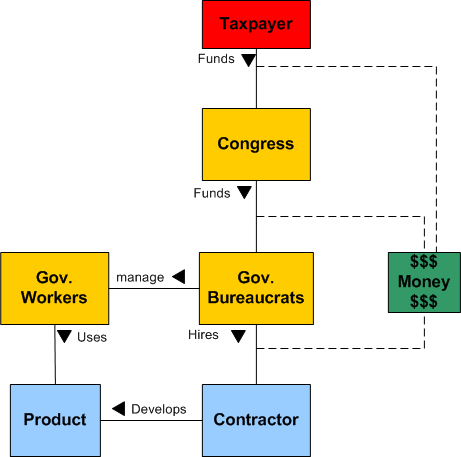
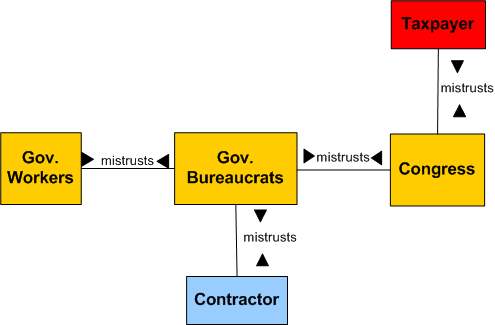
Yawn, meh. Boring and uninteresting, no? But wait, there’s more. Some hidden relationships between the “classes” in the system are not displayed by this proper and politically correct diagram. The diagram below shows just one of these hidden relationships – mistrust – between everyone 🙂 . How did this mistrust emerge and infiltrate the system? From the players getting burned in the past, that’s how. Especially the ultimate source of all money in the system – the taxpayer.
The last figure in this post shows the dynamic behaviors exhibited by each of the active players in this goverment business dance. In the UML, the middle compartment in a “class” (which is nothing more than a type of object – a classification) is intended to hold the attributes that characterize the class. I purposefully left them out because they’re not important to the message I’m trying to communicate.
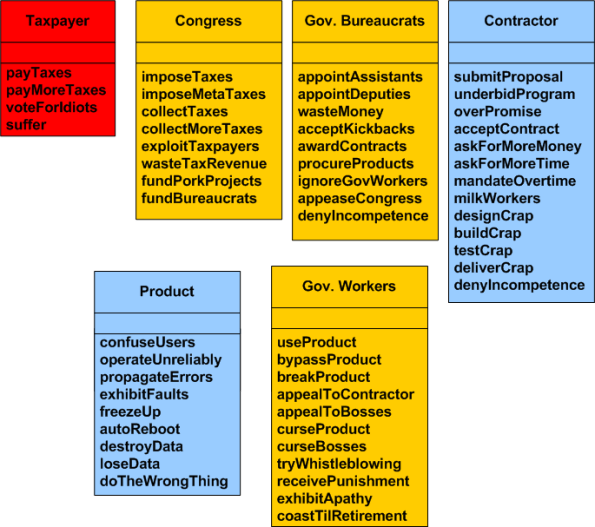
I’ll leave it to your imagination to create specific scenarios of system operation (called “use cases” in the UML). Scenarios are specific subsets of behaviors that are sequentially strung together in time (scenarios can be modeled with UML “sequence diagrams”). At the end of a given scenario execution, the system has achieved a specific goal, like “make everyone in the system miserable”, or “damage the environment”, or “reward those who deserve it the least and punish those who are innocent of wrongdoing”.
Are there any significant players missing in this system? Are there any relationships missing? Are there any behaviors missing? Got a different model of how this government system works or how it should work? Remember this:
The purpose of a system is what it does, not what its advocates say it does.
Thanks for listening!

Why am I here?
WTF?
Meh!
D'oh!

My BTC Address



 Bulldozer00's Blog