Archive
Sloppy and Undisciplined
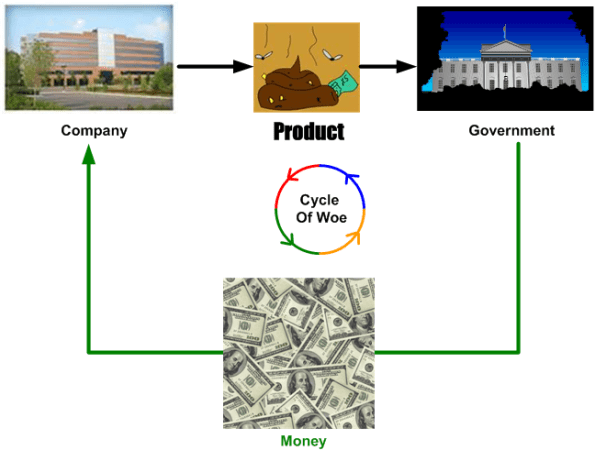
If a company is sloppy and undisciplined in execution, then almost all of its value-creation resources (people, time, money) are constantly putting out legacy product fires instead of developing new products/services – creating wealth. Revenues and, especially, profits may suffer. “May” and not “will” you ask? Yes, I say. You see, if a company can get customers to continuously pay for the messes that the company has innocently but surely created, then financial performance may actually be perpetually “good”, or even “excellent”. Say what? Hoodwinking customers to pay for cleaning up your messes? What customers in their right mind would do this? Government customers who love to spend other people’s money, of course. Nice work if you can get it.
Favorite Companies
Over the years, I’ve been on a constant watch for unique companies. By unique, I mean those that stand apart from the rest of the herd in the way that the executive leadership balances the needs of all stakeholders – not just the shareholders, or especially, themselves. Of course, unless you’ve worked at a company, it’s pretty tough to know if the company really lives up to its core values and “walks the talk”. That’s because all companies project the image that they are great places to work, regardless of whether they really are.
So, how do I decide whether a company is a cut above the rest? Via subjective evaluation of external observations, of course. Here’s my unscientific list of “research” methods:
- Read third party accounts of experience given by former and current non-management employees.
- Read, listen, and watch multiple interviews with CEOs and executives.
- Scour publicly available mission statements, visions, core values and cultural descriptions for authenticity, lack of corpo jargon, and attention to detail.
- Stay away from glossy annual reports.
- Ignore whatever the hand picked company spokesperson(s) say.
Of course, my methods aren’t perfect, but do you know of any better ones?
Here’s my current list of faves. What are yours?

Cisco CEO “Gets It”
Cisco Systems Inc. CEO John Chambers “gets it”. In this interview, he states:
“Today’s world requires a different leadership style — moving more into a collaboration and teamwork, including learning how to use Web 2.0 technologies. If you had told me I’d be video blogging and blogging, I would have said, no way. And yet our 20-somethings in the company really pushed me to use that more.”
Ossified corpo executive teams that still operate according to the 1920’s doctrine of separation, closed door meetings, and infrequently used, one-way communication channels, deserve what they get – mediocrity and a disconnected work force.
On the subject of interviewing potential leaders, Mr. Chambers also “gets it”:
“Then I ask them who are the best people you recruited and developed, and where are they today? And that tells an awful lot.”
He knows that in order to build a viable, sustainable, and robust company, you’ve got to actively develop people and not just sit on your throne issuing brilliant commands from an omniscient position of superiority.
Analysis Paralysis Vs. 59 Minutes
“If I had an hour to save the world, I would spend 59 minutes defining the problem and one minute finding solutions” – Albert Einstein
If they didn’t know that Einstein said the quote above, MBA taught and metrics-obsessed “go-go-go” textbook managers would propose that the person who did say it was a slacker who suffered from “analysis paralysis”. In the Nike age of “just do it” and a culture of “act first and think later” (in order to show immediate progress regardless of downstream consequences), not following Einstein’s sage advice often leads to massive financial or human damage when applied to big, multi-variable hairball problems.
The choice between “act first, think later” (AFTL) and “think first, act later” (TFAL) is not so simple. For small, one dimensional problems where after-the-fact mistakes can be detected quickly and readjustments can be made equally as quickly, AFTL is the best way to go. However, most managers, because they are measured on schedule and cost performance and not on quality (which is notoriously difficult to articulate and quantify), apply the AFTL approach exclusively. They behave this way regardless if the situation cries out for TFAL because that’s the way that hierarchical structured corpo orgs work. Since the long term downstream effects of crappy decisions may not be traceable back to the manager who made them, and he/she will likely be gone when the damage is discovered, everybody else loses – except the manager, of course. Leaders TFAL and managers AFTL.
Amazappos.com

This morning, I stumbled upon a New York Times article announcing that purchase of Zappos.com by the behemoth that is Amazon.com (I’ve owned shares in Amazon.com for over 10 years). From the article:
- “Amazon initially sought to pay cash, but Zappos asked for an all-stock deal, this person said.The extra cash and restricted stock for employees is meant to keep them on board and preserve the company’s culture, the person said. The deal is expected to close in the fall.”
- “Zappos appears to engender friendly feelings even among some of its smaller competitors. Korey Buzzell, who runs the independent site Shoe-Store.net, said Zappos had been an amicable competitor in the past, sending customers to his site when it could not fulfill their orders.”
Since (because of its totally unique and far out culture) Zappos is currently my favorite company to externally watch and follow, I was initially bummed. However after reading Zappos CEO Tony Hsieh’s down-to-earth, understandable, and jargon-less letter to employees, I’m actually excited about the future potential of Amazappos.com.
Here are some snippets from Hsieh’s letter that rang my bell and changed my feelings toward the deal. Notice how many times the word “culture” is used.
- “For Zappos, our vision remains the same: delivering happiness to customers, employees, and vendors. We just want to get there faster.”
- “Amazon supports us in continuing to grow our vision as an independent entity, under the Zappos brand and with our unique culture.“
- “Our culture at Zappos is unique and always evolving and changing, because one of our core values is to Embrace and Drive Change. What happens to our culture is up to us, which has always been true. Just like before, we are in control of our destiny and how our culture evolves.“
- “They are not looking to have their folks come in and run Zappos unless we ask them to. That being said, they have a lot of experience and expertise in a lot of areas, so we’re very excited about the opportunities to tap into their knowledge, expertise, and resources, especially on the technology side.“
- “We learned that they truly wanted us to continue to build the Zappos brand and continue to build the Zappos culture in our own unique way. I think “unique” was their way of saying “fun and a little weird.” 🙂 “
- “Amazon focuses on low prices, vast selection and convenience to make their customers happy, while Zappos does it through developing relationships, creating personal emotional connections, and delivering high touch (“WOW”) customer service.“
- “Jeff Bezos (CEO of Amazon) made it clear that he had a great deal of respect for our culture and that Amazon would look to protect it.“
- “Our mission remains the same: delivering happiness to all of our stakeholders, including our employees, our customers, and our vendors.“
- “We do not have any plans to move any departments, nor does Amazon want us to because they recognize that our culture is what makes the Zappos brand special.”
- “This is not a cash transaction. This is a stock exchange. Our shareholders and option holders will be issued approximately 10 million Amazon shares on a fully converted basis.“
I was also stunned by the disclosure that Zappos.com, which grew into a $1B company over 10 years selling a commodity product – shoes, only has (had?) 100 shareholders. I wish I was one, but now I am!
BTW, Hsieh’s e-letter has a really great video of Amazon CEO Jeff Bezos’ intro to Zappos employees embedded within it. He describes his values, and more interestingly, how Amazon got started. He also unembarassingly and openly shares some of the stupid mistakes that he made in piloting Amazon to where it is today.
Clanthink, Groupthink, Spreadthink
Everyone has heard of the term “groupthink“. However, have you ever heard of the terms “clanthink” or “spreadthink” applied to a group of people? John Warfield, a prolific systems thinker who’s been ignored for decades by the mainstream, defines these three types of psychological phenomena as follows:
Clanthink = Everyone in the group believes in the idea/concept, but it’s outright wrong. Those outside of the group that don’t believe the idea/concept are ostracized, tortured, killed……. or all of the above.
Groupthink = Everyone believes in the idea/concept, but tantalizingly, it could be either wrong or right. If the group is wrong and all of the the individuals outside of the groupthink circle of membership remain steadfastly silent out of fear of persecution, then the group, and those that that they lead, all suffer.
Spreadthink = Everyone in the group places a different level of importance and meaning on the idea/concept.
Classic clanthink examples are: 1) the massive group of flat-earthers back in Columbus’ time; 2) the church-brainwashed, sun-revolves-around-the-earth-because-humans-are-the-center-of-the-universe gang back in the Galileo era. Can you think of others, besides whack jobs like: Hitler’s inner circle, Enron executives, George W. Bush WMD disciples, the Moonies, scientologists?
Groupthink is a weaker, but much more common form of clanthink. The cult size is much smaller, but there are many more groupthink groups than clanthink groups, especially in the business domain. Just about every organization in the world is infected with groupthink to some extent because they are hierarchically structured. Hierarchically structured pyramids of rank, privilege, and I’m-smarter-than-you step-ladder-idiots are especially rife with the stank of groupthink. The higher up you go, the more groupthinkage there is. Why? Because (almost) everyone wants to get to the head shed in order to acquire the material riches and titles that hierarchs sprinkle upon themselves. Thus, the exclusive club members: 1) unconsciously accept whatever idea/concept/method the next hierarch above them espouses, 2) kiss ass, and 3) say “yes massa” in order to facilitate their next step up the gold plated ladder of privilege.
In my mind, spreadthink is the most interesting concept in Warfield’s trio. Each person is, duhhhh, an individual. Thus, each person will naturally have an internally created, different opinion on any given issue. In environments that facilitate/enable/catalyze the public externalization of each individual person’s true thoughts and opinions, spreadthink will naturally emerge. In such a situation, assuming that the group has an a-priori agreement on how to make and execute a decision, the “best” course of action may be achieved. Hierarchies, by the physical and meta-physical shackles that the pyramidal structural pattern imposes on their members, are anathema to the diversity of spreadthink. Bummer, cuz the corpo pyramid, an unnatural structure of human creation, hubris, and self-aggrandizement, isn’t gonna go away soon.
Hierarchy will never go away. Never. – Tom Peters
Prioritized Value
Obviously, everyone who contributes to a business’ success is important. However, because of compensation discrepancies and obvious differences in the way various groups of people are treated, management clearly has a prioritized list of what it thinks is more important – regardless of what is espoused.
Since everyone has their own agenda and subjective reasons for perceiving what and who is most important for a successful business, here’s my list, in order of decreasing priority:
- The products the company sells (well duhhhh!)
- The people who design, build, test, deliver, install, and maintain the product portfolio.
- The people who train the customers and serve as the front line customer interface when problems occur.
- The people who sell the products.
- The business overhead groups
- Management
My list is driven by the perception that the direct, hands-on creation and sustenance of value for customers is king. Everything else is secondary. A second (maybe the first?) driver is the fact that I’m a product designer, builder, and maintainer. See, I told you that everyone has their own agenda 🙂
Based on my observations over the years, the managements of all mediocre, follow-the-herd, companies have a a prioritized list that is the exact inverse of mine. Because of this clash of core values, I don’t have much professional respect (which is not the same as personal respect for individuals) for the guild of management.
What’s on your list?
Contrasting Customers
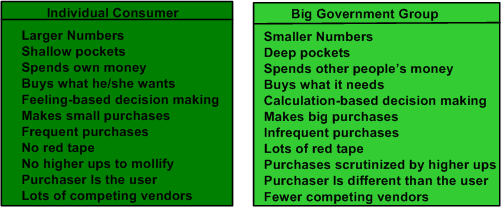
Much of the sage advice given by modern day business gurus like Tom Peters, Gary Hamel, Seth Godin, et al, is targeted at companies that sell to individual consumers. If you sell big, expensive, complex, and long-lived products to government groups, then much of their advice is not applicable.
The graphic below shows just some of the enormous contrasts between these two customer classes. Obviously, the number of individual consumers dwarfs the number of potential government groups. I think that this discrepancy is the major reason why the modern day business experts don’t try too hard at dispensing advice geared toward big system vendors.
One thing that both customer classes have in common is this:
If your product portfolio sux, you are in big trouble.
It doesn’t matter how skilled and talented your marketeers and business development people are. You’re doomed if your product doesn’t perform as expected. At best, your business will muddle along forever amongst the ranks of the mediocre. You will be boring, irrelevant, and uninspiring to all the stakeholders involved in your enterprise. Purgatory city. At worst, crisis management is the order of the day and bankruptcy is just a step or two away.
Can you think of other contrasting attributes between these two vastly different customer categories?
Adjacent Customers
One way to grow and expand a business is to probe and explore the needs and wants of adjacent customers. Assume that the vast majority of your customers are behemoth national governments who have the ability to generate their own revenue streams via the power of taxation. Unlike individual consumers, who are fickle and tighter with the dollar because they actually earn their money through (hopefully) honest work, revenue streams sourced from national governments are much larger and easier to tap into for big product manufacturers.
So what are some potential adjacent customers for a big and complex system manufacturer? The figure below shows some ideas.

Regarding new customers for your company, it seems reasonable to rule out individual consumers, not-for-profit organizations, and small private organizations. Even though the numbers of customers in those categories are huge, they either don’t have the deep pockets that can sustain your business, or they have no need for your big system products .
One could think of smaller, more numerous local governments as adjacent customer markets. It may be a further stretch, but big publicly held Fortune 500 companies may also be considered as potential adjacent customers. However, you may need to invest in, and development, smaller and less expensive adjacent products to serve these new markets.
Here’s the catch. Without allocating and directing any Business Development (BD) or Internal Research and Development (IR&D) resources to the task of probing, sensing, and exploring the needs and wants of these adjacent customer groups, there’s virtually no chance that you’re going to acquire new customers in these adjacent markets. They’re not just gonna show up out of nowhere at your doorstep with a bundle of money asking for your products. Duhhhh!
Business Acquisition And Execution
To become and maintain a successful business, a company must both acquire and efficiently execute ongoing chunks of business. When top management values both of these critical work activities equally, then all is well. When they value one over the other, and in my business domain it’s always business acquisition that’s shown preferential treatment, then mediocrity reigns.
How do you know when top management is one sided? It’s easy, just look around. Who gets the single offices and single cubes? Who gets the bigger salaries? Who do the executives give way more face time to?
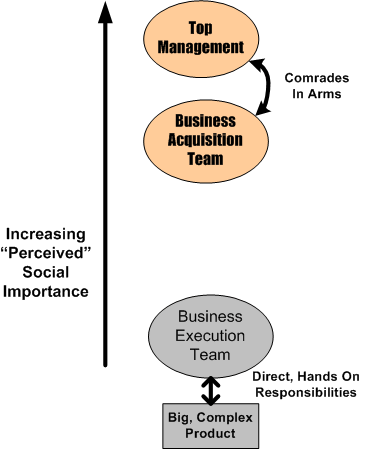
Business acquisition is glamorous and difficult, but in comparison, business execution is dirty, messy, and down right hard. When an acquisition team submits a proposal to a customer after a long and arduous courting period, it’s party time, and rightfully so. However, and this is key, the proposal doesn’t “have to work”. Products “have to work”, or else….
If a proposal is rejected and fails to acquire a chunk of business, then it’s usually because a competitor has offered up a similar or superior product for a lower price and/or a faster delivery time. The loser washes his hands clean and then just moves on to the next opportunity. It’s done and over with, kaput.
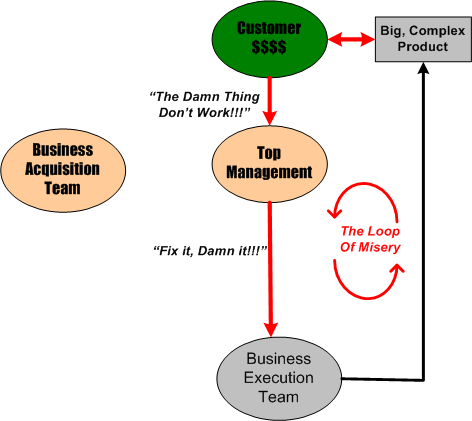
When a big, complex, and software-intensive product repeatedly and frequently fails in a customer’s day to day use of it, then continuous stress and pressure is placed on the execution team for what could be quite a long and sustained period of time. Until the execution team, usually through heroic acts of team sacrifice, makes the product behavior and performance “acceptable” to the customer, the two step chain of events is as follows: the customer pressures top management, and top management pressures the execution team. The loop of misery has been ignited. Notice that the acquisition team does not participate in the fun. In the worst case, the acquisition team merges with the top management team to apply greater pressure on the execution team.
Don’t be a stupid arse like me. If you’re given the choice between participating on an acquisition team or an execution team, choose the acquisition team 🙂

Why am I here?
WTF?
Meh!
D'oh!

My BTC Address



 Bulldozer00's Blog