Archive
Khan Academy
Via this Bill Gates tweet;

I discovered the Khan Academy. The breadth and depth of knowledge that Sal Khan has acquired and freely shares is astonishing and awe inspiring. Mr. Khan creates blackboard based videos in which he gently derives and explains the topic at hand. In real-time, Sal explains his thinking and makes/corrects mistakes on the way to the successful transmission of knowledge, understanding, and insight. I’ve watched several of Sal’s physics and math videos and I’m grateful for his selfless and passionate contribution to the world.
I’d love to create something on the scale of a Khan academy (would you?). Alas, all I need to do is develop a hard-to-copy product that someone actually wants and a strategy for selling it. D’oh! To the chagrin of the institutional world, the low cost tools of production and no-cost means of getting word out have been here for at least a decade, but it is only being slooowly recognized as the ultimate business infrastructure.

I’m The Right Guy At The Right Time
From a recent article (I forgot to bookmark the link – D’oh!) describing the large backlog of IPOs still scheduled for this year, I discovered that GM’s (supposed) resurrection is expected to be the largest. It’s estimated that the “Government Motors” IPO will raise $15B dollars, but none of it will come from me and you’ll understand why in the narrative that follows.
From the same article, I also learned that GM is being led by its fourth CEO in 18 months, Mr. Daniel Akerson. Guess what? Mr. Akerson is an aged and most probably out-of-touch white dude just like all the other recent esteemed GM CEOs. Guess what? Mr. Akerson also speaks in the same, self-centered, corpo tongue as most stereotypical Tayloristic CEOs:
I’m the right guy at the right time.
I’m looking out the front windshield.
GM’s products are second to none.
GM’s global manufacturing structure is the envy of the industry.
I did not get to where I am in life by being deaf, dumb, and blind.
I wish the company well, but, uh, I ain’t gonna invest in GM. Are you?
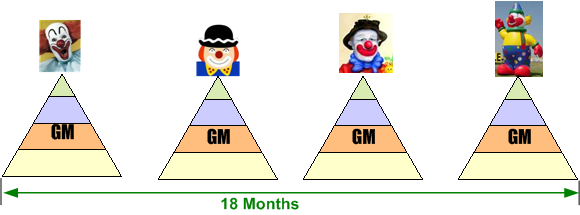
Assimilated And Digested
This is another one of my dorky pictures that doesn’t contain any accompanying words of explanation. “I’m a little verklempt, so talk amongst yourselves. I’ll give you a topic: Acquisition” – Linda Richman.

Thanx for the link dB!
Directors Of Disasters Wanted
As the title of the following “Directors Are in Demand, Even if Companies Fail” NY Times article states, high paid, do nothing directors who snoozed while the companies they “directed” went right down the tubular chute are still being sought out to “help” corpo survivors prosper.
While in some cases investors are suing members of the boards of the failed companies, shareholder advocates have for the most part focused their energies on other issues. And public outrage over the financial crisis has been mainly focused on the executives in charge of firms like Bear and Lehman.
In many cases during the real estate bubble, directors approved the strategy that paved the way for executives to make risky investments on borrowed money.
In our corporate system the directors are supposed to be in charge, not the C.E.O., yet they rarely get any of the blame because they’re typically dominated by the C.E.O.
The incestuous inbreeding that goes on in the CEO and board of directors stratosphere is so powerful that not even an A-bomb can break the lovefest. Of course, the classic response of board members from failed CCFs (which does have a grain of truth in the unlikely case where they’ve learned something from the failure) is that their hands-on experience will save their new CCFs from suffering the same fate. Uh, OK.

Inability To Assimilate
In this Federal Computer Week magazine blog post, the author laments about the inability to hire talented people into the government borg:
- “The supervisors here are sycophants who are only interested in their careers.”
- “My experience is (more or less) a third of folks (management and labor) are amazing and functional well beyond pay and expectations. Another third are limited, work-reward clock-punchers. The last third are untrainable and unfireable.”
- “I’ve seen one too many occasions of “hiring teams” not hiring the best qualified but hiring friends that don’t meet the job requirements. “
- “The federal human resources processes do not necessarily match skills and education with job positions. “
- “We have more layers of management and more keep getting added without adding any workers.”
- “There are contracting personnel put in jobs who have not a clue about true contracting processes. These individual are put in position because of favoritism.”
- “Most middle-level managers want to demonstrate they are in control.”
Of course, the statements above only apply to government bloat-ocracies, no?

The End Of An Era
I’m sad, very sad, to report the end of an era at my company. Because of the ominous near term business outlook in our industry, we’ve had to lay off 84 friends and colleagues after 25 years of no-reduction-in-workforce existence. In my mind, not having to lay off anyone in 25 years of operation is truly a remarkable achievement. Even the best make mistakes and go through tough times.
I feel very fortunate that up until now (and I’ve been around for a looooong time) I’ve never had to go through the experience of watching my employer shrink right before my eyes. But ultimately, ya gotta make money to stay in b’ness.

Death By A Thousand Cuts
Zappos.com CEO Tony Hsieh has a new book out titled “Delivering Happiness“. Early in this heartwarming and wonderful little tome, he tells the story of the first real company he co-founded – LinkExchange. As LinkExchange grew and became more successful, he turned down offers of $1M (from BigFoot) and then $20M (from Yahoo!) to sell the company. He ended up selling out later for $265M to Microsoft. Tony’s personal take from the sale was a whopping $40M, of which $8M would be forfeited if he didn’t stay on for 1 year after the sale.
Before the sale of LinkExchange, he woke up one day wondering what happened to the company culture. Tony pondered how the day-to-day culture transformed from a joyous “one for all, and all for one” working environment into one that was dominated by “politics, positioning, and rumors“. He couldn’t put a finger on any one specific event or person(s) as the cause of the deterioration in culture, it was more like “death by a thousand cuts“; an insidious and undetectable rise in malady sustained by some unknown force.
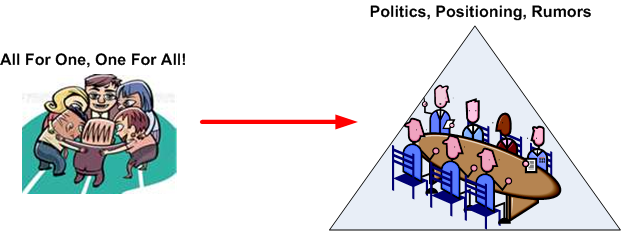
After the sale of LinkExchange, Tony walked away from the company before his contracted year was up, leaving $8M on the table. His reasoning was that he already had plenty of money and his happiness was worth more than the extra $8M. The end of LinkExchange was the start of Zappos.com…..
I had decided to stop chasing the money, and start chasing the passion – Tony Hsieh
DIC In A Box
I’ll wager $0 cents that 99% of corpo America institutes some kind of (yawn) standard DIC-in-a-box compensation system as shown in the figure below. Why? Because that’s what the Sloan, Wharton, and other “elite” B-schools say is the “optimum” motivational system, of course. Plus, it’s the safest and easiest way to reward the DICforce. What box are you in, fellow DICster? If you’re a BM, you’re unboxed at the mysterious and unrecorded level N+1, where there is no $Max, right?

Check out the two radical, but non-theoretical, compensation systems in place at these two real and deviant orgs:
According to “normal” business criteria, which are profit and revenue growth, Fog Creek Software and Semco must be considered successful companies, no?
 What kind of innovative compensation system does your company use?
A New Title Should Do It
“To solve our decreasing revenue and rising cost problems, we’ll just create a new title and insert the position into the org (thereby adding another layer to the stratified corpo cake). Voila! The problem will be solved (so let’s give ourselves a special bonus for being so smart).”
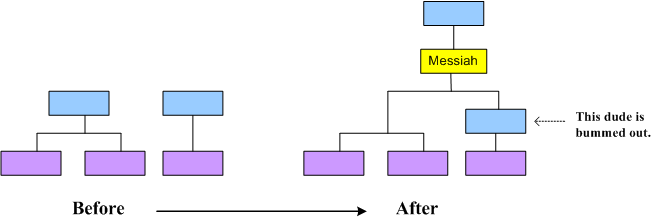
“But wait. What should the title be? Supervisor, Manager, Deputy Manager, Director, Deputy Director, General Manager? Should we bump it up by attaching a “Chief” and/or VP to the label? “We must be careful because the loftier the title, the more we’ll have to pay our new colleague (who will no doubt accomplish what we have failed to do).”

Such is the mindset of MBA trained corpo elites and their stooge press magazines like Business Week, Forbes, Fortune, et al. Do ya really think parachuting a messiah in to jumpstart an org with:
- an apathetic DICforce that is not as stupid as the head shed assumes and doesn’t appreciate management’s patronizing attitude
- an aging product development and manufacturing infrastructure (e.g. tools, processes, know how)
- an old and tired product portfolio that’s continually being usurped by competitor offerings
- a culture of undiscussable but obvious inter-group rivalry and disrespect
is realistic? Fragmented, hero-worshipping mindsets don’t clean up what Russell Ackoff calls, for lack of a better word, “messes”. Systemic thinking, along with the willingness to skinny dip, fully exposed, into the stinky mess is the only way to understand and clean up messes. Sadly, even if one or two dudes in the head shed junta are closet system thinkers and they try to speak out or take action, they’re promptly put back into their assigned slot….. and business resumes as usual…. while the mess grows ominously larger.
And now, for the bad news….. 🙂
MITRE
I work in the aerospace and defense industry. This industry is typically slow moving and not known for bleeding edge innovation. Thus, I was intrigued when I discovered that the MITRE corporation came in at number 30 in Fast Company magazine’s 2010 list of the 50 most innovative companies in the world. I scanned the list for other companies in the industry, but I (unsurprisingly) didn’t find any more industry stalwarts among the innovative elite.
In addition to the world class innovators, Fast Company also lists the top 10 innovative companies in a slew of industries, including the the defense business. Here is their list of innovators, subjectively decided by someone, or some group, at Fast Company.
- Mitre
- DARPA
- iRobot
- QinetiQ
- Northrup Grumman
- Raytheon
- Lockheed Martin
- Boeing
- Aurora Flight Services
- ATK
After reading the summary for each company, it appears that most money and brainpower are being invested in unmanned moving, sensor packed products like robots and aerial vehicles. For companies looking to branch out and explore new business opportunities, they may do well to invest in these areas and see if anything emerges.


Why am I here?
WTF?
Meh!
D'oh!

My BTC Address



 Bulldozer00's Blog