Archive
Requisite Knowledge
In “Item 3. Design Patterns” of Stephen Dewhurst’s “C++ Common Knowledge: Essential Intermediate Programming“, he states the following:
Design patterns are often described as “micro-architectures” that can be composed with other patterns to produce a new architecture. Of course, selecting appropriate patterns and composing them effectively requires design expertise and native ability. However, even your manager will be able to understand the completed design if he or she has the requisite knowledge of patterns.
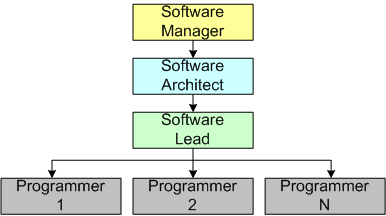
Uh, Stephen, you’re kidding, ain’t ya? In a project mini-corpricracy like the one below, you’ll be lucky if even the software lead knows what a pattern is, let alone the lofty manager. The software “Rocket-tect” will most likely know what a pattern is – but probably not how to apply it since he/she will be stuck in “lemme-show-u-how-smart-I-am” jargon-land. On the bright side, everybody in the power structure (which excludes the programmers, of course) will know what a Microsoft schedule, spreadsheet, and powerpoint deck are.
Two Paths
As a small group of people assembled for a purpose greater than each individual grows, some form of structure is required to prevent chaos from reigning. The top path shows the emergence of a group of integral coordinators while the bottom path shows a traditional, stratified CCH being born.
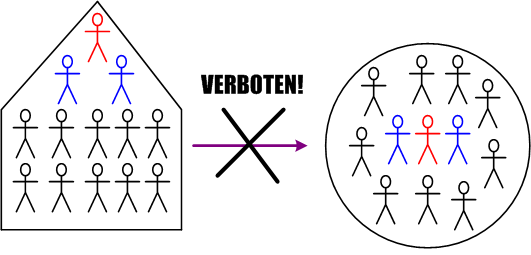
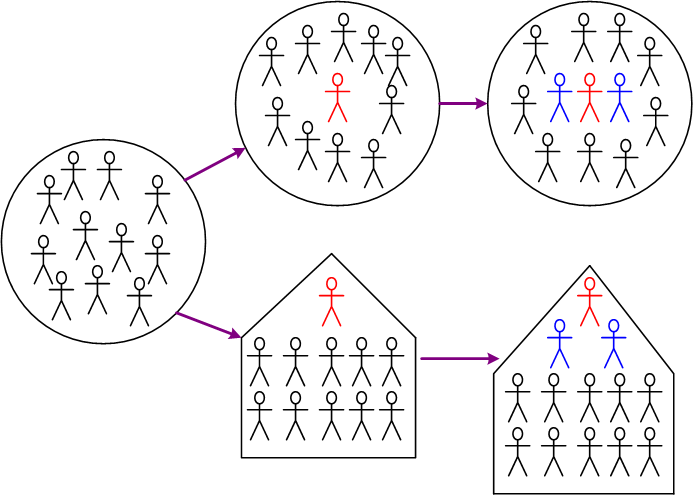 Which group would you rather be a part of? If you say you’d rather be a part of the “circular” group and you’re lucky enough to be a part of one, you’re still likely to get hosed down the road. You see, if your group continues to grow, it will naturally gravitate toward the pyramidal CCH caste system. That is, unless your natural or democratically chosen group leaders don’t morph into CGHs or BOOGLs and they actively prevent the subtle transformation from taking place.
 If you’re currently embedded in a CCH and one of its leaders bravely attempts to change the structure to a circular, participative meritocracy, fugg-ed-aboud-it. The change agent will get crushed by his/her clanthinking BOOGL and SCOL peers, who ironically espouse that they want circular behavior while still preserving the stratified CCH.
Busy Doing Nothing
The British created a civil service job in 1803 calling for a man to stand on the Cliffs of Dover. The man was supposed to ring a bell if he saw Napolean coming….. The job was abolished in 1945. – Robert Townsend.
The battle of Waterloo, in which Napolean’s army was routed, was fought in 1815. Thus, the series of dudes who stood guard for 130 years after the fall of the egotistical French emperor were busy doing nothing but pissing and pooping off the cliffs every few hours – and gettin’ paid for it.

In “Ackoff’s Best: His Classic Writings On Management“, uber systems thinker Russell Ackoff rails against bureaucracies:
A bureaucracy is an organization whose principle objective is to keep people busy doing nothing. They are preoccupied with what we call make-work…. The problem created by people who are busy doing nothing is that they frequently obstruct others who have real work to do. They impose unproductive requirements on others…. Bureaucracies obstruct development. They retard improvement of quality of life…. Bureaucrats want all parts of an organization to conform to one set of rules and regulations…. Conformity is treated as good in itself, an ultimate good. – Russell Ackoff
Mr. Ackoff not only rages against the machine, he advises on how to beat the system with a bevy of hilarious real-life examples in which individuals successfully “fought city hall” and won. He follows each ditty with a moral. Buy the book and read it for the delicious details of every battle.
Inability To Assimilate
In this Federal Computer Week magazine blog post, the author laments about the inability to hire talented people into the government borg:
- “The supervisors here are sycophants who are only interested in their careers.”
- “My experience is (more or less) a third of folks (management and labor) are amazing and functional well beyond pay and expectations. Another third are limited, work-reward clock-punchers. The last third are untrainable and unfireable.”
- “I’ve seen one too many occasions of “hiring teams” not hiring the best qualified but hiring friends that don’t meet the job requirements. “
- “The federal human resources processes do not necessarily match skills and education with job positions. “
- “We have more layers of management and more keep getting added without adding any workers.”
- “There are contracting personnel put in jobs who have not a clue about true contracting processes. These individual are put in position because of favoritism.”
- “Most middle-level managers want to demonstrate they are in control.”
Of course, the statements above only apply to government bloat-ocracies, no?

Ty Detmer
Remember Philadelphia Eagles quarterback Ty Detmer? The DETMER metric, which was introduced in yesterday’s post and stands for Decision-To-Meeting-Ratio, is named after Ty. Hah, hah – just joking. There’s no connection between Detmer and DETMER. DETMER is a bogus metric acronym that I concocted and, for some weird reason, Ty’s name repeatedly comes to my defective mind every time I think of it. Time for a straight jacket and meds?
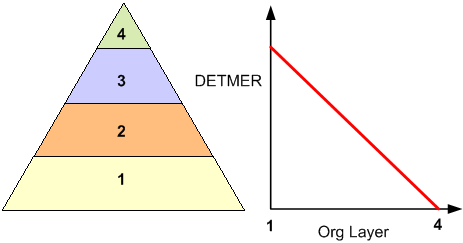
The figure below shows a madeup DETMER vs layer-of-importance curve for a typical corpricracy. The higher one moves up in the caste system, the more useless no-decision meetings one gets to attend. At these egofests, peer SCOLs psychologically duel with each other “under the covers” to prove “I’m great and you’re not“. It’s like a gaggle of peacocks struttin’ around in front of each other showing off how much prettier their plumes are. Of course, few if any important decisions are arrived at during these aristocratic social events. At the highest levels in the CCF, every hour of every day is booked with these “Dancing With The Czars” assemblies.
Meetings and Decisions
Orgs of people exist for a purpose. In order to continuously fulfill the org’s purpose in a changing external environment, its members need to make decisions regarding what to do and when to do it in order to counter unfavorable changes that are at odds with the org’s purpose. Since people need to know who will do what, when they’ll do it, and how they’ll coordinate with others to collectively counter external threats, decision-making meetings are held at all levels to decide such issues of importance.
The figure below introduces the Decision-To-Meeting-Ratio (DETMER) metric. It also shows the divergence of this metric for two competing orgs who initially had the same DETMER value at an arbitrary time, T=0. Assuming (and it’s a bad assumption) that all decisions made at each meeting are effective, as the DETMER goes to zero nothing changes for the good within the org walls. People do the same thing everyday, even as the environmental conditions outside the walls relentlessly change. Voila, a bureaucracy led by a cadre of Bozeltines emerges. Bummer.

Loop Of Disrespect
In most companies, “respect” is either an explicit or implicit core value. Is it respectful to repeatedly watch, and covertly condone, project teams working 50-60 hour, unpaid overtime weeks for years at a time to meet some schedule that they most likely had no hand in making? Since the overtime is not paid, it isn’t tracked and future schedule estimates derived from past performances don’t accurately reflect the effort needed to get the job done. Thus, the practice is a self-reinforcing loop of disrespect. But hey, since virtually all corpricracies operate that way, the practice must not be disrespectful, right?
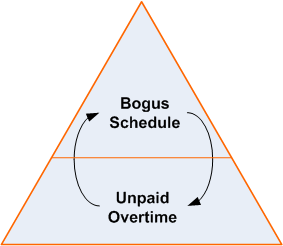
Demanding respect while not giving it, or pretending to give it, creates mediocracies. And since respect and loyalty are intimately coupled, demanding loyalty without giving respect doesn’t work too well either.
Crisis?, What Crisis?
The other day, I heard a song on Pandora from one of my fave albums of the 70s (yes, they were called albums back then); Supertramp‘s “Crisis?, What Crisis“. The album title reminded me of orgs that emotionally panic “under the covers” when a crisis occurs, but outwardly behave as if there is no crisis. By “behaving like no crisis is occurring“, I mean that the SCOLs in charge apply whatever band aids they can in the short term to get through the crisis but don’t do anything of substance to stave off, or better handle, future crises.
When the crisis at hand passes, the heroes are congratulated and: the org structure stays the same, the people in the top roles stay the same, the operational business processes remain the same, and most ominously, the patriarchal CCH mindsets stay the same. It’s back to the same-old, same-old, business as usual.
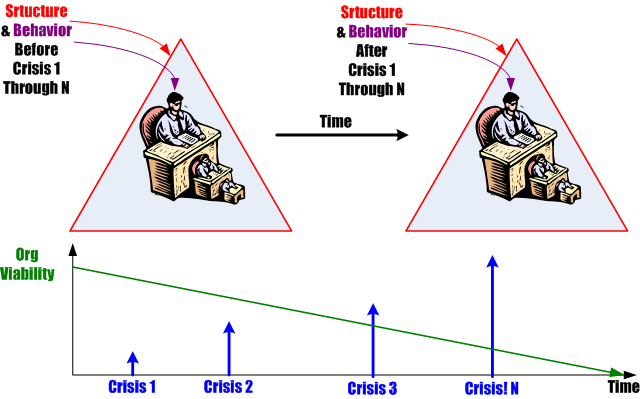
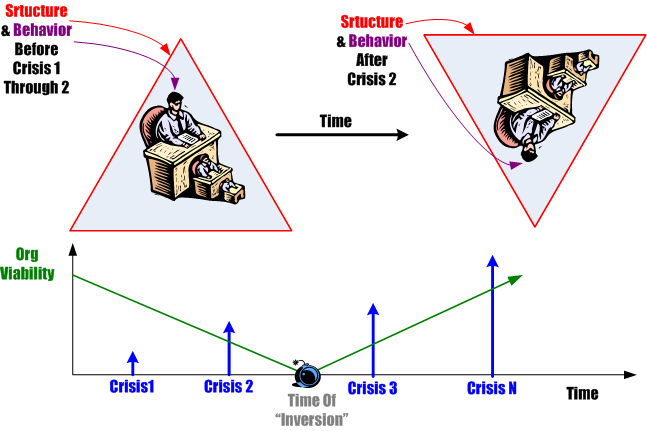
The figure below shows what maybe should happen when crises occur and learning takes place? Someone or some group willingly steps up to positively change the structures and behaviors so that the org can smoothly navigate through, and even thrive within, future crises. In the example below, it took 2 crises to stave off self destruction, right the course, and excel in the future. Alas, the problem with the previous sentence is the “someone or some group” phrase at the beginning.
Innovation Types
In the beginning of Scott Berkun’s delightful and entertaining “Managing Breakthrough Projects” video, Scott talks about two supposed types of innovation: product and process. He (rightly) poo-pooze away process innovation as not being innovative at all. Remember the business process re-engineering craze of the 90’s, anyone? Sick-sigma? Oh, I forgot that sick-sigma works. So, I’m sorry if I offended all you esteemed, variously colored belt holders out there.
According to self-professed process innovators, the process innovations they conjure up reduce the time and/or cost of making a product or performing a service without, and here’s the rub, sacrificing quality. Actually, most of the process improvement gurus that I’ve been exposed to don’t ever mention the word “quality”. They promise to reduce time to market (via some newfangled glorious tool or methodology) or cost (via, duh, outsourcing). Some of these snake oil salesmen dudes actually profess that they can increase quality while decreasing time and cost.
The difference between a terrorist and a methodologist is that you can negotiate with a terrorist – Unknown
Most process improvement initiatives that I’ve been, uh, lucky(?) to be a part of didn’t improve anything. That’s because the “improvements” weren’t developed by those closest to the work. You know, those interchangeable, fungible people who actually understand what processes and methods need to be done to ensure high quality.All that those highly esteemed, title-holding, mini-Hitlers did was saddle the value makers and service providers down with extra steps and paperwork and impressive looking checklists that took away productive time formerly used to make products and provide services.
Process improvement is a high-minded, overblown way of saying “kill the goose that laid the golden egg before it lays another one“.
A Blessing And A Curse
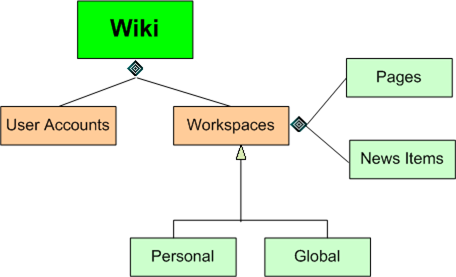
The figure below depicts a UML class diagram model of the static structure of a typical Wiki system. A Wiki may be comprised of many personally controlled and/or global workspaces. Each logical workspace is composed of user created work pages and news items (a.k.a. blog posts). Lastly, a Wiki contains many user accounts that are either created by the users themselves or, in a more controlled environment, created by a gatekeeper system administrator. Without an account, a user cannot contribute content to the Wiki database.
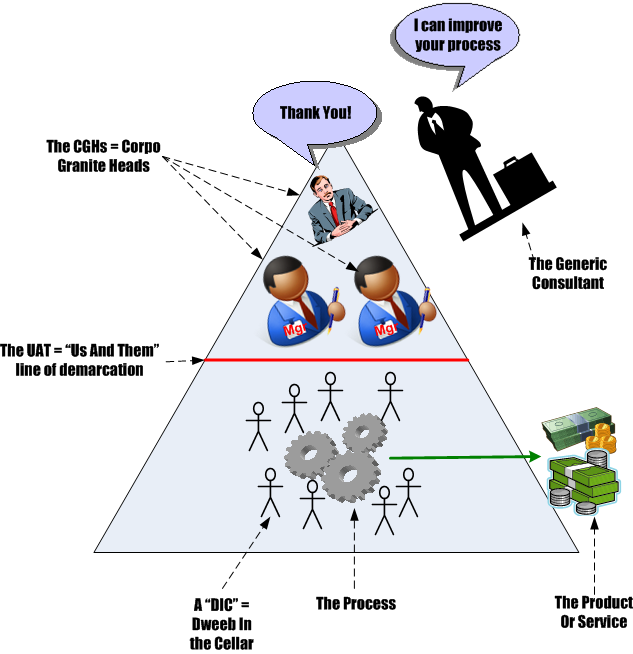
Org Wikis are both a blessing and a curse. They’re a blessing for the DICforce in that they allow for close collaboration and rapid, real-time information exchange between and across teams. They also serve as an easily searchable and publicly visible record of org history.
In malevolent and stovepiped CCHs where SCOLs and BOOGLs rarely communicate horizontally and, even more rarely, downward to the DICforce, Wikis are a curse because….
Networks make organizational culture and politics explicit. – Michael Schrage
BOOGLs and SCOLs that preside over malevolent CCHs don’t like having their day-to-day operational behavior exposed to the light of day. If a malevolent CCH org is liberal enough to “approve” of Wiki usage, chances are that none of the BOOGLs or SCOLs will contribute to its content. In the worse case, a Wiki police force may be established to enforce posting rules designed to keep politics and positioning behavior secret. Hell, without censorship, the DICforce might form the opinion that they are being led by a gang of thugs who are out for themselves instead of the lasting well being of the org.
Are you here to build a career or to build an organization? – Peter Block

Why am I here?
WTF?
Meh!
D'oh!

My BTC Address



 Bulldozer00's Blog