Waiting For The Bus
I’ve been following Scott Berkun for at least a decade. Every month or two, I mosey on over to his site to get my Berkun fix and see what he’s up to. I’ll read some of his blog posts and/or watch a video of one of his great talks.
While watching Scott’s lecture to MIT students on innovation, I paused the video to steal this insightful graphic:
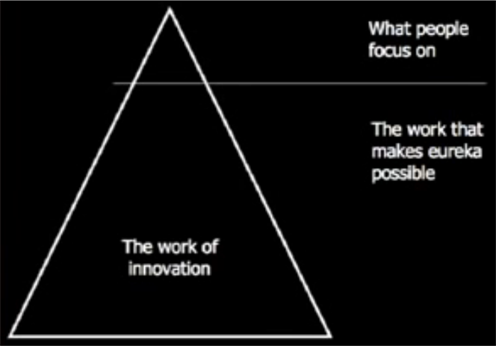
People (especially in western cultures) love short and sweet stories of epiphanies and overnight success – the tip of the iceberg. They yearn to believe that world changing innovations happen in flashes of instantaneous insight, no preparation required, all glory and no sweat.
Scott’s research for his Myths Of Innovation book busts the misconception of all mental play and no work. Oh sure, the epiphanies and eureka moments do indeed occur. But odds are that the innovator has been obsessing over a specific problem; immersing herself in the meticulous details of the problem and its enveloping context. The innovator has likely been exploring solution paths for months, years, or even decades. The hard, persistent, sustained, work of mulling over ideas prepares the innovator to receive the proverbial epiphany as thrust down upon her from the heavens.
But alas, doing the hard work can only get you to the bus stop. It doesn’t guarantee that the bus will arrive – ever.

Battling The Confirmation Bias
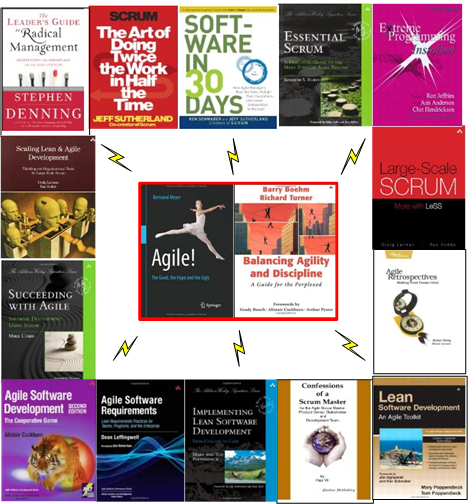
On my first pass through Bertrand Meyer’s “Agile!” book, I interpreted its contents as a well-reasoned diatribe against agilism (yes, “agile” has become so big that it warrants being called an “ism” now). Because I was eager to do so, I ignored virtually all the positive points Mr. Meyer made and fully embraced his negative points. My initial reading was a classic case of the “confirmation bias“; where one absorbs all the evidence aligning with one’s existing beliefs and jettisons any evidence to the contrary. I knew that the confirmation bias would kick in before I started reading the book – and I looked forward to scratching that ego-inflating itch.
On my second pass through the book, I purposely skimmed over the negatives and concentrated on the positives. Here is Mr. Meyer’s list of positive ideas and practices that “agile” has either contributed to, or (mostly) re-prioritized for, the software development industry:
- The central role of production code over all else
- Tests and regression test suites as first class citizens
- Short, time-boxed iterations
- Daily standup meetings
- The importance of accommodating change
- Continuous integration
- Velocity tracking & task boards
I should probably end this post here and thank the agile movement for refocusing the software development industry on what’s really important… but I won’t 🙂
The best and edgiest writing in the book, which crisply separates it from its toned down (but still very good) peer, Boehm and Turner’s “Balancing Agility And Discipline“, is the way Mr. Meyer gives the agilencia a dose of its own medicine. Much like some of the brightest agile luminaries (e.g. Sutherland, Cohn, Beck, Jeffries, Larman, Cockburn, Poppendieck, Derby, Denning (sic)) relish villainizing any and all traditional technical and management practices in use before the rise of agilism, Mr. Meyer convincingly points out the considerable downsides of some of agile’s most cherished ideas:
- User stories as the sole means of capturing requirements (too fine grained; miss the forest for the trees)
- Pair programming and open offices (ignores individual preferences, needs, personalities)
- Rejection of all upfront requirements and design activities (for complex systems, can lead to brittle, inextensible, dead-end products)
- Feature-based development and ignorance of (inter-feature) dependencies (see previous bullet)
- Test Driven Development (myopic, sequential test-by-test focus can lead to painting oneself into a corner).
- Coach as a separate role (A ploy to accommodate the burgeoning agile consulting industry. Need more doer roles, not talkers.)
- Embedded customer (There is no one, single, customer voice on non-trivial projects. It’s impractical and naive to think there is one.)
- Deprecation of documents (no structured repository of shared understanding to go to seek clarification on system level requirements/architecture/design issues; high maintenance costs for long-lived systems; costly on-boarding of new developers)
I’ve always maintained that there is much to like about the various agile approaches, but the way the agile big-wigs have been morphing the movement into a binary “do-this/don’t-do-that” religious dogma, and trashing anything not considered “agile“, is a huge turnoff to me. How about you?
Beware Of Micro-Fragmentation
While watching Neal Ford’s terrific “Agile Engineering Practices” video series, I paid close attention to the segment in which he interactively demonstrated the technique of Test Driven Development (TDD). At the end of his well-orchestrated example, which was to design/write/test code that determines whether an integer is a perfect number, Mr. Ford presented the following side-by-side summary comparison of the resulting “traditional” Code Before Test (CBT) and “agile” TDD designs.
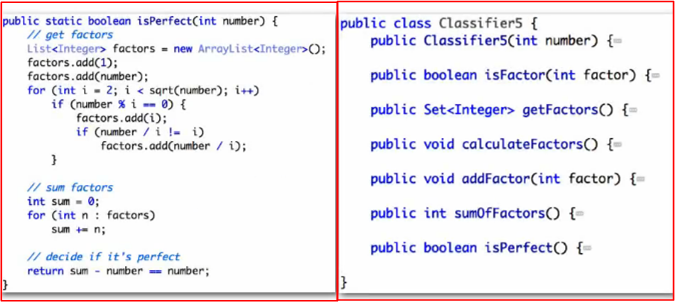
As expected from any good agilista soldier, Mr. Ford extolled the virtues of the TDD derived design on the right without mentioning any downside whatsoever. However, right off the bat, I judged (and still do) that the compact, cohesive, code-all-in-close-proximity CBT design on the left is more readable, understandable, and maintainable than the micro-fragmented TDD design on the right. If the atomic code in the CBT isPerfect() method on the left ended up spanning much more space than shown, I may have ended up agreeing with Neal’s final assessment that the TDD result is better – in this specific case. But I (and hopefully you) don’t subscribe to this, typical-of-agile-zealots, 100% true, assertion:
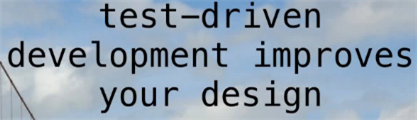
The downside of TDD (to which there are, amazingly, none according to those who dwell in the TDD cathedral), is eloquently put by Jim Coplien in his classic “Why Most Unit Testing Is Waste” paper:
If you find your testers (or yourself) splitting up functions to support the testing process, you’re destroying your system architecture and code comprehension along with it. Test at a coarser level of granularity. – Jim Coplien
As best I can, I try to avoid being an absolutist. Thus, if you think the TDD generated code structure on the right is “better” than the integrated code on the left, then kudos to you, my friend. The only point I’m trying to make, especially to younger and less experienced software engineers, is this: every decision is a tradeoff. When it comes to your intimate, personal, work habits, don’t blindly accept what any expert says at face value – especially “agile” experts.
A Bad Day
Last Saturday was a bad day. The head came flying off my five iron while hitting balls at the golf dome and I broke my giant tini’ glass. Boo hoo, poor me.

Looking on the bright side, I get to buy a new set of clubs. I also have a fashionable, albeit smaller, backup tini’ glass.
Tradagile
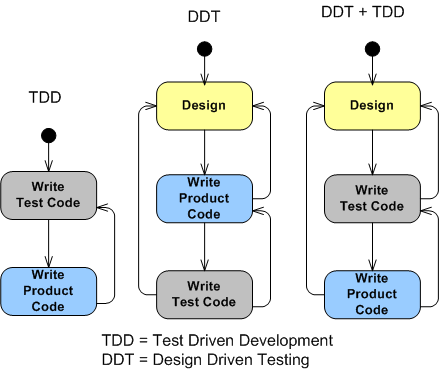
Even though hard-core agilistas (since every cause requires an evil enemy) present it as thus:

For large, complex, multi-disciplined, product developments, it should be as thus:

Scrumming For The Corner Office
Note1: This bogus post was inspired by Bertrand Meyer’s book: “Agile!“. Specifically, the juice is squeezed from chapter 2: “Deconstructing Agile Texts“.
Business gurus love to fabricate crises and instill fear in their deep-pocketed C-level executive clients so they can pitch their latest idea (at $2000/day plus expenses) to “reinvent management!”
Steve Denning is a big-league business management guru, ala Gary Hamel, Tom Peters, Ken Blanchard, Bob Sutton, etc. Even though Mr. Denning has no software background, he somehow got into Jeff Sutherland’s refrigerator and managed to drink a whole pitcher of “agile” koolaid with nary a burp.
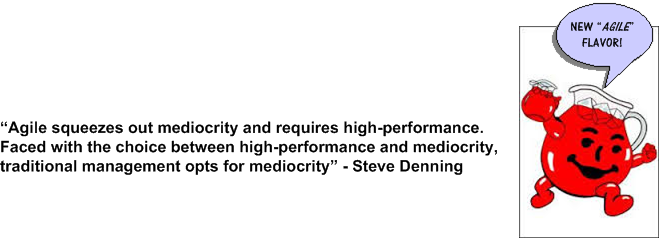
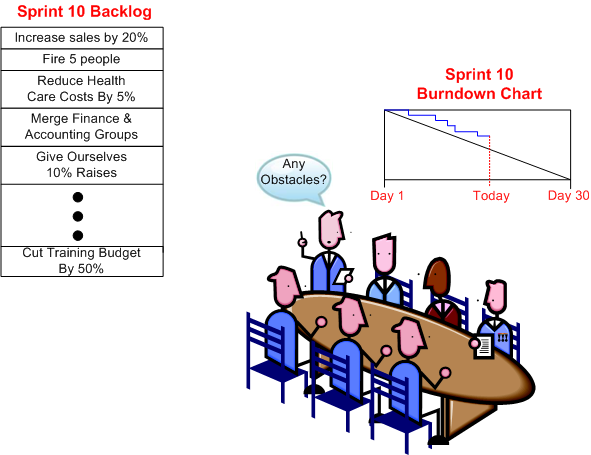
In a brilliant marketing move to distance himself from his peers, Steve has jumped on the “agile” bandwagon. He’s been busy advocating the migration of Scrum out of the software development trenches; up the ladder and into the corner office we go. I can visualize it: CEO as Certified Product Owner, COO as Certified Scrum Master, and the rest of the C-suite as second-class, uncertified, “developers“. (Why is there no certification program for developers?)
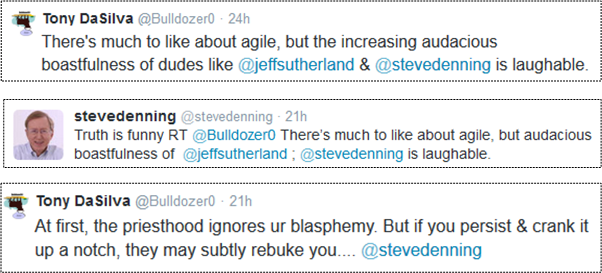
In closing out this post, I’d like to share with you this brief twitter exchange between Mr. Denning and the lowly BD00 :
Note2: I actually like many of Steve’s ideas: “Who’s Left Standing?“, “Salesmen And Accountants“.
Scaling Up And Out
Ever since I discovered the venerable Erlang programming language and the great cast of characters (especially Joe Armstrong) behind its creation, I’ve been chomping at the bit to use it on a real, rent-paying, project. That hasn’t happened, but the next best thing has. I’m currently in the beginning stage of a project that will be using “Akka” to implement a web-based radar system gateway.

Akka is an Erlang-inspired toolkit and runtime system for the JVM that elegantly supports the design and development of highly concurrent and distributed applications. It’s written in Scala, but it has both Scala and Java language bindings.

Jonas Boner, the creator of Akka, was blown away by the beauty of Erlang and its ability to support “nine nines” of availability – as realized in a commercial Ericsson telecom product. At first, he tried to get clients and customers to start using Erlang. But because Erlang has alien, Prologue-based syntax, and its own special VM/development infrastructure, it was a tough sell. Thus, he became determined to bring”Erlangness” to the JVM to lower the barriers to entry. Jonas seems to be succeeding in his crusade.
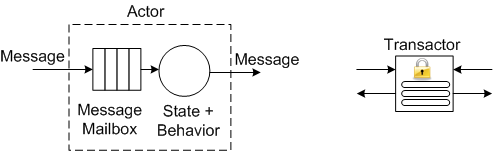
At the simplest level of description, an Akka-based application is comprised of actors running under the control of an overarching Akka runtime system container. An actor is an autonomous, reactive entity that contains state, behavior, and an input mailbox from which it consumes asynchronously arriving messages. An actor communicates with its parents/siblings by issuing immutable, fire-and-forget (or asynchronous request-and-remember), messages to them. The only way to get inside the “head” of an actor is to send messages to it. There are no backdoors that allow other actors to muck with the inner state of an actor during runtime. Like people, actors can be influenced, but not explicitly coerced or corrupted, by others. However, also like people, actors can be terminated for errant behavior by their supervisors. 🙂
For applications that absolutely require some sort of shared state between actors, Akka provides transactors (and agents). A transactor is an implementation of software transactional memory that serializes access to shared memory without the programmer having to deal with tedious, error-prone, mutexes and locks. In essence, the Akka runtime unshackles programmers from manually handling the frustrating minutiae (deadlocks, race conditions (Heisenbugs), memory corruption, scalability bottlenecks, resource contention) associated with concurrent programming. Akka allows programmers to work at a much more pleasant, higher level of abstraction than the traditional, bare bones, threads/locks model. You spend more time solving domain-level problems than battling with the language/library implementation constraints.

You design an Akka based system by, dare I say, exercising some upfront design brain muscle:
- decomposing and allocating application functionality to actors,
- allocating data to inter-actor messages and transactors,
- wiring the actors together to structure your concurrent system as a network of cooperating automatons.
The Akka runtime supervises the application by operating unobtrusively in the background:
- mapping actors to OS threads and hardware cores,
- activating an actor for each message that appears in its mailbox,
- handling actor failures,
- realizing the message passing mechanisms.
Gee, I wonder if the agile TDD and the “no upfront anything” practices mix well with concurrent, distributed system design. Silly me. Of course they do. Like all things agile, they’re universally applicable in all contexts. (Damn, I thought I’d make it through this whole post without dissing the dogmatic agile priesthood, but I failed yet again.)
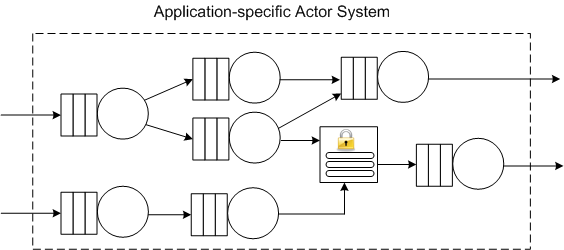
Akka not only makes it easy to scale up on a multi-core processor, Akka makes it simple to scale out and distribute (if needed) your concurrent design amongst multiple computing nodes via a URL-based addressing scheme.

There is much more deliciousness to Akka than I can gush about in this post (most notably, actor supervision trees, futures, routers, message dispatchers, etc), but you can dive deeper into Akka (or Erlang) if I’ve raised the hairs on the back of your geeky little neck. The online Akka API documentation is superb. I also have access to the following three Akka books via my safaribooksonline account:

Since C++ is my favorite programming language, I pray that the ISO C++ committee adds Erlang-Akka like abstractions and libraries to the standard soon. I know that proposals for software transactional memory and improved support for asynchronous tasking and futures are being worked on as we speak, but I don’t know if they’ll be polished enough to add to the 2017 standard. Hurry up guys :).


Blind Copy
I just finished watching Simon Brown’s brilliant talk: “Software Architecture vs Code”.
I thought the segment he presented on levels of testing was really, really good. Simon had the nerve to question the dogma of TDD and the dubious value of unit testing the hell out of your code (90%, 100% coverage anyone?). He cited the controversial writings of Jim Coplien and David Heinemeier-Hansson that poke some holes in those revered, extreme practices:
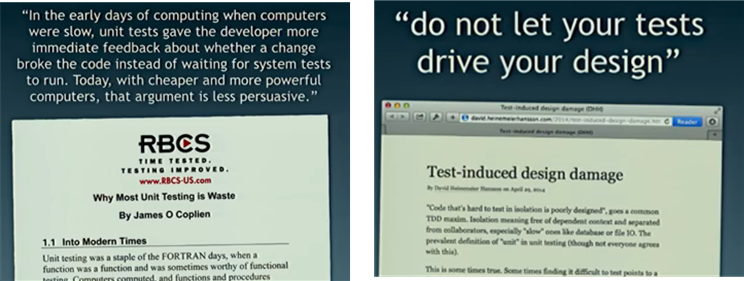
Like Cope and DHH, Simon does not advise shit-canning ALL unit testing. He simply suggests rethinking the test pyramid and how one allocates resources to the various levels of testing:
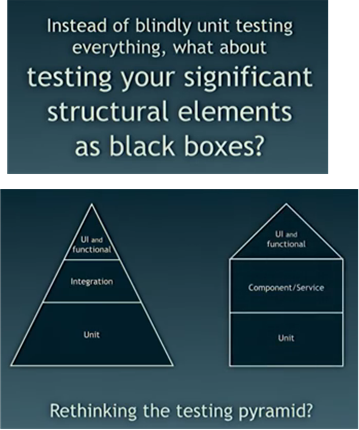
Instead of mandating 90 or 100 percent unit test coverage in order to create a high level of (false) confidence in your code base, perhaps you and your org should consider the potential silliness of the current obsession with TDD and writing huge unit test suites. Maybe you’d save some money and deliver your product faster. But then again, maybe not.
All About The Plunge!
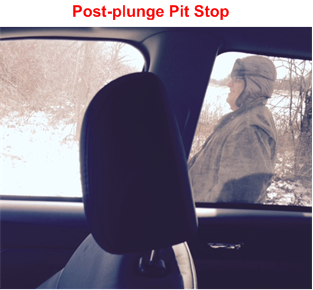
Damn, I did it! At 11 AM, on January 1, 2015, here’s what went down: “Forty-two participants brave icy waters of Cayuga Lake for annual Polar Bear Plunge”. W00t!





When are YOU gonna take the plunge????

Why am I here?
WTF?
Meh!
D'oh!

My BTC Address



 Bulldozer00's Blog