Archive
Thought Recognition
Do you ever find yourself in the throes of an ego-tantrum, and then recognize that your monster ego is in charge, and then still continue feeding your ego with the negative energy it requires to stay viable? I do it all the freakin’ time and it always leads to feelings of post-tantrum guilt. The reason guilt invades my psyche is because of the fact that thought recognition has taken place. If that didn’t happen, then there would be no guilt. In the “old days” prior to starting my search for spiritual advancement, I had no thought recognition skill. Not one iota. Thus, there was no post-tantrum guilt.

So, in this case, is ignorance bliss? Would you rather be ignorant of when your ego is wreaking havoc, or would you rather be cognizant of the fact? Assuming that you chose the latter, do you think you could stop the ego-tantrum dead in its tracks when (external?) thought recognition occurs? If so, what’s your secret?

Make Vs Create
After overcoming the religious specificity in which “A Course In Miracles” is written, I’m finding that it is a deeply moving piece of spiritual work. One of the profound and simple (being a simpleton, I love profound and simple) insights communicated to me is the difference ‘tween making and creating. According to the ACIM authors, human beings “make” out of necessity (to get paid, to solve a problem, etc) but “create” out of love (art, music, children, etc). Before this discovery, I thought that “making” and “creating” were cut from the same cloth.
The story behind the making of ACIM is remarkable:
A Course in Miracles began with the sudden decision of two people to join in a common goal. Their names were Helen Schucman and William Thetford, Professors of Medical Psychology at Columbia University’s College of Physicians and Surgeons in New York City. They were anything but spiritual. Their relationship with each other was difficult and often strained, and they were concerned with personal and professional acceptance and status. In general, they had considerable investment in the values of the world. Their lives were hardly in accord with anything that the Course advocates.
Schucman writes:
The head of my department unexpectedly announced that he was tired of the angry and aggressive feelings our attitudes reflected, and concluded that, ‘there must be another way.’ As if on cue I agreed to help him find it. Apparently this Course is the other way.
I was still very surprised when I wrote, “This is a course in miracles.” That was my introduction to the Voice. It made no sound, but seemed to be giving me a kind of rapid, inner dictation which I took down in a shorthand notebook. The writing was never automatic. It could be interrupted at any time and later picked up again. It made me very uncomfortable, but it never seriously occurred to me to stop. It seemed to be a special assignment I had somehow, somewhere agreed to complete.
I remember hearing Eckhart Tolle elaborate on how “The Power Of Now” came into existence. A former PhD student himself, Eckhart described the content as “coming through” him and not “from” him. Michael Jackson, when asked in an interview how he created his best work, stated that the music “came through” him.
I’d love for some creation that’s beneficial to mankind to “come through” me. How about you?

TAO (Pronounced “DOW”, As In The Dow Jones Industrials)
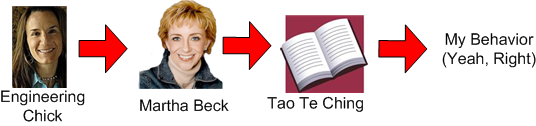
Relax……. Sit back and take three deep breaths, concentrating on the miraculous transitions between your in-breath and your out-breath along with the transitions between your out-breath and your in-breath (what force causes that to happen and keep you alive?). Next, please try to make sense of the following Newtonian cause and effect chain of events;
- I discovered Martha Beck through my colleague, the engineering chick.
- Through Martha Beck, I discovered the acronym TAO = Transparent, Authentic, Open.
- For many years, I’ve loved the eternal message conveyed in the 2600 year old Tao Te Ching.
Because of all of the above, I’ve decided to make a (half-assed, of course) commitment to try to live and behave in accordance with the spirit of Ms. Beck’s TAO. Sadly, it may lead to a life of loneliness and living on the streets begging for pennies, but I’m gonna give it a go.
On second thought, fuggedaboud this post cuz I’m too chicken to do it.
Stuck In The Middle
With the goal of bringing more peace into my life and the lives of others, I’ve studied the work of quite a few spiritual teachers over the years. Adyashanti is one of those sages whose teachings resonate with me. In this interview, Adya states:
“Simply because you’ve had an awakening, however, does not mean you stay awake. Enlightenment, in simple terms, is when you stay awake. If the awakening is abiding, that’s enlightenment. And most awakenings are not abiding — at least, not initially.”
Before those words, I always thought that enlightenment and awakening were the same concept, but Adya’s words make sense to me. I haven’t experienced either of those two states of being, but I hope to someday. The problem with this wishful thinking is that…. it’s wishful thinking:
“One of the best ways to avoid awakening is to let the idea of awakening be co-opted by the mind and then projected onto a future event: something that’s going to happen outside of this moment. This looking to the future isn’t really the fault of the spiritual practices themselves; it’s the attitude with which the mind engages in the practices — an attitude that is seeking a future end and seeing that end as somehow inherently different from what already exists here and now.”
Freakin’ Bummer. Since I’m a slave to my mind, I may be a lost cause. It’s time to change strategies, but wait, the mind devises strategies! According to Adya (and the vast majority of other teachers) using the mind to attain enlightenment is fruitless. Double bummer.
Many spiritual teachers profess that tragedy can be a doorway into awakening and Adya is no different:
Reality is not operating on any moral principle. It’s looking for a moment when the seeker is exhausted. It can be prompted by some tragic event: an illness, or the death of a loved one, or a divorce. Reality rushes into the crack and presents itself.
Triple bummer. I’ve experienced several deeply tragic events but reality hasn’t found any crack to infiltrate my being yet. The lead sarcophagus that encases me is still too impenetrable.
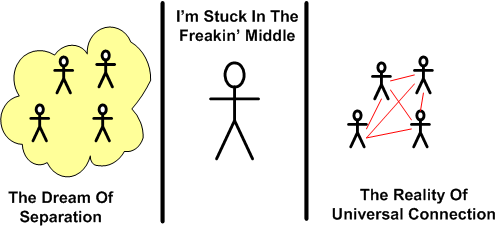
Oh well. With no clue on how to go about awakening out of the dream of separation and experiencing the reality of universal connectedness, I’m, as Stealers Wheel would sing, “Stuck In The Middle“.
RIP, Dear Syd
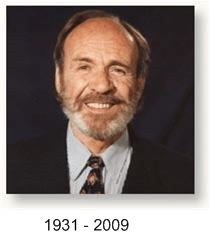
From an acquaintance on LinkedIn.com, I just found out that Sydney Banks died in May. Syd was a simple and under-educated man who didn’t strive for fame and fortune. He was the first spiritual teacher whose words of truth penetrated my thick Newtonian thinking skull. I’m very sad to see him go.
Over ten years ago, I stumbled upon obscure Syd’s work while reading Richard Carlson’s not-so-obscure “Don’t Sweat The Small Stuff — And It’s All Small Stuff”. When I read that small tome, the hairs on the back of my neck kept rising up and I found myself experiencing multiple simple, indescribable, and joyful moments of being. It was weird because the words were so simple, yet they were also very profound to me. I kept saying “WTF?” to myself as I turned the pages.
After finishing “Sweat“, I devoured all of the rest of Carlson’s books and they all had the same endearing effect on me. Curious as hell, I scoured the footnotes and bibliographies to find out where Carlson came up with such impactful and profound thoughts and words. Through at least one level of indirection, I discovered that Syd Banks was at the root of a whole ecosystem that revolved around his work: “The Three Principles – Mind, Consciousness, Thought“. Stunningly, West Virginia University, a stereotypical academic bastion of logical and mechanistic thinking, paid tribute to Syd’s spiritual work by initially naming the West Virginia Initiative for Innate Health after him.
I’m really thankful that I serendipitously discovered the work of Sydney Banks. Rest in peace my dear friend from afar.
Doing And Being
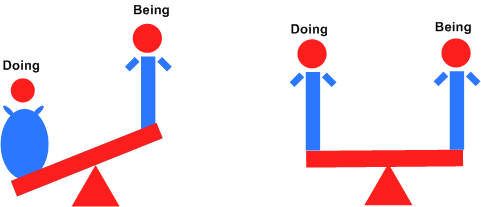
Echkart Tolle has stated that every human being has an inner purpose and an outer purpose. According to Mr. Tolle, our inner purpose is “being” and our outer purpose is “doing”. Along similar lines, Mother Theresa once said something to the effect that “the west is materially rich (from doing) but spiritually poor (from not being)”. I’m on-board with these related insights because I’ve realized them through personal experience. How about you?
A problem that I see with western cultures is that most people have their self worth totally fused with “doing”, while “being” is often disdained, looked down upon, and interpreted as sloth/laziness. There is no balance, and I’m one of those unabalanced (lol!) people. Do I have “factual evidence” to back this up? Of course not. I’m not a world renowned expert and I only speak from personal experience. Plus, I like to make stuff up.
Open, Closed, Inquiring
“Every man, wherever he goes, is encompassed by a cloud of comforting convictions, which move with him like flies on a summer day.” – Bertrand Russell
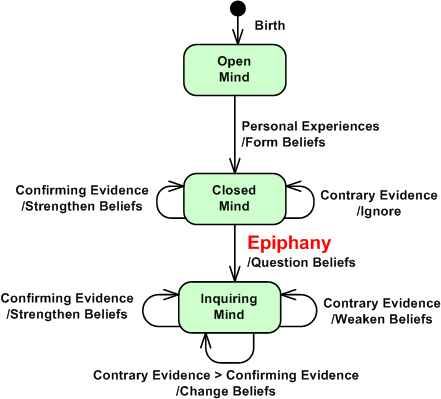
Out of the chute, so to speak, we’re all born with open minds. As we age and accumulate one experience after another, we naturally start forming beliefs based on those experiences. The experiences of other individuals (like our friends and parents) and institutions (like our schools, our corpocracies, and our government) are also impressed upon us. The more similar our new experiences to our previous experiences, the more attached we become to our beliefs. Unknowingly, we’ve started to construct our own very personal “unshakable cognitive burden” (UCB) from the ground up.

As our attachment to (at least some of) those beliefs hardens through exposure to more and more confirming evidence, our minds close up and we start suffering more and more. We tend to conveniently ignore, or violently reject, disconfirming evidence to the contrary in order to preserve our hard earned sense of safety and security. Each subsequent experience causes a nearly instantaneous transition out of, and back into, the closed mind state. Once a core belief (the earth is flat, the sun revolves around the earth, “they” are always right, “—-ism” is infallible) has hardened, intellectual and spiritual growth stops. Stasis sets in. Bummer.

So, how does one break the infinite loop of self-transitions out of, and then back into, the closed UCB mind state? Does another more flexible state exist? I think one may exist- the “Inquiring Mind” state, but I don’t have a clue on how to make the jump to get there. In this state, beliefs still exist but our attachment to them is not absolute. Our level of attachment is fluid and ever changing. As a consequence, our suffering, and more importantly, the suffering of those around us, decreases. The world becomes a kinder and gentler place to live in. We start to recognize our connectedness to all “things” and we empathize with people who still hold fast to their core beliefs.
The state machine below shows one speculative way out of the closed mind state and into the inquiring mind state – the experience of an instantaneous, life-changing epiphany. It’s speculation on my part because I don’t know squat and it’s just a belief that is a brick in my UCB.
Let’s Be Careful Out There!
Based on a recommendation from fellow whack-job W. L. Livingston, I’m currently trying to read “The Theory Of The Leisure Class” by Thorstein Veblen (cool name, eh?). Man, this guy’s a tough read. The vocabulary that Thor(?) uses and his huge paragraphs often cause my CPU to overheat and spew blue smoke, but the self-imposed intellectual torture is worth the pain.
I love exploring the ideas and thoughts of guys like Veblen because they are so far off the beaten path and mind stretching that they cause new, but previously unused synaptic sub-networks to be instantaneously created in my brain. For me, spiritual and intellectual growth is painful but inspiring. The acts of continuously trying to widen my horizons, destroying old and obsolete mental models, and exposing myself to the ideas of others makes me feel vibrantly alive.
When you consciously choose to explore and probe weird and non-standard ideas that go against the norm, you’ve got to watch out for yourself. Internalizing and then subsequently espousing your new learnings in public can be detrimental to your health. If people are really set in their ways and you don’t take their feelings into account, you could trigger the fight or flight response in them. In one-on-one exchanges, the blowback that you experience may not be so bad. However, publicizing your new thoughts in a meeting with a group of clanthinkers can cause you considerable external and internal damage.
“Let’s Be Careful Out There” – Sergeant Esterhaus

Defense Is War
I love Byron Katie because her wisdom never ceases to amaze me. Check out this quote from A Thousand Names For Joy:
Defense is the first act of war. When people used to say, “Katie, you don’t listen,” I would immediately bristle and respond, “Of course I listen! How dare you say that! Who do you think you are? I listen!” I didn’t realize that I was the one making war by defending myself. And I was the one who could end it. It doesn’t take two people to end war; it takes only one.
Like most of what Katie says, this one really hits home with me because I often (waaaay too often) automatically and instinctively flip into defensive mode when someone criticizes me. The problem is that I don’t have a kloo on how to eradicate this pervasively destructive behavior. It’s so ingrained into my being that it would take a miracle to overcome this malady. However, Katie is a beacon of hope. If you read about her 10 year struggle with debilitating depression and her miraculous transformation, you’ll understand what I mean.
Quantum Progress
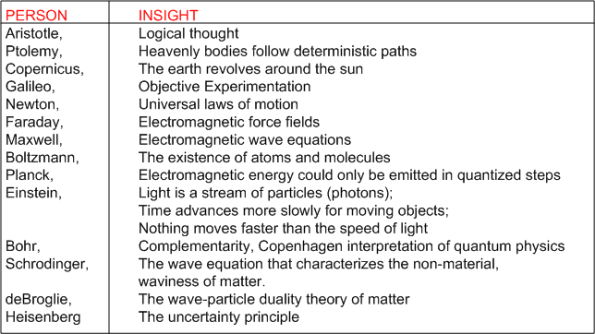
Kuttner and Rosenblum’s “Quantum Enigma” is the best book on quantum physics that I’ve read to date. The table below is my attempt to chronologically summarize some of the well known, brilliant people that led us to where we are today. I found it fascinating that most of the people developed their insights as a result of noticing and pursuing nagging “anomalies” in their work. I also found it fascinating that Einstein was constantly challenging quantum theory even though the math worked flawlessly at predicting outcomes.
The quote that I like most is Bohr’s: “If quantum mechanics hasn’t profoundly shocked you, you haven’t understood it yet”. Well, I don’t understand quantum physics, but I’m still shocked by it. However, since I’ve been consuming all kinds of spiritual teachings over the past 15 years, I’m not surprised by what quantum physics says. Academically “inferior”, but much wiser spiritual teachers have been saying the same thing for thousands, yes thousands, of years. From the Buddha, Lao Tzu, and Jesus, to Krishnamurti, Tolle, and Adyashanti; they didn’t need exotic and esoteric math skills to develop their ideas and thoughts.

Why am I here?
WTF?
Meh!
D'oh!

My BTC Address



 Bulldozer00's Blog