Archive
Fill In The Blanks
While doodling around with my e-sketchpad on a quiet Sunday morning, I conjured up the series of drawings you see below. However, when I tried to make up a BS story that tied the series together in a semi-coherent manner, I failed.
Rather than throwing the series of pics away, it occurred to me to ask for your help. So, can you help me out by filling in the blanks? Think of my plea for your right-brained help as a constrained exercise in creative writing.
The comments section is now open! Please come on down and give it a shot.
—————————————————————————————————————————
<<blank 1>>
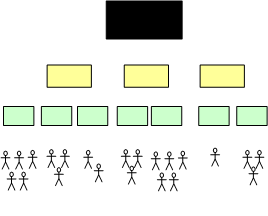
<<blank2>>
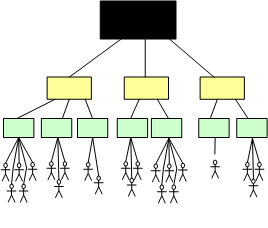
<<blank3>>
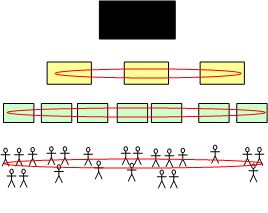
<<blank4>>
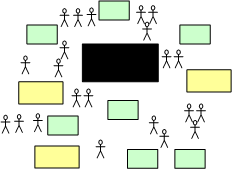
<<blank5>>
World Reknowned
WordPress.com is such a sweet blogging platform. The team keeps innovating and adding useful, customer-friendly features to the site. Here’s a recent addition to the stats page that enumerates page hits by country:

It’s thrilling to see people outside of the USA stopping by and taking a peek at bulldozer00.com. I anxiously await the arrival of viewers from North Korea, Cuba, Iran, the glorious nation of Kazakhstan, and the mud lands of Elbonia.
Robot00.com
The other day, I received a package from Amazon and I was popping the packing bubbles to reduce the volume for throwing them away. While robotically popping away, I had a sudden realization that I was thinking about what my next blog post was going to be about. I wasn’t paying attention at freakin’ all to what I was doing.
I reflected further, and then became amazed at how much of my so-called conscious time is spent on autopilot – not thinking in the least about what I’m doing at the moment. I realized that the only time I really think “in the moment” and pay attention to what I’m doing is when I’m designing/writing code, golfing, and writing blog posts. Sadly, that is not the majority of my time. Not even close.

How abut you? Do you find yourself in robopilot mode often?
Fish On Fridays III
It’s Friday, so it’s time to eat some more fish. Guest blogger “fishmeister” has fried up another tasty treat for you and me to savor.
Firefighter or Fire-proofer: The Tyranny of Today
Software coder. Designer. Thinker.
In those jobs, your primary purpose is to take a blank page and fill it with something that solves an identified problem or need. Often, this requires a great deal of cognitive thinking–noodling out an idea ahead of any actual work. And this takes time.
Unlike a laborer, who’s efforts are immediately apparent as their manual activities produce something tangible, cognitive thinking does not take place on a schedule. You can’t just sit down and say “at 10:30 on Tuesday, I’m going to have a brilliant thought“. It takes time. Sometimes lots of time. And sometimes it happens at odd times when you least expect it.
That ‘eureka moment’ can happen in the car, in the shower, at your desk, in line for coffee–anywhere, anytime. Which brings me to the real reason for this post.
If your work time is spent on putting out fires and solving immediate issues at the expense of thinking strategically about long-term solutions–innovation–you end up getting stuck in the Tyranny of Today–being a fireman instead of a fire-proofer.
Jeffrey Phillips writes a blog that I follow regularly. (BD00’s humble writings and Jeffrey’s are #1 and #2 on my daily morning reading list). ((I won’t say in which order, though)). 🙂
The other day he wrote about The Tyranny of Today. It resonated with me on so many levels that I had to share it with my boss. He outlines everything that we are currently struggling with in our business every day.
We have a large cadre of Designers in our organization, yet we are always being challenged because we don’t think ‘creatively‘. Our deadlines are short–sometimes less than a day between being given a project and expecting a solution to be generated. This creates a dilemma that up until now, I didn’t quite understand. Mr. Phillips puts it most succinctly…
…[The tyranny of today is] An “all hands on deck” mentality, which means that all available resources are focused on today’s issues, today’s needs, today’s problems. Ever more efficient operating models have pared organizations to the bone, meaning that anyone not working on today’s issues seem superfluous. Until the new products and services cupboard is bare because no one was working on new products and services.
We’ve created very powerful “business as usual” engines, and increasingly, these engines no longer serve us, we serve them. The BAU models dictate how we think, how we deploy resources and how we reward people. The tyranny of today is based on our business as usual operating models and the perverted ways in which they drive our strategies, our thinking and the way we apply resources.
We live in an immediate-gratification society these days. Technologies surrounding us have been developed to speed up the processes required to get things done. Back when “I was a kid” designer, developing a concept meant several days of pencil sketches, thumbnails, doodling, and eventually working out a refined concept, that required an artistic skill to draw, paint, and color in a visual representation of an idea up to a sufficient level that someone else (with the purse-strings) would be willing to shell out cash for your idea. All this effort meant that you were “off-line” for any other projects that came along, and as a result, the # of Designers and Freelancers in our studio would increase or decrease based on the workload at the time.
These days, I can bang out a 3-dimensional computer model–complete with textures, surfaces, lighting, and visuals–that looks so convincing that you’d think I’d just taken a picture of a real object in the real world. And I can do this in less than an hour. The tech around me has allowed the mechanical process of simulation to occur at the click of a mouse. But my brain still works the same old way.
At the same time, the down economy has meant that we’ve been cutting back on personnel, letting Designers go and not refilling those positions immediately. Those remaining have to just pick up the load. (“Leveraging resources” is the euphemism we hear every day.) Which means that we rely on our tech to an even greater degree just to get today’s workload completed.
As a result, we have bursts where there is more work that is due right now, than we have bodies in place to handle. Which means that in order to get it all done, I have to take off my propeller-equipped beanie hat and put on my fireman’s helmet. And with all the immediate issues of short-term needs–the fires that take place every day-I put out those fires and sacrifice the time needed to think creatively on another project. I become a victim of the Tyranny of Today.

How about you–do you spend your day sitting under an apple tree waiting for the fruit to smack you on your noggin, or do you piss on fires all day? What can you do in your business to escape the pattern and grow?
Fish On Fridays II
By popular demand, he’s back! Who, you ask? Why, it’s guest blogger “my name is a different kind of fish every time I post a comment on BD00’s blawg“. Here’s the second installment of “Fish (Sometimes) On Friday“. Enjoy!
Surrounded by Marching Morons
The trouble with the world is that the stupid are cocksure and the intelligent are full of doubt.”~Bertrand Russell
I saw that quote on the back door of a tractor trailer while driving down the highway. It wasn’t scribbled by hand in the dirty road buildup – it was actually printed on the truck itself as part of the company’s on-road marketing. Don’t ask me what the company was. I don’t remember, other than it was some printing/copying company delivery truck. Not sure how that quote was relevant to their business, but it sure is relevant to mine (and maybe yours?)
Does it ever feel like you’re the only one in your org who knows what’s going on, what needs to be done, and ends up taking care of it because the clowns around you are clueless?

Ayn Rand‘s character John Galt in Atlas Shrugged has this to say:
The man at the top of the intellectual pyramid contributes the most to all those below him, but gets nothing except his material payment, receiving no intellectual bonus from others to add to the value of his time. The man at the bottom who, left to himself, would starve in his hopeless ineptitude, contributes nothing to those above him, but receives the bonus of all of their brains.
I scraped the above from Mike LaBossiere‘s blog Talking Philosophy where he also says:
…innovations and inventions are developed by relatively few people and then used by the many who generally have little understanding of the technology, science, or theories involved.
All this started tickling the back of my head because I remember reading a short story from a Science Fiction collection back in the days of my youth and for the life of me, couldn’t remember what it was called or who wrote it.
After hours of fruitless explorations of my overloaded bookshelves (I did find an old quarter!), I sat down to an internet search where lo and behold, I uncovered the source of my memory.
Cyril M. Kornbluth published a short story in 1951 (no I don’t have the original, just a late 70’s paperback with a bunch of older recycled stories by Asimov, Heinlein, Clarke, etc.) entitled The Marching Morons. I actually found the full text here, but to summarize, The story is set hundreds of years in the future: the date is 7-B-936. A man from the past, John Barlow, is reanimated in this future, where he discovers a fantastic world where people drive around in fancy souped up convertibles at hundreds of miles-per-hour with the wind blowing in their face, but very little makes sense, until he learns that due to a massive population explosion, there are only a small group of intelligent people in the world who struggle to support this ever growing population where the average IQ is around 45. (If you’re interested, you can cheat and read the ‘cliff notes’ synopsis here.) My favorite part is when he realizes why the wind is blowing in his face, even though it doesn’t feel like he’s traveling very fast.
In my work, as I’ve said before, I’m a designer (with a lower case ‘d’, for style). I went through lots of schooling to learn my trade – I even have a masters degree. As a result, I’ve received a great deal of highly specialized training in how to think, look at the world, and solve problems. Innovate. All my peers are cut of the same cloth with years of experience, training, and successful problem-solving under our collective belts. Programmers are the same–you don’t learn code from the back of a crackerjack box. (or maybe you did, which could be the root of the problem).
Most of the other supporting cast in our company, on the other hand, lack this specialized focus – many have simply fallen into their current management and executive positions by luck, in-the-right-place opportunity, or because they fit the suit. These are the people who set the parameters of a project, provide the starting information, eventually critique the solution, and the approach to that solution even though they themselves lack the knowledge to effectively ‘drive the bus‘. And as Adam Bellows says, “… the more incompetent someone is in a particular area, the less qualified that person is to assess anyone’s skill in that space, including their own.” As BD00’s post on interdisciplinary team effort complexity shows, as a business grows, the seemingly disconnected groups that influence the project direction also lack many of the skills to even complete it, so their own inputs add little relative value to the result other than increasing the size of the output pile – and it’s relative stench.

The Berkun Process
Scott Berkun’s brilliance never ceases to amaze me. In the video below, which runs at 30X real-time, we see a 1000 word essay that took 3 hours to write being created in 5 freakin’ minutes. While the footage whizzes by, Scott explains what he was doing and thinking during the creative act.
Like Gerry Weinberg does in his “Fieldstone Method“, Scott carries a notebook around wherever he goes and jots down notes/ideas as they appear in his head out of the ether. This crucial practice prevents the dreaded “blank page” syndrome from manifesting when it’s time to sit down and write.
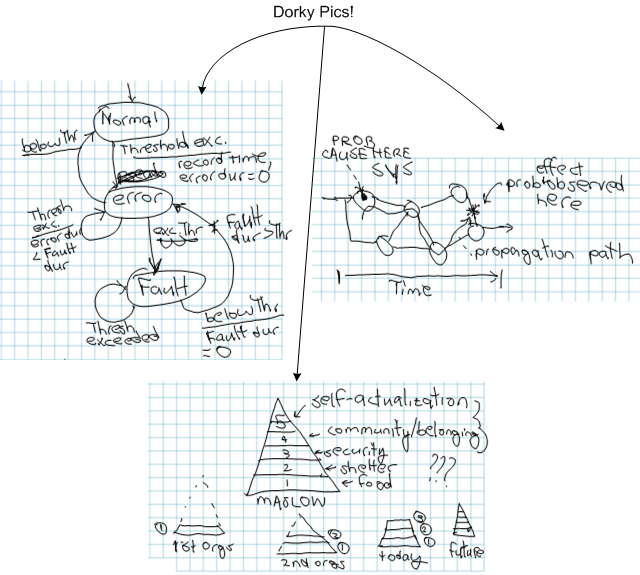
BD00 collects “fieldstones” in much the same way. He also sketches out dorky pictures for future enhancement and refinement in Microsoft Visio.
Self Made Myth
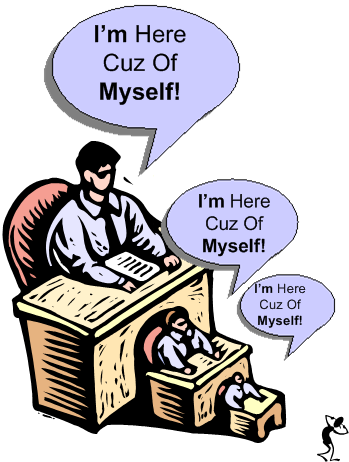
Western societies, especially the good ole USA, revere the myth of the “self-made” man. Even though many people might consider some of my greatest influencers; Seth Godin, Leo Babauta, Hugh MacLeod, and Scott Berkun self-made men, all of them depend on what Godin defines as “tribes” for their livelihood. And they’ll all humbly admit it – which is why I’m a fan.
I recently listened to Leo interview Seth on the subject of tribe-building for writers. Here are some tidbits of sage advice served up by Mr. Godin:
- Don’t get upset by the fact that you don’t have a vision and can’t tell what’s coming next.
- The core of any worthwhile, enduring business is not about maximizing profit.
- You’ve got to embrace a willingness to fail.
- Get that voice out of your head so you can do your best work. (D’oh!)
- Don’t write for strangers – you don’t need a huge “tribe“, and thus, you don’t have to dilute your message.
- Forget about writing “how to” books anymore. People just look it up online.
- People hate reading, so keep it short.
The first four bullets are not just applicable to aspiring writers, no?
The Chairman Was Wrong
Frank Sinatra was wrong. New York is NOT the city that never sleeps. Nawlins is the city that never sleeps – at least during Mardi Gras.

From Within, From Without
With exceptions (and there are always exceptions) everyone knows that the view “from within” is different than the view “from without“.

While viewing “from without“, there is typically less emotional attachment of the viewer to the viewed. The more one is attached to the view “from within“, the more difficult it is to extricate oneself from that view and form a secondary view “from without“.
On product development projects, it’s much easier for a project team member to step outside of the intricate details “from within” to form a view “from without” than it is for an “outsider” to form a view “from within“. But just because it’s easier, it doesn’t mean that it’s done often.
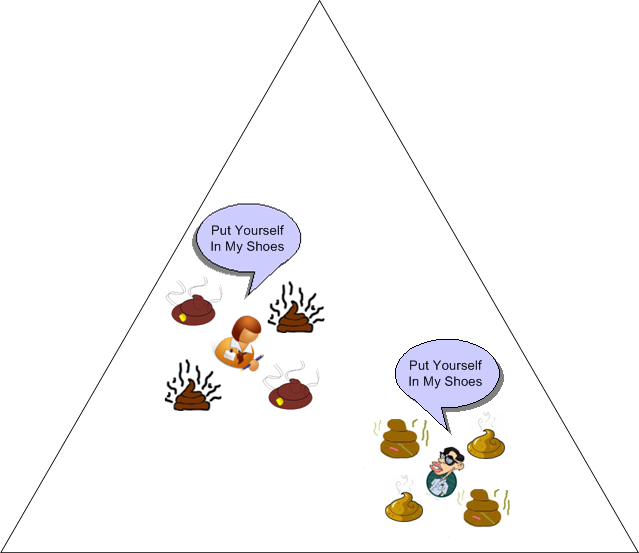
This “from within” and “from without” crap is simply a twist on the old “put yourself in someone else’s shoes” advice…..
Lost And Found
Check out what my best buddy Morrie (not Povich, not Wills) lost and found:


Why am I here?
WTF?
Meh!
D'oh!

My BTC Address



 Bulldozer00's Blog