Archive
Who’s That Masked Man?
I’m very skeptical of management consultants, but the dudes at VitalSmarts are really good. They are responsible for the wonderful “crucial” pair of books:
I’ve read both of these along with Influencer. They’re all very “down to earth” and highly accessible tomes that detail what works and what doesn’t work in terms of leading organizations of people. Their simple and “executable” advice is backed by academic research and, most importantly, their direct experiences from interacting with lots and lots (thousands) of real people in working organizations around the globe.
The following snippet from their latest e-newsletter caught my eye:
“People are excellent at masking ability problems.”
Man, ain’t that the truth! Along with you, I ‘ve put the “mask ” on many times, both willingly and unwillingly. The question is: “what would cause people to do this?”.
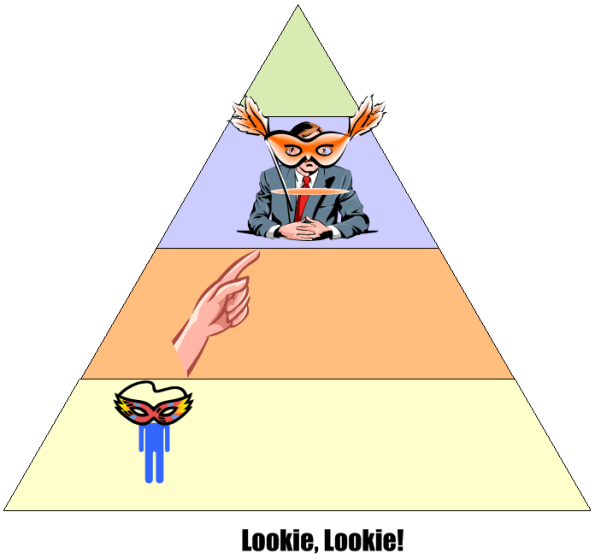
I think the main reason why people try to feign expertise is because they are stuck working in archaic corpo CCHs (Command & Control Hierarchies). All CCH orgs unquestioningly assume that everyone within the pyramid walls is supremely competent, regardless of whether they are or not. In a CCH, anyone who dares to persistently point out “ability” problems is excommunicated, regardless of how much evidence is presented to prove the case so that a beneficial change can be made. Heaven forbid the case where a lower level masked associate points to the huge masks being worn by one or more of the obviously infallible managers entrenched in an upper echelon. Retribution is swift and unambiguous.
Three Things
Three things: people, money, and time. These three interdependent resource types are the weapons that managers can deploy to create and sustain wealth for an organization. Managers are tasked with the challenge of judiciously apportioning these raw resources to the creation and sustainment of value-added products and services that solve customer problems. In addition to the creation and sustainment of products and services, the difficulty of continuously aligning and steering large groups of people toward the goals of growth and increasing profitability causes problem “fires” to be ignited within the corpo citadel. Bloated processes and warring factions are just two examples of the infinite variety of “pop up” fires that impede growth and profitability.
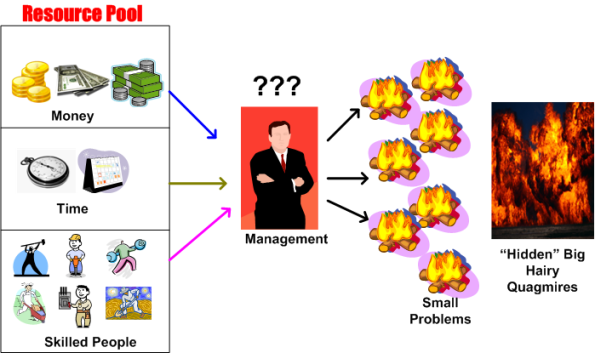
Left unchecked, internal brush fires always grow and merge into paradoxically massive, but hidden, forest fires that consume valuable resources. Brush fires feed on neglect and ignorance. Instead of creating wealth and continuously satisfying the external customer base, the three resource pools get exhausted by constantly being allocated to extinguishing internal fires.
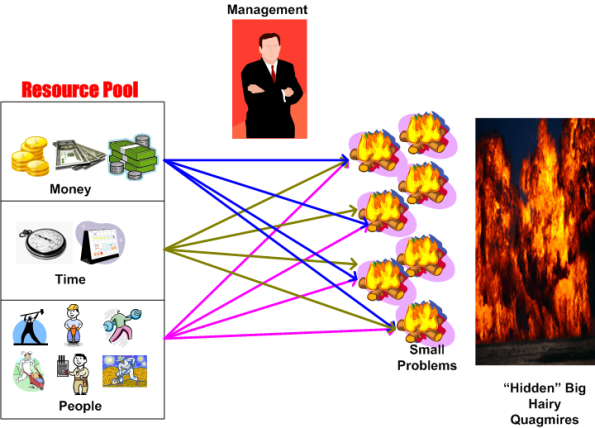
Unless managers can “see” the growing fires, one or more massive fireballs can burn the organization to the ground. So, how can managers prevent massive fireballs from consuming would-be profits and customer goodwill? By constantly listening to, and investigating, and smartly acting on, the concerns of their people and their customers. Just listening is not enough. Just investigating is not enough. Just listening and investigating is not enough. Just listening and investigating and ineffective action is not enough. Listening, investigating, and effective action are all required.
Wide But Shallow, Narrow But Deep
I just “finished” (yeah,that’s right –> 100% done (LOL!)) exploring, discovering, defining, and specifying, the functional changes required to add a new feature to one of our pre-existing, software-intensive products. I’m currently deep in the trenches exploring and discovering how to specify a new set of changes required to add a second related feature to the same product. Unlike glamorous “Greenfield” projects where one can start with a blank sheet of paper, I’m constrained and shackled by having to wrestle with a large and poorly documented legacy system. Sound familiar?
The extreme contrast between the demands of the two project types is illuminating. The first one required a “wide but shallow” (WBS) analysis and synthesis effort while the current one requires a “narrow but deep” (NBD) effort. Both types of projects require long periods of sustained immersion in the problem domain, so most (all?) managers won’t understand this post. They’re too busy running around in ADHD mode acting important, goin’ to endless agenda-less meetings, and puttin’ out fires (that they ignited in the first place via their own neglect, ignorance, and lack of listening skills). Gawd, I’m such a self-righteous and bad person obsessed with trashing the guild of management 🙂 .
The figure below highlights the difference between WBS and NBD efforts for a “hypothetical” product enhancement project.
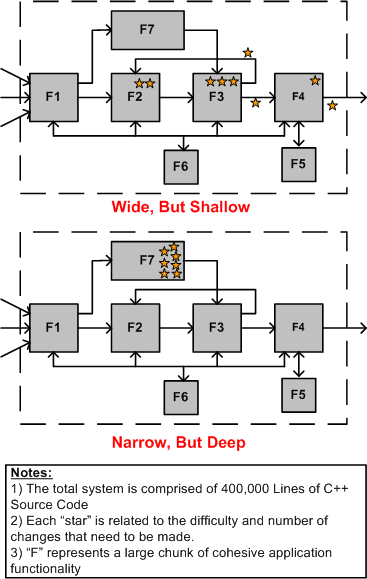
In WBS projects, the main challenge is hunting down all the well hidden spots that need to be changed within the behemoth. Missing any one of these change-spots can (and usually does) eat up lots of time and money down the road when the thing doesn’t work and the product team has to find out why. In NBD projects, the main obstacle to overcome is the acquisition of the specialized application domain knowledge and expertise required to perform localized surgery on the beast. Since the “search” for the change/insertion spots of an NBD effort is bounded and localized, an NBD effort is much lower risk and less frustrating than a WBS effort. This is doubly true for an undocumented system where studying massive quantities of source code is the only way to discover the change points throughout a large system. It’s also more difficult to guesstimate “time to completion” for a WBS project than it is for an NBD project. On the other hand, much more learning takes place in a WBS project because of the breadth of exposure to large swaths of the code base.
Assuming that you’re given a choice (I know that this assumption is a sh*tty one), which type of project would you choose to work on for your next assignment; a WBS project, or an NBD project? No cheatin’ is allowed by choosing “neither” 😉 .
Sloppy and Undisciplined
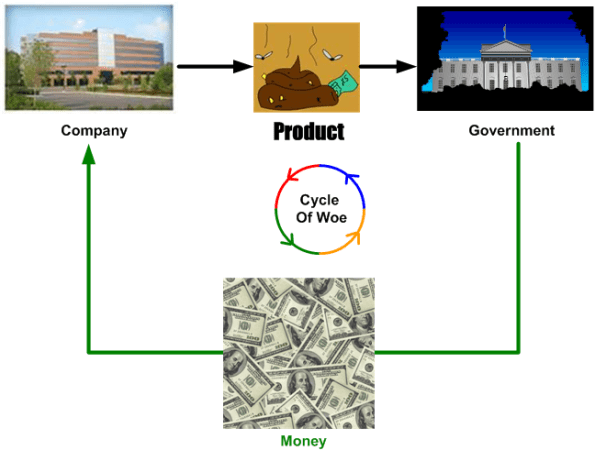
If a company is sloppy and undisciplined in execution, then almost all of its value-creation resources (people, time, money) are constantly putting out legacy product fires instead of developing new products/services – creating wealth. Revenues and, especially, profits may suffer. “May” and not “will” you ask? Yes, I say. You see, if a company can get customers to continuously pay for the messes that the company has innocently but surely created, then financial performance may actually be perpetually “good”, or even “excellent”. Say what? Hoodwinking customers to pay for cleaning up your messes? What customers in their right mind would do this? Government customers who love to spend other people’s money, of course. Nice work if you can get it.
Favorite Companies
Over the years, I’ve been on a constant watch for unique companies. By unique, I mean those that stand apart from the rest of the herd in the way that the executive leadership balances the needs of all stakeholders – not just the shareholders, or especially, themselves. Of course, unless you’ve worked at a company, it’s pretty tough to know if the company really lives up to its core values and “walks the talk”. That’s because all companies project the image that they are great places to work, regardless of whether they really are.
So, how do I decide whether a company is a cut above the rest? Via subjective evaluation of external observations, of course. Here’s my unscientific list of “research” methods:
- Read third party accounts of experience given by former and current non-management employees.
- Read, listen, and watch multiple interviews with CEOs and executives.
- Scour publicly available mission statements, visions, core values and cultural descriptions for authenticity, lack of corpo jargon, and attention to detail.
- Stay away from glossy annual reports.
- Ignore whatever the hand picked company spokesperson(s) say.
Of course, my methods aren’t perfect, but do you know of any better ones?
Here’s my current list of faves. What are yours?

Forgive Me

If you have read many of my posts, you may have formed the opinion that I’m rabidly against bozo managers who are members of a hierarchically structured organization. That’s not quite right. I’m not against them as individual persons. I’m against the behaviors that they are compelled to manifest and the decisions that they have to make because of the archaic structure that they are an integral part of. It doesn’t matter who the particular individuals are in a command & control hierarchy. Unless they are enlightened (and very few are), they will auto-behave in ways that are detrimental in the long term to customers, owners, and employees. Not detrimental to themselves and their brethren, of course.
A colleague who dogmatically worships at the alter of corpo-man recently told me that I was jealous of hierarchs. He said that I wanted to be “just like them”. Hmmm, interesting opinion, no? Since nothing is impossible, I guess that could be true. Deep down I just may be an imposter and a fraud 🙂 . In Thorstein Veblen‘s “theory of the leisure class“, he proposes that the middle class in “developed” countries doesn’t hold hierarchs accountable for the havoc they wreak because the middle class wants to be “just like them”.
I’ve often thought of what I would do if I was offered to be knighted by a hierarchical corpo king. Whenever I think of that possibility, it reminds me of the Galileo and Pope Urban story. Galileo, as you probably know, subscribed to the Copernican theory that the earth was NOT the center of the universe. In the all powerful eyes of the hierarchical church and its rabid followers, any such thinking was sacrilegious blasphemy – curiosity was a sin. Before Urban was given the papal throne, he was a friend of Galileo’s. Urban was intrigued by Galileo’s logic and compelling evidence that the earth revolved around the sun. Bingo, as soon as he became pope, Urban instantaneously flipped into a corpo droid incapable of independent thought. He gave Galileo a tour of the torture chambers and placed him under house arrest for the last years of his life. Uh, so much for friendship.
Ironically, in a standard command and control corpo hierarchy, the only way anyone has any chance of changing things for the better is if he/she secures a corpo title from the sitting politburo. Since I think I could possibly make a positive difference, I’d actually be tempted to take on an institutional title and become a corpo man. Alas, I don’t think I’d do it because I don’t have the psychological strength to withstand the corpo peer pressure to flip – just like pope Urban didn’t have. Bummer 😦
Collapsing The Wavefunction
I’m in the process of reading a third book on quantum physics. It’s called “The Self-Aware Universe”, and it is written by physicist Amit Gotswami. According to Q-physics, no localized object exists until a conscious observation is made. The universe is comprised of non-localized, infinitely distributed “waves” described by Schrodinger’s wave function equation. The wave function equation characterizes the “waviness” of matter and it displaces Newton’s F=ma as the universal law of motion. Even though Newton has been convincingly dethroned as the king of “materialistic reality”, Q-physics is consistent with Newton’s classical physics for “big” objects, which are all comprised of quantum waves. Thus, for (almost) all practical purposes, Newton’s laws can be leveraged in the macro world to “control” and enhance our environment to some extent.
When a subjective and conscious observation is made and discrete objects are “detected” at a point in space and time, the instantaneous collapse of the wave function occurs. The figure below woefully attempts to graphically depict this mysterious and miraculous process. On the left, we have “no”-things, just an infinite collection of waves. On the right, we have a bunch of (supposedly) independent “some”-things after the collapse. If, as most rational and educated people think, conscious observation is subjective and person specific, then why is there so much consensus on the post-collapse appearance of the world? In other words, why do most people see the same set of objects after they each independently and subjectively collapse the wave function? If you’re thinking that I have an answer for this subjective vs. consensus enigma, then you’re mistaken. I’m dumbfounded but enamored with the mystery of it all. How about you?

Suppose that you and I separately “collapse the wave function” and (miraculously?) agree on the appearance of the external world the engulfs us. Referring to the example above, assume that we transcend the first communication barrier between us and we agree that a post-collapse triangle exists, a rectangle exists, a pair of ellipses exist, etc.
Now assume that the group of objects that we’ve manifested (created ?) is comprised of people and some type of observable behavior emanating from that group is “bothering” us. Also, assume that we want to influence the group to change it’s behavior so that we are less distressed. What do we do? We consciously form a personal System-Of-Interest (SOI) and we try to understand what’s causing us the distress. We try to make sense of the dynamic interactions taking place between those people encircled in our own personal SOI and then we act to change it. Here’s where our original consensus starts to diverge. Since, as the figure below illustrates, our personally created SOIs will most likely be different, our interpretation of who and what is causing us our distress will be different. Thus, our ideas and thoughts regarding corrective actions will be different.
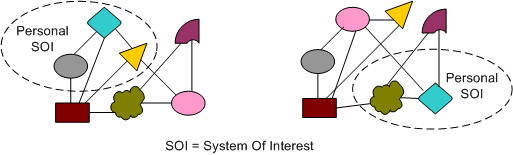
Note that even though we initially agreed on the number and types of objects=people present in our collapsed wave function worlds, the number and nature of the connections between those people are likely to be different for you and me. In the SOI example above, my SOI on the left contains three people and yours on the right only contains two. My SOI on the left doesn’t include the pink ellipse in the “problem” sub-group but yours on the right does. Your SOI doesn’t include an interface ‘tween the gray ellipse and blue diamond but mine does. Thus, our interpretations of what ails us will most likely differ. Add a third, fourth, fifth, etc., SOI to the mix and all kinds of diverging interpretations will emerge.
Now, apply this example to a work environment. If I’m the “boss” and you disagree with my interpretation of the problem situation, but are “afraid” of speaking truth to power because of standard stifling corpo culture norms, then you may just go along with my interpretation even though you’re pretty sure that your interpretation and solution is “right”. Since I’m the boss, all knowing and all powerful, I’m always “right” – even if I’m not. 🙂
Netflix Culture
I’m constantly scouring the landscape for companies with cultures that stand apart from the herd (moooo!). Via my e-friend Byron Davies’ discovery, I’ve just added another gem to my list: Netflix. Here’s the link that triggered the addition: Netflix Culture. It’s a simple, unadorned (content over format), behemoth 128 page presentation, but it’s so authentically different and norm-busting that it’ll stir your emotions (yuk, can’t have emotions in business, right?) if you’re a culture hound like me. Just in case you’re curious, but short on time, here are some zingers that rang my bell:
- The real company values, as opposed to the nice sounding values, are shown by who gets rewarded, promoted, or let go.
- We particularly value these nine skills and behaviors: judgment, communication, impact, curiosity, innovation, courage, passion, honesty, selflessness.
- You focus on results and not process.
- You challenge prevailing assumptions when warranted, and suggest better approaches.
- You say what you think, even if it’s controversial.
- You question actions inconsistent with our values.
- You only say things about fellow employees you will say to their face.
- You share information openly and proactively.
- It’s about effectiveness, not effort or hard work.
- Responsible people thrive on freedom and are worthy of freedom.
- Most companies curtail freedom as they grow bigger and to avoid errors, thus, we try to increase freedom.
- Process-focus drives talent to leave.
- The key to managing growth and complexity is to increase talent density; not to institute more freedom-constraining processes.
- We value simplicity, not the simplistic.
- Freedom is not absolute, a few basic and common sense rules are needed.
- In environments that demand creativity, fixing errors is cheaper than (fruitlessly) trying to prevent them via religious process adherence.
- Regularly scheduled strategy and context meetings.
- Flexibility is more important than efficiency in the long term.
- Set the context for your people instead of trying to control them.
- Highly aligned and loosely coupled as opposed to monolithic or siloed.
- Goal: fast, flexible AND big.
- Titles are not very helpful (all major league pitchers aren’t major league talents).
- No centrally administered “raise pools” every year.
- Whether Netflix is prospering or floundering, we pay at the top of the market.
- It’s a healthy idea, not a traitorous one, to understand what other firms would pay you, by interviewing and talking to peers at other companies.
- No bonuses, just include in salary. No free stock options – just big salary; and let people decide where to invest it.
- Rapid innovation AND excellent execution, creativity AND discipline, are required for continuous growth.
Here is my number one zinger:
- Netflix vacation and tracking policy: there is no vacation policy or tracking.
You read it right. One day, an employee pointed out that “we don’t track hours worked per day, night, or on weekends, so why do we track vacation days?“. The Netflix leadership responded to the challenge by removing the “N days per year” vacation rule. Pretty rad, removing rules instead of continuously piling them on, no?
Even if you’re extremely skeptical and can’t believe the Netflix leadership “walks the talk”, you gotta at least give them credit for writing down, in detail and with underlying rationale, the culture that they’re trying to build – so that they could be held accountable. No?

Cisco CEO “Gets It”
Cisco Systems Inc. CEO John Chambers “gets it”. In this interview, he states:
“Today’s world requires a different leadership style — moving more into a collaboration and teamwork, including learning how to use Web 2.0 technologies. If you had told me I’d be video blogging and blogging, I would have said, no way. And yet our 20-somethings in the company really pushed me to use that more.”
Ossified corpo executive teams that still operate according to the 1920’s doctrine of separation, closed door meetings, and infrequently used, one-way communication channels, deserve what they get – mediocrity and a disconnected work force.
On the subject of interviewing potential leaders, Mr. Chambers also “gets it”:
“Then I ask them who are the best people you recruited and developed, and where are they today? And that tells an awful lot.”
He knows that in order to build a viable, sustainable, and robust company, you’ve got to actively develop people and not just sit on your throne issuing brilliant commands from an omniscient position of superiority.
No Good Deed
Let’s say that the system engineering culture at your hierarchically structured corpo org is such that virtually all work products handed off (down?) to hardware, software and test engineers are incomplete, inconsistent, fragmented, and filled with incomprehensible ambiguity. Another word that describes this type of low quality work is “camouflage”. Since it is baked into the “culture”, camouflage is expected, it’s taken for granted, and it’s burned into everyone’s mind that “that’s the way it is and that’s the way it always will be”.
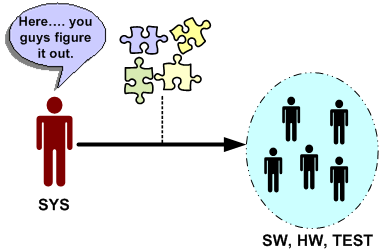
Now, assume that someone comes along and breaks from the herd. He/she produces coherent, understandable, and directly usable outputs for the SW and HW and TEST engineers to make rapid downstream progress. How do you think the maverick system engineer would be treated by his/her peers? If you guessed: “with open arms”, then you are wrong. Statements like “that’s too much detail”, “it took too much time”, “you’re not supposed to do that”, “that’s not what our process says we should do”, etc, will reign down on the maverick. No good deed goes unpunished. Sic.
Why would this seemingly irrational and dysfunctional behavior occur? Because hirearchical corpo cultures don’t accept “change” without a fight, regardless of whether the change is good or bad. By embracing change, the changees have to first acknowledge the fact that what they were doing before the change wasn’t working. For engineers, or non-engineers with an engineering mindset of infallibility, this level of self-awareness doesn’t exist. If a maverick can’t handle the psychological peer pressure to return to the norm and produce shoddy work products, then the status quo will remain entrenched. Sadly but surely, this is what everyone wants, including management, and even more outrageously, the HW, SW, and TEST engineers. Bummer.

Why am I here?
WTF?
Meh!
D'oh!

My BTC Address



 Bulldozer00's Blog