Archive
The Promotion Strategy
On the left side of the following figure, we have a typical mega-project structure with a minimal Overhead-to-Production personnel ratio (O/P). If all goes well, the O/P ratio stays the same throughout the execution phase. However, if the originally planned schedule starts slipping, there’s a tendency of some orgs to unconsciously exacerbate the slippage. In order to reign in the slippage via exercising tighter control, the org “promotes” one or more senior personnel out of the realm of production and into the ranks of overhead to help things along.
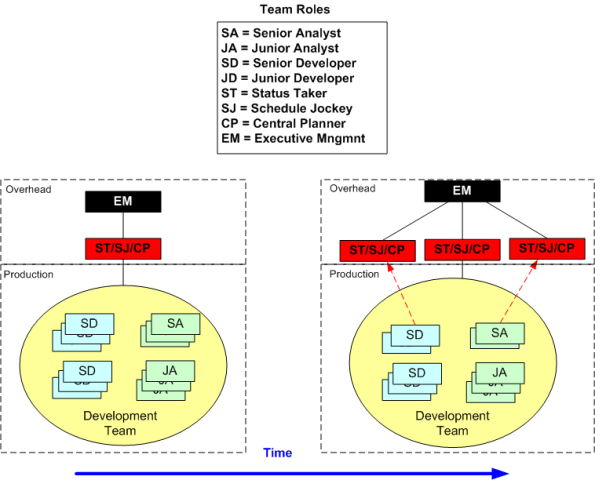
By executing the “promotion strategy“, the O/P ratio increases – which is never a good thing for profit margins. In addition, the remaining “unpromoted” senior + junior analysts and developers are left to pick up the work left behind by the newly minted overhead landlords.
So, if you’re in the uncomfortable position of being pressured to increase execution efficiency in order to pull in a slipping schedule, you might want to think twice about employing the “promotion strategy” to get things back on track.
The brilliant Fred Brooks famously stated something akin to “Adding people to a late project only makes it later“. In this infamous post, dimwit BD00 states that “Promoting personnel from production to overhead on a late project only makes it later“.
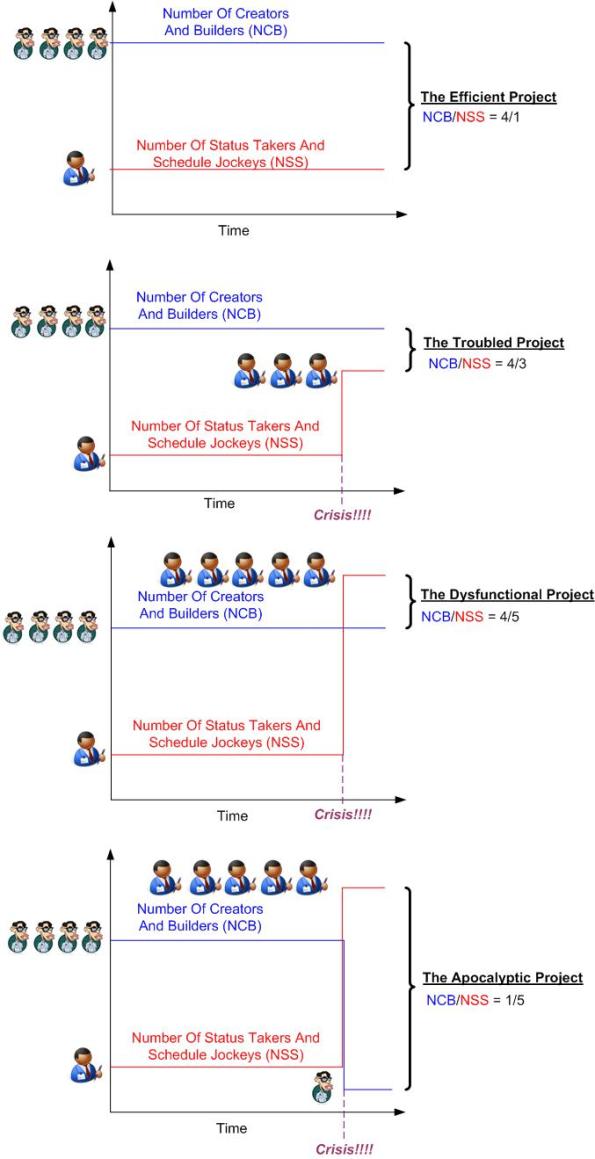
The Efficient, The Troubled, The Dysfunctional, The Apocalyptic
Inter And Intra
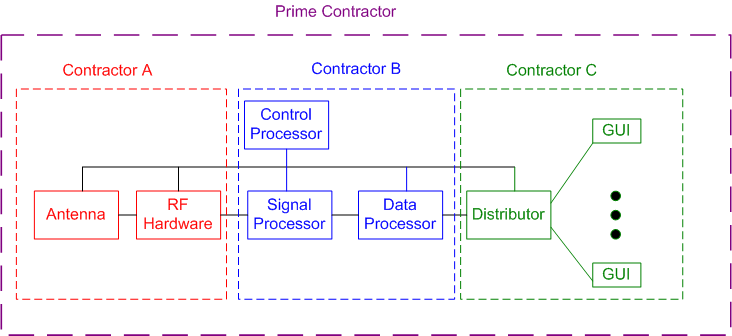
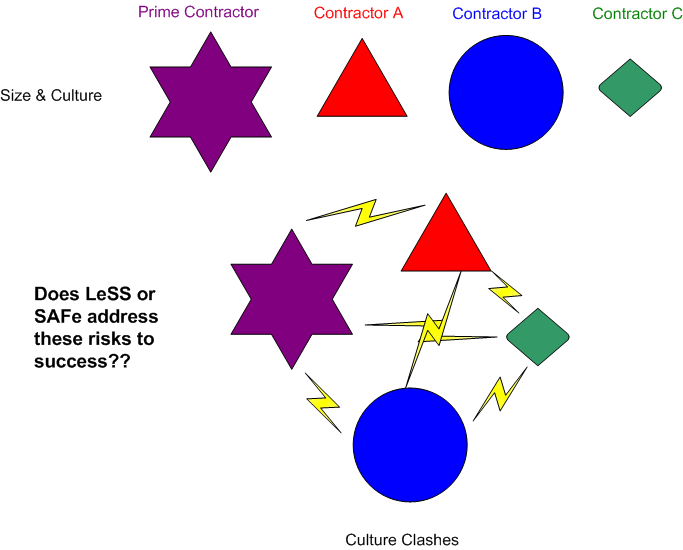
My previous post highlighted inter-company culture clashes. This followup highlights the most insidious intra-company culture clash:

I Dunno
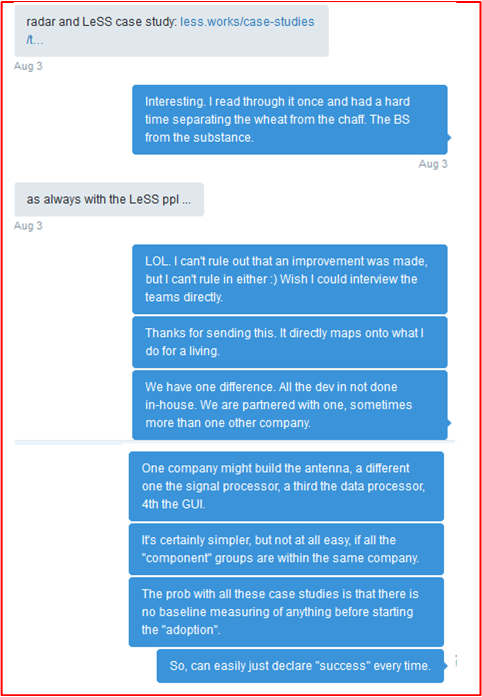
A dear twitter friend recently sent me a link to this case study written by a LeSS management consultant: “Thales Surface Radar”. Since I’ve been an active contributor to the development of multi-million dollar air defense and air traffic control radars for decades, I was excited to finally see a case study directly applicable to my domain of interest.
On my first reading, I found it difficult to separate the wheat from the chaff. Sadly, I experienced the same frustrating feeling on my second read-through – even though I slooowed down and arduously tried to absorb the content. Honestly, I tried, I really tried. I’m just not smart enough to “get it“. No “ah-hah!” moments for BD00.
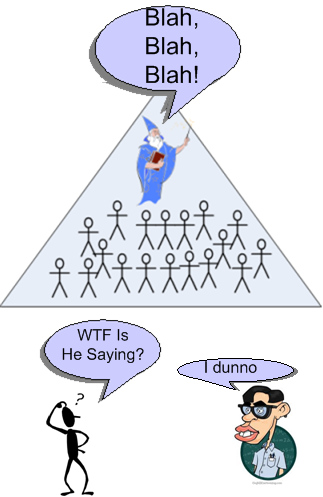
I think the case study is just another self-promoting, fluffy, smoke-and-mirrors piece written by a stereotypical consultant who wants your money. What do you think?
Deviation From The Norm
Without deviation from the norm, progress is not possible – Frank Zappa
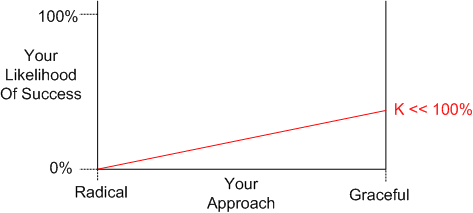
The further a new idea deviates from the norm, the more resistance there will be to its adoption – and the deviance/resistance relationship is ominously nonlinear:

Since it’s human nature to prefer the familiar over the comfortable, passionate purveyors of new ideas that have proven to work for themselves and their orgs better take heed: the way you promote a deviant idea matters.
The more radical your idea, the more graceful you must be in your advocacy in order for the idea to have any chance of infiltrating the mainstream. If both your idea and your approach are radically extreme, then you’ll likely be perceived as a frontal assault idiot by not only those few in power, but those many on the front lines who would otherwise become your allies.

Even if you eschew a militant stance and adopt a graceful approach toward getting your deviant idea widely accepted, the odds are still stacked against you because of the powerful “familiar over comfortable” force field that keeps the status quo in place.
Deal Of The Year
Hot off the presses, I just received a Groupon offer to take a $99 online Scrum Master certification course. Holy crap! Instead of paying $2000 and taking 3 consecutive days off from work, I can learn how to become a micro-managing process enforcer from the comfort of my own home; munching on chips while lounging around in my skivvies.

How can I refuse such a great deal? Just look at all those smart, well-dressed, professional, micro-managers in the advertisement staring at a burndown chart. It’s an especially nice touch that the marketing team put a pair of eyeglasses in Katherine Heigl’s hand.
From the course description:
CSMs understand Scrum values, practices, and applications and provide a level of knowledge and expertise above and beyond that of typical project managers.
If you’re a “typical project manager“, your days are numbered. The sky is falling and all that uncool PMI and EVM training you suffered through is sooooo yesterday.

Robo Jargon



By How Much?
Thanks to a social media friend, I was directed to an agile transformation case study written by a management consultant and posted on the consultancy’s site along side several other huge success stories. At the end of the long writeup, the following outcomes were asserted:
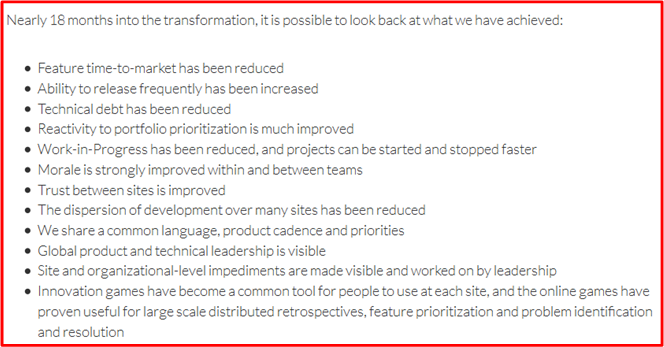
When I see fancy, professionally-crafted, “qualitative” success lists like these, knowing that they are touted by highly subjective people whose livelihoods require the projection of infallibility, my BS detector starts beeping. For this specific list, these questions come to mind:
- “Feature time-to-market has been reduced“: by how much?
- “Ability to release frequently has been increased“: by how much?
- “Technical debt has been reduced“: by how much?
- “Reactivity to portfolio prioritization is much improved“: by how much?
- “WIP has been reduced”: by how much?
- “Morale is strongly improved within and between teams“: by how much?
- “Trust between sites is improved“: by how much?
- “The dispersion of development over many sites has been reduced“: by how much?
- “Global product and technical leadership is visible“: by how much?
- How much did this 18 month transformation cost the client? How much money did you make?
- How much have client revenues increased and costs decreased as a result of your effort?
Of course, no quantitative percentages were given because no pre-transformation benchmarking was performed. If benchmarking was indeed performed, there would’ve been a chance that the before-and-after metrics may have driven the client to conclude that the whole effort was a huge waste of time and money.

It’s funny how managers who love to hold others accountable for adhering to micro-defined, quantitatively specified, burndown charts, not only get to evaluate themselves, but they get to do so qualitatively, with no supporting data.
In God we trust; all others must bring data. – W. E. Deming
In Consultants we trust; all others must bring data. – BD00

Why am I here?
WTF?
Meh!
D'oh!

My BTC Address



 Bulldozer00's Blog