Archive
Level Of Loyalty
Checkout the sketch below. Everyone knows why too little loyalty is detrimental to purposeful organizations of people, but why is too much loyalty a problem? (And no, that’s not a swastika.)

Through The Wall
“Break on through to the other side – The Doors
Any project of appreciable size is most likely partitioned into phases where specialists (systems, software, test) that do the work in one phase “hand off” their work products to a new group of specialists in the next phase. One challenge to managing these types of multidisciplinary projects is avoiding the “over the wall” syndrome. You know, the case where the specialist group in phase N chucks their work product over the wall to a previously uninvolved specialist group in phase N+1. Surprise!
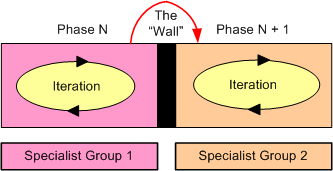
One textbook way of attempting to smooth the transitioning of work between groups is by holding an official “review” to serve as a visible waypoint in the project’s trajectory. Done well, a “review” can increase the quality of the work and inter-group relationships. However, done poorly, it is just a self-medicating waste of time where poor work is camouflaged and it serves as a stage for slick talking politicians to increase their stock.
As the figure below illustrates, an alternative to the one-shot, review-based project is the continuous review-based project. The “official” review is still held at a discrete point in time, but since collaborative inter-group communications were initiated well before the review, specialist group 2 will experience fewer “surprises” at review time.

Nevertheless, continuous review-based projects can still fail just as spectacularly as one-shot review-based projects. Can you think of how and why?
Montessori School
While reading Steven Levy‘s riveting “In The Plex“, I discovered the Maria Montessori teaching method:
“It’s really ingrained in their personalities,” she said. “To ask their own questions, do their own things. To disrespect authority. Do something because it makes sense, not because some authority figure told you. In Montessori school you go paint because you have something to express or you just want to do it that afternoon, not because the teacher said so. This is really baked into how Larry (Page) and Sergey (Brin) approach problems. They’re always asking ‘Why should it be like that?’ It’s the way their brains were programmed early on.”
“Discipline must come through liberty…. We do not consider an individual disciplined only when he has been rendered as artificially silent as a mute and as immovable as a paralytic. He is an individual annihilated, not disciplined. We call an individual disciplined when he is master of himself.”
To the non-managers out there: Have you been “rendered artificially silent as a mute and as immovable as a paralytic“…….. without being aware of it?

My Accomplishments
Here’s an idea. The next time you’re being formally evaluated for performance by a “superior” and he/she opines that your written accomplishments are vague, ask him/her for a copy of his/her latest accomplishments sheet – for guidance on how to do it right, of course.

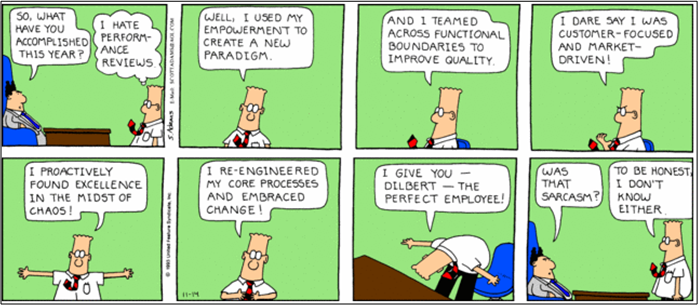
Note: Thanks to Fish-dude for finding the matching Dilbert strip.
UCB Reinforcement
Oh crap! I’ve done it again. I’ve scanned the horizon and found more evidence to further cement my Unshakable Cognitive Burden. I’ve started reading the classic “Human Side Of Enterprise“. It’s a classic because it was written in 1960 by Douglas McGregor and much of it remains relevant today – over 50 years later.
At the beginning of the book, Mr. McGregor asks his targeted audience, corporate managers, to truly “tune in” the next time they’re at a policy making meeting. By “tune in“, he means “listen to what hidden, implicit assumptions about human behavior are embedded within the discussions“.
Mr. McGregor asserts that the probability is high that policy discussions will be based on the assumption that those who will be affected by the policy are stupid, lazy, and not-to-be-trusted people. Has your personal experience indicated that he was, and still is, right?

Unfathomable Vault
Via work breakdown structures, time cards, and other management tools, most orgs track the time its people spend on projects. Thus, over time, a significant database of historical cost and time data that can be reused to estimate the cost and schedule of future projects gets accumulated. Alas, BD00’s opinion is that most org controllers don’t leverage their treasure troves of information to get reasonable “rev 0” estimates of future efforts. Either :
- they don’t want to know the truth – because they’ll cringe at how much time it really takes to execute an average project
- their tracking systems are so fragmented, un-integrated, and unnavigable that they can’t reuse the info – even if they wanted to
- both 1 and 2 above
It’s ironic how an average org’s controllers demand detailed planning and certainty from their teams but fail to demand the same standards for themselves, no? The next time you’re asked for a project estimate, try retorting with “what does the historical performance data in our unfathomable vault say about similar projects?“. Awe come on, you can do it – even though I can’t 🙂

Generalizations
To function semi-sanely in this world, we all have to make generalizations so that we can make sense of the world and to at least try to be able to predict future outcomes that result from our actions. It’s OK to make them as long as one realizes that there are exceptions to every generalization. There are very few, if any, absolutes in the world. Assuming that one’s personally concocted generalizations are absolutely 100% true all of the time invites “suffering“, no?
Take the mercurial CEO of Apple, Steve Jobs, for example. He seems to be at least one exception to my personal generalization that “dictator” bosses can’t be successful in the long term (Oracle CEO Larry Ellison is another exception). Check out these blurbs that I pulled from cyberspace:

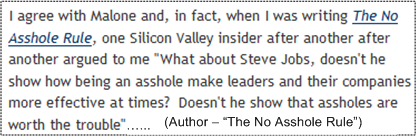
I think that one reason why Jobs and Apple achieve the stellar product and financial success that they do is because, even at the lofty CEO level, Mr. Jobs gets his hands dirty – and that endears him to the technical and creative talent that he does retain at the company. Contrast this to a Stalinist brute like “chainsaw” Al Dunlap, who lived in a separate world “above” his people.
How about you? Do you think that my “dictators can’t be successful leaders in the long run” generalization is valid in most cases? What’s your equivalent generalization?
Three Bottom Lines
“Management measures what’s easy, not what’s important.” – Unknown
“You can only measure 3% of what matters.” – W. E. Deming
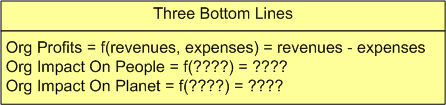
I don’t recall where, but I remember seeing the idea of “three bottom lines” being proposed somewhere in an online article. The three bottom lines are “profits, people, and planet“.
As in quantum physics, the hurdle to overcome is “the measurement problem“. Unlike profits, which are simple to measure and track, how do you come up with standard, objective measures of an org’s effect on its people and on the planet?
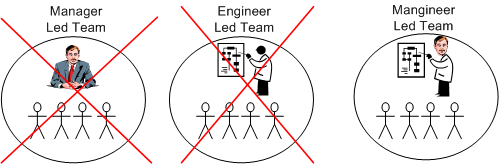
Mangineers And Enginanagers
Expert Number 1 sez:
Engineers don’t make good technical project leaders because they lack business acumen. Thus, they’ll blow the budget and schedule.
Expert Number 2 sez:
Generic managers don’t make good technical project leaders because they don’t understand the work. Thus, they’ll blow the budget and schedule.
Non-expert BD00, who likes to make stuff up and fabricate his own truths, sez:
Yeah, that dilemma sux, but assuming that it can be done, it’s less costly in time and dollars to train an engineer in business skills than it is to train a generic manager in engineering skills.
Of course, if you assume that successful engineer-to-manager or manager-to-engineer cross training is unrealistic (and not many “mainstream” people would fault you for thinking that), then you won’t have to dirty your manicured nails or reach into your pocketbook to, as your fellow managers like to say, “get it done“. The result of this irresponsible, hands off approach is that you will continue to get what you deserve: all of your non-routine, technically challenging development (but not production) projects will blow the budget and schedule more than they normally would if you had put a mangineer or enginanager in charge. Whoo Hoo! Way to go Mr. and Mrs. FOSTMA. Stay the course.
A Valiant Try
Google recently re-appointed Larry Page as it’s CEO after a 10 year hiatus. From the following blurb in “The Product Shakeup At Google Begins”, it seems like Google is valiantly trying to return to its roots:
(Larry) Page famously has a low opinion of managers, especially product managers who try to tell engineers what to do. “People don’t want to be managed,” he is quoted in Steven Levy’s new book, In the Plex. Page is a big believer in self-management. At one point early on in the company’s history, he and Brin tried to get rid of all managers.
Even though it is certainly impractical to get rid of all managers once an org grows to a certain size, ya gotta love the irony of anti-management CEOs like Page, Nayar, and Semler, no? With guys like that watching over an org, you can be confident that they’ll be vigilant in keeping the manager-to-worker ratio low and that they’ll make sure managers do more than just plan, watch, control, command, and evaluate others. Of course, this philosophy doesn’t guarantee success, but it sure does make working for a company more enjoyable for the majority of people who work there – not just the management minority.


Why am I here?
WTF?
Meh!
D'oh!

My BTC Address



 Bulldozer00's Blog