Archive
The “E” Test
From Dan Pink’s “FLIP Manifesto“:
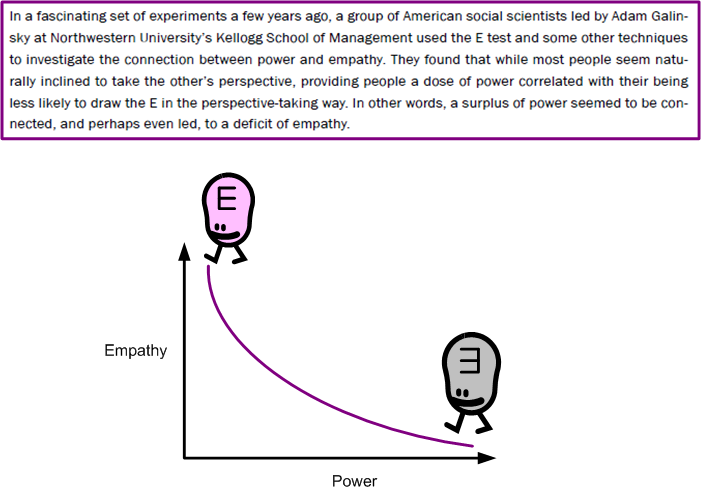 To take the E test, draw the letter “E” on your forehead. Oops, too late. You already know which way is the “correct” one.
Ingrained Internal Shared Mindset
All Models are wrong, but some are useful – George Box
One of the models below puts the owners and managers of an enterprise at the top and the other model places them at the bottom. Which system design do you think is capable of creating more wealth for all stakeholders over the long term?

An Unexpected Honor
Whoo hoo, BD00 has arrived! Effective immediately:
The Principle Objective
The principle objective of a system is what it does, not what its designers, controllers, and/or maintainers say it does. Thus, the principle objective of most corpocratic systems is not to maximize shareholder value, but to maximize the standard of living and quality of work life of those who manage the corpocracy…
The principal objective of corporate executives is to provide themselves with the standard of living and quality of work life to which they aspire. – Addison, Herbert; Ackoff, Russell (2011-11-30). Ackoff’s F/Laws: The Cake (Kindle Locations 1003-1004). Triarchy Press. Kindle Edition.
It seems amazing that the non-executive stakeholders of these institutions don’t point out this discrepancy when the wheels start falling off – or even earlier, when the wheels are still firmly attached. Err, on second thought, it’s not amazing. The 100 year old “system” demands that silence is expected on the matter, no?

Fierce Transparency
I’ve been trying to figure out why I admire Zappos.com (I know, I know, they had a nasty security breach recently), Semco, and HCL Technologies so much. Since I have a burning need to understand “why“, I’ve concocted at least one reason: Tony Hsieh, Ricardo Semler, and Vineet Nayar ensure that fierce transparency is practiced within their companies and all their “initiatives” are rooted there.
Working in an environment without transparency is like trying to solve a jigsaw puzzle without knowing what the finished picture is supposed to look like. – Vineet Nayar. Employees First, Customers Second: Turning Conventional Management Upside Down (Kindle Location 547). Kindle Edition.
Of course, I’m making up all this transparency stuff, but hey, it reinforces my weltanschauung (<- I had to look up the spelling a-freakin-gain!). That’s what humans do to give themselves comfort. No?

Reeking Of Rank
In the 20th century (remember what it was like way back when?), “neutron” Jack Welch unabashedly, successfully, and transparently used a ranking system to catapult GE to the top of the financial world by ex-communicating the bottom 10% on a yearly(?) schedule.
When leadership teams make a corpo-wide policy change, they do so in a sincere attempt to improve some performance metric in the org without inflicting too much collateral damage. For example, take the above policy of “ranking” employees. Orgs that rank their employees may “assert” that rankings will increase engagement, morale, and let people “know where they stand” in relation to their peers.

That’s all fine and dandy as long as the ranking system applies equally to each and every level in the org – especially if it’s asserted to be a guaranteed slam dunk for increasing employee engagement . Hell, if it’s a no-brainer, then why exclude the supervisor, manager, director, and C-level layers? After all they’re “employees” too, no?
I wonder if #1 Jack Welch ranked his direct reports and gracefully escorted his bottom 10% out the door every year?

Process Delays And Variety Suppression
Even though it’s unrealistically ideal and unworkable, I give you this zero-overhead value and wealth creation system as a point of reference:

For speculative comparison to the idealized design, I give you this system “enhancement“:

For the ultimate delay-inducing, variety-suppressing, and assimilating borg, I give you this “optimal” design:

Over time, as an org unconsciously but almost assuredly morphs into a borg, the existing delay-inducing “value-added overhead processes” grow bigger, and more of them are inserted into the pipeline for sincere but misguided performance-increasing reasons. To add insult to injury, more and thicker variety-suppression control channels are imposed on the pipeline from above. If this rings a bell with you, then it’s pure coincidence, because like all other delusionary BD00 posts, it’s totally made up.
ReOrg City
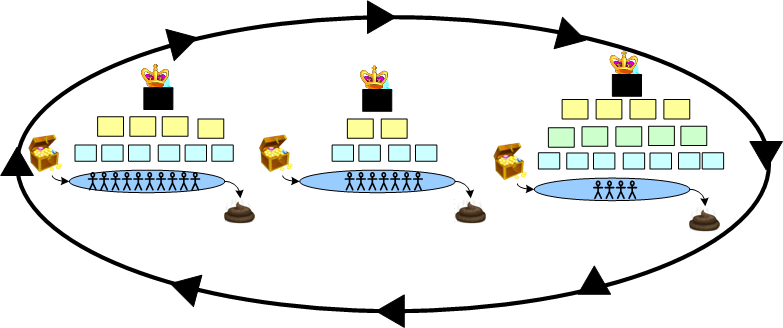
The structure of the “whole” and the behaviors at both the top and bottom remain the same. Only the width and/or height of the pyramid changes with each reorg. But alas, that’s just “the way it has to be“, no?

He’s In The MIX
Ricardo Semler, one of my innovation heroes, is now a MIXer: Ricardo Semler | Management Innovation eXchange. Until reading his first contribution to the MIX, I hadn’t seen hair nor hide of him for a couple of years. I had thought he’d retired or something like that.
As usual, in his “Retire-a-Little: Enabling More Fulfilled Working Lives“ management hack, Mr. Semler tells the story of yet another heretical and “outrageous” practice that he implemented at Semco Inc. Even if you don’t “buy into” his “retire a little” program, ya gotta love his 3 hour “Are You Nuts?” meetings, no? Try to picture the reception someone would get in your org for suggesting something like an “Are You Nuts?” initiative. Would anyone even attempt to suggest it?

Butt The Schedule
Did you ever work on a project where you thought (or knew) the schedule was pulled out of someone’s golden butt? Unlucky you, cuz Bulldozer00 never has.


Why am I here?
WTF?
Meh!
D'oh!

My BTC Address



 Bulldozer00's Blog