Archive
Assimilated And Digested
This is another one of my dorky pictures that doesn’t contain any accompanying words of explanation. “I’m a little verklempt, so talk amongst yourselves. I’ll give you a topic: Acquisition” – Linda Richman.

Thanx for the link dB!
Is This A CEO Talking?
From Who’ll Catalyze Change: Us or Them? – Harvard Business Review, HCL Technologies CEO Vineet Nayar says:
We at HCL have embraced a philosophy that’s based on an inversion of the management pyramid, with managers becoming as responsible to employees as employees are to managers.
Vineet’s joking, right? Nah, he’s fibbing to cover up the reality that he rules with a Stalinistic iron fist at HCL, no? This joker follows up with an even bigger whopper:
Too many people caution us about acting on instinct and conviction. But we must surround ourselves with employees that dare to try new things in new ways. They may not achieve perfect results, but if they focus on getting better each day with one more attempt, they will solve many problems that appear unsolvable.
Acting on “instinct and conviction” and not on objectively measured scientific “proof” (that really camouflages subjective, random, self-serving, opinion)? WTF? This Vineet dude needs to be cast out of the guild of management and “put in his place“, no?

In The “Old Days”
In the “old days”, when companies fell upon hard times and had to let some DICs go, or when the DICforce went on strike, jobs were mechanized enough so that managers could fill the holes and keep the joint running until the situation improved. Of course, in most orgs, that is no longer true today since most managers, certainly those that are BMs, shed and conveniently forget their lowly “worker’s skills” as soon as they are promoted out of the cellar into the clique of elites. Thus, a company that cuts front line DICs without cutting some managers puts itself into a deeper grave. Not only does productivity go down because the holes of work expertise go unfilled, but the overhead cost rises because the same number of managers are left to “supervise” fewer DICs. On the other hand, if all or most of the jettisoned DICs were dead weight, the previous sentence may not be true – unless dead weight BMs were retained. But hey, in the minds of most managers (and all of those who fall into the BM category), fellow comrade managers are not dead weight.
 Update: Shortly after I queued this post up for publication, a friend(?) serendipitously sent me this link: Lockheed Martin press release. Notice the “delay” that took place from the time they shed 10000 DICs to the time they offered some 600 BOOGLs, CGHs, and SCOLs their (no doubt generous) “Voluntary Executive Separation Program“. Better late than never, right?
The executive reductions will help align the number of senior leaders with the overall decline of about 10,000 in the employee population since the beginning of last year, cut overhead costs and management layers, and increase the Corporation’s speed and agility in meeting commitments.
Nice corpo jargon, no?
I Found Another Gem
Whoo hoo! I’ve stumbled upon another rare gem in a massive pile of ugly rocks. As the graphic below shows, I’ve added HCL Technologies to my list of favorite companies. Led by their visionary CEO, Vineet Nayar, HCL is one of the few models for successful companies of the future. Since the vast majority of corpo Executive Teams are stuck in the mechanistic Sloan/Taylor mindset of the 1900s with no intention of changing the way they manage, err, impose control, it’s always refreshing and exciting to discover a new game changer.

So, how do I decide whether a company is a cut above the rest? Via subjective evaluation of external observations, of course. Financial performance, which is of course important, is of secondary concern. Here’s my unscientific list of “research” methods:
* Read third party accounts of experience given by former and current non-management employees.
* Read, listen, and watch interviews with CEOs and executives.
* Scour publicly available mission statements, visions, core values and cultural descriptions for authenticity, lack of corpo jargon, and attention to detail.
* Stay away from glossy annual reports – which are all clones of each other.
* Ignore whatever the hand picked company spokesperson(s) say – propaganda city.
Of course, my methods aren’t perfect, but do you know of any better ones?
Related Articles
- Why HCL Technologies puts employees ahead of customers (tech.fortune.cnn.com)
- HCL Technologies Annual Revenues up 24.1 % YoY; Quarterly Revenues up by 21.5% YoY and 7.7% Sequentially; Europe Annual Revenues up by 20.6% YoY in FY10 (prnewswire.com)
- Management Innovation: Extreme Management Makeover (petervan.wordpress.com)
- Indian outsourcer HCL Technologies quarterly profit up 6.9 percent to $74M on strong demand (taragana.com)
Where Is Point A?
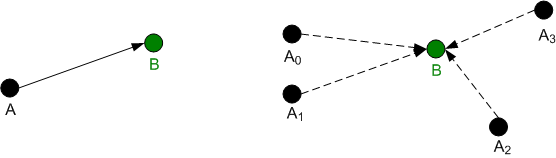
In the “Managing The Unmanageable” techonomy video discussion, HCL Technologies CEO Vineet Nayar says something like: “If your people don’t know where point A is, then they won’t know how to get to point B“. Vineet said this in response to a question regarding the concern that the more transparent your company is, the more your competitors can copy you. Vineet, along with the other two 21st century CEOs on the panel stated that the benefits of transparency far out weigh the risks of “giving away the family jewels“.
Look at the figure below. On the left side, through transparency and continuous full disclosure, your people know where you are (point A) and your people know where you and they want to be in the future (point B). Thus, you and your people can figure out what problems need to be solved and what new actions need to be taken. On the right side of the figure, everyone knows where point B is, but nobody (except for maybe a “select few” high up in the CCH) knows where they’re starting from. Where the frig is point A?
Related Articles
- Techonomy – Managing the Unmanageable: The New Empowered Workforce (nextbigfuture.com)
- Why HCL Technologies puts employees ahead of customers (tech.fortune.cnn.com)
- Techonomy: a new philosophy of progress (petervan.wordpress.com)
Zappos Rocks Again
As a huge, huge, huge, (did I say youuuuuuuge-uh?), fan of Tony Hsieh and Zappos.com, I blabber about them often. Zappos latest action to make the whole world, yes, the whole world, a better place is to offer up a free, yes free, download of the audio version of the best seller, yes best seller, book “Tribal Leadership“. The link is here, yes here.

Even though I’ve stalked Zappos.com for years, until recently I’ve never bought anything from them because I’m not a shoe or clothes dude. Hell, I’m an old and unredeemable person of questionable integrity and questionable character and questionable morality and questionable <<add your own trait here if you know me>>, so I renew these things about every 10 years or when they fall apart; whichever comes first. However, even with zero revenue from me, they upgraded me to VIP status. This means that with every order I place, they’ll guarantee free overnight shipping. WTF, you say? Uh, the only answer that I can give to you is: They’re fuckin’ Zappos.com dude, that”s why! Oops, I hope the F-bomb didn’t make you mad and send you to the altar to pray for me. If it did, then maybe you shouldn’t be wasting your time reading this blasphemous blog 🙂
From Wanted To Unwanted
You can have a product without a business, but you can’t have a business without a product. If you build a product that people want, a business will be born either from your loins or from some copycat’s. There’s no chicken and egg dilemma here. It’s simply, product-first and business-second. Ka-ching!
But wait, that’s not all! Let’s say you do get lucky and start a biniss around a “wanted” product that you built. To sustain your business, you gotta sustain your product. That means continuously maintaining it via the addition of new value-added features and the correction of customer-annoying defects.
Upon observing the deterioration of his original ArsDigita product under the so-called leadership of “new management”, Philip Greenspun said:
Once you have a product that nobody wants, it doesn’t matter how good your management team is. – Phil Greenspun (Founders At Work, Jessica Livingston)
So, how does a “wanted” product morph into an “unwanted” product? Via neglect and indifference. That’s what happened to Phil’s baby when the vulture capitalists he hooked up with installed an incompetent “professional management team” to run ArsDigita (into the ground). By focusing on the superficial instead of the substance, the promotion instead of the maintenance, the company’s product, and then the company itself, went down hill fast:
ArsDigita grew out of the software that Greenspun wrote for managing photo.net, a popular photography site. He released the software under an open source license and was soon deluged by requests from big companies for custom features. He and some friends founded ArsDigita in 1997 to take on such consulting projects. In 2000, ArsDigita took $38 million from venture capitalists. Within weeks of the deal closing, conflict arose between the new investors and the founders. They marginalized and then fired most of the founders, who responded by retaking control of the company using a loophole the VCs had overlooked. The legal battle culminated in Greenspun’s being bought out, and a few months later the company crashed. ArsDigita was dissolved in 2002. – (Founders At Work, Jessica Livingston)

Inability To Assimilate
In this Federal Computer Week magazine blog post, the author laments about the inability to hire talented people into the government borg:
- “The supervisors here are sycophants who are only interested in their careers.”
- “My experience is (more or less) a third of folks (management and labor) are amazing and functional well beyond pay and expectations. Another third are limited, work-reward clock-punchers. The last third are untrainable and unfireable.”
- “I’ve seen one too many occasions of “hiring teams” not hiring the best qualified but hiring friends that don’t meet the job requirements. “
- “The federal human resources processes do not necessarily match skills and education with job positions. “
- “We have more layers of management and more keep getting added without adding any workers.”
- “There are contracting personnel put in jobs who have not a clue about true contracting processes. These individual are put in position because of favoritism.”
- “Most middle-level managers want to demonstrate they are in control.”
Of course, the statements above only apply to government bloat-ocracies, no?

Meetings and Decisions
Orgs of people exist for a purpose. In order to continuously fulfill the org’s purpose in a changing external environment, its members need to make decisions regarding what to do and when to do it in order to counter unfavorable changes that are at odds with the org’s purpose. Since people need to know who will do what, when they’ll do it, and how they’ll coordinate with others to collectively counter external threats, decision-making meetings are held at all levels to decide such issues of importance.
The figure below introduces the Decision-To-Meeting-Ratio (DETMER) metric. It also shows the divergence of this metric for two competing orgs who initially had the same DETMER value at an arbitrary time, T=0. Assuming (and it’s a bad assumption) that all decisions made at each meeting are effective, as the DETMER goes to zero nothing changes for the good within the org walls. People do the same thing everyday, even as the environmental conditions outside the walls relentlessly change. Voila, a bureaucracy led by a cadre of Bozeltines emerges. Bummer.

Delusions of Grandeur
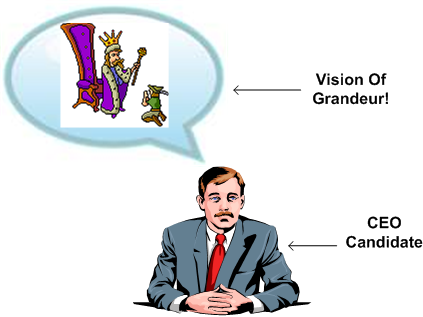
In “Founders At Work“, Jessica Livingston interviews a boatload of company founders about their personal experiences with regard to starting their companies from the ground up. Paul Graham, who co-founded “ViaWeb” and sold it to Yahoo 3 years later for a cool $45M, was asked about his search for a CEO in the early days. Here’s what he said:
The problem with all of them was that they had delusions of grandeur. This was the beginning of the Internet Bubble, remember, and I think all of these guys saw themselves as some kind of grand CEO, while we programmers labored in the kitchen cooking the food and washing the dishes. If the deal were simply that the business guy would be the public face of the company, but we would be allowed to do what we wanted and make sure everything worked right, that would have been OK. But we were worried about what might happen if one of these guys wanted to actually be the chief executive officer and tell us what our strategy should be. We’d be hosed, because they didn’t know anything about computer stuff. – Paul Graham

Why am I here?
WTF?
Meh!
D'oh!

My BTC Address



 Bulldozer00's Blog