Archive
Money, Tools, Materials, Know-How, Products
Since you’ve stopped by, check out the company-centered, system loop diagram below. The model is composed of three interdependent parts: the company, the customers, and the suppliers. In equilibrium, when all is well:
- The company produces products that are paid for, and consumed by, customers.
- The company purchases tools and materials from suppliers.
- The company uses the tools, materials, and the knowledge of its workforce to create the products that sustain the viability of the company.
- The company’s cash inflow exceeds it’s cash outflow
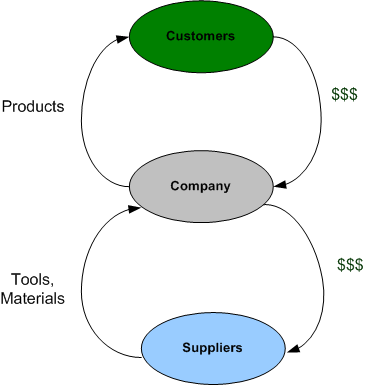
Note that if any of the links in the system get severed, the company collapses. If the products stop flowing out of the company, the life-giving cash stops flowing in. If the cash stops flowing in, the products stop flowing out. If the tools and materials stop flowing in, the products stop flowing out. From the company’s perspective, products lead to cash and cash leads to more products in a positive, self-reinforcing, feedback loop.
Using the diagram below, let’s look in more depth at the company’s cash inflows and outflows. In stable, steady-state operation, the cash inflow is managed competently by the executive team. After taking their cut of the action, the executives push some cash downward through the patriarchy to keep the operation humming and they approve of all outflows to suppliers.
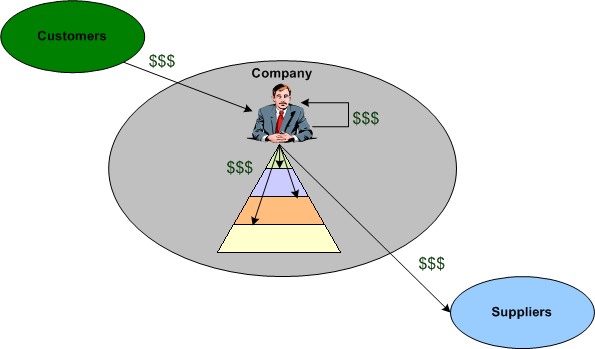
What the picture doesn’t show, is the indirect source of the customer cash – the company’s product set. Lets augment the diagram above and close the loops:
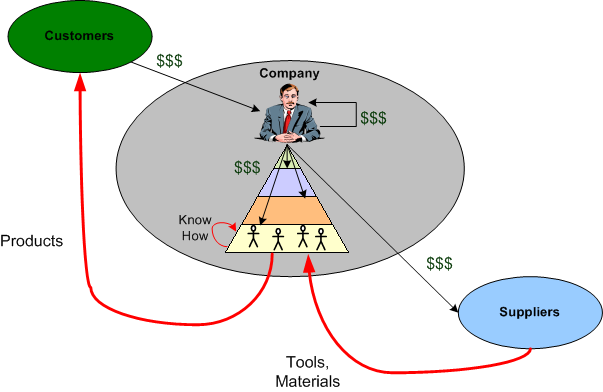
There are a bazillion external, and especially, internal threats to system viability. Externally, customers can run out of cash and suppliers can go bust. Internally, bureaucratic little Hitlers, byzantine processes, lack of investments in tools and people, inequities in status and pay, silo-to-silo infighting, and poor hiring practices are among the myriad of threats that can contribute to corpo implosion. Of course, the purpose of management is to gracefully overcome the threats. But hey, regardless of whether executives and their management appointees are the cause of success or failure, they still have the right to high status and high compensation because…. well, just because.
Yahoo! Boohoo!
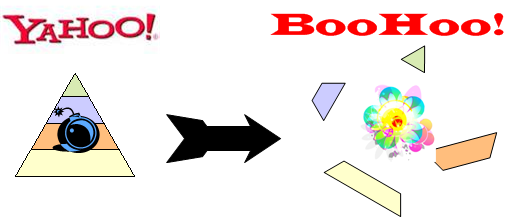
Unless you were born yesterday, you’ve probably heard about the death spiral that former internet great Yahoo! has commenced. In this blarticle from TechCrunch, “Former Yahoo Engineers Shed Light On Why Delicious And Other Acquisitions Failed“, a couple of quotes from former employees brought a tear to my eye.
…it does provide a picture of a company that bogged its acquired-startups down in its company’s administrative BS. As Chad Dickerson, former Yahoo developer evangelist and the current CTO of Etsy comments, “In my experience, entrepreneurs moving into Yahoo! often got stuck doing PowerPoints about “strategy” instead of writing code and shipping products.”
Elliott-McCrea writes: I recently pulled up a worklog I was keeping in 2008-2009, and I found 18 meetings scheduled over a 9 month period discussing why Flickr’s API was poorly designed and when we’d be shutting it down and migrating it to the YOS Web Services Standard.
What I’d like to know is: “Did any of the layers of corpo honchos have any conscious clue that the patriarchical and bureaucratic monster they brought to life was killing the golden goose?” What do you think?
Infinitely Late
In deference to Fred Brooks‘s “adding more people to a late project makes it later“, I present you with the enhanced version: “adding more people to a late project makes it later, and at some critical size K, adding more people makes it infinitely late“.
 As more smart and competent people are added to an org or project, the capability of the group to accomplish great things increases. The really sad thing about poor management is that this increased capability is countered by increased fragmentation and growth in fatty middle corpo layers that slowly snuff out productivity. The lag time between the addition of people and degraded org productivity can be can be so great that the correlation is totally missed and the probability of recovery goes to zero.
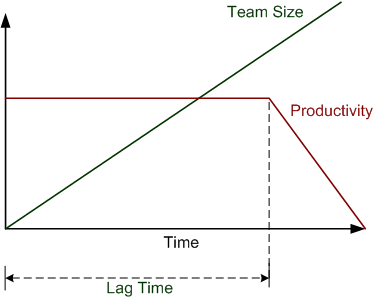
At a really dysfunctional institution, productivity plummets to zero and the immobilized institution withers away – unless some sugar daddy starts subsidizing the beast without regard to performance.
In the cases where the hapless institution is a government, it can become is its own sugar daddy. Since it has the bullying power to subsidize itself via taxation of its constituency, it can maintain its comatose state for essentially infinity. DYSCOs are not so lucky. They can, and often do, run out of money before they even know what hit them.
The Sparfish
On a tip from HCL Technologies CEO Vineet Nayar, I purchased and started reading “The Starfish And The Spider“. In the book, authors Brafman and Beckstrom define seven principles of decentralized orgs of people:
- When attacked, a decentralized org tends to become even more open and decentralized.
- It’s easy to mistake decentralized orgs (starfish) for centralized orgs (spiders).
- A decentralized org doesn’t have central intelligence; the intelligence is spread throughout the system.
- A decentralized org can easily mutate.
- A decentralized org sneaks up on you.
- As industries become decentralized, overall profits decrease.
- Put people into a decentralized org and they’ll automatically want to contribute.
Because of numbers 3 and 6, owners and SCOLs of centralized command and control hierarchies will never embrace the “starfish” concept. The self-centered need for SCOLs to project the image that “I’m great and you’re not” (number 3) and the constant external pressure to generate increasing profits (number 6) guarantee the status quo for all but the most enlightened leaders. However, because number 7 is the holy grail for the CGHs that sit on the throne, they try their best to feign being a starfish while remaining a spider. This systemic and self-defeating behavior is recursively nested all the way down the CCH; from the upper echelon of VPs and directors down through the fatty middle management layers and ultimately down to the BMs that rule at the interface with the DICforce.
Like Mr. Nayer, I don’t buy into the Brafman/Beckstrom set of principles 100%. Their starfish/spider metaphor works well up to a point. For example, a spider is much more mobile than a starfish; which enables it to be more proactive in acquiring the resources it needs to survive. Specifically, I believe that a hybrid “sparfish” org can increase profits while simultaneously providing an environment in which all members automatically want to contribute. By distributing resources more equitably via democracy and implementing a true meritocracy, the best of both species can be merged. The trick is figuring out how to freakin’ do it, no?

What We Look for in Founders
In “What We Look for in Founders“, Y Combinator principal Paul Graham lists the top 5 traits that his vulture capital investment company looks for in a would-be entrepreneur:
- Determination
- Flexibility
- Imagination
- Naughtiness
- Friendship
While writing about “determination”, Mr. Graham says:
“We thought when we started Y Combinator that the most important quality would be intelligence. That’s the myth in the Valley.”
Note that the following traits that pervade toxic corpocracies everywhere are not on the list:
- infallibility
- arrogance
- entitlement
- image
- bloodline

All Hands Meeting: Open To The Public
Check out this e-mail invite from Zappos.com:
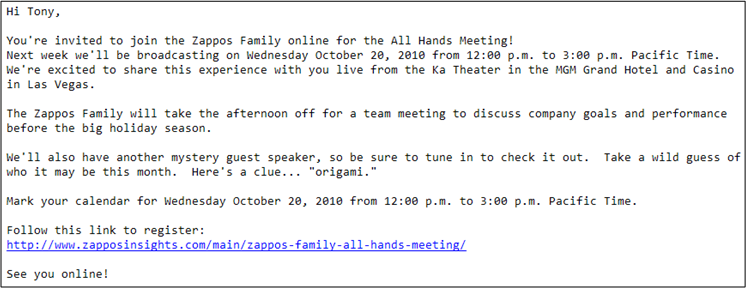
I participated as a cyber-attendee at the previous Zappos.com online all hands meeting. It wasn’t scripted, and some topics were discussed that your grandfather’s company of yesteryear would never air in public. Of course, your grandfather’s company of yesteryear, stuck in its FOSTMA mindset, could never even conceive of the idea of broadcasting an all hands meeting online.
“Few people are capable of expressing with equanimity opinions which differ from the prejudices of their social environment. Most people are even incapable of forming such opinions.” – Albert Einstein
Since clicking on the link in the above graphic won’t work, here’s a clickable signup link: Zappos All Hands Meeting Signup. Attend the meeting if you can and judge for yourself whether or not it’s a pure propaganda play.
Khan Academy
Via this Bill Gates tweet;
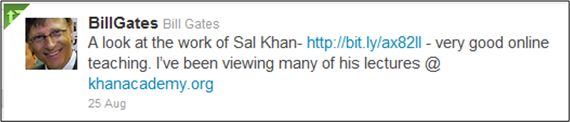
I discovered the Khan Academy. The breadth and depth of knowledge that Sal Khan has acquired and freely shares is astonishing and awe inspiring. Mr. Khan creates blackboard based videos in which he gently derives and explains the topic at hand. In real-time, Sal explains his thinking and makes/corrects mistakes on the way to the successful transmission of knowledge, understanding, and insight. I’ve watched several of Sal’s physics and math videos and I’m grateful for his selfless and passionate contribution to the world.
I’d love to create something on the scale of a Khan academy (would you?). Alas, all I need to do is develop a hard-to-copy product that someone actually wants and a strategy for selling it. D’oh! To the chagrin of the institutional world, the low cost tools of production and no-cost means of getting word out have been here for at least a decade, but it is only being slooowly recognized as the ultimate business infrastructure.

Relatively Lean
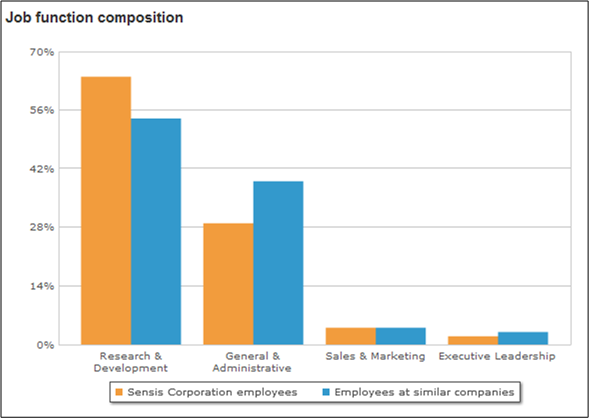
As this not-too-out-of-date blog post details, “My Company“, I work for Sensis Inc. According to this unscientific, but interesting chart from LinkedIn.com (computed from it’s membership data) we’re leaner than our fatty competitors. Our R&D to G&A ratio seems to be quite higher than most other “similar” companies. Encouraging, no?
Priority List
In his brilliant and elegant essay, “Capitalism is Dead. Long Live Capitalism“, Gary Hamel laments about the deterioration of capitalism into those other bad, highly inequitable, anti-American “isms”. He says:
So why do fewer than four out of ten consumers in the developed world believe that large corporations make a “somewhat” or “generally” positive contribution to society? Why is it that only 19% of Americans tell pollsters they have “quite a lot” or a “great deal” of confidence in big business?
In Gary’s opinion, the reason is……
… the unwillingness of executives to confront the changing expectations of their stakeholders. In recent years, consumers and citizens have become increasingly disgruntled with the implicit contract that governs the rights and obligations of society’s most powerful economic actors—large corporations. To many, the bargain seems one-sided—it’s worked well for CEOs and shareholders, but not so well for everyone else.
This lead-in dovetails into the idea of a “CEO stakeholder priority list“. The UML class diagram below shows six types of corpo stakeholders. Of course, the six types were arbitrarily picked by me and there may be others on the same level of abstraction that you think are missing. Notice that the “earth” is a passive stakeholder that can’t directly and instantaneously exert pressure on the way corpricracies behave; unlike the other people-type stakeholders.

Now, check out some sample CEO stakeholder priority lists below. With 6 stakeholders types, the number of unique lists is quite a lot: 6! = 6 x 5 x 4 x 3 x 2 = 720. I just semi-randomly concocted these three specific sample lists so that I can continue babbling on while hoping that you’re still reading my drivel.
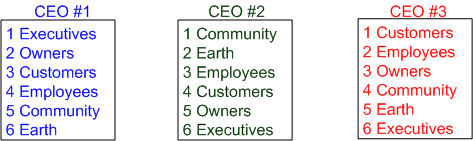
My own unscholarly opinion is that the vast majority of CEOs, their appointed-yes-men VP teams, and their hand picked boards of directors either consciously or unconsciously operate according to the blue list (or any other instance that prioritizes the “executives” stakeholder first). My opinion aligns with Mr. Hamel’s assertion that too many corpo captains are making decisions that materially favor themselves (first) and their shareholders while disproportionately harming the other stakeholder types.
But wait, hasn’t this always been the case with capitalism? If so, why has it suddenly become fashionable for dweebs like me to vilify corpricracies that operate in accordance with the blue list?
In closing, I feel the need to repeat the best quote in Hamel’s blarticle:
There are CEOs who still cling to the belief that a company is first and foremost an economic entity rather than a social one. – Gary Hamel
To those CEOs who still think that the word “social” equates to communism, get over it and move into this century.
I’m The Right Guy At The Right Time
From a recent article (I forgot to bookmark the link – D’oh!) describing the large backlog of IPOs still scheduled for this year, I discovered that GM’s (supposed) resurrection is expected to be the largest. It’s estimated that the “Government Motors” IPO will raise $15B dollars, but none of it will come from me and you’ll understand why in the narrative that follows.
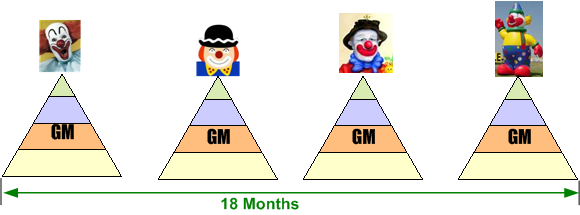
From the same article, I also learned that GM is being led by its fourth CEO in 18 months, Mr. Daniel Akerson. Guess what? Mr. Akerson is an aged and most probably out-of-touch white dude just like all the other recent esteemed GM CEOs. Guess what? Mr. Akerson also speaks in the same, self-centered, corpo tongue as most stereotypical Tayloristic CEOs:
I’m the right guy at the right time.
I’m looking out the front windshield.
GM’s products are second to none.
GM’s global manufacturing structure is the envy of the industry.
I did not get to where I am in life by being deaf, dumb, and blind.
I wish the company well, but, uh, I ain’t gonna invest in GM. Are you?

Why am I here?
WTF?
Meh!
D'oh!

My BTC Address



 Bulldozer00's Blog