Archive
Round And Round We Go
Engineering Councils, Master Engineering Groups, Centers of Excellence, yada-yada-yada. Has your company repeatedly formed and dissolved elite groups like these over the years? The purpose of sanctioning these groups is always well-intentioned, but always doomed. Why are they doomed? Because:
- they are always underfunded and, at the first hint of corpo financial stress, they are abandoned because they are an overhead expense group that doesn’t create or add value.
- all of the sitting members have real day jobs that need to get done in order to put money in the corpo coffers and food on the table.
- they don’t actively solicit input from the people who have to operate by their decisions – if they ever make any decisions and produce non-verbal output at all.
- they ignore input from non-members when they do get it – losing credibility and respect in the process.
- they never agree to a systematic method of making decisions when they are formed.
- they spend all their time in philosophical debates, with each elite member trying show how smart he/she is.
I could probably make up some more excuses for the repeated cyclical failure of elite councils, but I’ll leave it as an exercise for you, dear reader, to add your own reasons to the list. Feel free to add your own thoughts on this via the comments section.
Each time the elite council idea is recycled, nobody seems to remember the failures of the past and the same unproductive group behavior emerges. Everybody but the BOTG (Boots On The Ground) innocently thinks that this time it will be “different”. I’ve participated in these elite groups in the past, but from now on, I’ll always respectfully decline membership when asked. The last time I was asked, I declined to sit on one of these boards (that’s exactly what they do – just sit) . However, I offered up my services to work on any specific and funded task that the group deemed important. Unsurprisingly, nobody has taken me up on my offer. Bummer :^)
So how can the elite council idea be successful and add value to an org? Just invert the reasons-for-failure list above. Even if you do manage to change the context from disabling to enabling, it still might not work but, at least it will have a chance.
Stagnation Or Growth?
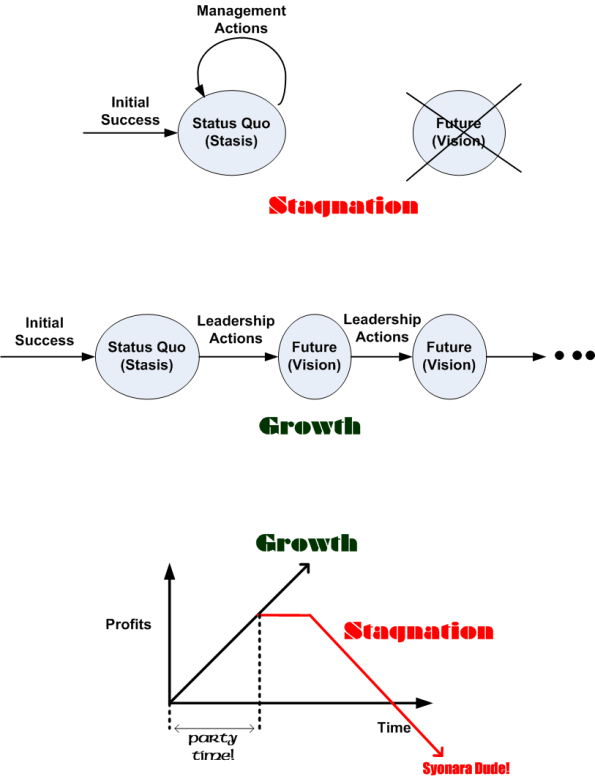
What type of system do you work in, day in and day out? Do you work for scared managers or courageous leaders?
Scouts
The figure below is intended to show a successful and profitable company operating in an external environment that’s changing over time. Since the corporation achieved its current successful state by employing strategies and practices that worked well to get it there, it naturally employs the same techniques over and over again. This causes the corpo walls to harden and protect those inside of the org from the forces of external change.

If the external winds of change are characterized by a low velocity (more like a breeze than a tornado), then the company’s success may last for quite a long time even though it’s unconsciously stuck in neutral and not adapting to the external environment. However, as the breezy external environment transforms into a maelstrom of tornadoes as a result of new competitors appearing and the sudden emergence of game changing technologies like the internet, company revenues/profits and the corpo pyramid may come tumbling down. Conscious and enlightenend company leaders know that stasis is a corpo killer, but textbook spreadsheet managers don’t.
One way to “sense” when change is needed is to formally designate a cadre of “scouts” at all functional levels of the org, from marketing all the way down the corpo steps to engineering and customer service. I first heard about the concept of scouts from Steve McConnell many years ago, before the internet and the exponential rise of third world engineering know how. At the time, I thought it was a novel idea and now I think it may be essential for survival.
As the picture below illustrates, scouts can serve as external sensors/probes that monitor and make meaning of the rapidly changing external environment. They separate the wheat from the chaff and, if they’re paid attention and nurtured, they can provide accurate information to corpo decision makers regarding which new technology and practices to embrace, and which new products to prototype and try.

Of course, dysfunctional org executives who think highly of themselves but don’t think much of their people (while simultaneously praising them as the company’s most valuable assets), will get what they deserve. They won’t create the role of a “scout” and they’ll ignore or subtlely berate self-motivated people who voluntarily perform the role of a scout. In their minds, they think they are the only ones who are capable of steering the company toward the future – using the same worn out , obsolete thinking that used to work but is virtually useless. Bummer.

System Science And Fat Heads
I recently finished reading John Warfield’s An Introduction To System Science . John asserts that whenever you try to design a system that will involve human beings during its operation (and what non-trivial system doesn’t? ), you must take into account these two universal human characteristics:
- The primal instinct to survive
- Miller’s number: 7 plus or minus 2
If your technical system design doesn’t pay homage to these human frailties, it will most likely fail – big time. The money will be gone, the time will be gone, and the damn thing won’t work. Warfield claims that his generic system design process effectively deals with these issues. In his book, John describes his process and cites several examples of it’s success in the public, private, and educational domains.
Warfield also says that the biggest hurdle to overcome, which he doesn’t have a solution for, is the propensity of high level executives for refusing to accept/acknowledge great ideas founded on firm principles from subordinates. I believe what John says, but in my layman’s mind, I equate this strange and unproductive behavior with egomania. The higher up you go and the more titles that you acquire, the bigger and fatter your head gets. Of course, there are always exceptions to every rule :^)
Scary Stuff
Since the word “manager” appears directly in their title, I can certainly understand (and maybe even empathize a little, just a little) why a product manager, program manager, and a general manager would obsess about meeting the schedule. However, it gets real freakin’ scary when all the engineers are talking about schedule too! It makes me think:
If everybody on the project is concentrating on the schedule, who the hell is doing the freakin’ work?
Anti-Collaboration
I’d like to think that most people would agree with me when I make the following assertion:
Dysfunctional corpo orgs that consciously (or unconsciously) maintain a localized lock on knowledge, expertise, and experience steer themselves toward inefficient and mediocre organizational performance.
Thus, it pains me when I come across (so-called) leaders who ignore social collaboration tools that could bust the chastity belt lock wide open and tremendously boost corpo performance. Believe it or not, some managers go beyond the call of duty. Because of their innate fear of change and their instinctual desire to maintain the status quo, they discourage the use of these tools by never using them to contribute and by privately ostracizing the people that are trying to use them for the company’s benefit. Yet, they always seem to be going to meetings where cost reduction and productivity improvements are the burning fires of the day. What a wonderful world :^)
Arrogant And Self-Righteous
I’m currently working on a really difficult assignment that’s starting to put me into an arrogant and self-righteous mood. My task is to add a customer-demanded feature to our flagship product that requires pervasive change throughout 400,000 lines of legacy embedded C++ code. Our flagship product is a software-intensive, distributed real-time sensor system that’s used to provide safety-critical surveillance information to our customers.
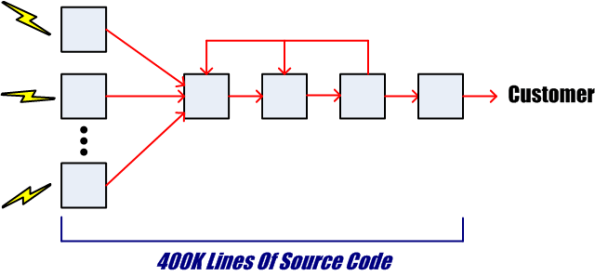
This is actually the third try at getting this task done. The first two attempts by other people fizzled out with nary a whimper. They were in way over their heads and thus, the work that they left behind is useless to me. So here I am, reverse-engineering 100s of thousands of lines of algorithmically deep code to:
- try and figure out what the current code base does
- try and understand why the code does what it does
- determine what changes need to be made to which code sections in order to implement the feature
This task is hard, really hard, but I’m up to it. The work requires long periods of sustained immersion in the code base and the mental absorption and retention of many fragile and diverse associations. Way more than Miller’s famous 7 plus or minus 2 limit of individual human capacity. I’m not getting any deep help and I’ve got two (yes two) managers taking “status” and watching the schedule . Other well-meaning product team members do help out when I ask them, but they just provide tidbits of help here and there. Help from the managers? Fuggedaboud it. It’s not their “job”, and they don’t have the expertise to help out even if they wanted to (which they don’t). Don’t get me wrong. They’re both good people and I like them very much, but they just can’t help, period.
Alas, I feel that I’m virtually all alone on this effort and it’s making me arrogant, self-righteous, and mad. Why’s it making me mad? Because I don’t feel appreciated and I feel that no one, save for one other person, has any idea of the inherent difficulty baked into the project. I look at what I’m doing, compare it with what others around me are doing, and then I ask myself “why did I willingly sign up for this type of work – again“? When the job gets finished, I’ll in all likelihood just get an “atta boy” and the same average raise as everyone else – just as has happened several times in the past. Thank God that I’m internally motivated to grow and learn.
Boo hoo, poor me!
Sassy!

The SAS Institute has been one of my favorite software companies to watch over the years. They were like Google before Google. The reason that I’m mentioning SAS is because while I was browsing through my notes, I stumbled upon this quote from a SAS manager:
Nothing corrodes respect between a boss and an employee more quickly than the sense that the boss has no idea what the employee is doing. Managers who understand the work that they oversee can make sure that details don’t slide. At SAS, groups agree on deadlines, and managers understand what their groups do — so unrealistically optimistic promises about time-tables and completion dates are relatively rare.
The quote came from this 2004 article in Fast Company magazine: Sanity Inc. The quote struck a chord with me back then, and it still does now. In my case, I don’t necessarily disrespect a manager that doesn’t know what I’m doing. I disrespect managers who:
- Are apathetic and show no interest in what I’m doing, regardless of whether they know the subject matter or not.
- Don’t ask me how I’m doing, and how they can help me do my job better, regardless of whether they know the subject matter or not.
- Just stop by only when they need to collect status, without wanting to hear about any bureaucratic procedural roadblocks that are, or specific people who are, hindering my progress.
- Pretend to know what I’m doing and make suggestions on what to do next, even though we both know (or, at least I know) that the manager has no clue.
How about you? What causes you to lose respect for your manager(s)?
FORM-ASS
How can someone effectively judge quality of content when they have no idea, nada, of what that content means? Well, they can’t. No matter how hard they try, and how sincere they are, they just can’t. People that are placed in those types of positions end up doing the best they can, which is judging the container that houses the content.
In technical companies that have separate Quality Assurance (QA) and Test groups, that’s often what the QA members end up doing – judging containers and not contents. The testers judge the contents (which adds value) and the QA group judges the containers (which doesn’t add value).
It’s not the QA group’s fault, it’s just the way the system IS. Even the managers who structure their companies in this costly and inefficient way aren’t fully at fault. That’s because customers, especially government bureaucracies, often require a separate QA silo group before they will do business with you. In a perverted way, it gives them a false sense of safety that the product or service they receive will be of high quality.
Since I’m a firm believer in POSIWID (the Purpose Of a System Is What It Does), then I propose to change the name of all non-test QA groups to FORM-ASS, which is short for: the “FORMat ASSurance” group. Since the FORM-ASS acronym more directly reflects what they do, it is a better fit, dontcha think?
High Falutin’ Titles
Along with a whole bunch of co-workers, I’m a member of the professional networking site linkedin.com. It’s a great site and I highly recommend it.
It’s interesting to browse through the profiles on LinkedIn. Everybody’s a freakin’ manager, or director, or chief-this, or chief-that. However, when you read their accomplishments, you can’t tell what the freak they’ve done. They seem to mostly describe the functions of the org areas that they’ve worked in. WTF? Of course, I don’t have any facts (I only use facts when they bolster my argument and I auto-reject all others 🙂 ), but I’d bet the farm that most of these people don’t direct or manage anyone and they haven’t done squat in years. They’re each, OMG!, a dreaded individual contributor. I picture them, perhaps wrongly, walking around flaunting their titles, manipulating people (instead of helping them to develop and grow) and barking out non-sensical orders that they’ve pulled out of their arses. They behave this way to look/feel important and they actually fool a few people for a while.
It’s sad, because I think that at the core of their souls, all people want to do the right thing for all. However, the shining light at their core has been trapped in no man’s land by layer upon layer of ego. The culprit behind ego inflation in the corpo world is a dysfunctional org structure. Specifically, it’s the obsolete 150 year old pyramidal, hierarchical structure of entitlement that all dinosaur corpo citadels pay homage to.
“Enough with the rant, got any alternative ideas smarty pants”? How can you mobilize a large group of people to change the world and prevent chaos from reigning without a corpo pyramidal caste system? One way is to organize as, and more importantly, operate in accordance with, a circular ring structure where all rings are directly connected with robust and high bandwidth communication channels. Instead of managers in the inner rings, there are leaders. Leaders focus more on developing people instead of enriching themselves.
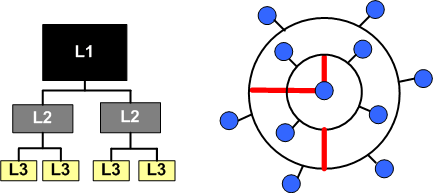
So you say that the multi-ring design is nothing more than a squashed hierarchy with the innermost node representing the CEO? You’re literally right, but not figuratively. The main reason for operating your org structure as a flat concentric set of rings is to eradicate the deeply ingrained 1000s of years old “I’m better than you because I’m higher up in the food chain” mindset that unconsciously pervades all hierarchies. Sure, the people residing on the inner rings still have the responsibility to make org-wide decisions, but they do so with a more down-to-earth and people-centric mindset.
A non-conforming, ring-based company organization can’t possibly work, right? Blasphemy and off with my head! I know of at least one company that’s successfully implemented the “ringo star”. Semco Inc. of Brazil. If it piques your interest, Google them and/or check out the articles bookmarked in this twine: The Magic of Semco.
Thanks for listening.

Why am I here?
WTF?
Meh!
D'oh!

My BTC Address



 Bulldozer00's Blog