Archive
Two Playbooks
When revenues and/or profits go flat or they start eroding, one of the 3 textbook moves that a mediocre company usually make is to reorganize (yet again). The other two moves in the utterly uncreative and standard MBA playbook are: 2) fire people; 3) instill fear via coercion and adding more rigid/constraining processes to extract more productivity from the value creation team at the bottom of the corpo hierarchy. Sometimes, especially in a time of crisis, all three actions are executed. Notice that all 3 moves are attempts to cut costs and not to raise revenues. Raising revenues requires exploring, discovering, and finding new customers along with developing successful new products that open up new markets. These actions require creativity, innovation, new ways of thinking, leadership, and courage. Sadly, these attributes are not the forte of mechanistic and Newtonian MBAs who are trained to solely look at data and compute fancy state-of-the art derivative business metrics.
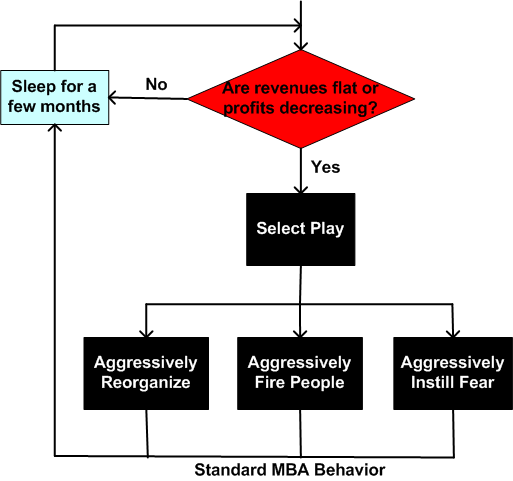
When a company reorganizes, which is the least painful action that can be applied to the productive members at the bottom of the org, grand new titles are created, groups are renamed, and new layers are added/subtracted. Management temporarily feels better and optimism permeates the top of the stratified pyramid. The people down in the dirty boiler room know better. Since the reorg usually consists of shuffling the same people with the same old crusted mindsets into new positions, no deep and lasting change happens. If, during the reorg, people with new ideas are promoted from the bottom or brought in from the outside, they are quickly “set in their place” by the old guard that remains. They get absorbed by the borg. Blech.

Imposers And Imposees
“Never tell people how to do things. Tell them what to do and they will surprise you with their ingenuity.” – George S. Patton
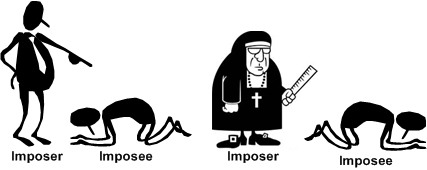
Isn’t it amazing at how people and groups, especially those in positions of authority, are always exhorting others to perform work exactly the way that they want the work to be done? Instead of carefully clarifying “what” needs to be done, which is much more difficult and requires leadership over management, the “imposers” obsess over every little detail of the “how” – which is management over leadership. Leaders focus on the “what”, but managers obsess over the “how”. What’s really mind-boggling, is that if you ask an imposer for helpful examples of excellence that they’ve personally created before they were promoted from an imposee to an imposer, you get some kind of evasive smokescreen answer, or some combo of body and facial movement that conveys this message: “it’s taboo for you to ask that question”. When that happens, credibility and professional respect, extremely tough to earn but easily lost, go right down the crapper. Is asking for leadership-by-example a disrespectful thing to do? In dysfunctional orgs where there are few, if any leadership-by-examples of excellence, asking probing questions is considered an act of subordination that is not easily forgiven or forgotten.
Under the veil of “industry best practices”, and the unspoken but clearly understood directive that imposees are required to learn the details of the “how” fully and instantaneously on their own time, the pounding into submission by imposers continues. The pounding only stops when enough camouflage has been generated by the imposee(s) to anesthesize the imposers into thinking that they’ve prevailed. It’s only a temporary high. Sooner or later, everyone finds out, sometimes spectacularly, that the neglected “what” is FUBAR. In dysfunctional organizations that behave in accordance with these “industry worst practices”, it’s no wonder that the majority of employees become cynical, apathetic, disengaged, and disgruntled camouflage creators.
“You do not lead by hitting people over the head – that’s assault, not leadership” – Dwight D. Eisenhower
So, am I a “do as I say not as I do” imposer and hippocrate? Well, I try not to be one, but I might be failing miserably at it. Judge for yourself by reading one or more of the rants on this blog. Do I overdo it sometimes or, uhhh, always? Decide for yourself.
A Classic Response
In a product development organization, when schedules are consistently missed, costs are rising, and profits are decreasing, a classic management response is to add more “oversight” to turn things around. This sincere, but often counterproductive response to deteriorating performance, exacerbates the mess by adding more cost and further slowing progress.
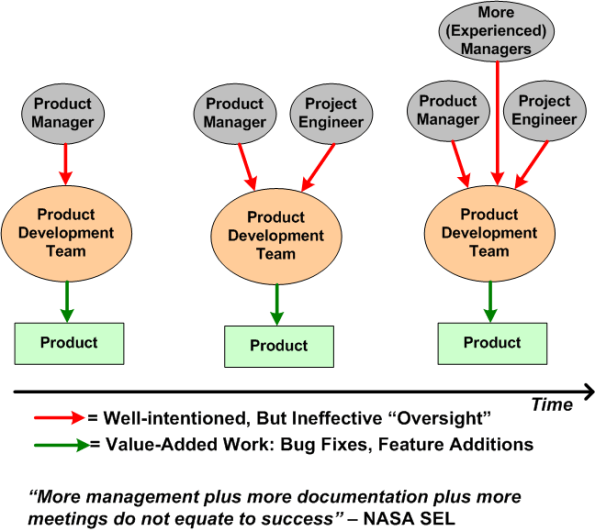
The above figure graphically shows the deterioration in performance over time ignited by the “classic response” to perceived poor execution. The additions to the management team somehow magnify the illusion of control that managers think they have over the product development/maintenance process. The act of piling on more management serves as an anesthesia that temporarily relieves the pain of poor performance. When the numbers show that performance hasn’t improved, the next step is to keep the top heavy structure in place, but replace one or more members of the management team with “proven” managers. Sick city.
So what’s an alternative to the “classic response”? Take a look at the figure below. In this response, the product manager rolls up his/her sleeves and gets dirty with the product development team. She dives deep into the product infrastructure and scours the landscape for missing information, erroneous information, and “camouflage”. Armed with this realistic, unfiltered “status” data, effective decisions can be made and productive direction can be given. In addition, by visibly doing some non-status-taking and non-schedule-hawking work, credibility and trust (which are difficult to acquire but easy to lose) are gained.
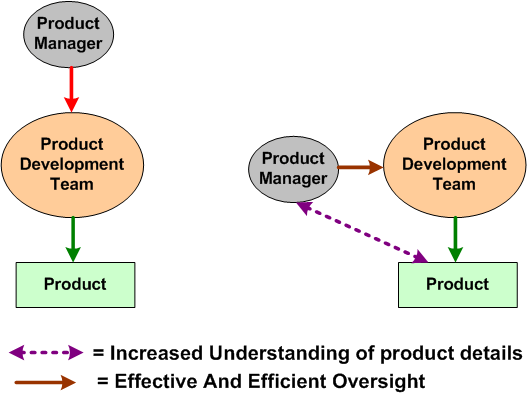
Sadly, during the transition from doer to manager, an automatic mindset switch occurs. Instead of growing into a 3D status taker plus schedule jockey PLUS, most importantly, a helper, only the first two responsibilities are internalized. “I’ve arrived and I don’t have to do any hard, messy work anymore”. Even worse, upper management innocently, but surely, encourages this post-transition mindset because it’s the same mindset that guides their behavior. Bummer.
“You have to know a lot to be of help. Learning is slow and tedious. You don’t have to know much to cause harm. It’s fast and instinctive.” – Rudolph Starkermann
The Peek-A-Boo Pattern
This behavior pattern occurs when your boss, or someone else higher up in the titular chain of command, actively seeks you out for misbehaving according to some set of unwritten corpo rules. You “need talking to”.
The bigger the title of your scolder, the more serious the behavior transgression. After you’ve been “talked to”, the boss disappears behind his/her title to do “the important stuff that keeps the organization running”. He/she is nowhere to be seen until your next episode of bad behavior. Notice that the boss never stops by to ask you if there’s anything that he/she can do to help you get the job done.
Peek-a-boo, I see you!

Heaps And Systems
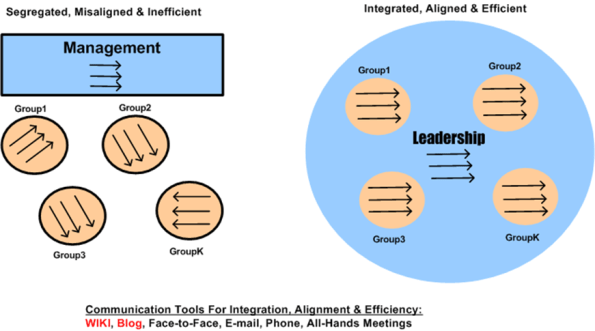
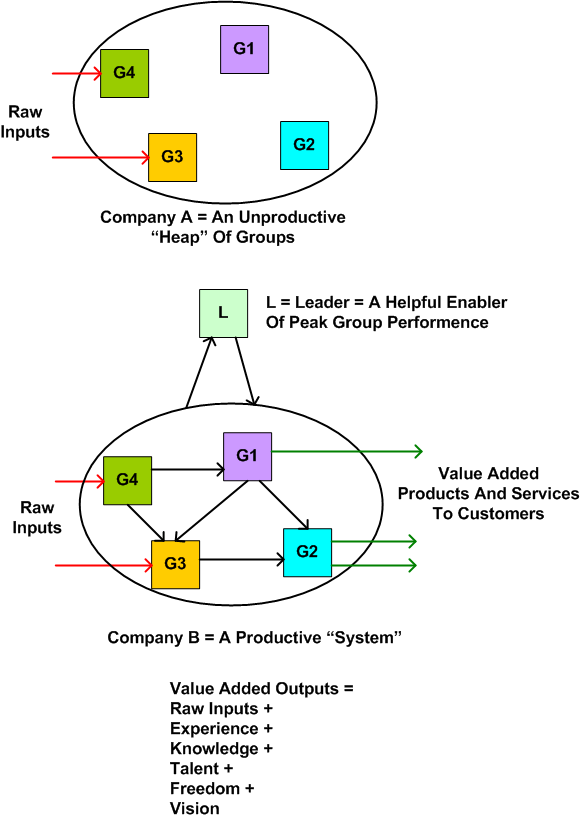
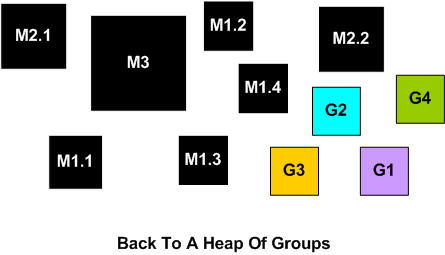
A “heap” is a collection of individual “parts”. A “system” is an intentionally designed set of interconnected parts with a purpose. The purpose of a system transcends AND includes the purpose of each of the individual parts. As an example, think of an automobile. If we disassemble one, we end up with a heap of individual parts. When these parts are assembled and interconnected in accordance with the purpose of human transportation as the goal, we may get a system. Structural design and interconnection are not enough. The system must be energized and steered so that purposeful behavior can be manifested. For a car, the energy is fuel and the steerer is a human being. For an organization of mutli-disciplined groups of people, the energy is motivation and the steerer is a leader. Without motivation and a leader, an organization of human groups is just an unproductive heap that consumes natural resources and doesn’t produce any value added output to share with the world.
The figure below shows two companies that are each comprised of 4 potentially diverse and productive groups of people. Company A is unconnected and leaderless. Thus, it just consumes resources from the external environment and produces nothing of value to share with the world. Company B is both connected and well led. What kind of company do you work for?
Look at company C in the illustration below. In this company, the leader has propelled his/her company to the head of the pack by creating the internal environment for, and nurturing the system’s internal groups and interfaces for peak performance. All of the internal connections and relationships between the groups are comprised of low latency and high bandwidth collaboration. Both high quality outputs and speed of execution distinguish company C from the rest of the herd.
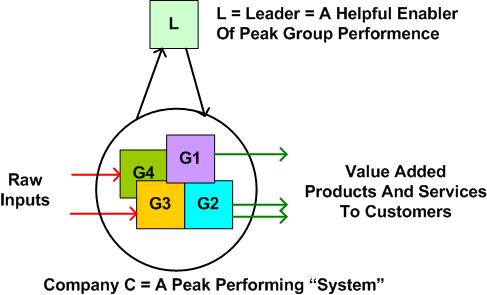
In a high performing system, the danger of over-optimization looms in the form of inflexibility. A system optimized for a single purpose tends to harden and become resistant to change overt time – corposclerosis sets in. The trick for the leader is to create and sustain a delicate balance between optimization and flexibility that adapts with the rapidly changing external environment.
In an attempt to over-optimize performance, some leaders unknowingly morph into “managers”. They start inserting subordinate management layers of questionable value between themselves and the productive subsystems of the company. They start creating and accumulating titles that distance themselves from the productive groups. These and other symbols of status divide and alienate instead of integrate and endear. Instead of guiding, steering, and nurturing, they start commanding, controlling, and constraining. Productivity plummets and quality of workmanship deteriorates.
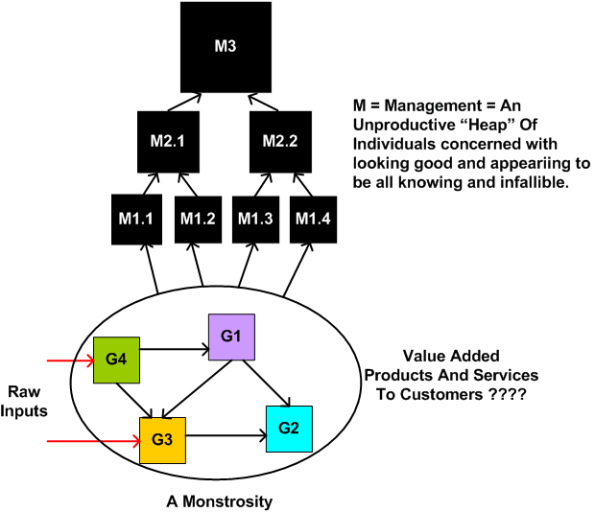
Because of increasing rules and procedures mandated by management, the internal interfaces between the formerly productive groups start transitioning into high latency and low bandwidth communication channels. In the worst case, like an overheated engine, the interfaces rupture and the system abruptly disintegrates; leaving an unconnected and purposeless heap of parts in its wake. Bummer.
Major League Vaporware
For the past year or so, every time I went down the hall to get a cup of coffee, I passed by a nice, big, intellectually superior poster of a non-existent “advanced XXXX software architecture”. (I substituted XXX for the actual name in order to stay politically correct and to provide the appearance of “being nice”). Since:
- the damn monstrosity doesn’t exist
- there is no “recorded” physical evidence that the damn monstrosity exists
- nobody’s working on the damn monstrosity
- there are no plans to “allocate resources” to work on the damn monstrosity
- the damn monstrosity doesn’t make any sense with regard to our product portfolio
I decided to flip it over. I could’ve taken it down (even though I didn’t have the ‘authority’ <—- lol!) , but I left it up on purpose. On the back of the poster is nothing but a blank, vanilla, white background; nada. Since customers walk by that poster-lie all the time, I thought it would be best for the company to dispose of the lie before someone asked about it and a company representative would have to lie about the lie.
‘Nuff said.
Behavior And Performance
Assume that a company’s managers:
- Have a truly fair and objective system in place for judging employee behavior as good or bad
- Have a truly fair and objective system in place for judging job performance as good or bad
- Have the power to promote, fire, and tolerate (ignore) their employees.
For the moment, please indulge me by believing that assumptions 1 and 2 are true even though they are spectacularly and patently false. Given these 3 discretely valued parameters, there are 2 x 2 x 3=12 different combinations available to classify a company. The figure below shows 4 of these combos.

Which company would you want to work for? Which company comes closest to the company that you do work for?
Are U smart?
One of my favorite quotes iz: “If you’re so smart, how come you ain’t rich?”. My response iz: “I ain’t smart, and that’s why I ain’t rich”. What’s your response?
Business Acquisition And Execution
To become and maintain a successful business, a company must both acquire and efficiently execute ongoing chunks of business. When top management values both of these critical work activities equally, then all is well. When they value one over the other, and in my business domain it’s always business acquisition that’s shown preferential treatment, then mediocrity reigns.
How do you know when top management is one sided? It’s easy, just look around. Who gets the single offices and single cubes? Who gets the bigger salaries? Who do the executives give way more face time to?
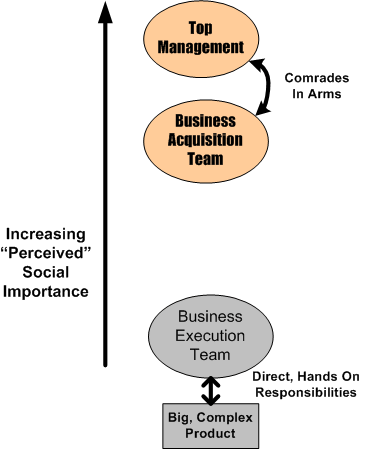
Business acquisition is glamorous and difficult, but in comparison, business execution is dirty, messy, and down right hard. When an acquisition team submits a proposal to a customer after a long and arduous courting period, it’s party time, and rightfully so. However, and this is key, the proposal doesn’t “have to work”. Products “have to work”, or else….
If a proposal is rejected and fails to acquire a chunk of business, then it’s usually because a competitor has offered up a similar or superior product for a lower price and/or a faster delivery time. The loser washes his hands clean and then just moves on to the next opportunity. It’s done and over with, kaput.
When a big, complex, and software-intensive product repeatedly and frequently fails in a customer’s day to day use of it, then continuous stress and pressure is placed on the execution team for what could be quite a long and sustained period of time. Until the execution team, usually through heroic acts of team sacrifice, makes the product behavior and performance “acceptable” to the customer, the two step chain of events is as follows: the customer pressures top management, and top management pressures the execution team. The loop of misery has been ignited. Notice that the acquisition team does not participate in the fun. In the worst case, the acquisition team merges with the top management team to apply greater pressure on the execution team.
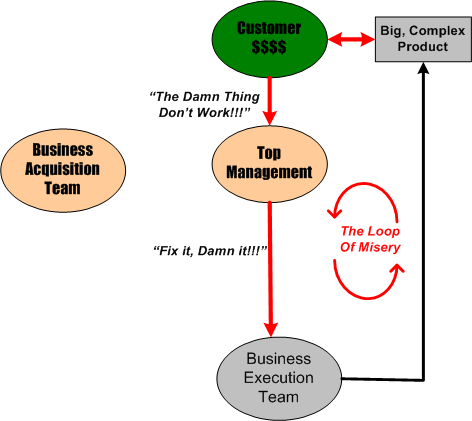
Don’t be a stupid arse like me. If you’re given the choice between participating on an acquisition team or an execution team, choose the acquisition team 🙂

Why am I here?
WTF?
Meh!
D'oh!

My BTC Address



 Bulldozer00's Blog